Why Do Chinese People Say "Too Much Dampness"? Your Body Isn't Flooded—The Pipes Are Clogged
Part 1A Question
Have you ever had this experience?
In summer, when it rains for days on end, the air is muggy and hot. You wake up feeling like your body is wrapped in something, heavy and sluggish. Your face is shining with oil, your tongue has teeth marks, your stool sticks to the toilet and won't flush clean. You think you didn't sleep well, but after eight hours of sleep you're still exhausted.
In China, the elders will say: "Too much dampness."
But in Europe, a doctor might say: "You've been stressed lately, get some rest." Or: "It might be allergies, take some antihistamines." Or simply: "Everything is normal, nothing to worry about."
Two ways of speaking, describing the same phenomenon, but the explanation paths are completely different. Chinese people observed this phenomenon 2,500 years ago and gave it a name: Dampness (湿). Europeans observed the same phenomenon, but only in recent decades began to understand it with terms like "chronic inflammation," "fluid retention," and "metabolic syndrome."
The question is not who is right or wrong. The question is: Why does the same bodily phenomenon require Chinese people to sum it up in one word, while Europeans need three different disciplines to explain it?
Part 2Traditional Chinese Explanation
The word "dampness" (湿) appears in the Huangdi Neijing (Yellow Emperor's Inner Canon). The ancients had no microscopes, no blood tests. What did they rely on? Observation.
Jin Gui Yao Lue: "When dampness affects a person, the whole body aches, there is fever, and the body color is smoky yellow."
(Modern translation: Dampness affects the entire body—joint pain, fever-like sensations, and a sluggish, yellowish complexion.)
They observed: people who live in damp places tend to get sick. Their bodies feel heavy, joints ache, skin develops rashes, digestion suffers. They observed: when the weather is hot and humid, people feel tired. They observed: some people's symptoms worsen after eating sweet or greasy foods.
So they summarized a concept: Dampness. Dampness is not "water"—it is a state where water does not flow smoothly inside the body. Too much dampness, and the body is like a sponge soaked full of water—heavy, sluggish, slow.
In traditional Chinese theory, "dampness" is divided into external and internal dampness. External dampness comes from the environment—rainy seasons, wet walls, living in a basement. Internal dampness comes from the body—weak spleen and stomach function, unable to effectively transport and transform fluids. Weak spleen generates dampness, dampness traps the spleen, forming a vicious cycle.
The ancients used a functional model to describe phenomena that today's physiology needs "lymphatic circulation," "extracellular fluid balance," and "intestinal barrier function" to explain.
Part 3giaogiao Modern Translation
Okay, now let's translate "dampness" into modern language.
I'm not going to talk about the lymphatic system, intestinal barriers, or insulin sensitivity. Too complicated. Just remember one metaphor:
External dampness = rain getting in from outside (environmental impact)
Internal dampness = the sewer is blocked, water can't drain out (metabolic problem)
Weak spleen = the water pump lacks power, can't move the water (weak digestive function)
Specifically:
What does external dampness correspond to? It corresponds to the effect of environmental humidity on the body. In high-humidity environments, the body's heat dissipation efficiency drops, evaporation of water from the skin surface slows down, and internal heat can't escape. At the same time, barometric pressure changes affect the fluid pressure inside joint cavities, causing joint discomfort. This is not "dampness" drilling into the body—it is environmental humidity affecting the body's fluid regulation function.
What does internal dampness correspond to? It corresponds to the body's declining ability to process and excrete fluids and metabolic waste. When lymphatic circulation is slow, the intestinal barrier is damaged, and cellular metabolism is inefficient, fluids and waste accumulate in the body, causing edema, heaviness, fatigue, and a thick tongue coating. This is what Chinese people call "heavy dampness"—the body feels heavy, like it's filled with water.
What does phlegm-dampness correspond to? It corresponds to the accumulation of metabolic waste caused by high-sugar, high-fat diets. High-sugar foods trigger massive insulin secretion, blood sugar fluctuates rapidly, and the gut microbiome is overfed by sugar, producing large amounts of metabolic waste. If these wastes cannot be excreted in time, they accumulate in the body, causing fatigue, mental fog, and sticky stool. This is "dampness mixed with phlegm, sticky and gooey."
So "dampness" is not superstition. It is simply a functional metaphor—describing a problem with the body's ability to process fluids and metabolic waste.
The ancients had no microscopes, but with the concept of "dampness" they precisely described what modern people need four concepts—"lymphatic circulation," "extracellular fluid balance," "intestinal barrier function," and "insulin sensitivity"—to explain.
Part 4Real-Life Cases
Three stories to make you instantly understand what dampness is.
Case 1: Swelling after staying up all night.
You pull an all-nighter. The next morning, your eyes are swollen, your face is puffy, and when you press your finger into your skin it leaves a dent. You think you drank too much water. But traditional Chinese medicine says: this is "weak spleen with excessive dampness." Why does staying up late create dampness? Because nighttime is when the body repairs itself. The lymphatic system, liver, and kidneys all work during this time. If you don't sleep, they can't process the fluids and metabolic waste accumulated during the day. So fluids accumulate in the tissue spaces, becoming "dampness."
Truth: Staying up late directly weakens the body's "drainage capacity"—it's not that too much water came in, it's that the drainage pipes shut down.
Case 2: Heavy body during the rainy season.
Every June, southern China enters the plum rain season. It rains continuously, humidity exceeds 90%. Many people feel their bodies are especially heavy, joints ache, they don't want to move. Chinese elders say: "External dampness has invaded." Modern explanation: In high-humidity environments, the body's heat dissipation efficiency drops, evaporation of water from the skin surface slows, and internal heat can't escape. At the same time, barometric pressure changes affect the fluid pressure inside joint cavities, causing joint discomfort. This is not "dampness" drilling into the body—it is environmental humidity affecting the body's fluid regulation function.
Truth: It's like a basement getting damp—not because water flooded in, but because the air is so humid the walls are seeping water.
Case 3: Eating too much sugar makes you sluggish.
You eat a big slice of cake, or drink a cup of milk tea, and an hour later you suddenly feel incredibly sleepy, your brain won't turn. You think it's "blood sugar spiking then crashing." Traditional Chinese medicine says: this is "dampness trapping the middle burner." High-sugar foods trigger massive insulin secretion, blood sugar drops rapidly, and the gut microbiome is overfed by sugar, producing large amounts of metabolic waste. If these wastes cannot be excreted in time, they accumulate in the body, causing fatigue and mental fog. This is "dampness."
Truth: It's not the sugar that makes you sleepy—it's the sugar manufacturing a mountain of metabolic garbage. Your body is busy cleaning up the trash, and has no energy left for anything else.
Three cases, three scenarios, one underlying logic: the body's ability to process fluids is weakened by various factors.
Part 5Modern Research
Does "dampness" have scientific research?
Yes, but scientists don't use the word "dampness." They use:
• Chronic inflammation and metabolic syndrome. Low-grade chronic inflammation is the common foundation of many modern diseases. This state closely aligns with the Chinese medicine concept of "dampness-toxin"—metabolic waste accumulation, the body in a long-term exhausted state of "cleaning up garbage."
• Gut microbiome and whole-body health. In the past decade, gut microbiome research has exploded. Gut microbiome dysbiosis can cause systemic inflammation, immune dysregulation, and metabolic disorders. This aligns with the direction of the Chinese medicine theory "weak spleen generates dampness"—the gut is the body's largest "wastewater treatment plant." When the plant breaks down, the whole city stinks.
• Lymphatic system and brain cleaning. Scientists discovered that the brain has a lymphatic system responsible for clearing metabolic waste during sleep. This provides a physiological basis for the Chinese medicine connection between dampness and sleep—when you sleep, your brain is unclogging the drains.
• Humidity and health. Environmental epidemiology research has found that long-term high-humidity environments are indeed associated with increased rates of joint pain, respiratory disease, and skin conditions. This supports the Chinese medicine observation of "external dampness causing disease"—when the environment is humid, the body's regulatory burden is heavy.
But it is important to note: no single study has directly proven the existence of "dampness" as an independent entity. "Dampness" is still a conceptual model, not a measurable substance. It describes a collection of phenomena, not a specific biomolecule.
So we must be honest: the modern explanation of "dampness" is an alignment in direction, not equivalence in evidence.
Part 6Practical Methods
Now that you understand dampness, how do you get rid of it?
First, let's bust a few myths:
• Drinking red bean and coix seed water is not a cure-all. Coix seed does have diuretic and anti-inflammatory properties; red beans are rich in potassium and help reduce edema. But if your "drainage system" itself is clogged, simply draining water doesn't solve the root problem. Unclog first, then drain.
• Sweating more is not always better. Moderate sweating helps excrete fluids and metabolic waste, but excessive exercise produces large amounts of lactic acid and free radicals, which actually increases the metabolic burden. Sweating is a supplement, not the main act.
• Avoiding cold food is correct. Cold food temporarily lowers digestive enzyme activity and affects gut function. This aligns with the Chinese medicine observation that "cold damages spleen yang"—when the water pump freezes, it's even harder to move the water.
Specific methods:
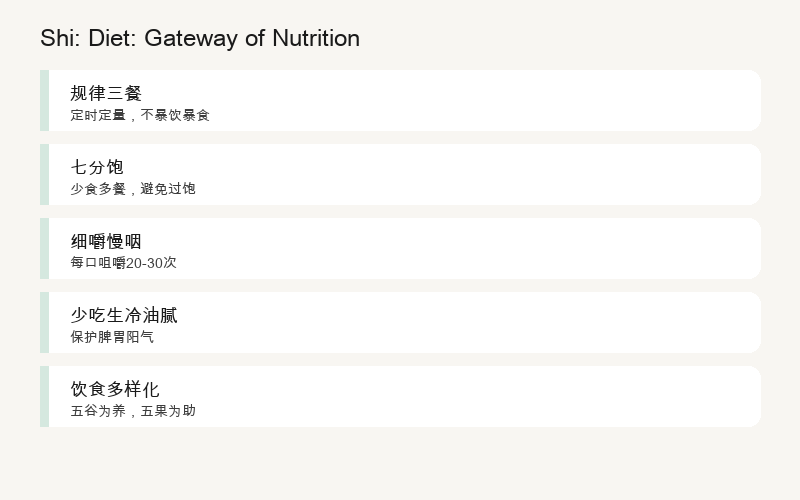
• Sleep well. Nighttime is when the lymphatic system cleans metabolic waste from the brain. Staying up late directly weakens "dampness-draining" capacity. Deep sleep matters more than duration.
• Eat less refined sugar. Sugar is the biggest source of "dampness"—it directly challenges the insulin system and manufactures metabolic waste. Cut back on milk tea, cake, and white rice. Eat more vegetables, whole grains, and legumes.
• Exercise moderately. Sweating is an important channel for the body to excrete fluids and metabolic waste. Moderate aerobic exercise promotes lymphatic circulation and sweat secretion. But don't overdo it—slightly out of breath is enough.
• Don't sit for too long. Prolonged sitting slows venous return and lymphatic circulation in the lower limbs, easily causing edema. Get up and move every 30 minutes.
• Use a dehumidifier during rainy season. Reduce environmental humidity and lighten the body's regulatory burden. Keep rooms ventilated—fresh air helps metabolism.
These methods don't require you to believe in traditional Chinese medicine. You only need to understand: the body's ability to process fluids can be affected by lifestyle.
Part 7One-Minute Summary
🕐 Understand "Dampness" in One Minute
Dampness = the body's drainage system is clogged, water can't get out.
External dampness = rain getting in from outside (environmental impact).
Internal dampness = the sewer is blocked (metabolic problem).
Phlegm-dampness = too much garbage clogging the pipes (dietary problem).
Signs: heavy body, swelling, fatigue, thick tongue coating, sticky stool.
Causes: staying up late, high-sugar diet, sedentary lifestyle, humid environment.
Improvement: sleep well, eat less sugar, sweat more, eat fiber.
The ancients called it "dampness." Modern people call it "metabolic dysfunction." Different names, same thing the body is saying.
Modern medicine says: Metabolic waste accumulates, fluid regulation is imbalanced.
People 2,500 years ago and people today looked at the same body and reached similar conclusions.
This is not superstition. This is observation.
Observation is the starting point of science.
Making money is the art of living; art is the life after making money.
Giaogiao Decodes Chinese Traditional Wisdom · Concept 1
Using modern scientific language to help the world understand Chinese traditional wisdom.
No mysticism, no deification, no negation.
Understanding, not believing.
Coach Liu
Written in Florence