Why Do Chinese People Say "Yang Deficiency"? Your Body's Heating System Isn't Hot Enough
Part 1The Question
Have you ever had this experience?
In the same office, everyone else wears short sleeves while you wear a jacket and still feel cold. Your hands and feet are always icy, especially in winter. You get tired more easily than others, speak in a low voice, don't want to move, just want to sit. You eat no less than anyone else, but can't gain weight. You're out of breath after three flights of stairs, while others complain you're walking too slowly.
In Western medicine, a doctor might check your thyroid function and say "subclinical hypothyroidism"; might check your adrenaline and say "autonomic nervous system dysfunction"; might check your blood count and say "mild anemia." Three tests, three departments, three diagnoses.
In Traditional Chinese Medicine, the old master takes your pulse for three seconds and says: "Yang deficiency."
One diagnosis, three explanations. Which is more efficient?
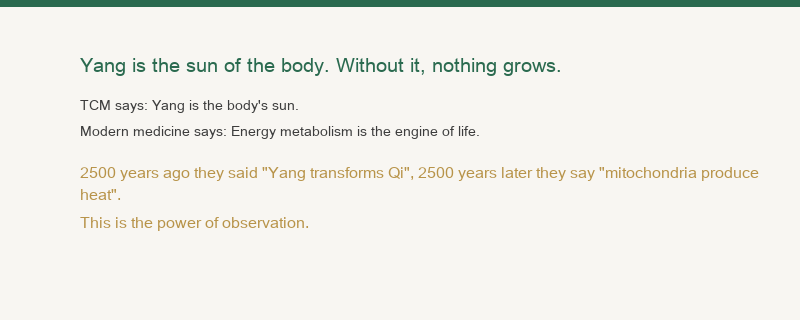
The Yellow Emperor's Inner Canon, written in 475 BCE, proposed "Yang transforms into Qi, Yin gives form"—Yang is responsible for turning matter into energy, while Yin is responsible for solidifying energy into matter. 2,500 years later, modern cell biology discovered: mitochondria are the factories that convert matter into energy. Both describe the same process: turning food into heat, and heat into power.
The question is: how did the ancients know?
Part 2Traditional Chinese Explanation
The character "Yang" (阳) in oracle bone script was originally a pictograph of "the sun rising over a hillside." Its original meaning was singular: warmth, light, and upward-moving force.
— Yellow Emperor's Inner Canon · Basic Questions (《黄帝内经·素问》: "阳气者,若天与日,失其所则折寿而不彰。")
"Yang governs movement, Yin governs stillness."
— Yellow Emperor's Inner Canon (《黄帝内经》: "阳主动,阴主静。")
Traditional Chinese Medicine divides the body's "Yang" into three levels—ordinary people only need to remember three:
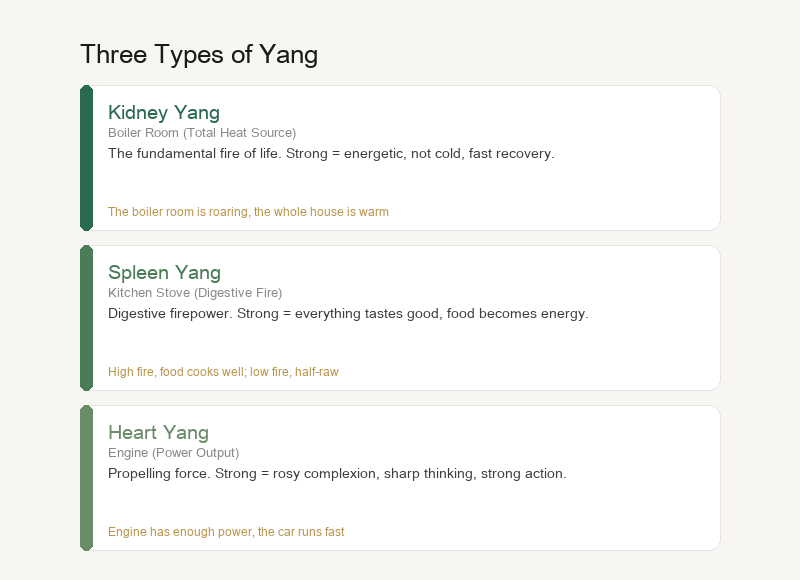
Kidney Yang (Primordial Yang) — the fundamental fire of life. People with abundant Kidney Yang are energetic, fearless of cold, and recover quickly. Those with insufficient Kidney Yang have cold hands and feet, low spirits, and weak immunity. The ancients likened Kidney Yang to the "fire of the life gate"—the stove of life. When the boiler room is burning bright, the whole house is warm.
Spleen Yang — the digestive fire. People with robust Spleen Yang eat with gusto, and food transforms into Qi and blood. Those with weak Spleen Yang feel bloated after a little food, digestion fails, and food becomes "dampness" and "phlegm." Spleen Yang is like the kitchen stove—when the fire is strong, the dish is well-cooked; when the fire is weak, it's half-raw.
Heart Yang — the driving force. People with abundant Heart Yang have a rosy complexion, sharp thinking, and strong initiative. Those with weak Heart Yang have a pale complexion, sluggish thinking, and tire easily. Heart Yang is like a car's engine—when the power is sufficient, the car runs fast; when the power is insufficient, pressing the accelerator won't speed it up.
These three levels of Yang together form a single concept: Yang Qi. Yang Qi is the body's "heating system"—it makes the heart beat, blood flow, cells metabolize, and muscles contract. Without Yang Qi, the body is a house with no heating: cold, stiff, unable to move.
The ancients summarized the symptoms of Yang Qi deficiency as "aversion to cold, cold limbs, low spirits, pale complexion, weak voice, clear long urine, loose stools"—in modern terms, low body temperature, insufficient energy, low metabolic rate, and weak immune function.
The ancients had no thermometers, no blood tests. But through observation, they compiled a complete "energy deficiency" model. This model has been used for 2,500 years and remains valid today.
Part 3giaogiao Modern Translation
Now, let's translate "Yang" into modern language.
I won't talk about mitochondria, ATP, or thyroid hormones. Too complicated. You only need to remember one metaphor:
Kidney Yang = Boiler Room (total heat source)
Spleen Yang = Kitchen Stove (digestive fire)
Heart Yang = Engine (power output)
Specifically:
What does Kidney Yang correspond to? It corresponds to the body's "basal heat production capacity." People with a high basal metabolic rate burn energy even while lying down, naturally energetic and fearless of cold. People with a low basal metabolic rate feel tired even while sitting, with cold hands and feet. This is Kidney Yang—the fire in the boiler room determines the temperature of the whole house.
What does Spleen Yang correspond to? It corresponds to the digestive system's "energy conversion efficiency." Food goes in—can it become useful heat? Digestive enzyme activity, gastrointestinal motility, gut microbiome health—these combined are Spleen Yang. When the stove fire is strong, food gets cooked; when the fire is weak, no matter how much you eat, it's still "raw."
What does Heart Yang correspond to? It corresponds to the body's "power output capacity." The heart pumping blood, muscles contracting, the brain thinking—all require energy. People with abundant Heart Yang think sharply and act decisively; those with weak Heart Yang "can't get their brain to turn" and "don't want to move their body." When the engine lacks power, the car simply can't run fast.
So, "Yang" is not mysticism. It's a functional metaphor—describing the body's overall ability to transform matter into heat and power.
The ancients used the single concept of "Yang" to encompass three systems. Modern medicine needs three systems to explain the same phenomenon. That's the power of a concept.
Part 4Real-Life Cases
Three stories to instantly understand what "Yang" is.
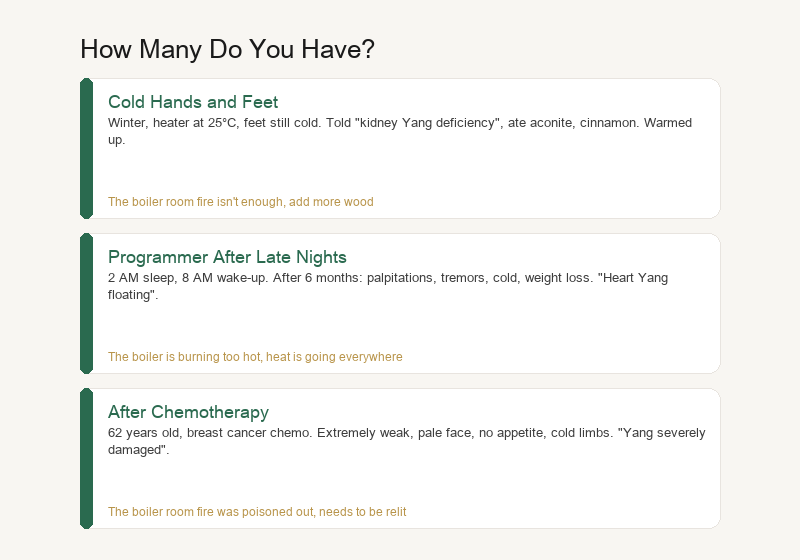
Case One: The Young Woman with Icy Hands and Feet in Winter.
28 years old, office worker. Hands and feet are ice-cold in winter; even with the heater set to 25°C, her feet are still cold. She had her thyroid checked, and the doctor said "normal." But she is always cold, easily fatigued, and has scanty menstruation. The TCM doctor said she has "Kidney Yang deficiency" and prescribed aconite and cinnamon bark. Three months later, her hands and feet warmed up, and her menstruation normalized.
The truth: Her thyroid function was in a "subclinical hypothyroid" state—levels within the normal range but at the lower limit, and her body was already feeling it. Insufficient thyroid hormone causes peripheral vasoconstriction, reducing blood flow to the hands and feet. Aconite and cinnamon bark promote blood circulation and activate heat production. Chinese medicine is not mysticism—it's precise functional regulation: when the boiler room fire is insufficient, add more wood.
Case Two: The Programmer Who Burned the Midnight Oil.
35 years old, tech lead at an IT company. Sleeps at 2 a.m., wakes up at 8 a.m. every day. After six months, he began experiencing palpitations, trembling hands, aversion to cold, and weight loss. Western medicine checked his thyroid function and found "hyperthyroidism"—excessive thyroid hormone secretion. The TCM pulse diagnosis said "Heart Yang floating upward"—Yang Qi should be hidden, but long-term sleep deprivation made it float outward.
The truth: Chronic sleep deprivation disrupts the neuroendocrine system, cortisol rhythm becomes disordered, which in turn affects thyroid function. Excessive thyroid hormone secretion leads to hypermetabolism. What TCM calls "floating Yang" is the body's heating system running out of control—the boiler is burning too hot, heat is rushing everywhere, the places that should be warm aren't, and the places that shouldn't be hot are burning.
Case Three: The Cancer Patient After Chemotherapy.
62 years old, after chemotherapy for breast cancer. Extremely weak, pale complexion, speaks with a feeble voice, can't eat, cold hands and feet. Western medicine says "post-chemotherapy bone marrow suppression, anemia + low white blood cells." TCM says "severe Yang damage, declining life-gate fire"—the toxicity of chemotherapy has damaged the body's energy system.
The truth: Chemotherapy drugs not only kill cancer cells but also damage the body's energy production system. The body faces a dual crisis of "insufficient heat" and "insufficient transport." TCM's "restoring Yang to save reversal" formulas are essentially cardiotonic, pressor, and microcirculation-improving drugs that help the body relight the fire in the boiler room.
Three cases, three scenarios, one underlying logic: the body's heating system has a problem.
Part 5Modern Research
Is there scientific research on "Yang Qi"?
Yes, but scientists don't use the word "Yang Qi." They use:
• Mitochondrial function and aging. Mitochondrial dysfunction is one of the core mechanisms of aging. Mitochondrial DNA damage leads to reduced energy synthesis, triggering a cellular energy crisis. This aligns perfectly with TCM's description of "Yang Qi declining with age"—the boiler room is aging, so the fire naturally weakens.
• Thyroid function and metabolism. Thyroid hormones regulate 60% of the body's basal metabolic rate. Hypothyroid patients have an average body temperature 0.5–1°C lower than normal people, with 20–30% less energy expenditure. This explains why people with "Yang deficiency" are cold, prone to weight gain, and easily fatigued—the boiler's thermostat is broken, the fire isn't strong enough.
• Brown fat and heat production. Adults still have brown fat, specifically for producing heat. Its activity is negatively correlated with BMI and decreases with age. TCM's "warming Yang" methods (like moxibustion and warm foods) may work by activating brown fat—installing a few extra small heaters in the body.
• Autonomic nerves and fatigue. Patients with chronic fatigue syndrome have autonomic nervous system dysfunction, with reduced sympathetic nerve activity and excessive parasympathetic nerve activity. This is completely consistent with the "low spirits, reluctant to speak and move" caused by "Yang Qi deficiency"—the heating system's switch is malfunctioning, stuck permanently on the "low temperature" setting.
But we must also be honest: currently, no study can directly "measure" Yang Qi. Yang Qi remains a conceptual model, not a quantifiable physical quantity. It describes a set of functional states, not a specific molecule or cell.
Part 6Practical Methods
Now that you understand "Yang," how do you replenish it?
First, let's dispel a few myths:
• Yang-boosting pills are not a cure-all. Yang-boosting pills may temporarily boost certain functions, but if the body's "boiler room" itself is failing, forcing more fire will only burn out the equipment. Fix the boiler first, then add wood.
• More exercise is not always better. Moderate exercise increases heat production, but excessive exercise depletes energy reserves. If you're Qi-deficient, start with walking; don't jump straight into a marathon. When the boiler fire is insufficient, flooring the accelerator will burn out the engine.
• Air conditioning is not the enemy; direct blowing is. Air conditioning in summer is fine, but cold air blowing directly on the back of the neck (Dazhui point) causes neck vasoconstriction, affecting blood supply to the brain. The ancients said "avoid wind like avoiding arrows"—it's not that you can't feel the wind, it's that you shouldn't let cold wind blow directly on the heating pipes.
Specific methods:
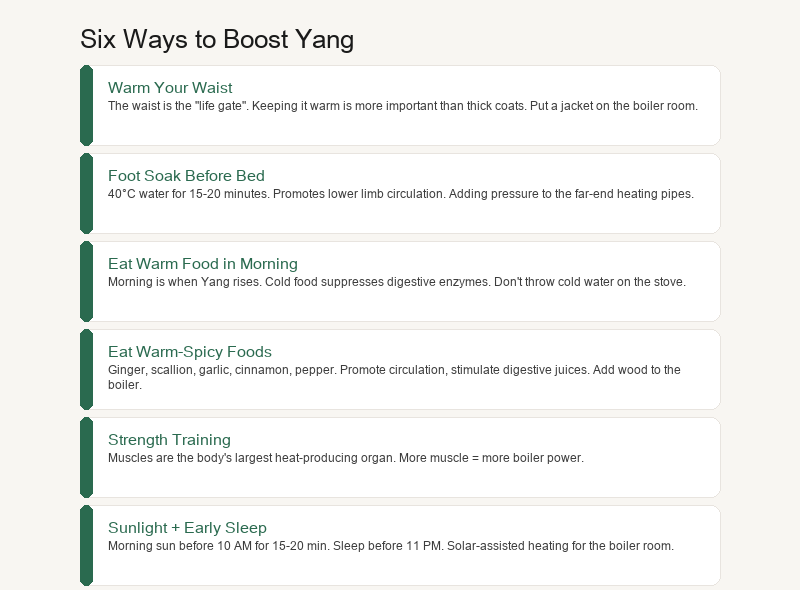
• Keep your waist and abdomen warm. The waist and abdomen are where the "life gate" resides; keeping them warm is more important than wearing a thick coat. Cold in the waist and abdomen directly affects internal organ temperature, lowering metabolic efficiency. Put a padded jacket on the boiler room.
• Soak your feet before bed. Soak in water around 40°C for 15–20 minutes to promote blood circulation in the lower limbs and aid sleep. The feet are the part of the body farthest from the heart, with poor blood circulation. Soaking your feet is like adding pressure to the far-end heating pipes.
• Eat warm foods in the morning. Morning is when Yang Qi rises; cold food suppresses digestive enzyme activity and slows metabolic startup. Light the stove in the morning, don't throw cold water on it.
• Eat pungent and warm foods in moderation. Ginger, scallions, garlic, cinnamon, and pepper contain volatile compounds that promote blood circulation and stimulate digestive juices. Add a handful of firewood to the boiler.
• Moderate strength training. Muscle is the body's largest heat-producing organ and the main site of glucose consumption. Increasing muscle mass = increasing the boiler's power.
• Get sunlight. Morning sunlight before 10 a.m. promotes skin synthesis of vitamin D, regulates calcium metabolism, and simultaneously, light through the retina affects circadian rhythms, regulating melatonin and cortisol secretion. Add a solar auxiliary heater to the boiler room.
• Go to bed early. Sleep before 11 p.m. Nighttime is when cells repair and the energy system recovers. Staying up late directly damages the body's ability to restore "Yang Qi"—you're still burning the boiler hard when it should be under maintenance.
These methods don't require you to believe in TCM. You only need to understand: the body's heat production and energy supply is a system that can be regulated.
Part 7One-Minute Summary
🕐 Understanding "Yang" in One Minute
Yang = The body's heating system.
Kidney Yang = Boiler room (total heat source).
Spleen Yang = Kitchen stove (digestive fire).
Heart Yang = Engine (power output).
Yang deficiency symptoms: cold intolerance, fatigue, cold hands and feet, pale complexion, weak voice, lack of motivation.
Causes: chronic sleep deprivation, excessive dieting, prolonged sitting, cold environments, aging.
Methods: keep waist and abdomen warm, foot soaks, eat hot foods in the morning, strength training, sun exposure, early sleep.
The ancients called it "Yang Qi"; modern people call it "energy metabolism" and "basal metabolic rate."
Different names, but the body only understands one language: feeling.
Modern medicine says: energy metabolism is the engine of life; without heat, cells die.
People 2,500 years ago said "Yang transforms into Qi"; people 2,500 years later say "mitochondria produce heat."
Humanity, looking at the same body, used different languages and reached the same conclusion.
That is the power of observation.
Making money is the art of living; art is the life after making money
giaogiao Decodes Traditional Chinese Wisdom · Concept 2
Using the language of modern science to help the world understand traditional Chinese wisdom.
No mysticism, no superstition, no belittlement.
Understand, rather than merely believe.
Coach Liu
Written in Florence