Why Do Chinese People Say "Yin Deficiency"? Your Body Isn't Lacking Energy—The Cooling System Isn't Enough
Part 1The Problem
Have you ever had this experience?
It's thirty-plus degrees outside. Your friend is devouring popsicles, blasting the AC, drinking ice-cold beer—living their best life. You try the same routine, and end up running to the bathroom three times that night, with leg cramps the next day. Your friend asks, "Are you just cold-natured?" You reply, "I don't know, I've been like this since I was a kid."
It gets even weirder. Other people stay up late and recover after a good sleep-in. You stay up late, and the next day your eyes feel like sandpaper, your mouth feels like you've swallowed a fireball, and no amount of water quenches the thirst. You're not tired—you're "burning up."
You go to the hospital, get your thyroid function, blood sugar, and electrolytes checked. The doctor says: "All your indicators are normal. Drink more water and get some rest."
You go to a TCM practitioner. The old doctor takes your pulse for three seconds and says: "Yin deficiency with internal fire."
No tests were run, yet a diagnosis was made. Do you believe it or not?
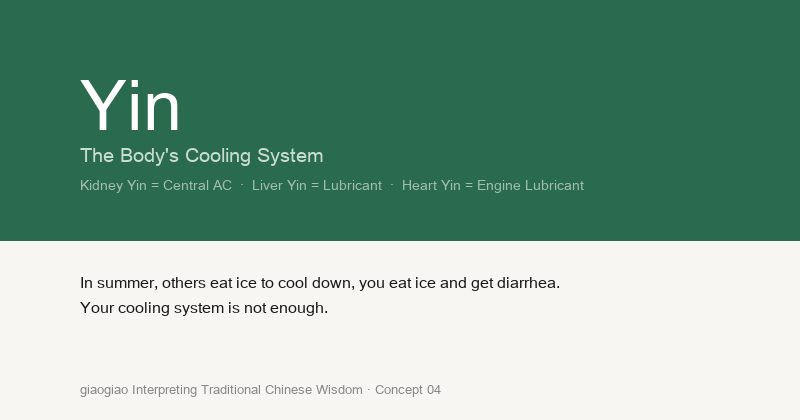
Even more bizarre is that the word "Yin" in Chinese is almost synonymous with "bad." Cloudy days, darkness, sinister, gloomy—all negative. But in TCM, "Yin" is actually a good thing. It's not what you think of as "cold"—it's the body's "cooling system."
Without a cooling system, even the strongest engine will burn out.
Part 2Traditional Chinese Explanation
TCM talks about Yin and Yang, but they're not opposites—they're partners. Yang is fire; Yin is water. Yang makes you move; Yin lets you rest. Yang generates heat; Yin cools you down. Yang is the engine; Yin is the coolant.
"When Yin is balanced and Yang is secured, the spirit is well-regulated."
——《黄帝内经》· Yellow Emperor's Inner Canon
"阴虚则内热,阳虚则外寒。"
"When Yin is deficient, internal heat arises; when Yang is deficient, external cold arises."
——《素问》· Basic Questions
The concept of Yin is abstract, but for ordinary people, just remember three types:
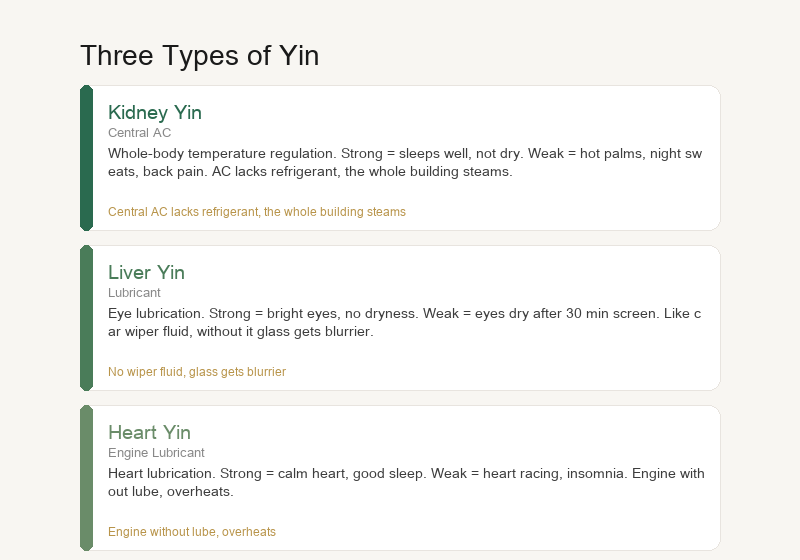
Kidney Yin (肾阴)—Your body's central air conditioning. People with abundant Kidney Yin have good whole-body temperature regulation: they don't fear heat or dryness, sleep deeply, and are full of energy. People with insufficient Kidney Yin have hot palms and soles, night sweats, and weak knees and back—like a building with no refrigerant in the AC, the whole place is steaming. Kidney Yin is the "chassis cooling" of the entire body; if the chassis isn't stable, everything above wobbles.
Liver Yin (肝阴)—Your eyes' lubricant. People with abundant Liver Yin have bright, clear eyes without dryness or redness. People with insufficient Liver Yin can't keep their eyes open after half an hour of screen time, like sandpaper rubbing against their eyeballs. Liver Yin is like the windshield wiper fluid in your car—without it, the glass just gets smeared. The Liver opens into the eyes; when Liver Yin is low, the eyes are the first to sound the alarm.
Heart Yin (心阴)—The lubricant for your blood. People with abundant Heart Yin have steady heartbeats, restful sleep, and calm emotions. People with insufficient Heart Yin have palpitations, insomnia, and restlessness—like an engine running without oil, grinding and screeching. Heart Yin is like engine lubricant: it doesn't make the engine run, but it makes the engine run without overheating.
These three types of Yin together make up what TCM calls "Yin." It's not one specific thing—it's the sum of all the body's "cooling, lubricating, and nourishing" functions: temperature reduction, moisture retention, lubrication, and calming the spirit—all of it.
The ancient sages were brilliant. They discovered that there's an "invisible something" in the body maintaining balance. When it's abundant, you're not dry, irritable, or overheated; when it's insufficient, your whole body is "overheating." They didn't know what to call it, so they used the simplest word: "Yin."
Part 3giaogiao Modern Translation
Okay, now let's translate "Yin" into modern language.
I'm not going to talk about the hypothalamus, vagus nerve, or autonomic nervous system. Too complicated. You just need to remember one analogy:
Kidney Yin = Central Air Conditioning (whole-body cooling)
Liver Yin = Eye Lubricant (local lubrication)
Heart Yin = Engine Lubricant (heart cooling)
That simple. Your "Yin" is essentially the body's ability to cool down, retain moisture, and lubricate. But this ability isn't like a refrigerator's "cooling"—it's about distributing heat reasonably, so no single area gets scorched.
Specifically:
What does Kidney Yin correspond to? It corresponds to your body's "temperature regulation and fluid balance capability." People with abundant Kidney Yin have a stable hypothalamic-pituitary-adrenal axis, precise temperature regulation—they don't sweat at the slightest heat, and their hands and feet don't turn ice-cold at the slightest chill. People with insufficient Kidney Yin have a dysregulated system, like a broken thermostat: it doesn't cool when it should, and overheats when it shouldn't.
What does Liver Yin correspond to? It corresponds to your mucosal system's "moisture retention capability." The mucous membranes of your eyes, mouth, and nose need continuous secretion of tears, saliva, and mucus to stay moist. People with abundant Liver Yin have normal secretory function. People with insufficient Liver Yin have dry mucous membranes and reduced secretions—like an empty windshield wiper fluid tank, the glass just gets drier and drier.
What does Heart Yin correspond to? It corresponds to the cardiovascular system's "stable operation capability." People with abundant Heart Yin have normal heart rate variability and a balanced autonomic nervous system—when the sympathetic nervous system gets overexcited, the parasympathetic system can pull it back in time. People with insufficient Heart Yin have overactive sympathetic nerves: rapid heartbeat, high blood pressure, can't sleep—like an engine without coolant, the longer it runs, the hotter it gets.
So, "Yin" is not mysticism. It's a functional metaphor—describing the body's overall ability to cool down, retain moisture, lubricate, and maintain stability.
The ancients didn't have thermometers or blood biochemistry analysis, but they used the concept of "Yin" to precisely describe what modern people need three separate concepts—"thermoregulatory function," "mucosal secretory function," and "autonomic nervous system balance"—to explain.
Part 4Real-Life Cases
Three stories to instantly help you understand what "Yin" is.
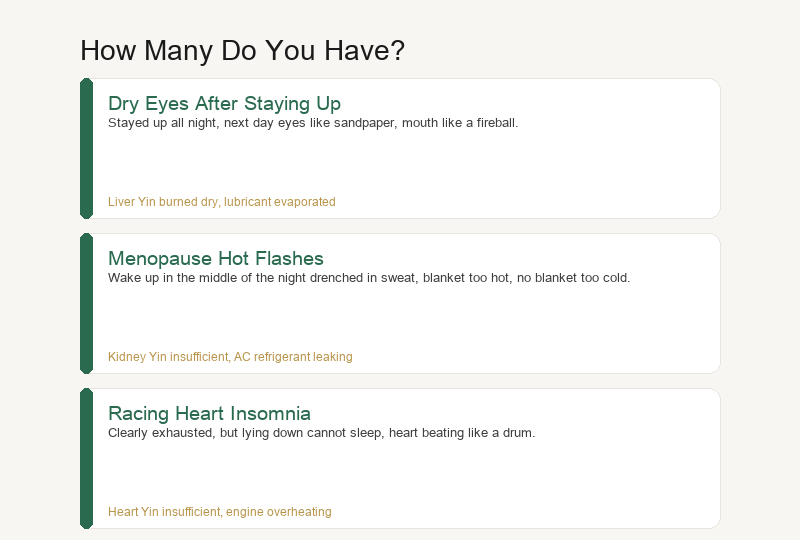
Case One: Dry eyes after staying up late.
You scroll on your phone until 2 AM, and the next morning your eyes feel like they're full of sand. Eye drops help for half an hour, then they're even drier. You think it's "too much screen time," but you can read books all day without this happening. Why?
TCM says: "Liver Yin deficiency." From 11 PM to 3 AM is when the Liver meridian is on duty; if you don't sleep during this time, the Liver doesn't get a chance to repair, and Liver Yin gets depleted. The Liver opens into the eyes; when Liver Yin is insufficient, the eyes dry first. Like running on the highway with no wiper fluid.
The truth: Sleep deprivation reduces tear secretion and increases evaporation. Meanwhile, continuous sympathetic nervous system activation inhibits the parasympathetic system's repair function. Liver Yin is essentially the "repair state of the neuro-endocrine system."
Case Two: Menopausal hot flashes.
Your mother (or you) hits fifty and suddenly starts waking up in the middle of the night, drenched in sweat. Throw off the blanket and you're cold; pull it back on and you're hot—five or six rounds per night. Western medicine says declining estrogen; TCM says "Kidney Yin deficiency."
The truth: Estrogen participates in hypothalamic temperature regulation. When estrogen declines, the thermostat goes haywire—the body can't tell if it's hot or cold, so it keeps sending "overheating" signals and triggers sweating to cool down. TCM calls this "Yin deficiency with fire blazing"—the cooling system isn't enough, so the body thinks it has a fever and desperately sweats to dissipate heat. Kidney Yin is essentially "temperature homeostasis under hormonal regulation."
Case Three: Palpitations and insomnia.
You've been busy all day, and at night you lie in bed with your brain running non-stop, your heart pounding like you just finished a sprint. You count sheep to a thousand, and you're still wide awake. You're not not tired—you're "over-tired."
TCM says: "Heart Yin deficiency." Heart Yin is the lubricant for the heart; daytime overuse of the brain and emotional tension deplete Heart Yin. At night, when Heart Yin is insufficient, the heart can't run smoothly, the sympathetic nervous system stays overactive, and you can't sleep. Like an engine that ran ten hours on the highway and is still steaming after you turn it off—the cooling system can't keep up.
The truth: Chronic stress and overthinking raise cortisol and adrenaline, both of which accelerate heart rate and raise blood pressure. Normally, the parasympathetic system should take over at night to lower the heart rate. But in people with Heart Yin deficiency, the parasympathetic system "can't pull back" the sympathetic system—the heart keeps "idling on overdrive."
Three cases, one underlying logic: the body's "cooling, lubricating, and stabilizing system" has a problem.
Part 5Modern Research
Is there scientific research on "Yin"?
Yes, but scientists don't use the word "Yin." They use:
• Autonomic nervous system balance. Research has found that patients with "Yin deficiency with internal fire" show significantly elevated sympathetic nerve activity, reduced parasympathetic activity, and decreased heart rate variability (HRV). This directly corresponds to TCM's concept of "Yin failing to restrain Yang."
• Hormone levels. Declining estrogen in menopausal women is linked to temperature regulation center dysfunction, causing hot flashes and night sweats. This aligns perfectly with the description of "Kidney Yin deficiency." Supplementing phytoestrogens (like soy isoflavones) can improve symptoms, consistent with TCM's approach of "nourishing Kidney Yin."
• Sleep and tear secretion. Sleep deprivation reduces tear secretion and destabilizes the tear film, causing dry eye syndrome. This is completely consistent with the clinical manifestation of "Liver Yin deficiency, eyes losing nourishment." More importantly, during sleep repair, the parasympathetic system promotes glandular secretion—this is the process of "Liver Yin" recovery.
These studies are not numerous, but the direction is consistent: "Yin" describes the body's overall state of "cooling, moisture retention, and stability"—not one specific substance.
Part 6Practical Methods
Now that you understand "Yin," how do you replenish it?
First, let's dispel a few myths:
• Eating ice doesn't replenish Yin. Ice is external cold; Yin is internal cooling capability. Eating ice actually damages the Spleen and Stomach, consuming more energy for digestion. For people with Yin deficiency, eating ice is like pouring cold water on an overheating engine: short-term cooling, long-term cracked cylinder.
• Drinking more water isn't a cure-all. People with Yin deficiency aren't lacking water—they're lacking the body's ability to "hold onto water." Drink it and it goes straight through, or turns into phlegm-dampness. Nourishing Yin isn't about adding water; it's about enhancing the body's ability to "lock in moisture, retain hydration, and distribute properly."
• Nourishing Yin isn't about taking supplements. Donkey-hide gelatin and bird's nest are Yin-nourishing, but only if you can digest them. People with Spleen-Stomach deficiency and cold will get "fire" from supplements because they can't digest such "sticky and rich" things, which instead turn into phlegm-dampness. Regulate the Spleen and Stomach first, then nourish Yin.
Specific methods:
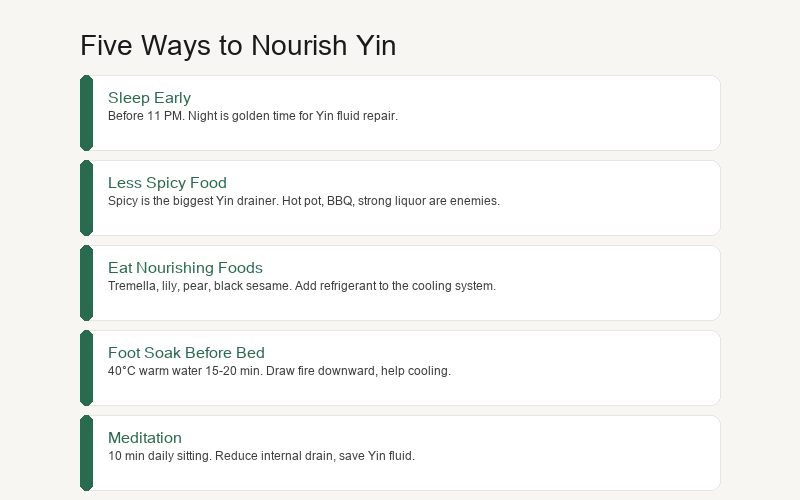
• Don't stay up late. This is the number one method for nourishing Yin. Sleep before 11 PM to give the Liver and Kidney meridians time to repair. Staying up late directly depletes Yin; no amount of supplements can make up for it. Can't do it? Start with midnight, and move 15 minutes earlier each week.
• Eat less spicy food. Chili, Sichuan pepper, barbecue, hot pot—these "dispersing" foods are like adding firewood to the body. People with Yin deficiency already don't have enough cooling system; adding more fire is like pouring oil on flames. It's not that you can't eat them—just eat them sparingly.
• Eat more Yin-nourishing foods. Tremella (white fungus), lily bulb, pear, water chestnut, lotus root, Chinese yam, goji berry, black sesame. These foods share common characteristics: high water content, soft and moist texture, rich in mucilage and gelatin. They don't directly "add water"—they provide raw materials for the body's "moisture retention system."
• Soak your feet before bed. Water around 40 degrees Celsius, for 15–20 minutes. The feet are the starting point of the Kidney meridian; foot soaking promotes lower limb circulation, drawing the day's heat and tension "downward," helping the Heart and Kidney to connect. But for people with Yin deficiency and internal fire, don't make the water too hot or soak too long—stop when you get a slight sweat, as heavy sweating actually damages Yin.
• Meditation and relaxation. Ten minutes a day, focusing on your breath. People with Yin deficiency have overly active sympathetic nerves; meditation activates the parasympathetic system, putting the body into "repair mode." This isn't mysticism—it's a physiological effect confirmed by heart rate variability research.
These methods don't require you to believe in TCM. You just need to understand: your body is a machine that needs a cooling system, and "Yin" is the operating capability of that system.
Part 7One-Minute Summary
🕐 Understand "Yin" in One Minute
Yin = The body's cooling / lubricating / moisture retention system.
Kidney Yin = Central air conditioning (whole-body cooling, determines whether you fear heat).
Liver Yin = Eye lubricant (local moisture retention, determines whether you get dry).
Heart Yin = Engine lubricant (heart stabilization, determines whether you can sleep).
Signs of Yin deficiency: dry mouth, dry eyes, hot palms, night sweats, restlessness, insomnia—the essence is "body overheating."
Causes: staying up late, spicy food, excessive eye use, emotional tension, chronic stress.
Methods: don't stay up late, eat less spicy food, eat more tremella/lily bulb/pear, soak feet before bed, meditate and relax.
The ancients called it "Yin"; modern people call it "the cooling system."
Different names, but the body knows: without cooling, the engine overheats.
Without cooling, the engine overheats.
This is probably the most down-to-earth wisdom of the Chinese people:
Knowing how to start a fire isn't skill; knowing how to put it out is mastery.
Making money is the art of living; art is the life after making money
giaogiao Explains Traditional Chinese Wisdom · Concept 04
Using modern scientific language to help the world understand traditional Chinese wisdom.
No mystery, no superstition, no dismissal.
Understand, rather than merely believe.
Coach Liu
Written in Florence