Why Do Chinese People Use "Five Elements" to Explain Everything? Your Body Has Five Colleagues with Different Personalities
Part 1A Question
Why do Chinese people like to explain everything with "metal, wood, water, fire, and earth"?
Fortune tellers say you're "lacking metal in your Five Elements." Old Chinese doctors say your "liver fire is too strong." Feng shui masters say "this direction belongs to water." Even your interior designer will throw in, "Use wood tones here, it boosts wealth luck."
You might ask: Aren't these five words just five materials? Wood, flame, dirt, metal, water. Did the ancients really believe that everything in the world is made of these five materials?
If that were true, the Chinese worldview would be way too simplistic. Even ancient Greece had four elements — water, air, fire, and earth — and that's one short.
But the truth is exactly the opposite — the Five Elements are not five substances; they're five functions. The ancients weren't saying "what the world is made of," they were saying "how the world operates."
It's like saying, you don't say "a company is made of five types of people," you say "a company needs five functions to operate" — creativity, communication, execution, control, and wisdom. Missing any one, and the company is in trouble.
Your body is also such a company.
Part 2Traditional Chinese Explanation
The term "Five Elements" first appeared in the Book of Documents (Shang Shu). But back then it wasn't called Five Elements, it was called "Five Materials" — literally five materials. Later, the ancients discovered that these five words weren't just materials, but five "modes of movement":
—— Book of Documents · Hong Fan (《尚书·洪范》)
Translated into human language:
Wood — bending and straightening, can bend and can straighten. Like a tree, generating, upward, elastic. Corresponds to the "generation" function.
Fire — flaming upward, burning, rising, heating. Like a flame, warming, spreading, illuminating. Corresponds to the "warming" function.
Earth — sowing and reaping, planting and harvesting. Like the ground, bearing, nurturing, transforming. Corresponds to the "transformation" function.
Metal — conforming to change, following transformation. Like metal, astringing, strict, precise. Corresponds to the "astringing" function.
Water — moistening downward, nourishing, downward, flowing. Like a stream, cooling, wise, conserving. Corresponds to the "moistening downward" function.
Note: The ancients weren't saying "wood = tree," they were saying "wood = the function of generating upward." A tree is wood, but a person sprouting in spring is also wood; a fireball is fire, but a passionate person is also fire.
Even more interesting, these five functions don't exist in isolation. They have two sets of relationships:
Mutual Generation (相生 Xiang Sheng) — nourishing each other:
Wood generates fire (wood burns to make fire) → Fire generates earth (fire turns to ash) → Earth generates metal (metal is dug from earth) → Metal generates water (metal melts into liquid) → Water generates wood (water nourishes trees to grow).
Draw it as a circle: Wood → Fire → Earth → Metal → Water → Wood. A perfect loop.
Mutual Restraint (相克 Xiang Ke) — checking each other:
Wood restrains earth (tree roots penetrate soil) → Earth restrains water (dams block floods) → Water restrains fire (water extinguishes flames) → Fire restrains metal (fire melts metal) → Metal restrains wood (an axe fells a tree).
Draw it as a star: Wood restrains earth, earth restrains water, water restrains fire, fire restrains metal, metal restrains wood. A network of checks and balances.
Mutual generation is teamwork; mutual restraint is supervision. Neither can be missing.
Part 3giaogiao Modern Translation
Okay, now let's translate "Five Elements" into modern language.
I'm not going to talk about the complex tables matching Five Elements to five organs, five colors, and five flavors. You can't memorize that stuff anyway. You only need to remember one metaphor:
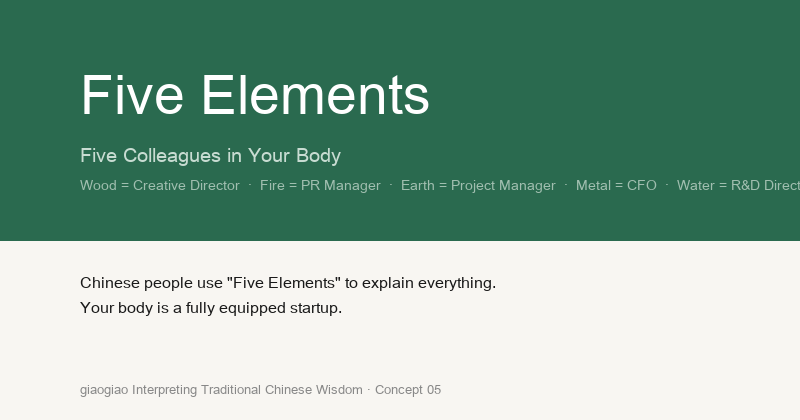
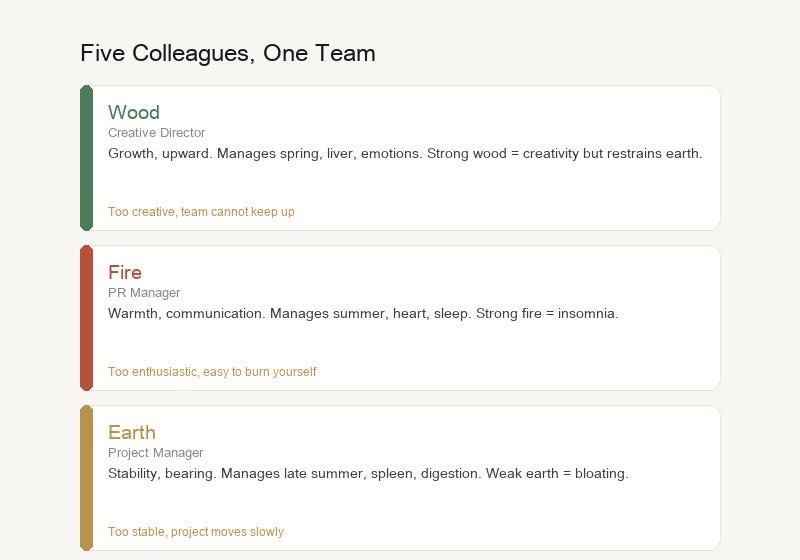
Wood = Creative Director (生发 generation, 向上 upward)
Fire = PR Manager (热情 enthusiasm, 传播 communication)
Earth = Project Manager (稳定 stability, 承载 bearing)
Metal = CFO (收敛 astringing, 精准 precision)
Water = R&D Director (润下 moistening downward, 智慧 wisdom)
Your body is a fully equipped startup. These five "directors" manage different departments:
Creative Director (Wood) manages "generation" — metabolism, cell regeneration, creativity. In spring, all things generate, and your body is also renewing itself. People with strong wood energy are energetic, full of ideas, and action-oriented. People with weak wood energy are listless, lifeless, and can't get excited about anything.
PR Manager (Fire) manages "warming" — blood circulation, temperature regulation, emotional expression. In summer, passion is like fire, and your body is running at high speed. People with strong fire energy are warm, outgoing, and infectiously charismatic. People with weak fire energy have cold hands and feet, social anxiety, and speak without confidence.
Project Manager (Earth) manages "transformation" — digestion and absorption, energy conversion, logistics support. In late summer (the transition between summer and autumn), it's harvest season, and your body is turning food into energy. People with strong earth energy eat well, digest well, and have solid bodies. People with weak earth energy get bloated from a little food, have loose stools, and feel tired all over.
CFO (Metal) manages "astringing" — breathing rhythm, skin barrier, resource management. In autumn, energy converges, and all things begin to store. People with strong metal energy breathe deeply, have good skin, and are organized. People with weak metal energy catch colds easily, have dry skin, and suffer from constipation or diarrhea.
R&D Director (Water) manages "moistening downward" — fluid circulation, bone marrow blood production, deep thinking. In winter, all things hide, and your body is repairing and storing. People with strong water energy think deeply, are calm and rational, and resilient. People with weak water energy are easily thirsty, have weak lower back and knees, fear cold, and have declining memory.
So, the Five Elements are not five substances, but five functions. Your "body company" needs these five departments to work together to operate normally.
What is mutual generation? The Creative Director (Wood) comes up with a great idea and hands it to the PR Manager (Fire) to spread. After the PR Manager throws the event, the Project Manager (Earth) cleans up the site and summarizes the experience. The Project Manager hands the budget report to the CFO (Metal) for review. The CFO finds there's still a surplus and allocates it to the R&D Director (Water) for technical reserves. The R&D Director's technical breakthrough gives the Creative Director new inspiration — a perfect closed loop.
What is mutual restraint? The Creative Director's ideas are too wild, and the CFO (Metal) steps on the brakes. The PR Manager (Fire) spends too much money, and the CFO cuts the budget. The Project Manager (Earth) is too conservative, and the Creative Director (Wood) breaks the deadlock. That's checks and balances.
Without these checks and balances, the company goes haywire. The body is the same.
Part 4Real-Life Cases
Four stories to let you instantly understand what Five Element imbalance feels like.
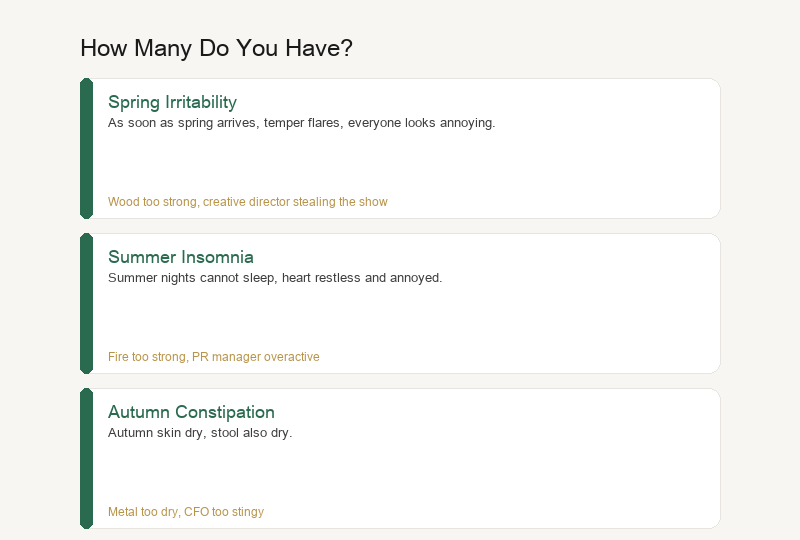
Case 1: Spring Irritability — Wood Too Strong.
Every spring, don't you get especially irritable? Little things set you off, everyone annoys you, and a morning traffic jam can make you want to quit your job. You think it's "spring fatigue," but it's actually "spring anger."
TCM says: Spring belongs to wood, all things generate. The "Creative Director" (Wood) in your body is in peak season, firing on all cylinders, full of ideas, energy, and drive. But here's the problem: when wood is too strong, it restrains earth (the Project Manager). Earth is restrained, and the digestive system has problems — you're raging while your stomach hurts.
The truth: Spring cortisol and testosterone levels do fluctuate, and nervous system excitability increases. The ancients didn't have hormone tests, but they precisely described this phenomenon: in spring, wood is strong, and people easily have "rising liver fire."
Case 2: Summer Insomnia — Fire Too Strong.
On summer nights, you're obviously sleepy, but once you lie down, you can't fall asleep. Your brain is like a spinning lantern, the day's events replaying like a movie, tomorrow's plans fully scheduled. It's 2 AM, and you're still scrolling on your phone. At 7 AM, the alarm rings, and you feel like you haven't slept at all.
TCM says: Summer belongs to fire, and the "PR Manager" is in peak season. People with strong fire energy are overly enthusiastic, and even at night, their brain is still "socializing" — it can't stop. When fire is too strong, it restrains metal (the CFO). Metal is restrained, and the respiratory system has problems — you're insomniac while also having dry mouth and dry skin.
The truth: High summer temperatures cause core body temperature to drop slowly, delaying melatonin secretion. The ancients didn't have thermometers, but they said "excessive heart fire, spirit cannot stay" — the brain can't stop because "fire" is burning.
Case 3: Autumn Constipation — Metal Too Dry.
As soon as autumn arrives, going to the bathroom becomes difficult. It's not because you don't drink enough water, but because of "dryness." Dry skin, dry lips, dry nose, even dry stools. You think it's because the weather is dry, but why don't some people get constipated in autumn?
TCM says: Autumn belongs to metal, and the "CFO" is in peak season, astringing function fully activated. But astringing too much becomes "dryness." When metal is too dry, it restrains wood (the Creative Director). Wood is restrained, and the generation function has problems — you're constipated while also feeling down and unmotivated.
The truth: Autumn air humidity drops, and human body water evaporates faster. If you add spicy food and staying up late, intestinal water further decreases. The ancients called it "autumn dryness injuring fluids" — "metal" is too dry and needs "water" to moisten.
Case 4: Winter Cold Sensitivity — Water Too Cold.
In winter, others wear sweaters, you wear a down jacket. Others drink cold drinks, you drink hot water. Others have warm hands and feet, you feel like you just came out of the refrigerator. It's not because you're weak, but because "water is too cold."
TCM says: Winter belongs to water, and the "R&D Director" is in peak season. Water governs coldness and hiding. When water is too cold, it restrains fire (the PR Manager). Fire is restrained, and temperature regulation has problems — you're freezing while also feeling mentally sluggish and not wanting to socialize.
The truth: Winter thyroid hormone and adrenaline secretion decrease, and basal metabolic rate drops. If circulation is already poor, peripheral blood supply is even worse. The ancients called it "kidney yang deficiency" — "water" is too cold and needs "fire" to warm.
Four cases, one underlying logic: Five Element imbalance is not about having too much or too little of a certain "substance," but about a certain "function" being too strong or too weak, breaking the team's balance.
Part 5Modern Research
Is there scientific research on "Five Elements"?
There aren't many papers directly studying "Five Elements," but papers studying "body function balance" are countless. Re-translated in modern language, you'll find that every sentence the ancients said has a corresponding scientific explanation:
• Wood = Neuro-Endocrine-Immune Network. Research shows that spring sympathetic nerve excitability does increase, cortisol levels fluctuate more, leading to mood swings and irritability. This is the modern version of "strong wood restraining earth."
• Fire = Temperature Regulation and Metabolic Rate. Under high summer temperatures, core body temperature drops slowly, melatonin secretion is delayed, leading to difficulty falling asleep. Meanwhile, heat dissipation demand increases, heart rate accelerates, and metabolic rate rises. This is the scientific explanation of "fire too strong."
• Earth = Gut Microbiota and Digestive Absorption. The gut is called the "second brain," and gut microbiota-produced neurotransmitters (like serotonin) directly affect mood and energy levels. Digestive dysfunction is often accompanied by anxiety and fatigue. This is the microscopic mechanism of "weak earth."
• Metal = Skin Barrier and Breathing Rhythm. Autumn skin barrier function declines, transepidermal water loss increases, and respiratory mucosa dries, making it susceptible to pathogen invasion. Research shows autumn is the high season for asthma and allergic rhinitis. This is the scientific counterpart of "dry metal."
• Water = Fluid Circulation and Deep Repair. Winter deep sleep ratio increases, and growth hormone secretion peaks at night. But people with poor circulation have insufficient peripheral blood supply, leading to cold hands and feet. Meanwhile, winter vitamin D synthesis decreases, affecting immunity and mood. This is the modern explanation of "cold water."
These studies don't "prove Five Elements is correct," but prove: the ancients used the "Five Elements" framework to precisely describe the body's functional changes in different seasons. They didn't have microscopes, but they had observation. They didn't have statistics, but they had experience.
Part 6Practical Methods
Understood Five Elements, so how do you use it?
First, dispel a few misconceptions:
• It's not about lacking something and supplementing it. Lacking metal in Five Elements doesn't mean you should eat metal. Lacking water doesn't mean you should drink more water. What's lacking is "function," not "substance."
• It's not that more of one is always better. People with strong wood energy are creative, but too strong wood restrains earth, causing digestive problems. People with strong fire energy are warm and outgoing, but too strong fire restrains metal, causing respiratory and skin problems. Balance is the key.
• It's not a fortune-telling tool. Five Elements can help you understand your body, but it can't predict stock trends. If someone uses "you lack metal in your Five Elements" to sell you gold, please block them.
Specific methods:
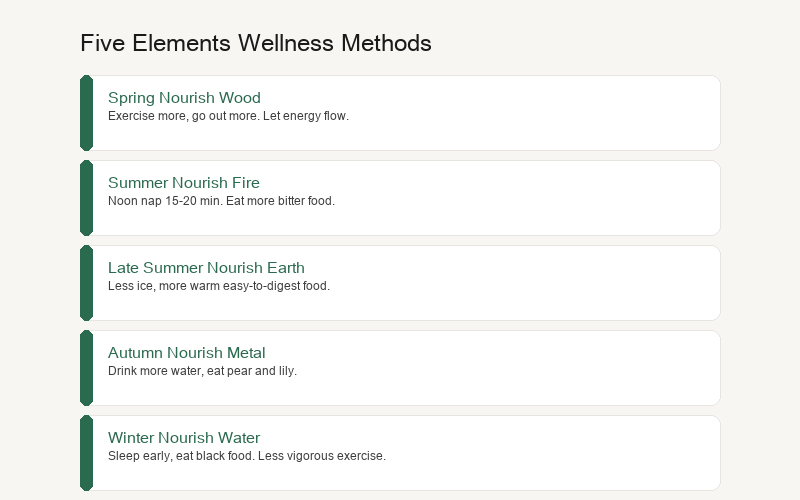
• Spring nourishes wood — dredge, not supplement. In spring, wood is strong. The key is "dredge," not "supplement." Exercise more, stretch more, go out more, let energy flow. Eat less sour (sour astringes, not good for generation), eat more pungent (pungent disperses, helps generation). Emotionally, let out your fire, don't hold it in — holding in anger in spring means stagnation all year.
• Summer nourishes fire — cool, not extinguish. In summer, fire is strong. The key is "cool," not "extinguish." Take a 15-20 minute nap at noon, avoid the hottest hours. Eat more bitter (bitter melon, lotus seed heart), bitterness can clear heat. At night, socialize less and scroll less on your phone — "fire" too strong, spirit can't stay, you can't sleep.
• Late summer nourishes earth — warm, not cold. In the transition between summer and autumn, earth is in charge. The key is "warm," not "cold." Eat less ice and cold food, eat more warm and easy-to-digest food. Millet, pumpkin, and yam are all "earth" foods. Don't overthink — overthinking injures the spleen, and too much thinking leads to poor digestion.
• Autumn nourishes metal — moisten, not astringe. In autumn, metal is strong. The key is "moisten," not "astringe." Drink more water, eat more lung-moistening foods (pear, lily, tremella). Exercise moderately, but not too vigorously — sweating too much makes water loss faster. Emotionally, "autumn sadness" is normal, don't fight it, allow yourself to feel down for a few days.
• Winter nourishes water — store, not consume. In winter, water is strong. The key is "store," not "consume." Go to bed early (try 10 PM), wake up late (after the sun rises). Eat more black foods (black beans, black sesame, black fungus). Sweat less, stay up less, exercise less vigorously — winter is the season for the "R&D Director" to retreat, don't disturb him.
There's also a general principle: find your dominant type, but don't let it dominate alone.
If you're a "wood type" person (creative, fast-moving, easily annoyed), pay attention to nourishing your spleen and stomach (earth), don't let wood restrain earth. If you're a "fire type" person (warm, outgoing, easily insomniac), pay attention to nourishing your lungs (metal), don't let fire restrain metal. If you're a "water type" person (calm, deep, easily cold), pay attention to nourishing your heart (fire), don't let water restrain fire.
Five Elements balance is not about all five being strong, but about all five being sufficient. Like a good team, it's not about every department being the strongest, but about every department functioning normally and cooperating with each other.
Part 7One-Minute Summary
🕐 Understand "Five Elements" in One Minute
Five Elements = Five functions, not five substances.
Wood = Creative Director (生发 generation, 向上 upward)
Fire = PR Manager (热情 enthusiasm, 传播 communication)
Earth = Project Manager (稳定 stability, 承载 bearing)
Metal = CFO (收敛 astringing, 精准 precision)
Water = R&D Director (润下 moistening downward, 智慧 wisdom)
Mutual generation (相生): Wood→Fire→Earth→Metal→Water→Wood (teamwork)
Mutual restraint (相克): Wood restrains earth, earth restrains water, water restrains fire, fire restrains metal, metal restrains wood (checks and balances)
Imbalance manifestations: spring irritability (strong wood), summer insomnia (strong fire), autumn constipation (dry metal), winter cold sensitivity (cold water).
Methods: spring dredge, summer cool, late summer warm, autumn moisten, winter store. Adjust diet and rest according to season, find balance, don't force one element.
Your body is a fully equipped startup.
Five Elements is not fortune-telling, it's management.
Your body is not built from five materials,
but operated by five departments.
This is probably the most down-to-earth wisdom of the Chinese:
The world is not made of what things are, but by how things move.
What matters is not the material, but the relationship.
Making money is the art of living; art is the life after making money.
giaogiao Decodes Chinese Traditional Wisdom · Concept 05
Explaining Chinese traditional wisdom in the language of modern science.
No mysticism, no superstition, no belittlement.
Understand, not merely believe.
Coach Liu
Written in Florence