Why Do Chinese People Say "Kidney Essence Deficiency"? Your Body Isn't Lacking Money—The Savings Account Is Empty

Part 1A Question
Have you ever noticed that some people around you seem to have an endless supply?
The same workload, and someone can work overtime until midnight then hit the gym, while you feel your legs go soft just squeezing into the subway after work. The same drinking party, and someone can handle a second round and still sing karaoke, while two beers make your head spin. The same age, and someone has dark hair and bright eyes, while you're already shopping for anti-hair-loss shampoo and eye massagers.
You go to the hospital for a checkup—blood work, kidney function, sex hormones. The doctor says: "Everything's within normal range. Just get more rest."
You go to a Chinese medicine doctor. The old physician glances at your tongue and says: "Kidney Essence Deficiency."
He didn't check your sperm, and he didn't scan your kidneys, but he says your "Jing" is running low. What does that actually mean?
Even more confusing is how the Chinese language itself is split on the word "Jing." "Jingshen" (spirit) is a compliment, "Jingli" (energy) is praise, "Jujing huishen" (concentrated focus) is admirable, but "Yijing" (nocturnal emission) is a disease, and "Jing jin ren wang" (dying from essence exhaustion) is a warning. The same character "Jing" is sometimes praise, sometimes taboo. So what on earth is this "Jing"?
Part 2The Traditional Chinese Explanation
The character "Jing" in oracle bone script is literally "rice" plus "green/blue," originally meaning purified rice, and by extension, refined essence. The ancients, using the most朴素 observations, defined "Jing" as the most fundamental substance of life, stored in the kidneys, determining your growth, development, reproduction, and aging.
——《黄帝内经》 (Yellow Emperor's Inner Canon)
"夫精者,身之本也。" (Essence is the root of the body.)
——《素问》 (Plain Questions)
Chinese medicine divides "Jing" into three types. Understand this classification, and you'll understand why Chinese people are always talking about "nourishing the kidneys":
Congenital Jing (先天之精)—the startup capital your parents gave you. When you were born, this "deposit" was fixed. People with abundant congenital Jing are naturally strong, develop quickly, and are full of energy. Those with insufficient congenital Jing have been weak and sickly since childhood, with delayed development and easy fatigue. This "startup capital" cannot be replenished once used up. All you can do is slow down its consumption.
Acquired Jing (后天之精)—the savings you earn yourself. Through eating, sleeping, and exercising, your body produces new "Jing" every day, depositing it into your "account." The production of acquired Jing depends on your lifestyle: eat well, sleep well, and stay in a good mood, and production is high; stay up late, indulge excessively, feel anxious, and binge eat, and production is low while consumption is high.
Reproductive Jing (生殖之精)—the seed capital for entrepreneurship. This is the "special fund" dedicated to reproduction. The adequacy of reproductive Jing determines your fertility, sex hormone levels, and sexual function. When the ancients talked about "preserving Jing," they mainly meant protecting this seed capital and not spending it recklessly.
These three types of Jing are essentially the same thing: the body's original energy reserve. Congenital Jing is the principal, acquired Jing is the interest, and reproductive Jing is the special allocation. When the principal runs out, you can only live on interest; when the interest isn't enough, the person collapses.
The ancients were very practical. They discovered that there is a "most fundamental thing" in the body supporting everything. When it's abundant, you have strength, desire, and spirit; when it's depleted, nothing is left. They didn't know how to name it, so they used the most朴素 word: "Jing"—essence, the core, the root.
Part 3giaogiao's Modern Translation
Okay, now let's translate "Jing" into modern language.
I'm not going to talk about stem cells, DNA, or telomere length. Too complicated. You only need to remember one analogy:
Congenital Jing = Startup capital from parents (factory settings, unchangeable)
Acquired Jing = Savings you earn yourself (daily accumulation, continuously replenishable)
Reproductive Jing = Seed capital for entrepreneurship (reproduction, dedicated use)
That's it. Your "Jing" is essentially the body's original energy reserve and regenerative potential. But this reserve isn't sitting in a bank doing nothing—it's being consumed every day and replenished every day.
Specifically:
What does congenital Jing correspond to? It corresponds to your genetic endowment and the nutritional reserves from the embryonic period. This includes gene quality, mitochondrial count, and the initial scale of the stem cell reservoir. People with abundant congenital Jing are like buying a high-end computer—the factory configuration is already high. People with insufficient congenital Jing are like a low-end computer. Congenital conditions determine your "ceiling."
What does acquired Jing correspond to? It corresponds to your body's daily energy synthesis and repair capacity. After food is digested and absorbed, part of it is converted into energy for daily activities (Qi), and another part is converted into reserve energy (Jing), stored in the bone marrow, kidneys, and various organs. Acquired Jing is like your monthly salary—what you save is your deposit, and what you spend is your expense.
What does reproductive Jing correspond to? It corresponds to sex hormone levels and the functional reserve of the reproductive system. This isn't just about sperm or eggs, but the regulatory capacity and reserve capacity of the entire endocrine axis (hypothalamus-pituitary-gonadal axis). People with abundant reproductive Jing have normal sexual development, strong fertility, and prominent secondary sexual characteristics. People with insufficient reproductive Jing may experience sexual dysfunction, infertility, and premature aging.
So, "Jing" is not mysticism. It's just a reserve metaphor—describing the body's most fundamental energy reserve, regenerative potential, and genetic endowment.
The ancients didn't have genetic testing, but they used the concept of "Jing" to precisely describe what modern people need a pile of concepts like "genetic endowment," "stem cell reserve," "endocrine regulation," and "energy metabolism" to explain.
Part 4Real-Life Cases
Three stories to make you instantly understand what "Jing" is.
Case 1: The 30-year-old programmer's hair.
Little Li, 30, works at a top tech company. Million-dollar salary, thinning hair. He works overtime until midnight every day, fueled by coffee, and still drinks socially on weekends. Recently, he noticed more and more white hairs, and an alarming amount of hair falling out when washing. He went to the hospital—thyroid function normal, trace elements sufficient, androgen levels normal. Western medicine says: "Probably genetic hair loss. Consider a hair transplant."
Chinese medicine says: "Kidney Essence Deficiency. Hair is the surplus of blood; when essence is insufficient, hair cannot flourish."
The truth: Long-term sleep deprivation, overwork, and high mental stress consume a large amount of "acquired Jing," and the body's repair capacity can't keep up with the consumption rate. Hair growth requires sufficient protein and blood supply. When "Jing" is insufficient, the body prioritizes ensuring the function of internal organs, and hair—this "non-essential organ"—is sacrificed. This isn't simply "androgenetic alopecia"; it's the body's "deposit" running low. Save your life first, then your hair.
Case 2: The athlete's recovery after retirement.
Old Zhang, retired athlete, 45. In his youth, his physical fitness was superb—national team level, training intensity unimaginable to ordinary people. After retirement, his body反而 developed all sorts of problems: joint wear, declining immunity, slower recovery speed, and he even looked older than his peers.
Chinese medicine says: "Excessive strain and overconsumption of essence."
The truth: The extreme training of professional athletes actually consumes large amounts of "congenital Jing" and "acquired Jing." In youth, the body's "production capacity" can barely keep up with the "consumption rate," but long-term overconsumption causes the "Jing" reserve to deplete prematurely. After retirement, the body's repair capacity drops sharply, and all sorts of problems surface. It's like a company that operates at high capacity for a long time—while performance is good, equipment and capital损耗 are enormous. Once it stops, you realize the account has been empty for a while.
Case 3: Memory decline in the elderly.
Auntie Wang, 70. She had an excellent memory in her youth, but now she frequently forgets things—she puts something down and can't find it moments later. She went to the hospital; no Alzheimer's, brain CT normal. The doctor says it's "normal aging."
Chinese medicine says: "The sea of marrow is insufficient; essence is scarce and the spirit wanes."
The truth: Chinese medicine believes that "the kidney governs the bones, produces marrow, and connects to the brain." When "Jing" is abundant, the bone marrow and brain marrow are abundant, thinking is sharp, and memory is good. With age, "congenital Jing" is continuously consumed, and the production of "acquired Jing" also declines. "Jing" is insufficient to nourish the brain marrow, and brain function degrades. Modern neuroscience has also confirmed that age-related cognitive decline is closely related to decreased neural stem cell regeneration, reduced cerebral blood flow, and lowered energy metabolism efficiency. These are all micro-level manifestations of "Jing" depletion.
Three cases, one underlying logic: the body's fundamental reserve is decreasing, and repair capacity can't keep up with consumption.
Part 5Modern Research
Does "Jing" have scientific research?
Yes, but scientists don't use the word "Jing." They use:
• Stem cell reserves. Research has found that the number and quality of mesenchymal stem cells in bone marrow decline with age. These stem cells are the body's "original cells" for repair and regeneration, corresponding to what Chinese medicine calls "congenital Jing." The more and better the stem cells, the stronger the body's repair capacity.
• Telomere length. Telomeres are protective caps at the ends of chromosomes. Every time a cell divides, telomeres shorten a bit. People with long telomeres have longer cell lifespans and younger bodies. People with short telomeres age faster. Research has found that chronic stress, insufficient sleep, and poor diet accelerate telomere shortening, while meditation, exercise, and a healthy diet can slow this process. Isn't this exactly the theory that "acquired Jing" can be replenished and "congenital Jing" can be consumed?
• Hormonal regulation. The hypothalamus-pituitary-gonadal axis (HPG axis) is the core system regulating reproductive function. Research has found that long-term physical and mental stress, insufficient sleep, and excessive exercise can lead to HPG axis dysfunction and declining sex hormone levels. This is the scientific explanation for "reproductive Jing" deficiency.
• Epigenetics. The latest research has found that parents' lifestyles (diet, stress, environmental exposure) affect the DNA methylation patterns of reproductive cells, thereby altering the gene expression of offspring. This means that "congenital Jing" depends not only on inheritance but also on the parents' pre-conception state of life. The ancient concepts of "fetal education" and "pre-conception care" have actually found support in modern science.
This research is not extensive, but the direction is consistent: "Jing" describes the body's fundamental reserve, regenerative capacity, and genetic potential—not a specific substance.
Part 6Practical Methods
Understanding "Jing," how do you save it?
First, dispel a few misconceptions:
• Taking supplements isn't saving money. Liuwei Dihuang Wan, kidney-tonifying supplements—these aren't "deposits," they're "financial products." If the principal is already depleted, the best financial product won't save you. Moreover, taking too many tonics that you can't digest反而 becomes a burden. Stop the loss first, then invest.
• More exercise isn't always better. Moderate exercise can increase the production of "acquired Jing," but excessive exercise consumes "congenital Jing." The case of athletes' bodies collapsing after retirement is the best lesson. For ordinary people, three times a week, 30 minutes of moderate-intensity exercise is enough.
• Celibacy isn't the only way to preserve Jing. The ancients advocated "preserving Jing," but they weren't telling you to become a monk. Normal sex life doesn't consume too much "Jing." Rather, it's excessive indulgence, frequent masturbation, and repeated sexual arousal from excessive pornography consumption that heavily depletes "reproductive Jing." Moderation is key; too much is as bad as too little.
Specific methods:
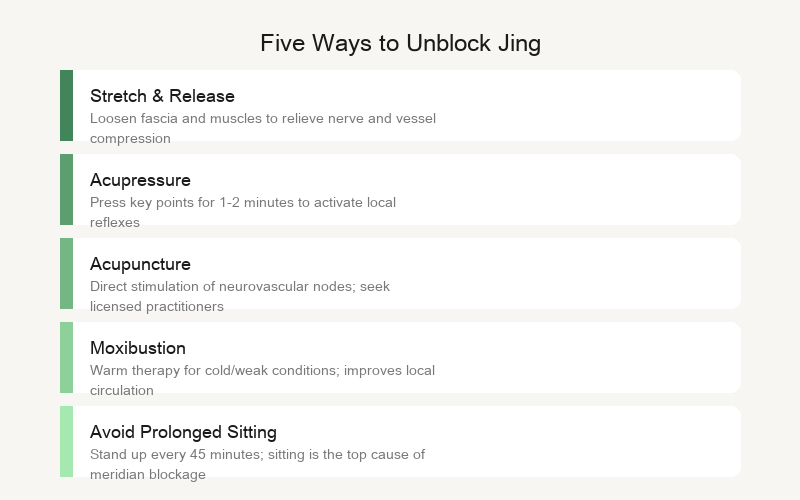
• Sleep well (earn deposits). This is the most effective way to replenish "acquired Jing." Go to bed before 11 PM and ensure 7-8 hours of high-quality sleep. During deep sleep, the body secretes growth hormone, repairs cells, and replenishes energy. One late night consumes "Jing" that takes three days of normal sleep to recover.
• Exercise moderately (capital preservation). Walking, Tai Chi, swimming, yoga—these low-intensity exercises promote blood circulation, improve metabolic efficiency, and increase the production of "acquired Jing." Remember: exercise is for "preserving capital," not for "doubling your money." Don't push yourself to the limit.
• Practice moderation (don't spend recklessly). Control sexual desire, appetite, and material desire. Excessive sexual desire consumes "reproductive Jing," excessive appetite consumes "acquired Jing," and excessive material desire consumes "mental Jing." Learning "delayed gratification" is the basic skill of saving "Jing."
• Eat black foods (nourish the kidneys). Black sesame, black beans, black rice, mulberries, black goji berries. Chinese medicine believes black enters the kidneys. These foods are rich in trace elements, anthocyanins, and antioxidants, supporting kidney function and the body's repair capacity. Modern nutrition also confirms that these foods are beneficial for maintaining endocrine balance and anti-aging.
• Reduce emotional drain (stop the thief). Anxiety, anger, fear, and excessive overthinking are the biggest consumers of "Jing." Every emotional outburst causes the body to secrete large amounts of stress hormones, consuming energy reserves. Learning meditation, deep breathing, and mindfulness to reduce emotional drain is equivalent to reducing the outflow of your "deposit."
These methods don't require you to believe in Chinese medicine. You only need to understand: your body has a "Life Bank," and "Jing" is your deposit. People with more deposits have stronger risk resistance; people with fewer deposits collapse at the slightest breeze.
Part 7One-Minute Summary
🕐 Understand "Jing" in One Minute
Jing = The body's original savings.
Congenital Jing = Startup capital from parents (factory settings, gone when used up).
Acquired Jing = Savings you earn yourself (through eating and sleeping, continuously replenishable).
Reproductive Jing = Seed capital for entrepreneurship (reproduction, dedicated use).
Signs of Jing deficiency: premature graying, hair loss, memory decline, slow recovery, decreased sexual function, premature aging.
Causes: late nights, excessive indulgence, overwork, emotional drain, binge eating.
Methods: sleep well (earn deposits), exercise moderately (preserve capital), practice moderation (don't spend recklessly), eat black foods (nourish kidneys), reduce emotional drain (stop the thief).
Remember one sentence: Jing is not sperm; it's the body's original savings. People with more savings have stronger risk resistance.
Different names, but the body knows: when the account is empty, it's time to save.
Congenital Jing is the startup capital from parents; acquired Jing is the savings you earn yourself.
Some people are naturally full of energy—that's because they have more savings.
Some people collapse after one late night—that's because they have fewer savings.
People with more savings have stronger risk resistance.
This is probably the most朴素 wisdom of the Chinese people: don't overdraw, save up.
Making money is the art of living; art is the life after making money
giaogiao Decoding Chinese Wisdom · Concept 06
Using modern scientific language to help the world understand Chinese traditional wisdom.
Not mysterious, not superstitious, not derogatory.
Understand, rather than merely believe.
Coach Liu
Written in Florence