Why Do the Chinese Say "Xíng-Shén Unity"? Your Body Isn't Just Hardware, It Needs Software
Part 1A Question
Have you ever had this experience?
You go for a check-up. Every indicator is normal—blood pressure, cholesterol, BMI. The doctor pats your shoulder and says, "You're in good shape, kid." But deep down, you know something's off. You can't get up in the morning, can't sleep at night, zone out in meetings, and spend weekends horizontal. You're not sick. You're just "not in the zone."
On the flip side, do you know someone who looks completely average, even a bit scrawny, but speaks with power, moves with purpose, pulls an all-nighter and still bounces around the next day? You ask them their secret. They say, "I don't know, I've always been like this." You think: That's not fair.
Traditional Chinese Medicine calls the first type "Xíng-shèng Qì-shuāi"—the hardware looks great, but the software is already failing. It calls the second type "Xíng-Qì Jù-zú"—both hardware and software are online and working in sync.
Even more striking, TCM has a phrase called "Xíng-Shén Hé-yī"—Xíng is the body, Shén is the spirit. These two aren't simply added together; they're deeply fused. Someone with Xíng-Shén unity moves with a sense of "wholeness." Someone with Xíng-Shén separation can wear expensive clothes and still have no presence, can have great muscles and still lack aura.
So here's the question: if Xíng is the body's hardware and Shén is the body's software, then are we maybe a bit lopsided when we only focus on lifting weights and running marathons?
Part 2The Traditional Chinese Explanation
The character "Xíng" (形) in oracle bone script is simply the outline of a person in profile—head, torso, limbs. Its original meaning is straightforward: the visible, tangible body.
— Huainanzi
"Xíng and Shén together, to live out one's natural years."
— Yellow Emperor's Inner Canon
TCM divides Xíng into several levels, but for ordinary people, three layers are enough:
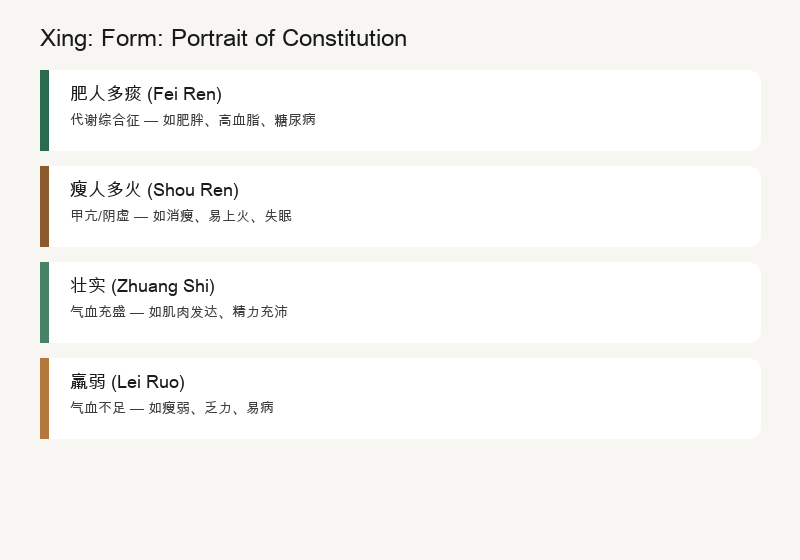
Xíng-tǐ (Body Form) — Your chassis and frame. Bones, muscles, skin, facial features—everything you can see. Someone with good body form stands straight, walks steady, and looks upright. Someone with poor body form is hunched, flabby, and has dull skin. The body form is like a computer case: how sturdy the case is determines whether the hardware can run properly.
Zàng-fǔ (Organs) — Your motherboard and CPU. The five Zàng (heart, liver, spleen, lungs, kidneys) and six Fǔ (stomach, gallbladder, small intestine, large intestine, bladder, Sanjiao)—the core components hidden inside your "case." Someone with healthy organs digests well, sleeps well, and has smooth metabolism. Someone with weak organs eats poorly, sleeps poorly, and feels "stuck" all over. The organs are like the motherboard and CPU: they're silent, but they determine whether everything can run normally.
Qì-Xuè (Qi and Blood) — Your body's electric current and signals. Blood is the material; Qi is the power. Qi and Blood circulate through the whole body like electric current transmitting signals across a circuit board. Someone with abundant Qi and Blood has a rosy complexion, warm hands and feet, and sharp reactions. Someone with deficient Qi and Blood is pale, has cold hands and feet, and is slow to react. Qi and Blood are like the computer's power supply and operating system—if the current is unstable, even the best hardware is useless.
These three layers, together, are what TCM calls "Xíng." It doesn't simply mean "how much muscle you have." It's the total sum of the body's material structure—from outside to inside, from hard to soft, from bones to blood and Qi, everything is included.
But here's the key: the ancients didn't only look at "Xíng." They valued "Xíng-Shén unity" even more.
What is "Shén"? Not a deity, but your consciousness, reactions, state, and gaze. If someone's eyes are vacant, TCM says "the Shén has scattered." If someone's eyes are bright and focused, TCM says "the Shén has gathered." The same body, with scattered Shén versus gathered Shén, is two completely different people.
So what the ancients pursued wasn't simply muscle mass, but Xíng-Shén unity—the body's hardware and the spirit's software, perfectly coordinated and running smoothly.
Part 3giaogiao's Modern Translation
Okay, let's translate Xíng and Shén into modern language.
I'm not going to explain anatomy, histology, or cell biology. Too complex. You just need to remember one analogy:
Body Form = chassis (hardware frame)
Organs = motherboard and CPU (core components)
Qi and Blood = electric current and signals (software operation)
Shén = operating system + applications (consciousness, reactions, state)
That's it. Your body is essentially a supercomputer.
Specifically:
What does Body Form correspond to? It corresponds to your skeletal-muscular system, skin barrier, and external structure. The muscles built in the gym, the flexibility from yoga, the posture from chiropractic care—these are all upgrades to "Body Form." It's like swapping your computer for a sturdier case with better cooling and durability.
What do Organs correspond to? They correspond to your internal organ function—cardiopulmonary function, liver and kidney function, digestive and absorptive capacity. The liver enzymes, creatinine, and pulmonary function tests in your medical report are the modern medical expression of "Organs." It's like the load tests on the motherboard and CPU—they're silent normally, but they determine the whole machine's performance.
What do Qi and Blood correspond to? They correspond to your blood circulation, oxygen transport, and energy metabolism. Hemoglobin levels, blood oxygen saturation, basal metabolic rate—these are the quantified indicators of "Qi and Blood." It's like the power supply wattage and current stability: if the current is unstable, even a high-end graphics card can't run.
What does Shén correspond to? It corresponds to your nervous system state, cognitive function, and emotional regulation. Focus, reaction speed, emotional stability, sleep quality—these are the modern version of "Shén." It's like the operating system—when Windows freezes, even the best hardware is useless; when macOS runs smoothly, even an older machine can fly.
So, "Xíng-Shén unity" isn't mysticism. It's a system optimization metaphor—describing the degree of coordination between the body's hardware and the spirit's software.
The ancients didn't have computers, but they used the two concepts of "Xíng" and "Shén" to precisely describe what modern people need "hardware performance" and "software optimization"—two dimensions—to explain.
Part 4Real-Life Examples
Three stories to instantly understand what Xíng and Shén are.
Example 1: The Retired Athlete's Confusion.
Lǎo Zhāng was a national second-tier athlete in his youth. He ran the 100 meters in 11 seconds, bench-pressed 100 kg, and had six-pack abs like they were carved from stone. Ten years after retirement, he still kept up his fitness routine, his muscle mass unchanged, his stomach flatter than his peers'. But when you talk to him, something feels off. His eyes are blank, his reactions are slow, and his voice is weak. "I've been sleeping poorly lately," he says. "I don't know why, I just feel tired."
Western medicine says: all indicators are normal, might be mild depression. TCM says: "The Xíng is present, but the Shén has scattered."
Truth: the muscles are still there (hardware intact), but the nervous system has been under long-term pressure without psychological regulation, so "software" efficiency is extremely low. It's like a top-of-the-line computer loaded with viruses and junk programs—takes five minutes to boot, and everything lags. No matter how good the hardware is, if the software crashes, the overall experience is terrible.
Example 2: The Haggard Face of Long-Term Depression.
Xiǎo Lǐ worked overtime for eight straight months. The project finally launched, but he was drained. Not thin—"collapsed." Sunken cheeks, dark circles, yellowish skin. His diet hadn't changed, his sleep hadn't decreased, but the person in the mirror looked ten years older. A colleague asked, "What's wrong with you lately? Are you sick?"
TCM says: "When the Shén is injured, the Xíng is damaged." Software bugs for too long, and the hardware starts breaking down.
Truth: long-term psychological pressure causes chronically elevated cortisol. Cortisol breaks down muscle, reduces collagen synthesis, and suppresses immune function. The "software" of emotion has a problem, and it directly affects the "hardware" of skin, muscle, and bones. This is the negative textbook example of Xíng-Shén unity—software bugs dragging the hardware down.
Example 3: The Yoga Instructor's "Wholeness."
Have you ever met a yoga instructor who isn't the thinnest, isn't the most flexible, and isn't even the most beautiful? But the moment she stands there, you feel she's "different." Her eyes are clear, her movements are calm, and she speaks unhurriedly. When she does a handstand, you feel her body and spirit are one—not "doing a pose," but "breathing."
TCM says: "Xíng and Shén both full, unity of heaven and human."
Truth: yoga isn't just training muscles. It simultaneously trains the nervous system (parasympathetic activation), emotional regulation (mindful awareness), and bodily structure (flexibility and strength). The hardware is upgrading, and the software is optimizing, in sync. That's why excellent yoga practitioners have an indescribable sense of "wholeness"—because their hardware and software are running in coordination.
Three examples, one underlying logic: the body isn't isolated hardware, the spirit isn't independent software. The two influence each other, and neither can be missing.
Part 5Modern Research
Is there scientific research on Xíng and Shén?
Yes, but scientists don't use the words "Xíng-Shén." They use:
• Psychosomatic Medicine. Research has found that long-term psychological stress leads to immune system dysfunction, gut microbiome imbalance, and increased chronic inflammation. This is the scientific version of "Shén injury damages Xíng"—when the software of emotion has a problem, the hardware really does break down.
• Neuroplasticity. Meditation and mindfulness practice can change brain structure—prefrontal cortex thickening, amygdala shrinking, hippocampus enlarging. This means: software optimization (meditation) can directly change hardware structure (the brain). What the ancients called "nourishing the Shén," modern neuroscience has proven really works.
• Epigenetics. Research has found that long-term meditators show changes in gene expression—inflammatory response genes are suppressed, cell repair genes are activated. In other words: mental state can, through chemical signals, change the "switches" in your body's cells. This is molecular-level evidence of Xíng-Shén unity.
• Sports Psychology. The increasingly defining criterion for top athletes is no longer physical fitness, but "mental resilience." Athletes at the same physical level perform more stably when their mental state is better. This is: same hardware, software determines the experience.
These studies aren't numerous, but the direction is consistent: "Xíng" and "Shén" are not two independent things, but two layers of one system, influencing each other, deeply coupled.
Part 6Practical Methods
Now that you understand Xíng and Shén, how do you train them?
First, let's dispel a few myths:
• Building muscle isn't a universal upgrade. The muscles built in the gym are hardware upgrades. But if you only train hardware without optimizing software, it's like putting a new graphics card in an old computer with insufficient memory and CPU—still lags.
• Meditation isn't "thinking about nothing." Many people think meditation is "spacing out." In fact, meditation is software cleanup—closing background programs, freeing memory, defragmenting. You don't need an hour. Ten minutes a day is enough.
• Sleep isn't just "resting the body." During deep sleep, the brain clears metabolic waste (glymphatic system active), while consolidating memory and resetting neurotransmitters. Sleep is the software's automatic nightly update, not a simple hardware shutdown.
Specific methods:
• Don't just train muscles, train "neuromuscular control." Tai Chi, yoga, Pilates—the essence of these exercises isn't building big muscles, but training the nervous system's fine control over muscles. When the hardware is pretty good, it's time to upgrade the software.
• Meditation or mindfulness practice. Ten minutes a day, doing nothing, just observing your breath. This is doing a "disk cleanup" for the brain—closing stray thoughts, releasing anxiety, resetting attention. When the software lags, the most effective solution is a reboot.
• Maintain curiosity (software updates). Learn new skills, read books in new fields, go places you've never been. The brain's "plasticity" needs new stimuli to activate. Curiosity is the best patch to prevent software aging.
• Reduce sitting time (prevent hardware rust). Sitting for long periods doesn't just hurt your back—it hurts your brain too. Reduced blood flow, decreased oxygen supply, even attention is affected. Every 45 minutes of sitting, stand up and walk for 5 minutes. Hardware needs to move, and software needs blood supply.
• No phone for one hour before bed. Blue light suppresses melatonin, affecting deep sleep. Deep sleep is the "automatic nightly repair" for body and brain. Not only is the hardware charging, but the software is updating too. Can't do it? Start with half an hour before bed.
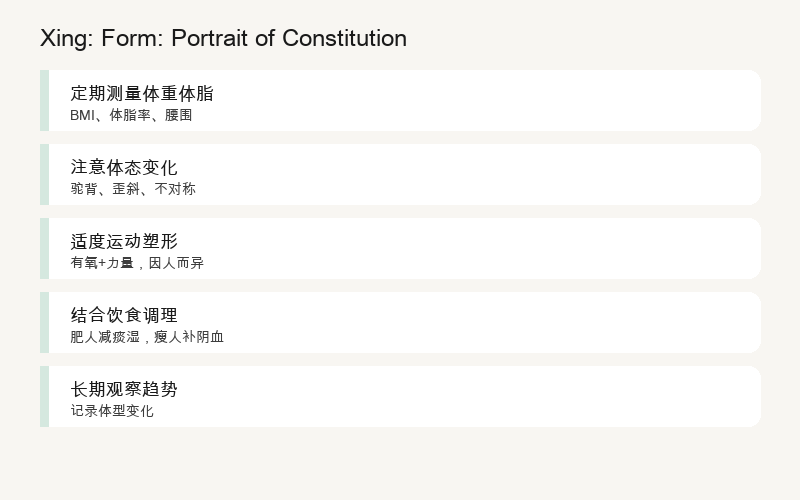
You don't need to believe in TCM to use these methods. You just need to understand: your body is a supercomputer. Hardware needs maintenance, and software needs upgrades too. Upgrade only one, and the other will hold you back.
Part 7One-Minute Summary
🕐 One Minute to Understand "Xíng"
Xíng = the body's hardware. Shén = the body's software.
Body Form = chassis (bones, muscles, skin).
Organs = motherboard and CPU (heart, liver, spleen, lungs, kidneys).
Qi and Blood = electric current and signals (blood circulation, energy metabolism).
Xíng-Shén unity = hardware and software perfectly coordinated.
Only training muscles without nourishing Shén is like installing a 4090 graphics card but pairing it with an i3 CPU—lag city.
Long-term anxiety without regulation is like a software virus dragging down the hardware—crash.
Methods: don't just train muscles (upgrade hardware), but also meditate and sleep (optimize software).
Maintain curiosity (software updates), reduce sitting time (prevent hardware rust).
The ancients called it "Xíng-Shén unity." Modern people call it "mind-body integration."
Different names, but the body knows: hardware is great, but without software, it's still useless.
Upgrading hardware without updating software, and the computer still lags.
Reinstalling software without maintaining hardware, and the system still crashes.
The Chinese people's most朴素 wisdom: don't be lopsided, work on both hardware and software.
This is probably the ultimate meaning of "Xíng-Shén unity": wholeness, not perfection.
Money is the art of living; art is the life after making money
giaogiao Explains Chinese Wisdom · Concept 08
Using the language of modern science to help the world understand Chinese wisdom.
No mysticism, no superstition, no condescension.
Understand, don't just believe.
Coach Liu
Written in Florence