Why Do Chinese Say "Harmony Is Most Precious"? Your Body Is Not Lacking Nutrients—Your Departments Are Fighting
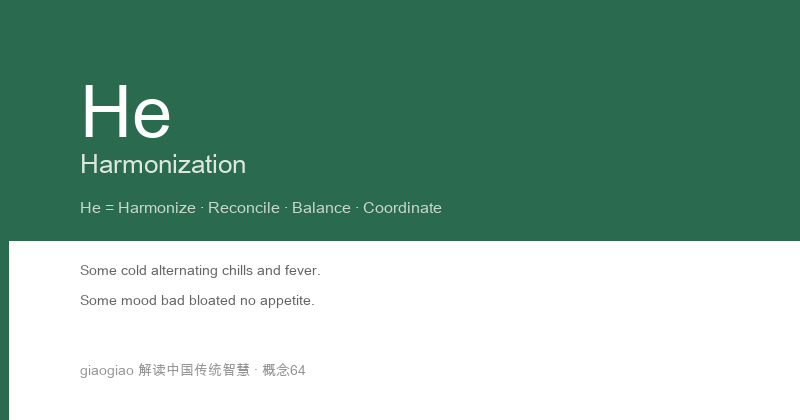
Part 1A Problem
Have you ever noticed that "conflicts" inside your body are everywhere?
Some people eat more carefully than nutrition influencers, yet their complexion is sallow and they have no energy. Ask them what they ate: bird's nest, cordyceps, donkey-hide gelatin—supplements galore. But look at their tongue: thick and white—what TCM calls "phlegm-dampness constitution." They over-supplemented, and their body couldn't process it, so it piled up as garbage. Supplements became burdens. This is not a lack of nutrients; it's "supplementing" and "transforming" fighting each other.
Some people are workaholics: in the office at 7 a.m., home at 11 p.m., still answering emails on weekends. On the surface, great performance, boss loves them. But privately? Bad stomach, bad sleep, explosive emotions. The doctor says: quit your job. They reply: "And stop paying the mortgage?" Work and life—can't you two just get along?
Then there's the couple with a perfectly nice home, but they fight every few days. The adults are fine after the fight, but the kid starts running a fever. At the hospital, the doctor says it's a viral infection. Back home, they ask: why does he get sick every time he goes to school? Dig deeper, and you find: "family stress affects immunity through neuroendocrine pathways"—is that science? No, that's called "when parents don't harmonize, the child suffers."
See, these three scenarios seem completely unrelated: one eats too well, one works too much, one fights at home. But they share the same underlying issue: the various departments of the body (or the external environment) are not on the same page.
TCM calls this "loss of harmony." Western medicine? It calls it "metabolic syndrome," "chronic stress response," "psychosomatic dysregulation"—each term is correct, but each sees only the trees, not the forest. TCM says: never mind what kind of tree it is; the problem is in the forest.
Part 2Traditional Chinese Explanation
The character "He" (和) in ancient China was not just an adjective. It is one of the most central concepts in TCM and Chinese culture as a whole.
— Yellow Emperor's Inner Canon
"When Yin is calm and Yang is secure, the spirit is well governed."
— Plain Questions: Treatise on the Generation of Qi and the Communication with Heaven
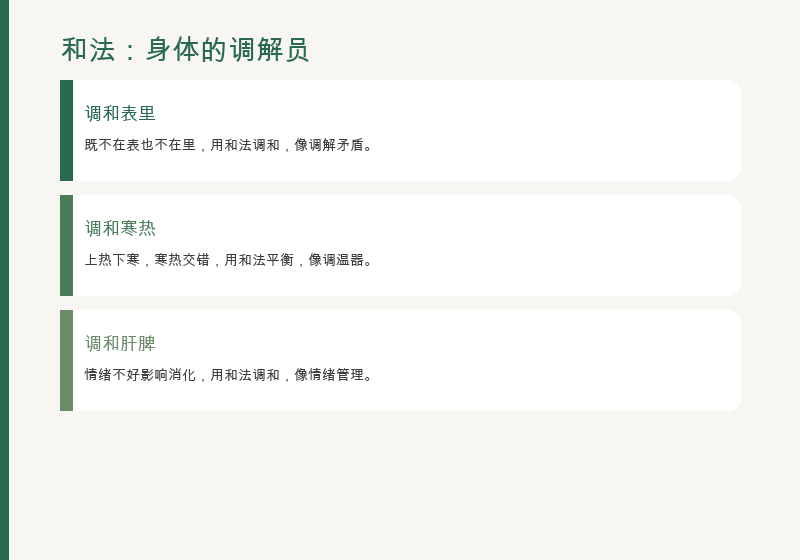
TCM's concept of "harmony" has three layers:
Yin-Yang Harmony — the conductor and the orchestra of your body. Yin is the material foundation; Yang is the functional driving force. Without Yin, Yang is a blank check. Without Yang, Yin is a stagnant pool. Yin-Yang harmony is like an orchestra with a great conductor: strings, woodwinds, brass, and percussion all in their places, cooperating seamlessly. When Yin and Yang lose harmony, the conductor throws down the baton, the violin goes off-key, the bass drum pounds randomly, and the whole concert hall explodes.
Organ Harmony — the cooperation of different instrument sections. The heart governs blood circulation, the liver governs free flow, the spleen governs transformation, the lungs govern respiration, and the kidneys govern essence storage. These five "departments" each have their roles, but they are constantly coordinating. After you eat, the spleen starts transforming, the liver sends nutrients out, the kidneys store the essence, the heart ensures blood reaches the whole body, and the lungs supply oxygen. If one department strikes or steals the show, the whole system goes haywire. Spleen and stomach out of harmony? You bloat after every meal. Liver and kidneys out of harmony? Dry eyes, hair loss. Heart and kidneys out of harmony? Drowsy by day, wired by night—these are all internal fights.
Qi-Blood Harmony — the rhythm and melody of the music. Qi is the driving force; blood is the carrier. Qi moves blood; blood carries Qi. When Qi moves slowly, blood stagnates; when blood is insufficient, Qi scatters. You feel down, Qi stagnates, blood stops with it, and your complexion turns dark. You overwork, Qi is depleted, blood follows into deficiency, and the whole person wilts. When Qi and blood are harmonious, it's like a symphony finding its rhythm—the melody flows, the audience feels comfortable, and the body operates smoothly. When Qi and blood are not harmonious, it's like someone in the band suddenly rushing half a beat—the melody collapses instantly.
So, "harmony" is not everyone being nice to each other. "Harmony" is a precise state—departments cooperate yet have boundaries, coordinate yet remain independent. It does not erase differences; it makes differences complementary.
Part 3giaogiao's Modern Translation
Okay, now let's translate "harmony" into modern language.
I won't talk about the neuroendocrine axis, the hypothalamic-pituitary-adrenal axis, or vagal tone. Too complicated. You only need to remember one metaphor:
Yin-Yang balance = The默契 between conductor and orchestra
Organ coordination = The cooperation of different instrument sections
Qi-blood flow = The rhythm and melody of the music
That's it. Your "harmony" is essentially the coordinated state among your body's systems. But this coordination is not decided by any single department; it is global, dynamic, and constantly adjusting.
Specifically:
What does Yin-Yang balance correspond to? It corresponds to "dynamic homeostasis" in the body. Take body temperature: when cold, you shiver to produce heat; when hot, you sweat to dissipate heat. When you're hungry, the stomach secretes acid; when full, insulin comes out to lower blood sugar. Behind this is a precise feedback mechanism—suppress when too high, supplement when too low, always staying in the "just right" zone. This "just right" is Yin-Yang balance. When Yin-Yang is out of balance? Blood sugar goes out of control, temperature regulation goes haywire, the immune system becomes overactive—these are all breaks in "harmony."
What does organ coordination correspond to? It corresponds to "functional coupling" between organs. You eat a meal, the stomach expands, sends a signal to the small intestine: "Prepare to receive!" Simultaneously signals the pancreas: "Secrete digestive enzymes!" Signals the gallbladder: "Release bile!" These signals proceed one after another, like a relay race. If one link is delayed or overdone, you get indigestion, acid reflux, bloating. This is not just a "stomach problem"—it's the "stomach, small intestine, pancreas, and gallbladder failing to negotiate."
What does Qi-blood flow correspond to? It corresponds to the communication efficiency of the "neuro-endocrine-immune" network. Qi is the electrical signal; blood is the delivery courier. Nerves command, hormones carry messages, immune cells patrol—all three need to synchronize for the body to produce a coordinated response. Say you get scared: adrenaline releases, heart rate speeds up, blood pressure rises, muscles prepare for fight-or-flight. In a state of "Qi-blood harmony," this response is precise and brief. If the communication network goes haywire, the response lasts too long, and you shift from "emergency mode" to "chronic inflammatory mode"—this is how many modern diseases originate.
So, "harmony" is not mysticism. It is a systemic metaphor—describing how the body's various systems communicate, coordinate, and cooperate to maintain overall health.
The ancients had no MRI, but they used the concept of "harmony" to precisely describe what modern people need three professional terms—"neuroendocrine axis," "metabolic coupling," and "immune regulation"—to explain.
Part 4Real-Life Cases
Three stories to make you instantly understand what "harmony" is.
Case 1: Parents fight, the child gets sick.
I know a couple, both with good jobs, but both strong personalities. One weekend, they fought for two hours over which kindergarten their child should attend. After the fight, nothing—they both went to work the next day. But on day three, the child started coughing and running a fever. At the hospital, they said it was a viral cold. Back home, the family said no other kids at the kindergarten were sick. Strange.
TCM says: "When parents are not harmonious, the child must be weak." Modern research calls it "immune suppression caused by family stress." The child didn't participate in the fight, but he could sense the parents' emotions. When parents fight, the household "energy field" goes chaotic. The child isn't equipped with an emotion sensor, but he is a child—the most sensitive, the first to react. This is called "external environment and body losing harmony"—when the outside is chaotic, the inside follows.
The truth: family conflict triggers stress hormones (cortisol) in the parents. When children are present, they also perceive the tense atmosphere. Long-term family tension raises children's cortisol levels and suppresses immunity. The child doesn't need to be hit by the fight; he just senses it from the sidelines, and his body launches a stress response.
Case 2: The workaholic's stomach ulcer.
A programmer, 996 schedule, three years. At thirty, hospitalized with a stomach ulcer. The doctor asks: "Irregular diet?" Answer: "Quite regular—I eat a jianbing guozi at 9 a.m. every morning and takeout at 11 p.m." The doctor rolls his eyes. That's not regular; that's "your stomach and small intestine are in different time zones"—the stomach is ready, the small intestine is asleep. The small intestine clocks in, the stomach is throwing a tantrum. Their "biological clocks" are not in "harmony."
TCM says: "Overthinking injures the spleen." You think too much, and the spleen and stomach stop working properly. You eat while working, and the brain and digestive system are competing for resources. Who gets the blood supply? The brain says: give it to me, I'm on a deadline. The stomach says: give it to me, I need to digest. In the end, neither gets what it needs—the food isn't digested well, and the work isn't done well either. TCM calls this "heart-spleen disharmony"—but the core issue is: the brain and the digestive system are fighting.
The truth: the brain and digestive system communicate through the vagus nerve. When you are stressed and highly focused, the sympathetic nervous system dominates, and the vagus nerve is suppressed. Blood flow to the digestive system decreases, gastrointestinal motility slows, and gastric acid secretion becomes abnormal—you ate food, but the body never switched to "digestion mode." Over time, stomach ulcers arrive. It's not the stomach's fault; it's the brain and the gastrointestinal tract failing to coordinate.
Case 3: Long-term irregular diet, metabolic syndrome.
Another friend, an entrepreneur, meals at irregular times. Sometimes skips breakfast, starves until 3 p.m. and eats a huge meal, then has a midnight snack. Blood sugar like a roller coaster, insulin following up and down. Three years later: high lipids, high blood sugar, big belly, but not overweight—classic metabolic syndrome.
TCM says: "Irregular diet injures the spleen and stomach." But you think it's just the "stomach" that's broken? No. Your stomach, small intestine, pancreas, liver, and fat cells are all fighting over the rhythm. When the stomach is empty, food arrives; when the pancreas just secreted insulin, new blood sugar crashes in; when the liver needs to process fat, insulin levels have already sent it in the wrong direction. This is called "rhythmic disharmony of the metabolic system"—every department is working hard, but together it's a mess.
The truth: human metabolic rhythm is controlled by "circadian clock genes." These genes are expressed in the liver, pancreas, intestines, and fat tissue. If you skip breakfast, the liver's "gluconeogenesis" overactivates; if you eat a midnight snack, the fat cells' "synthesis signal" is incorrectly triggered. Over time, rhythms are completely off, departments go their own way, and metabolic syndrome arrives. This is the modern version of "organ disharmony."
Three cases, one underlying logic: it's not that one department is broken; it's that the relationships between departments have gone haywire.

Part 5Modern Research
Does "harmony" have scientific research?
Yes, but scientists don't use the word "harmony." They use:
• Homeostasis. Harvard Medical School research found that healthy human indicators are not "normal" as a straight line, but fluctuate around a mean. Excessive fluctuation means "harmony" is broken. Take blood sugar: healthy fluctuation is like a wave, not a roller coaster.
• Neuro-Endocrine-Immune Axis (NEI axis). Nobel laureate Candace Pert discovered that neurotransmitters and immune cells share the same "messenger molecules." The brain and immune system communicate in the same "language." This means: emotions affect immunity, and immunity affects emotions. The "harmony" between them determines whether you are "healthy or sick."
• Gut-Brain Axis. Gut microbiota communicates directly with the brain through the vagus nerve. People with gut microbiota imbalance not only have poor digestion but are also prone to anxiety and depression. TCM's saying "when the spleen and stomach are harmonious, the heart is at peace" is not a metaphor—it's a scientific fact. The "harmony" between the gut and the brain determines your overall physical and mental state.
• Circadian Rhythm. The 2017 Nobel Prize in Physiology or Medicine was awarded for circadian rhythm research. Studies found that your liver, pancreas, heart, and brain each have their own "clock genes." If the expression rhythms of these genes are not aligned, your metabolism, immunity, and sleep will all go wrong. TCM's concept of "unity between heaven and human" is essentially "harmony between human rhythms and the environment."
These studies, combined, point to one conclusion: "harmony" is not an abstract concept, but a systemic state of coordinated operation among multiple body systems. You don't lack nutrients, you don't lack medicine—you lack coordination between departments.
Part 6Practical Methods
You understand "harmony"; now how do you adjust it?
First, dispel a few misconceptions:
• Supplements are not a cure-all. If your Qi and blood are not harmonious, don't rush to take supplements. Supplements are fuel for the "departments," but the premise is that your departments are not fighting. You make the car go faster, but the tires and steering wheel are not aligned—the car will just crash. So, first adjust "harmony," then supplement.
• Feeling good does not mean you're "in harmony." Some people can stay up all night, eat junk food, and work sixteen hours, feeling fine. That's not "harmony"—that's "overdraft." You feel good because your body is "compensating"—one department is running overload, another is holding on. This state can't last long; once it collapses, it's total.
• More exercise is not always better. Exercise is a great way to "coordinate" the body, but excessive exercise is the fastest way to "destroy harmony." You run until your muscles break down and your immune system drops—that's not fitness, it's demolition. People with Qi deficiency should just take a walk; people with Yin-Yang imbalance shouldn't practice tai chi with the intensity of baduanjin.
Specific methods:
• Regular schedule. Unify the rhythm of all body departments. Wake up at the same time every morning, eat at the same time every day, sleep at the same time every night. Once the rhythm is unified, all departments know "when to work and when to rest," and they stop fighting. This is called "temporal harmony."
• Emotion management. Reduce "internal conflict." Emotions are the body's "internal wars"—when angry, the liver fights; when anxious, the spleen stops working; when depressed, the heart contracts. Every emotional outburst is an internal war. Meditation, deep breathing, journaling, chatting with friends—these are not "wellness," they are "ceasefires."
• Moderate diet. Don't put pressure on any single department. Eat to 70% full; don't let your stomach, small intestine, and pancreas work overtime every meal. Every time you eat until you burst, it's like letting the warehouse overflow daily—the logistics system will collapse sooner or later. Not overeating is not depriving yourself; it's giving your body a break.
• Harmonious relationships. Stabilize the external environment. Your nervous system is constantly scanning the environment—safe or dangerous? "When the family is harmonious, all affairs prosper" is not just about family; it's about the body's perception of the environment. When your interpersonal relationships are harmonious, your parasympathetic nervous system (responsible for relaxation and repair) can function normally. This external "harmony" directly affects your internal "harmony."
• Regular "self-checks," not just lab tests. Ask yourself: sleeping well lately? Eating well? Going to the bathroom regularly? In a good mood? These are the "self-check list" for "harmony." If two or more are off, you don't lack nutrients—you have internal disharmony. Fix the relationships first, then supplement.
These methods don't require you to believe in TCM. You only need to understand: your body is a symphony orchestra, each department is a musician, but the overall sound needs coordination. When one department rushes the beat and another lags behind, the music is ruined.

Part 7One-Minute Summary
🕐 Understand "Harmony" in One Minute
Harmony = The Symphony Orchestra of your body's departments.
Yin-Yang balance = The默契 between conductor and orchestra (dynamic homeostasis).
Organ coordination = The cooperation of different instrument sections (functional coupling between organs).
Qi-blood flow = The rhythm and melody of the music (neuro-endocrine-immune communication).
Signs of disharmony: eating well but digesting poorly, over-supplementing but getting inflamed, working hard but body collapsing, fighting at home but child getting sick.
Causes: irregular diet, disrupted schedule, emotional drain, interpersonal conflict, chaotic rhythm.
Methods: unify schedule (temporal harmony), manage emotions (reduce internal conflict), moderate diet (don't pressure departments), harmonious relationships (stable external environment).
The ancients called it "harmony"; modern people call it "systemic coordination."
Different names, but the body knows: when departments don't fight, the music sounds beautiful.
When someone rushes the beat and someone lags behind, the music is ruined.
You think you lack nutrients, but actually your stomach and spleen are arguing.
You think you lack exercise, but actually your brain and gut haven't reached an agreement.
You think you lack rest, but actually life and body are playing a game of chess.
True health is not about one department being the strongest, but all departments being in tune.
Making money is the art of living; art is the life after making money
giaogiao Explains Chinese Traditional Wisdom · Concept 09
Using the language of modern science to help the world understand Chinese traditional wisdom.
Not mystical, not superstitious, not dismissive.
Understand, rather than merely believe.
Coach Liu
Written in Florence