Why Do the Chinese Say "Dao Follows Nature"? Your Body Is Not a Machine — It Has Its Own Internal Rhythm
Part 1A Question
Have you ever noticed that there are always a few people around you like this:
They wear T-shirts in winter, drink ice-cold beer, eat whatever they want, and nothing happens. Meanwhile, you're wrapped in scarves, gloves, and hand warmers, and one careless moment gives you a cold that lasts two weeks.
Or: your colleague posts on social media at 2 a.m. every night, then shows up at the 8 a.m. meeting bright-eyed and bushy-tailed. You pull one all-nighter, and the next day you feel like a truck ran over you. Your brain is porridge during meetings.
You ask the doctor: why? The doctor says: different constitution. What constitution? Doesn't know. Just different.
You ask a Traditional Chinese Medicine (TCM) practitioner: why? They say: his "Dao" and your "Dao" are different.
"Dao"? Here we go again. This concept is even more mysterious than "Qi." "Dao follows nature," "The great Dao is simple," "Those who follow the Dao receive much help" — "Dao" is a universal word in Chinese culture. Philosophy has it, politics has it, medicine has it. But when it comes to the body, what exactly is "Dao"?
Today, we're translating this most mystical TCM concept into language you can actually understand.
Part 2The Traditional Chinese Explanation
The character "Dao" (道) in oracle bone script shows a person standing at a crossroads — it means "path." Later it expanded to mean "law," "method," and "origin." In TCM, "Dao" took on a very specific meaning: natural rhythm.
—— Dao De Jing (Tao Te Ching)
"Spring generates, Summer grows, Autumn harvests, Winter stores — this is the great law of Heavenly Dao."
—— Yellow Emperor's Inner Canon
The ancients discovered: the human body is not a machine. It doesn't run on fixed programs. It has its own "timetable" — when to wake, when to sleep, when to be active, when to rest. This timetable isn't set by humans; it's set by "Heaven." Hence, "Heavenly Dao."
TCM summarized this rhythm into several key metaphors:
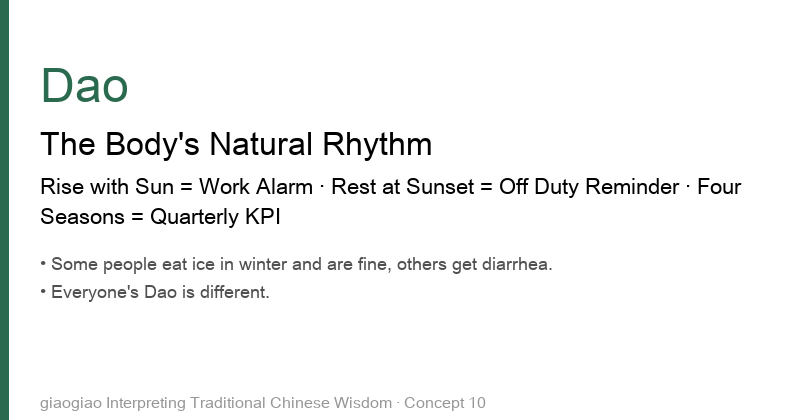
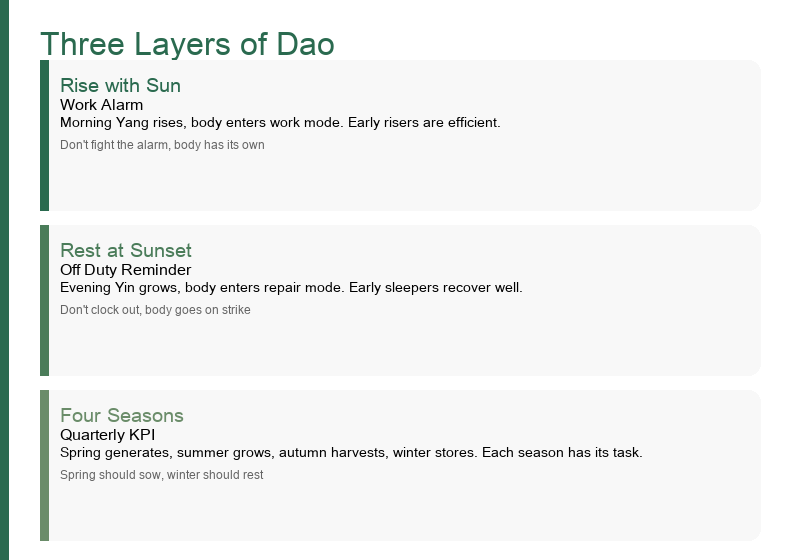
Rise at sunrise = the body's morning alarm clock. When the sun comes out, Yang energy rises, and the body switches from sleep mode to work mode. This is when you should get up, move, and get things done. Forcing yourself to sleep until noon is like hitting snooze on your body's alarm — for six hours straight.
Rest at sunset = the body's end-of-day reminder. When the sun sets, Yang energy withdraws inward, and the body switches from work mode to repair mode. This is when you should rest, sleep, and let your internal organs work overtime on repairs. You insist on scrolling your phone until 2 a.m.? That's like your body has clocked out, and you drag it back for a meeting.
Spring generates, Summer grows, Autumn harvests, Winter stores = the body's quarterly KPIs. In spring, the body should "generate" — metabolism speeds up, perfect for exercise, starting new projects, and sprouting. In summer, the body should "grow" — energy peaks, ideal for output, performance, and sprinting. In autumn, the body should "harvest" — energy begins to consolidate, time for reflection, summarizing, and stockpiling. In winter, the body should "store" — metabolism slows, time for rest, energy storage, and not pushing too hard. If you insist on dieting, night jogging, or launching new projects in winter — you're assigning the body impossible quarterly KPIs.
So the core meaning of "Dao" in TCM is: the body has its natural operating rhythm. Follow it, and you stay healthy. Violate it, and you get sick.
The ancients didn't have the word "biological clock," but they used "Dao" to precisely describe what modern people need "circadian rhythm," "seasonal hormone changes," and "metabolic cycles" to explain.
Part 3ggiao's Modern Translation
Okay, now let's translate "Dao" into modern language.
I'm not going to talk about the suprachiasmatic nucleus, melatonin secretion curves, or cortisol circadian fluctuations. Too complex. Just remember one metaphor:
Rise at sunrise = the biological clock's morning alarm (cortisol peak in the morning)
Rest at sunset = the biological clock's end-of-day reminder (melatonin secretion at night)
Spring generates, Summer grows, Autumn harvests, Winter stores = the biological clock's quarterly KPIs (seasonal thyroid hormone–melatonin fluctuations)
That's it. Your "Dao" is essentially your body's built-in time management system. This system isn't controlled by your conscious mind; it's written into your genes by evolution.
Specifically:
What does "rise at sunrise" correspond to? It corresponds to cortisol's "wake-up peak." Between 6 and 8 a.m., cortisol levels naturally rise, making you alert, motivated, and raising your blood sugar. This is the body's "morning alarm." If you get up then, you're going with the flow. If you force yourself to sleep until 10, you miss this peak — it's like ignoring the alarm and then complaining you "have no energy."
What does "rest at sunset" correspond to? It corresponds to melatonin's "sleep signal." Between 9 and 11 p.m., as light dims, retinal signals reach the hypothalamus, and melatonin begins to secrete. This is the body's "end-of-day reminder." If you prepare for sleep then, you're going with the flow. If you insist on scrolling your phone, blue light suppresses melatonin — it's like the body says "I'm off work" and you reply "let's have one more meeting."
What do the four seasons correspond to? They correspond to the seasonal tug-of-war between thyroid hormone and melatonin. In spring and summer, longer daylight hours boost thyroid hormone secretion, metabolism speeds up, ideal for activity and consumption. In autumn and winter, shorter daylight hours increase melatonin secretion, metabolism slows, ideal for energy storage and rest. If you insist on summer-level exercise in winter, you're assigning the body unreasonable quarterly KPIs.
So "Dao" is not mysticism. It's a functional metaphor — describing the body's built-in time management system and its synchronization with the external environment.
The ancients had no gene sequencing, but they used the concept of "Dao" to precisely describe what modern people need three concepts — "circadian rhythm," "photoperiodism," and "seasonal metabolic regulation" — to explain.
Part 4Real-Life Examples
Three stories to instantly understand what "Dao" is.
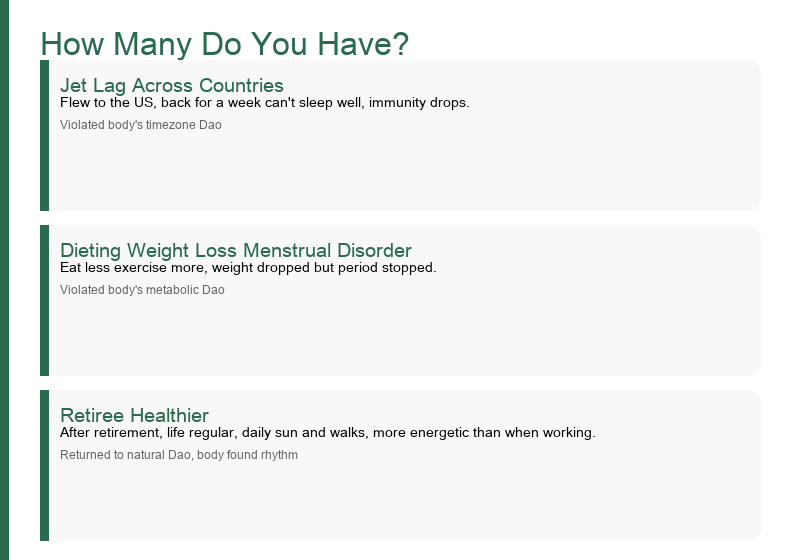
Example 1: Jet lag after flying from Beijing to New York.
You fly from Beijing to New York. Twelve hours later, it's 8 p.m. local time, but your body thinks it's 8 a.m. You're tired, because your body says "time to wake up." You force yourself to sleep, but can't. You finally fall asleep, then wake up at 6 a.m. New York time — but your body thinks it's 6 p.m. You're groggy, have no appetite, your immunity drops, and one draft of cold air gives you a cold.
Western medicine says: this is circadian rhythm disruption, needing 3–7 days to resynchronize. TCM says: you've violated your body's "timezone Dao" — your body is running on Beijing time, but you're forcing it to clock in on New York time.
The truth: your biological clock is regulated by light, temperature, and dietary signals. Crossing time zones scrambles all signals. Your body needs time to recalibrate. That recalibration process is the process of "finding the Dao."
Example 2: Crash dieting leads to missing periods.
You read some celebrity's method: eat only one meal a day, lose 10 pounds in a month. Your weight does drop, but your period stops. You panic, go to the doctor, who says: your weight dropped too fast; your hypothalamus thinks you're in a famine and shut off the reproductive system's power supply.
TCM says: you've violated your body's "metabolic Dao." The body has its energy budget. You suddenly cut two-thirds of the budget, and the body says: "Fine, reproduction is non-essential spending — let's pause that." Missing periods is the body protecting itself.
The truth: the hypothalamic-pituitary-ovarian axis is extremely sensitive to energy status. A sudden drop in caloric intake lowers leptin levels; the hypothalamus receives a "famine signal" and pauses gonadotropin-releasing hormone. This is the body's "Dao" playing its protective role.
Example 3: After retirement, regular life leads to better health.
Old Zhang used to work until 9 p.m. every day, with weekend social obligations on top. He had high blood pressure, high blood sugar, high cholesterol — all maintained by medication. After retirement, he gets up at 7 a.m. for a walk, takes a noon nap, and goes to bed at 10 p.m., with three regular meals. Six months later, his blood pressure dropped, blood sugar stabilized, and his medication dosage was reduced.
Western medicine says: this is the effect of lifestyle intervention. TCM says: Old Zhang has returned to the "Dao" — no longer fighting his body, no longer going against heaven, but following the natural rhythm, so the body fixed its own problems.
The truth: after retirement, Old Zhang's sleep-wake rhythm, dietary rhythm, and activity rhythm all returned to a natural state. His circadian rhythm synchronized, insulin sensitivity recovered, and blood pressure fluctuations decreased. The body didn't need medication because the "Dao" was flowing smoothly.
Three examples, one underlying logic: the body has its own timetable. Fight it, and problems arise.
Part 5Modern Research
Is there scientific research on "Dao"?
Yes, and quite a lot. Scientists don't use the word "Dao"; they use:
• Circadian Rhythm. The 2017 Nobel Prize in Physiology or Medicine was awarded to scientists who discovered the molecular mechanisms of circadian rhythm. They found that nearly every cell in the human body has its own "clock genes" (CLOCK, BMAL1, PER, CRY). These genes cycle throughout the day, regulating metabolism, immunity, endocrine function — virtually all physiological processes. This is the cellular-level expression of "Dao."
• Chrononutrition. Research shows that the same food eaten at different times produces completely different metabolic effects. Eating carbs in the morning produces 30% lower blood glucose response than at night. Eating high-fat food in the evening results in 50% lower fat oxidation than in the morning. This is the scientific explanation of "rise at sunrise" at the metabolic level — the body has its "eating timetable."
• Seasonal Affective Disorder (SAD). In autumn and winter, reduced sunlight increases melatonin secretion and decreases serotonin levels; about 5% of people develop depressive symptoms. This corresponds to TCM's concept of "winter storage" — in winter, energy withdraws inward, and mood withdraws too. Forcing yourself to maintain summer-level activity in winter is fighting your body.
• Shift Work and Health Risks. The World Health Organization has classified "shift work" as a Class 2A carcinogen. People who regularly violate their circadian rhythm have significantly higher rates of breast cancer, prostate cancer, metabolic syndrome, and cardiovascular disease. This is the price of violating the "timezone Dao."
All these studies are saying the same thing: the body has a built-in time management system. This system is not determined by willpower, but shaped by genes and environment. Follow it, and you stay healthy. Violate it, and you get sick.
Part 6Practical Methods
You understand "Dao" — now how do you practice it?
First, dispel a few misconceptions:
• Not everyone is suited to early rising. Human chronotypes divide into "larks" (early risers) and "owls" (night owls) — this is genetically determined. Forcing an owl to get up at 5 a.m. is like forcing a lark to stay up late. Finding your own rhythm is more important than forcing yourself into a "standard timetable."
• Not every season demands the same intensity. Winter metabolism slows — this is the body's natural law. If you insist on matching summer's exercise volume in winter, it's like growing watermelons in winter — not impossible, just not worth the effort. Sleep more, move less, and store energy in winter; move more, consume more, and output more in summer. This is the "Dao."
• More discipline isn't always better. Many people interpret discipline as "wake up at 5 a.m. every day, exercise every day, eat the same thing every day." But if this "discipline" violates your body's rhythm, it's self-torture. True discipline means reading your body's signals and then cooperating with it.
Specific methods:
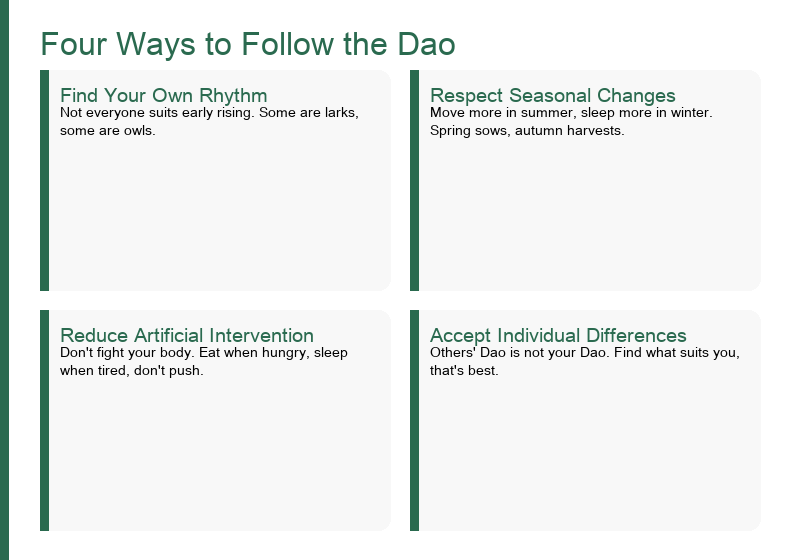
• Find your rhythm. For one week, don't set an alarm. Record when you naturally fall asleep and wake up. This is your "Dao." If you naturally wake at 7 a.m., don't force yourself up at 5. If you naturally sleep at 11 p.m., don't force yourself to bed at 9.
• Respect seasonal changes. Summer: exercise more, sweat more, socialize more, launch new projects. Winter: rest more, sleep more, store energy more, complete existing projects. Spring: start new habits. Autumn: summarize, wrap up, prepare for winter. This is the modern version of "spring generates, summer grows, autumn harvests, winter stores."
• Reduce artificial intervention. Don't fight your body. Sleepy? Sleep. Hungry? Eat. Tired? Rest. Sounds simple, but how many people drink coffee when sleepy, skip meals when hungry, and push through when tired? These "interventions" seem effective short-term, but long-term they're overdrawing your account.
• Accept individual differences. Some people eat ice cream in winter and feel fine; others get diarrhea. It's not about right or wrong — it's different "Dao." Find the diet, exercise, and rest patterns that suit you, rather than copying someone else's. Your body has its own "Dao."
• Light management. After getting up in the morning, get natural light exposure as soon as possible (even on cloudy days) — let retinal signals tell your brain "time to clock in." One hour before bed, reduce blue light exposure (turn on night mode, wear blue-light glasses) — let your brain receive the "time to clock out" signal. This is the cheapest and most effective "Dao-tuning" method.
You don't need to believe in TCM to use these methods. You only need to understand: your body is not a machine; it has its own time management system. Going with that system is the "Dao."
Part 7One-Minute Summary
🕐 Understand "Dao" in One Minute
Dao = Your body's natural rhythm.
Rise at sunrise = the biological clock's morning alarm (cortisol peak in the morning — time to wake up).
Rest at sunset = the biological clock's end-of-day reminder (melatonin secretion at night — time to sleep).
Spring generates, summer grows, autumn harvests, winter stores = the biological clock's quarterly KPIs (consume more in summer, store energy in winter).
Signs of violating the "Dao": getting sick after jet lag, missing periods after crash dieting, crashing after staying up late — your body fighting its own timetable.
Causes: disrupted light exposure, irregular eating, seasonal mismatch, forced schedule changes, ignoring individual differences.
Methods: find your rhythm, respect seasonal changes, reduce artificial intervention, accept individual differences, manage light exposure.
The ancients called it "Dao"; modern people call it "biological clock," "circadian rhythm," "chronobiology."
Different names, but the body knows: go with the flow, save energy; go against it, wear out your life.
Fighting this rhythm is like rowing upstream — exhausting and you don't get far.
You don't need to conquer your body; you need to understand it.
It says sleepy, you sleep; it says hungry, you eat; it says tired, you rest.
This is "Dao follows nature."
Making money is the art of living; art is the life after making money
ggiao Explains Chinese Traditional Wisdom · Concept 10
Using modern scientific language to help the world understand Chinese traditional wisdom.
No mysticism, no superstition, no dismissal.
Understanding, not merely believing.
Coach Liu
Written in Florence