Why Do Chinese People Say "Fluid Deficiency"? Your Body Isn't Thirsty—Lubricant and Coolant Are Insufficient
Part 1A Question
Have you ever had this experience?
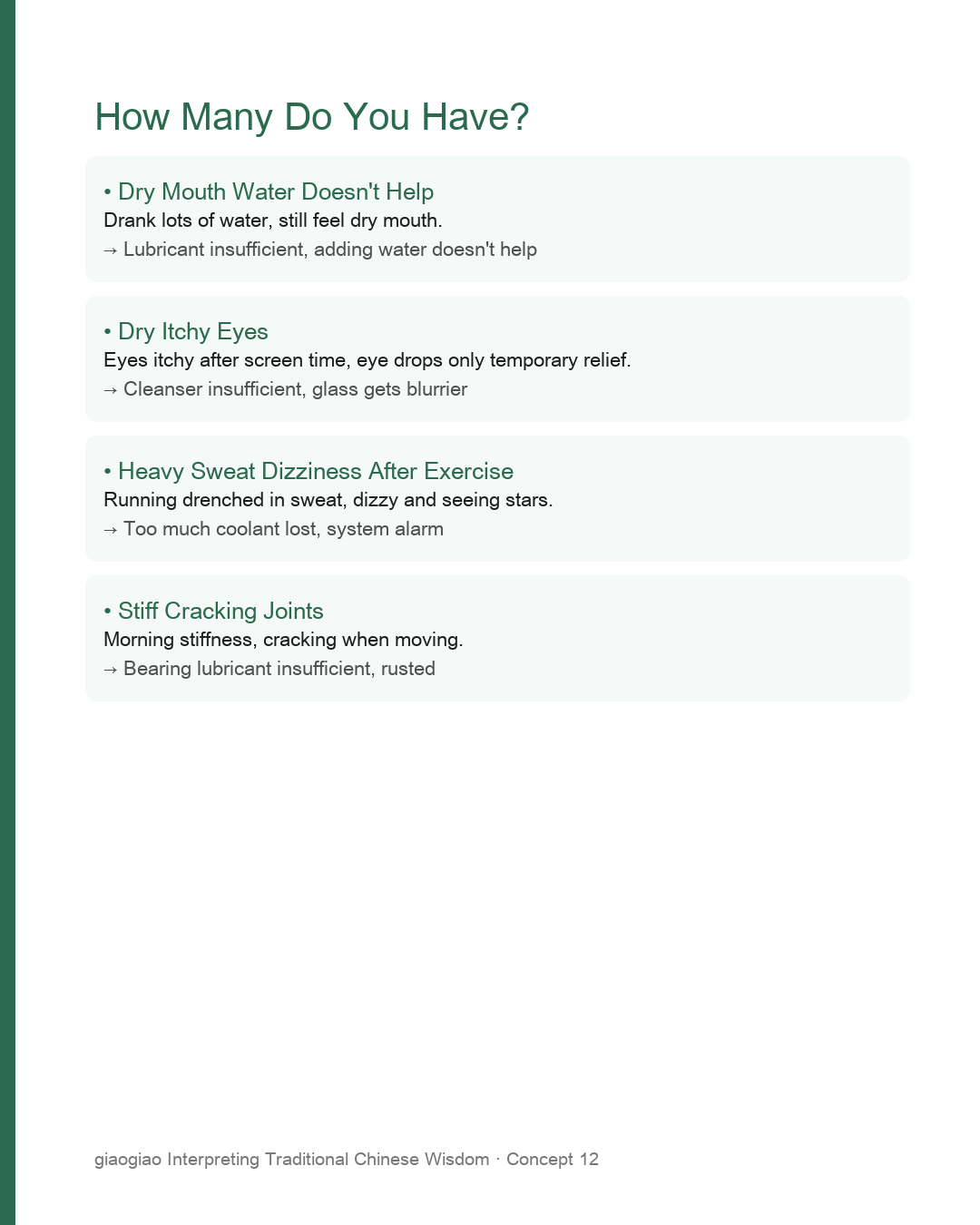
You wake up in the morning, your mouth as dry as if you'd been chewing cotton all night. You get up and gulp down a glass of cool boiled water, your throat is moistened, and half an hour later it's dry again. It's not thirst—it's "not getting moistened."
Sitting in an air-conditioned room facing the computer, your eyes get increasingly dry. You put in eye drops, they feel better for five minutes, then dry again. It's not sleepiness—it's "your eyes are out of oil."
After playing basketball in summer, you break out in a sweat, feel dizzy and see spots. You drink a bottle of iced cola, but still don't feel refreshed. It's not heat—it's "coolant loss is excessive."
Older people, when they get up in the morning, their knees crack. Squatting down and standing up, the joints are like rusty hinges. It's not old age—it's "not enough lubricant."
You go to the hospital, check blood sugar, thyroid function, kidney function. The doctor says: "All indicators are normal, drink more water, rest more."
You go to a TCM doctor. The old physician glances at your tongue and says: "Fluid deficiency."
You've drunk so much water your belly is bloated, and you're still fluid deficient? What exactly is this fluid, and how is it different from water?
Even more bizarre, when Chinese people compliment someone, they say "this person has ample fluids, good complexion"; describing a place as livable, they say "this place has abundant fluids, outstanding people and spiritual land." The same word, sometimes talking about the body, sometimes about feng shui. What on earth is this thing?
Part 2Traditional Chinese Explanation
"Jin" and "Ye" are actually two different things in Chinese medicine, but for ordinary people, just remember one metaphor: they are both "water" in the body, but not the water you drink—they are water the body has processed itself, useful water.
——Huangdi Neijing (The Yellow Emperor's Inner Canon)
"When fluids are preserved, life is preserved; when fluids are lost, life is lost."
——Yizong Jinjian (Golden Mirror of Medical Tradition)
Chinese medicine divides fluids into several categories, but in daily life, you only need to remember four "liquids":
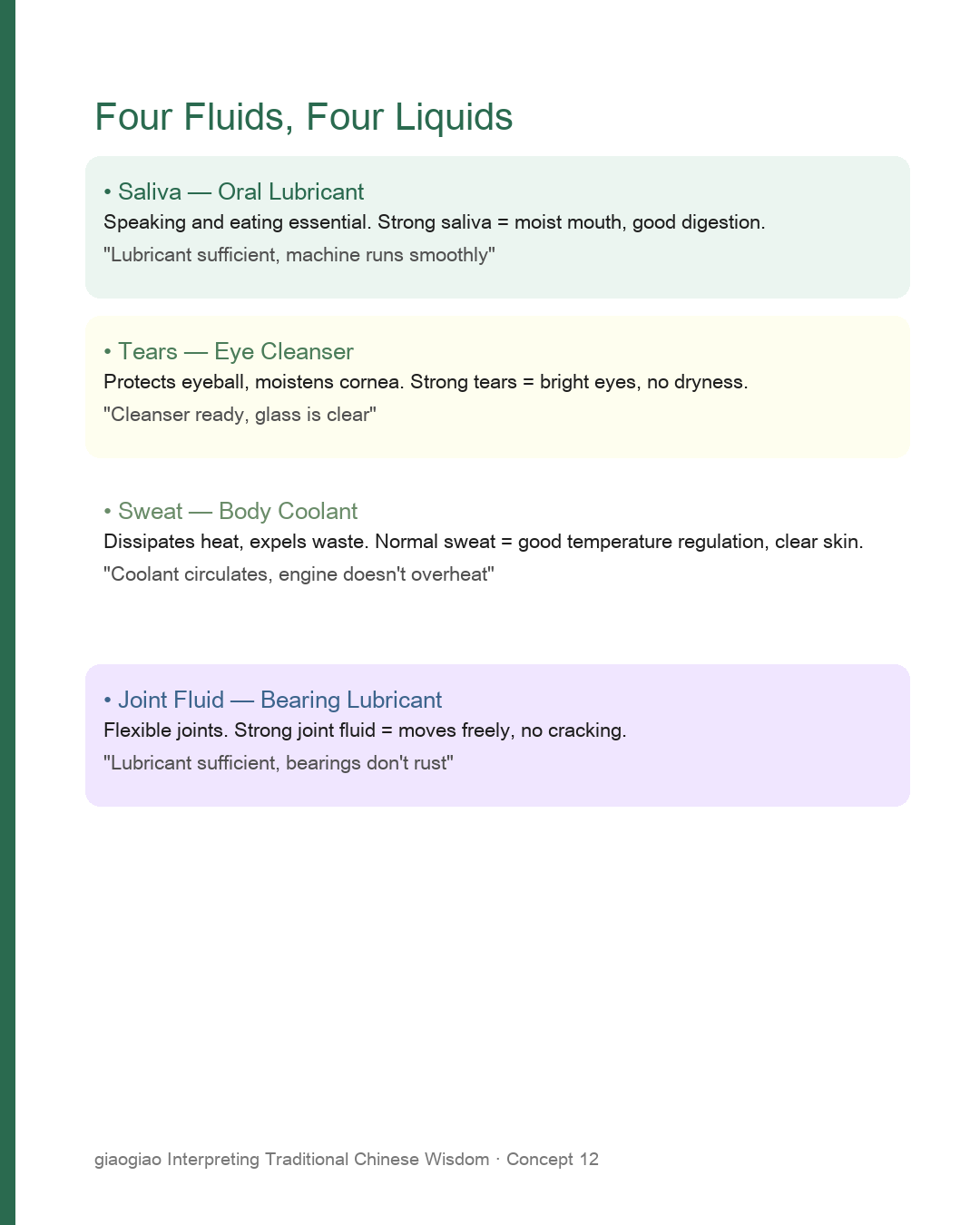
Saliva — Oral lubricant. Talking, eating, swallowing—all depend on it. People with ample saliva have moist lips, speak fluently, and eat with pleasure. People with insufficient saliva have dry mouth, bad breath, speech that gets stuck, and have to eat dry rice with soup or they can't swallow it down. Saliva is like the lubricant in your mouth; without it, the mouth machine can't turn.
Tears — Eye cleaning fluid. Protects the eyeball, lubricates the cornea, flushes away dust. People with ample tears have bright, spirited eyes and don't tear up even in strong wind. People with insufficient tears have dry, itchy eyes with red veins, can't keep their eyes open after half an hour of screen time, and tears stream when the wind blows. Tears are like the windshield washer fluid for your eyes; without it, the view is blurred, and it's easy to get scratched.
Sweat — Body coolant. Dissipates heat, expels waste, regulates body temperature. People with normal sweat perspire during exercise, their body feels transparent, and they tolerate summer heat. People with sweat disorders either sweat without moving (spontaneous sweating), or don't sweat when hot (anhidrosis), or feel dizzy and weak after sweating (collapse). Sweat is like a car's coolant—when circulation is normal, the engine doesn't overheat; when circulation fails, it either boils over or freezes up.
Joint Fluid — Bearing lubricant. Keeps joints flexible, cushions pressure, reduces friction. People with ample joint fluid squat and rise freely, walk with wind in their steps. People with insufficient joint fluid have knees that crack, pain going up and down stairs, can't squat down, can't stand up. Joint fluid is like the lubricant in a machine's bearings—when there's enough oil, it turns silky smooth; when there's little oil, it grinds dry, and sooner or later it'll be scrapped.
These four liquids together constitute what Chinese medicine calls "fluids." It's not a specific substance, but the sum of all lubrication and cooling systems in the body—secretion, circulation, regulation, and protection are all inside.
The ancients were very clever. They discovered that the body has a kind of "self-processed water" that maintains operation. When it's abundant, your eyes are bright, mouth is moist, skin is smooth, and joints are flexible; when it's insufficient, the whole body is dry, stuck, and rusted. They didn't know how to name it, so they used the most simple word: "Jin Ye" — Jin, a ferry crossing, extended to mean circulating liquid; Ye, something that can flow and has a moistening effect.
Part 3giaogiao Modern Translation
Okay, let's translate "fluids" into modern language.
I'm not going to talk about extracellular fluid, tissue fluid, mucous membrane secretion, or synovial fluid. Too complicated. Just remember one metaphor:
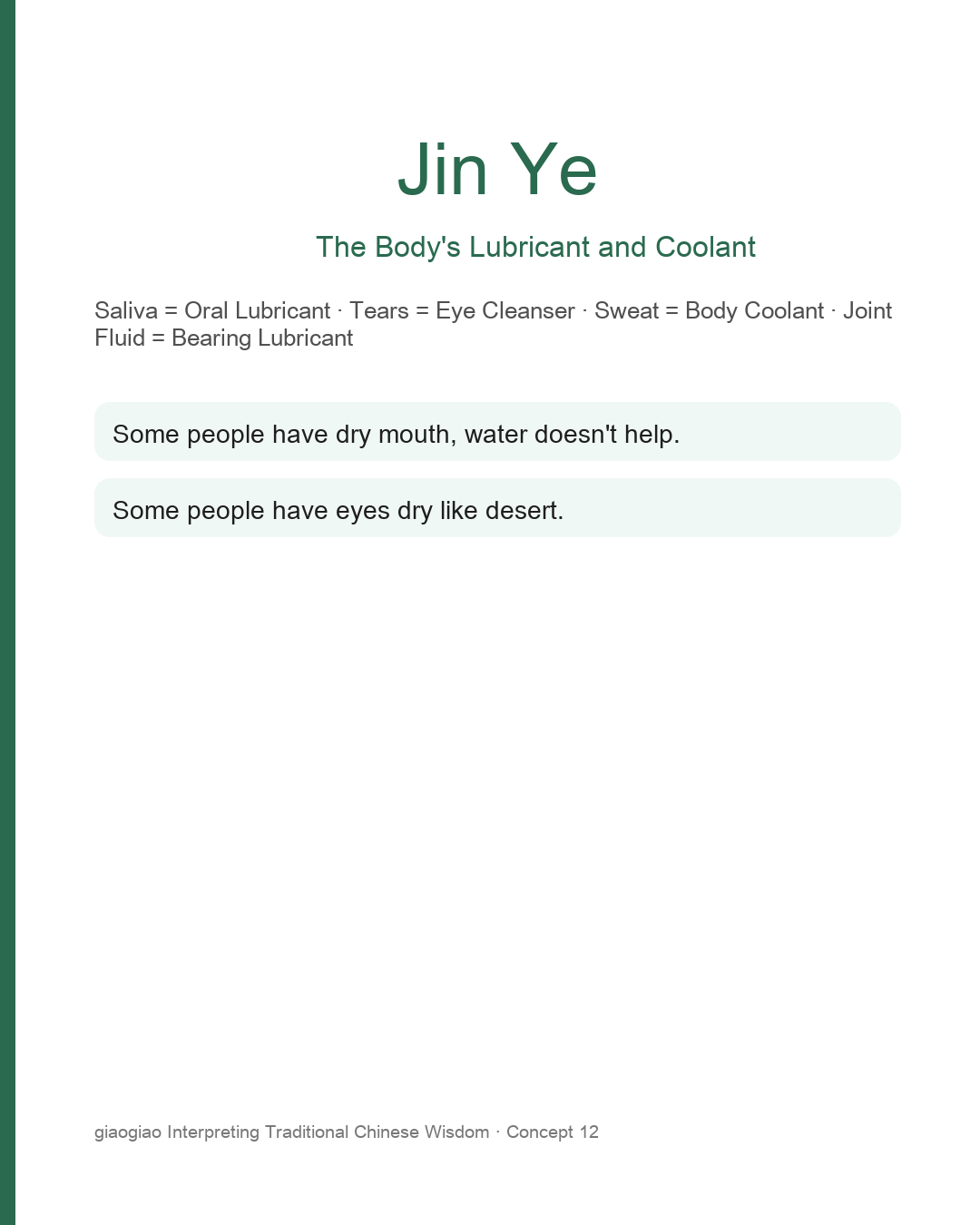
Saliva = Oral Lubricant (essential for talking and eating)
Tears = Eye Cleaning Fluid (protects the eyeball)
Sweat = Body Coolant (dissipates heat and expels waste)
Joint Fluid = Bearing Lubricant (keeps joints flexible)
That's it. Your "fluids" are essentially functional liquids that the body produces and distributes itself. But they are not tap water—you can't just pour them in and be done.
Specifically:
What does saliva correspond to? It corresponds to the "active secretion capacity" of your oral mucosa. Drooling at the sight of delicious food isn't greed—it's the body secreting lubricant in advance, preparing for digestion. If salivary gland function declines, no matter how much water you drink, your mouth is still dry, because water is not saliva—saliva contains digestive enzymes, antimicrobial proteins, and mucins, making it a "premium liquid" processed by the body.
What do tears correspond to? They correspond to the "steady-state secretion capacity" of your lacrimal glands. Tears aren't just there when you cry; they are secreted every minute, just in small amounts you can't see. Staring at a screen without blinking causes tears to evaporate too quickly, and the lacrimal glands get worn out. Eye drops can only provide temporary relief, because they are external, not the body's own formula.
What does sweat correspond to? It corresponds to the body's "temperature regulation system." Sweating isn't just draining water; it expels metabolic waste (urea, salts, lactic acid) while carrying away heat. After heavy exercise, what is lost isn't just water, but also electrolytes and energy. Drinking only water without replenishing electrolytes makes the body weaker the more it drinks.
What does joint fluid correspond to? It corresponds to the "lubrication and cushioning capacity" of your joint synovium. Joint fluid isn't stagnant water; it circulates and renews during joint movement, providing nutrition to cartilage. Sitting still for long periods, joint fluid doesn't circulate, like lubricant that has settled—the joint naturally rusts. Conversely, excessive exercise squeezes out joint fluid, and cartilage rubs directly against bone, also prone to wear.
So, "fluid deficiency" is not "not drinking enough water." It means: the body's ability to produce, distribute, and circulate these functional liquids has declined.
The ancients didn't have microscopes, but with the concept of "fluids," they precisely described what modern people need four concepts to explain: "mucosal secretion function," "tear film stability," "thermoregulation efficiency," and "joint synovial fluid circulation."
Part 4Life Cases
Four anecdotes to instantly help you understand what "fluids" are.
Case One: Dry mouth, drinking water doesn't quench thirst.
You stay up until two in the morning, the next day you wake up, your mouth is as dry as a desert. You gulp down two large glasses of warm water, your throat is moistened, and half an hour later it's dry again. You think it's "internal heat," so you brew chrysanthemum tea, drink mung bean soup, but it's still dry.
Chinese medicine says: "Fluid deficiency." You don't understand: I clearly drank a bellyful of water, how can I still be deficient?
Truth: Staying up late damages yin, and the body's "liquid processing factory" has shut down. Water poured in isn't processed into saliva, mucous fluid, or tissue fluid—it directly becomes urine and is expelled. You drink water, but the body needs "processed liquid." Raw materials are piled in the warehouse, but the production line isn't turning—products are still lacking.
Case Two: Dry, itchy eyes, eye drops make them drier.
You stare at a screen in an air-conditioned room for ten hours every day, your eyes are dry like the Sahara. You put in eye drops from Japan, cool and stimulating, feel good for five minutes, then dry again. You've switched several brands, increasingly dependent.
Chinese medicine says: "The liver opens into the eyes, fluids cannot ascend to moisten." You don't understand: what does this have to do with the liver?
Truth: Tear secretion is an active regulation process. Long-term screen staring reduces blinking frequency from 20 times per minute to 5 times, tear film evaporates too quickly, and the lacrimal glands are worn out. The preservatives in eye drops can also damage corneal cells, making eyes drier the more you use them. This isn't a water shortage problem; it's the "tear production system" on strike. Resting the eyes, hot compresses, and promoting natural secretion are more effective than eye drops.
Case Three: Excessive sweating after exercise, dizziness and weakness.
You go running in summer, five kilometers later, your clothes can be wrung out. You go home and drink two bottles of ice water, lie down to rest, and end up dizzy, nauseous, and weak in hands and feet. You think it's "heatstroke," but your body temperature is normal.
Chinese medicine says: "Excessive sweating, fluids leak outward, qi follows fluids and escapes." You don't understand: isn't sweating detoxifying? How can it detoxify until you're depleted?
Truth: Sweat isn't pure water; it contains sodium, potassium, chlorine, and glucose. After heavy sweating, drinking only pure water dilutes the electrolytes in the blood, worsening electrolyte imbalance. Dizziness and weakness mean too much "coolant" has been lost, and the body enters a protective low-power mode. The correct approach is to drink lightly salted water or sports drinks to replenish electrolytes.
Case Four: Joints cracking, can't squat down.
You're in your thirties, when you get up in the morning, your knees crack. Squatting down to tie your shoelaces, you have to hold the wall. You think it's "calcium deficiency," took calcium tablets for half a year, still cracking. You get an X-ray, the doctor says "bones are fine, might be cartilage wear."
Chinese medicine says: "Fluids cannot moisten, joints lose nourishment." You don't understand: what does cartilage have to do with fluids?
Truth: Joint cartilage has no blood vessels; its nutrition entirely depends on joint fluid for transport. Insufficient joint fluid or poor circulation, cartilage doesn't get nourishment, like a machine bearing lacking oil, grinding dry. Long-term dry grinding thins cartilage, eventually wearing it out. Taking calcium supplements bones, not joint fluid. Moderate exercise promoting joint fluid circulation is the real "adding lubricant."
Four cases, one underlying logic: the body's efficiency in producing and using functional liquids has a problem.
Part 5Modern Research
Is there scientific research on "fluids"?
Yes, but scientists don't use the word "fluids." They use:
• Mucosal Secretion Function. Research has found that people who stay up late long-term or are under high stress have salivary gland secretion volume drop by more than 30%, and immunoglobulin A (IgA) content in saliva also decreases. This is the modern medical manifestation of "insufficient saliva"—it's not not drinking water, but gland function being suppressed.
• Tear Film Stability. Ophthalmology research has found that video display terminal (VDT) syndrome patients have significantly shortened tear film breakup time and decreased tear secretion volume. This is the scientific version of "insufficient tears"—it's not that the eyes lack water, but the lacrimal glands' steady-state secretion has been disrupted.
• Thermoregulation and Electrolyte Balance. Sports medicine research has found that after heavy sweating, if only pure water is supplemented, it can lead to hyponatremia, causing dizziness, nausea, and even confusion. This is the scientific explanation of "sweating damages fluids"—what's lost isn't water, but functional liquids containing electrolytes.
• Joint Synovial Fluid Composition. Research has found that joint synovial fluid contains hyaluronic acid, glucosamine, and chondroitin, and these components decrease with age. People who sit still for long periods have poor synovial fluid circulation, and cartilage nutrition supply is insufficient. This is the microscopic mechanism of "insufficient joint fluid"—it's not that bones lack calcium, but the lubrication and nutrient transport system efficiency has declined.
These studies are limited, but the direction is consistent: "fluids" describes the body's overall state of producing, distributing, and circulating functional liquids—not a specific substance, nor simply "not drinking enough water."
Part 6Practical Methods
Now that you understand "fluids," how do you replenish them?
First, dispel a few misconceptions:
• Guzzling water cannot replenish fluids. Water is from nature; fluids are processed by the body. Drinking too much water increases kidney burden, and instead expels more electrolytes. People with fluid deficiency aren't not drinking enough—it's the body's ability to process liquids that has declined. Guzzling is ineffective; small, slow sips are what works.
• Eye drops cannot replace tears. Artificial tears can only temporarily moisten; they cannot repair lacrimal gland function. Long-term dependence damages corneal cells, making eyes drier the more you use them. Letting eyes rest, hot compresses, and promoting natural secretion are the fundamentals.
• Calcium tablets cannot replenish joint fluid. Calcium supplements bone hardness and nerve conduction; joint fluid is secreted by the synovium, with completely different components. Taking calcium is basically useless for cracking joints; moderate exercise promoting synovial fluid circulation is the real deal.
Specific methods:
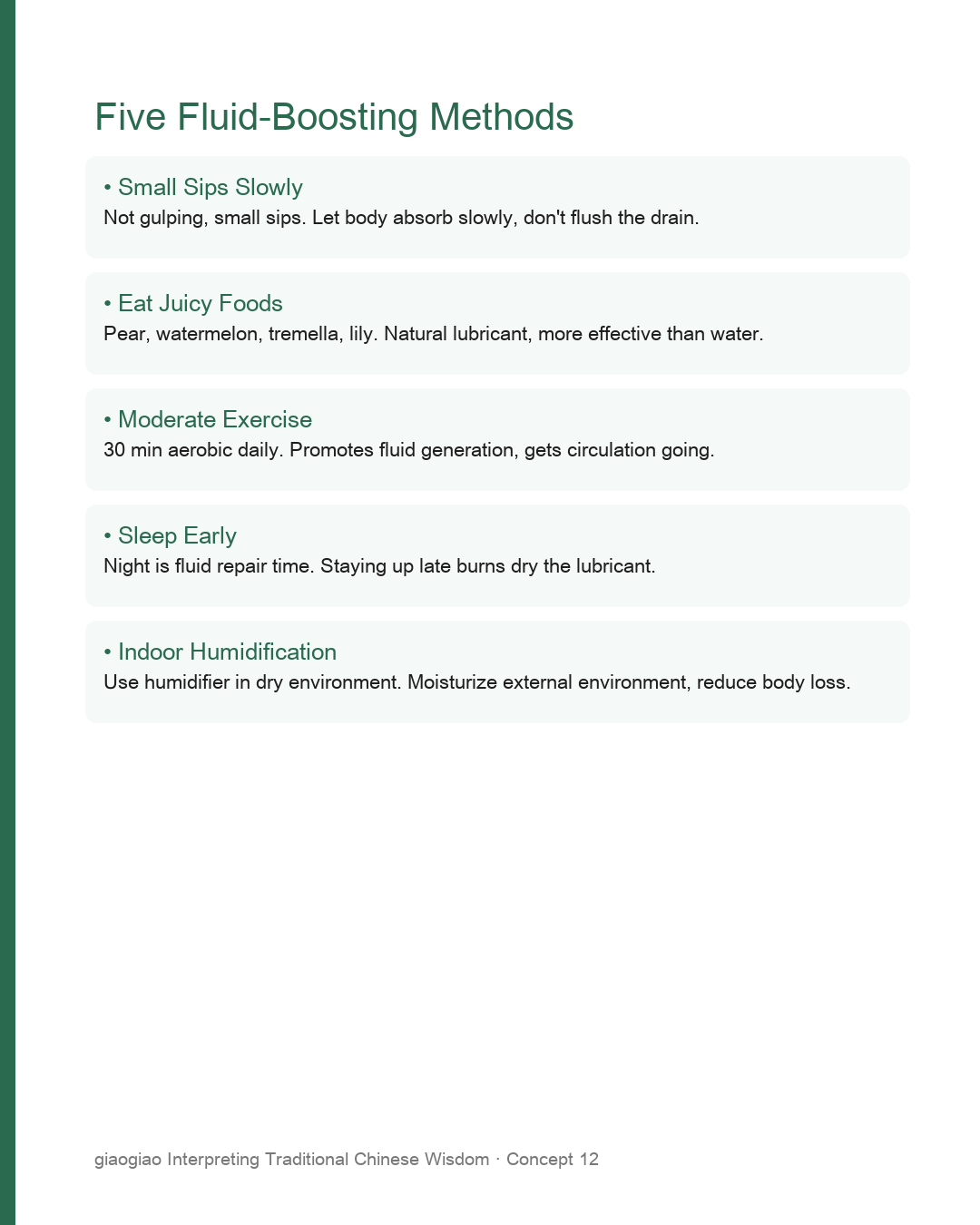
• Small, slow sips. Not guzzling, but small, frequent, warm sips. 100-150 milliliters each time, giving the digestive system time to absorb and transform. Ice water stimulates the stomach and intestines, actually reducing absorption efficiency. Warm water is the most nourishing—this is what the ancients meant by "warmly nourishing fluids."
• Eat juicy foods. Pears, watermelon, white fungus, lily bulbs, lotus root—these foods' "juices" are more easily converted into fluids by the body. Not telling you to eat fruit until you're full, but prioritize water-rich, easy-to-digest foods, reducing the digestive system's burden, saving energy to produce fluids.
• Moderate exercise. Walking, swimming, tai chi—these low-intensity exercises promote whole-body fluid circulation, including joint fluid, tissue fluid, and lymph fluid. People who sit for long periods have stagnant fluid circulation, like a stagnant pond, easy to go foul. Move, so fluids can "come alive."
• No staying up late. This is the most important point. From 11 p.m. to 3 a.m. is the body's key time for repairing and generating fluids. Staying up late means letting the "liquid processing factory" work the night shift without overtime pay. Short-term is fine; long-term, fluids will definitely be depleted.
• Indoor humidification. Air-conditioned rooms, heated rooms, when air humidity is below 30%, skin, eyes, and respiratory tract fluid evaporation accelerates. This isn't your body's problem; it's the environment stealing your fluids. Run a humidifier to 50-60% humidity, reduce unnecessary evaporation, save some oil for the body.
These methods don't require you to believe in Chinese medicine. You only need to understand: your body is not a bucket, pouring water in fills it up. The body is a complex liquid processing factory—raw materials need processing, products need distribution, circulation needs to be unobstructed. You're taking care of the entire system, not a single indicator.
Part 7One-Minute Summary
🕐 One Minute to Understand "Fluids"
Fluids = The body's lubricant and coolant.
Saliva = Oral lubricant (essential for talking and eating).
Tears = Eye cleaning fluid (protects the eyeball).
Sweat = Body coolant (dissipates heat and expels waste).
Joint Fluid = Bearing lubricant (keeps joints flexible).
Signs of fluid deficiency: dry mouth, dry eyes, weakness after sweating, cracking joints—the whole body is dry, stuck, and rusted.
Causes: staying up late, prolonged sitting, guzzling water, excessive eye use, dry air-conditioned rooms.
Methods: small slow sips, eat juicy foods, moderate exercise, no staying up late, indoor humidification.
The ancients called it "fluids"; modern people call it "functional liquid metabolism."
Different names, but the body knows: a machine without oil can't turn; a body without fluids is dry and stuck.
A machine without oil can't turn; a body without fluids is dry and stuck.
What you drink isn't fluids; it's raw material.
The body machine's processing capacity is the core.
Treat it well, don't let it work the night shift.
This is what Chinese people call "nourishing yin and generating fluids"—what is nourished is never water, but the body's processing capacity.
Making money is the art of living; art is life after making money.
giaogiao Decodes Chinese Traditional Wisdom · Concept 12
Using modern scientific language to help the world understand Chinese traditional wisdom.
No mysticism, no superstition, no disrespect.
Understand, rather than merely believe.
Coach Liu
Written in Florence