Why Do Chinese People Say "Nutritive Qi Deficiency"? Eating Well Doesn't Matter—Delivery Matters
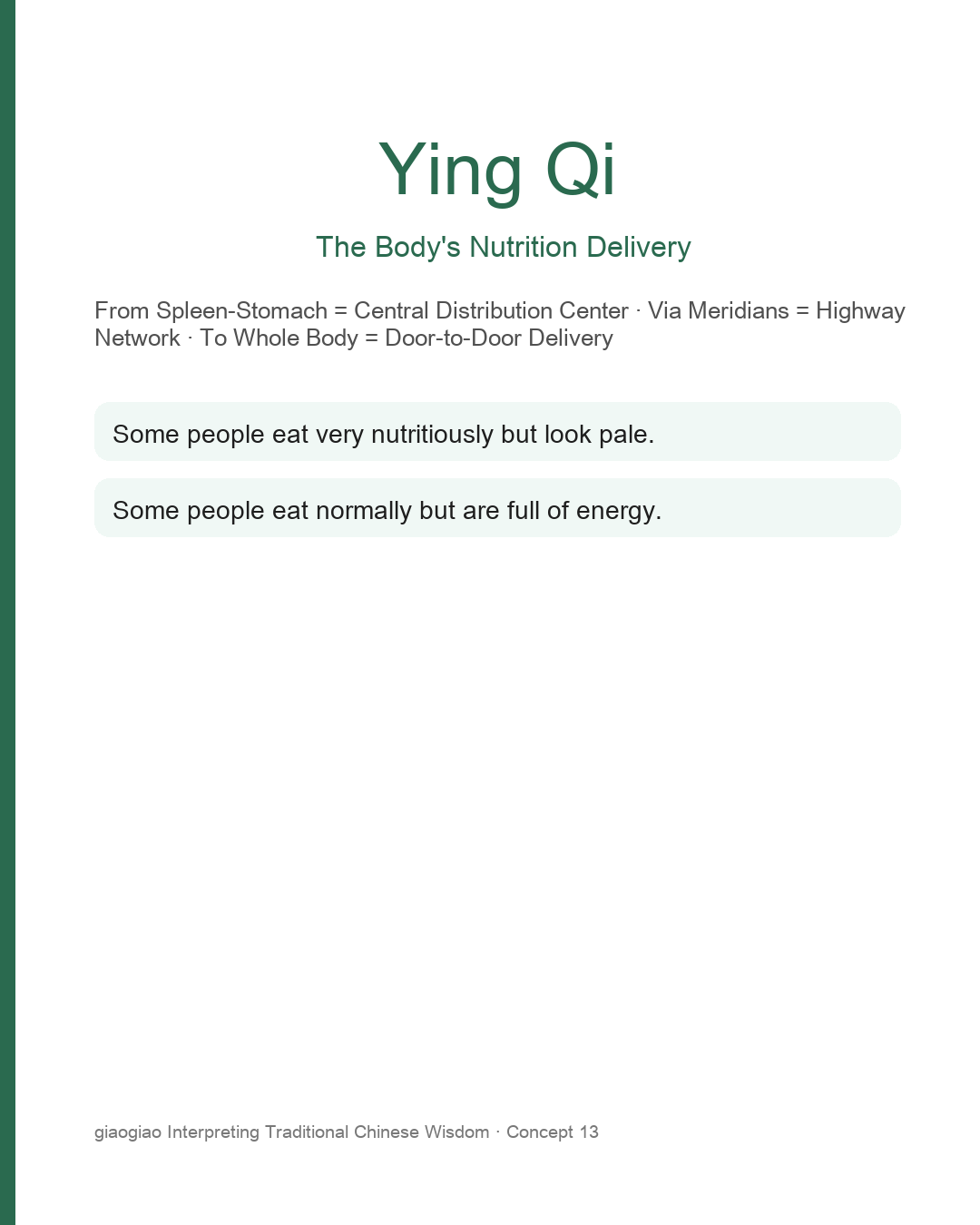
Part 1A Question
Have you ever had this experience?
Weekend at the high-end supermarket, you bought a bunch of organic vegetables, imported beef, wild salmon. Went home and carefully cooked, plated, photographed, posted on social media. Finished eating, lay down satisfied. Next day looking in the mirror, complexion still dark, nails still white, still panting climbing stairs. You start to wonder: are the ingredients not high-end enough? Should you add more collagen powder?
Meanwhile, one of your colleagues has lunch at the company cafeteria downstairs—12 yuan rice bowl with meat, a few pieces of meat, the greens even yellowing. Afternoon meeting, his voice is loud and clear, his thoughts are sharp, he continuously talks for forty minutes of PPT without drinking water. You feel drowsy while thinking: This isn't scientific?
You go to the hospital, checked blood routine, trace elements, liver and kidney function. The doctor says: "Nutrition indicators are all normal, maybe recent stress is high, rest more." But you clearly rest every day—eating the best things, sleeping the longest hours.
You go to a TCM doctor. The old physician glances at you, asks: "Is your belly bloated? Are stools formed?" Then says: "Nutritive Qi deficiency."
Not one check done, one diagnosis given. Do you believe it or not?
Even more absurd, you open the refrigerator and find it piled with expired health supplements and imported enzymes—you thought you were "supplementing nutrition," but the body simply didn't receive the goods. It's like a shopping addict, constantly placing orders, but the delivery address is wrong, all packages go to the empty house next door. Money spent, things not received.
Chinese medicine calls this "delivery system"—Ying Qi, the Nutritive Qi.
Part 2Traditional Chinese Explanation
The character "Ying" (营) in ancient times had the meaning of "management, operation, and running." Ying Qi is the Qi within the body responsible for "managing nutrition."
——Huangdi Neijing · Ling Shu
"Nutritive Qi is inside the vessels, Defensive Qi is outside the vessels."
——Huangdi Neijing · Ling Shu
The ancients discovered that the food people eat doesn't automatically become energy. It must go through a complete "production-transportation-delivery" process:
Step One: Production and Manufacturing. Food enters the Spleen and Stomach, is digested, decomposed, and refined into useful essence. This process is called "receiving and transforming" in Chinese medicine. The Spleen and Stomach are the central kitchen, responsible for processing raw materials into "nutritional semi-finished products."
Step Two: Packaging and Shipping. These essences are infused into the blood vessels, becoming part of the blood. The ancients observed that blood is not just red liquid; it also "carries" something nourishing. This thing is Ying Qi. Ying Qi is in the blood vessels, flowing with the blood, delivered to the whole body.
Step Three: Door-to-Door Delivery. Ying Qi travels through the twelve meridians' "highway network," reaching the extremities (fingers and toes), the five organs and six viscera (heart, liver, spleen, lungs, kidneys), and the skin and hair. After delivery, cells can be fed, repaired, and regenerated.
So Chinese medicine says "Nutritive Qi is inside the vessels, Defensive Qi is outside the vessels"—Ying Qi is the "delivery guy" running in the blood vessels, Wei Qi is the "security guard" standing outside the blood vessels. One is responsible for delivering nutrition, the other for defending against external enemies. Working together, the body can operate normally.
The ancients also discovered that Ying Qi has a running pattern: it flows along the meridians, completing a full circle every day, morning through the Large Intestine meridian, noon through the Heart meridian, evening through the Liver meridian. So Chinese medicine says "Zi Wu Liu Zhu" (Midnight-Noon Ebb-Flow)—at different times, the nutrition delivery arrives at different organs. This is also why if you eat too much at night, the liver has to work overtime, and the next day you get internal heat.
To summarize: Ying Qi is not a specific nutrient, but the body's ability to distribute nutrition. It departs from the Spleen and Stomach, travels through the meridian channels, and reaches every part of the body. With ample Ying Qi, you can eat coarse food and still have a rosy complexion; with insufficient Ying Qi, even eating delicacies is just a fleeting pleasure for the mouth.
Part 3giaogiao Modern Translation
Okay, let's translate "Ying Qi" into modern language.
I'm not going to talk about blood biochemistry, apolipoproteins, or microcirculation dynamics. Too complicated. Just remember one metaphor:
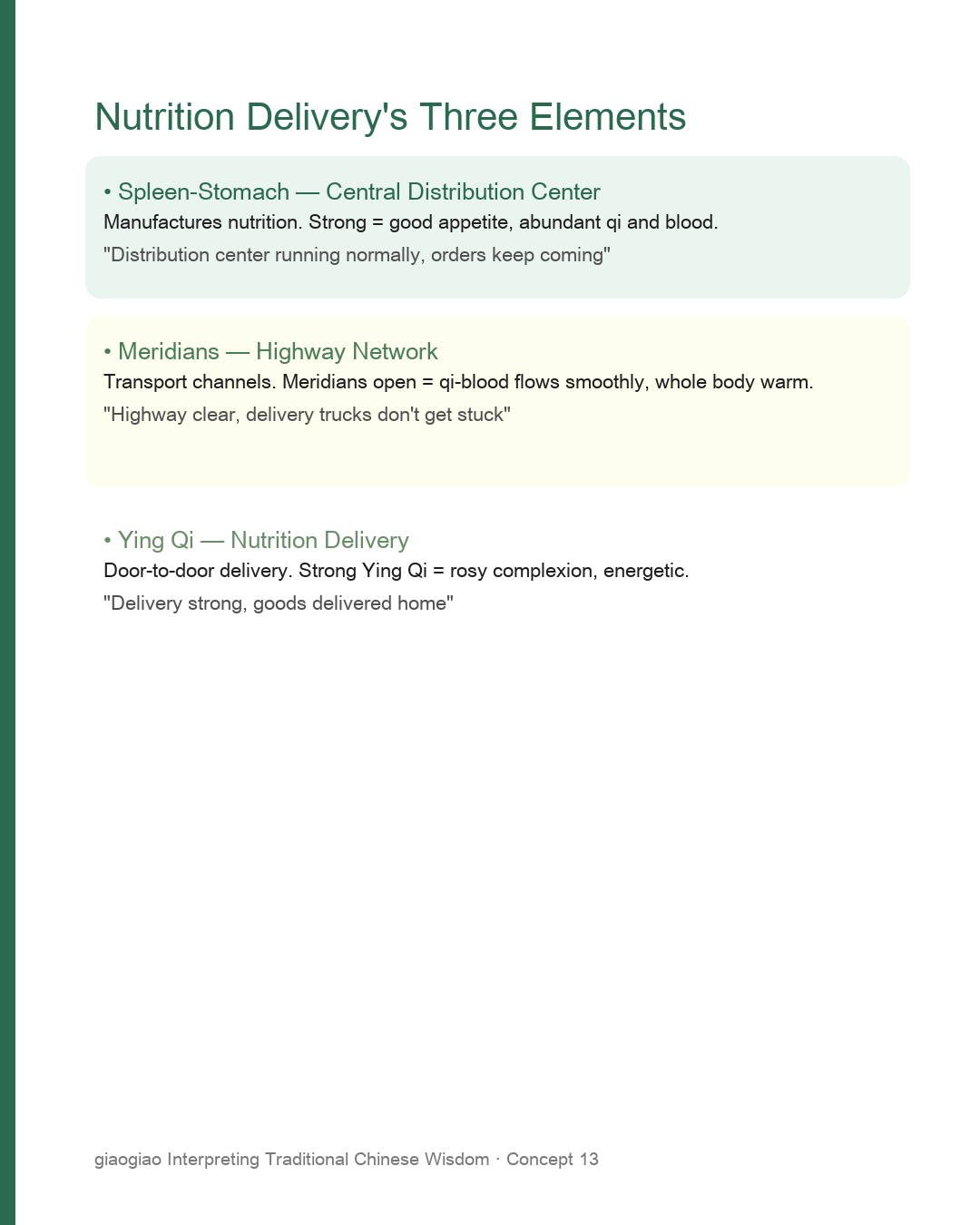
Spleen-Stomach = Central Distribution Center (production and manufacturing)
Meridians = Highway Network (transportation channels)
Whole body cells = Delivery addresses (end users)
That's it. The food you eat must first be processed into transportable "nutrition packages" at the Spleen-Stomach "central distribution center." Then, these packages are loaded onto "blood delivery trucks" and travel along the meridian "highways" to every part of the body.
Specifically:
What does Spleen-Stomach correspond to? It corresponds to your "digestive and absorptive system + liver metabolism." Food enters the stomach, is decomposed by stomach acid and protease; the small intestine absorbs nutrients; the liver reprocesses nutrients into forms the body needs. The efficiency of this process is the modern version of "Spleen-Stomach strength." Strong Spleen-Stomach is like an automated warehouse, fast sorting and few errors; weak Spleen-Stomach is like a manual warehouse, packages piled to the ceiling but can't be shipped out.
What do Meridians correspond to? They correspond to the comprehensive pathways of your "blood circulation system + nervous system + lymphatic system." Modern medicine has found that meridian pathways highly overlap with the distribution of blood vessels and nerves. The ancients didn't have microscopes, but they perceived the existence of these "channels" through bodily sensation—Ying Qi runs along these channels, and nutrition can be delivered.
What does Ying Qi deficiency correspond to? It corresponds to "low nutrient transportation efficiency." It could be a production-side problem (poor digestion and absorption, unable to manufacture enough nutrition packages), or a logistics-side problem (poor blood circulation, delivery trucks can't move), or even an address-side problem (microcirculation障碍, packages arrived at the community gate but can't be delivered to the doorstep).
So, "Ying Qi deficiency" doesn't mean you don't eat enough, but means nutrition can't be delivered. This is like a city where supermarket shelves are fully stocked, but logistics is paralyzed, and residents still go hungry.
The ancients didn't have the concept of cold-chain logistics, but with the metaphor of "Ying Qi," they precisely described what modern people need three concepts to explain: "digestive and absorptive function," "blood circulation efficiency," and "microcirculation perfusion."
Part 4Life Cases
Four anecdotes to instantly help you understand what Ying Qi deficiency feels like.
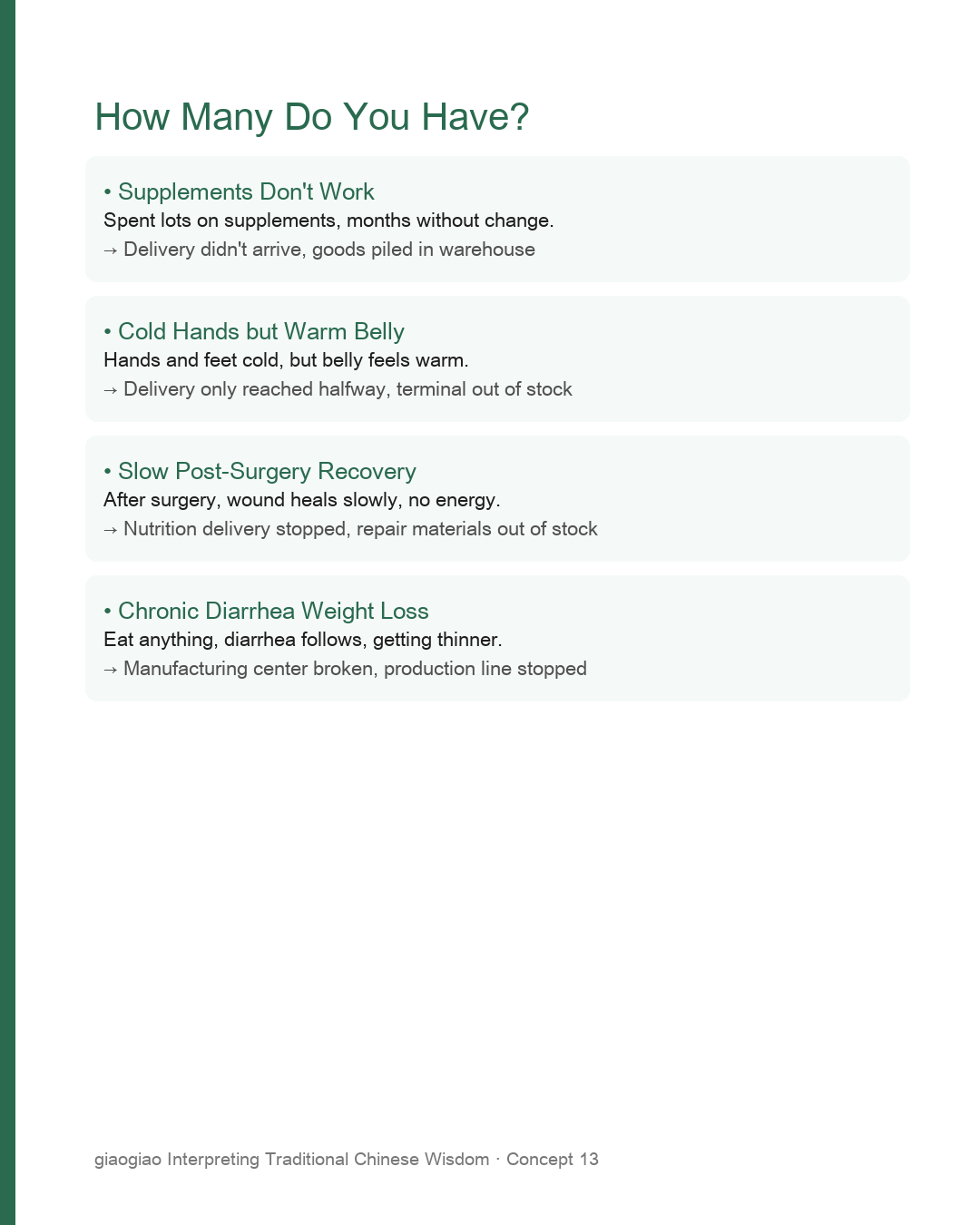
Case One: Supplements don't work.
You spent three thousand yuan on imported collagen, ginseng essence, and bird's nest oral liquid. You take it on time every morning, like completing a ritual. Three months later, skin is still dry, hair still falling out, sleep quality still poor. You go to the seller to argue, the seller says: "Everyone's constitution is different, absorption varies." You go to a TCM doctor, who says: "Ying Qi deficiency, can't deliver."
Truth: Your Spleen-Stomach (distribution center) has limited processing capacity. No matter how good the supplements, it can't process them. It's like constantly stuffing packages into a delivery station that's already at full capacity—the result isn't faster, but complete爆仓. People with Ying Qi deficiency taking supplements is like adding pressure to a paralyzed logistics system, the more you supplement, the more blocked it gets.
Case Two: Cold hands and feet, but belly is hot.
In winter, you wear two pairs of pants, hands are still icy, feet are still cold. But you touch your own belly, it's hot. You think it's "body cold," drank countless brown sugar ginger tea, hands are still icy. Chinese medicine says: "Ying Qi cannot reach the four extremities."
Truth: Ying Qi (nutrition delivery) departs from the Spleen-Stomach (central distribution center), but halfway through (extremities) it collapses from exhaustion. The delivery only reaches the transfer station, not the end user. The belly being hot means the production side is fine, but the logistics end is paralyzed. In this situation, the more ginger tea you drink, the more you get internal heat—because the belly is already very hot, you add more heat, the production side is going to explode, but the extremities still can't receive the goods.
Case Three: Slow post-surgery recovery.
You had a not-too-big, not-too-small surgery. The doctor said two weeks to recover, but you were weak for two months. Others post-surgery can eat and sleep, but you post-surgery vomit whatever you eat, wound heals slowly, no strength to get out of bed. Western medicine says: "Individual differences, observe more." Chinese medicine says: "Ying Qi severely damaged, nutrition delivery stopped."
Truth: Surgery is trauma, the body needs large amounts of nutrition to repair tissue. But post-surgery Spleen-Stomach function is shattered by anesthesia, antibiotics, and bed rest, the distribution center is almost paralyzed. Without Ying Qi, the wound is like a construction site without materials, how to repair? At this time, forcibly eating big fish and meat instead increases Spleen-Stomach burden.
Case Four: Chronic diarrhea, gradually losing weight.
You eat and then have diarrhea, whatever you eat comes out the same. In three months you lost ten jin, face caved in, eye sockets deepened. Went to the hospital, had a colonoscopy, checked gut flora, the doctor says: "Might be irritable bowel syndrome, watch your diet." You did watch your diet, no spicy, no oil, no cold raw food, still diarrhea. Chinese medicine says: "Spleen-Stomach decline, manufacturing center has a problem."
Truth: The Spleen-Stomach is the source of Ying Qi. Chronic diarrhea means the digestive system can't complete any processing—food goes in, comes out the same, nutrition wasn't absorbed at all. Manufacturing center shut down, nutrition delivery system cut off from the source. This isn't "can't deliver," but "nothing to deliver."
Four cases, one underlying logic: Ying Qi is not nutrition itself, but the ability to transport and distribute nutrition. When this ability has a problem, eating more is useless.
Part 5Modern Research
Is there scientific research on "Ying Qi"?
Yes, but scientists don't use the word "Ying Qi." They use:
• Microcirculation. Modern medicine has found that the total length of human capillaries can reach 100,000 kilometers, which is the "last mile" of nutrient delivery. People with microcirculation障碍 have tissue cells that don't get enough nutrition and oxygen, manifesting as cold hands and feet, pale complexion, and slow wound healing. This is the scientific version of "Ying Qi cannot reach the four extremities."
• Intestinal Absorption Function. Small intestinal villi are the main site of nutrient absorption; the larger the villi surface area, the higher the absorption efficiency. Chronic diarrhea or intestinal inflammation leads to villous atrophy, reducing absorption area. This is the microscopic explanation of "Spleen-Stomach decline, manufacturing center shut down."
• Hemorheology. Blood viscosity, red blood cell deformability, and platelet aggregation all affect blood transport efficiency. Blood too thick, like oil too viscous, delivery trucks can't move; red blood cells too hard, like tires without air, stuck on the highway. This is the scientific version of "Ying Qi运行不畅."
• Post-Surgery Nutritional Support. Modern surgery has found that early post-surgery enteral nutrition (nutrition directly absorbed through the intestine) recovers faster than单纯 intravenous infusion. Why? Because the intestine itself is the "manufacturing center," activating the intestine restores Ying Qi. This is the scientific validation of Chinese medicine's "post-surgery first regulate the Spleen-Stomach."
These studies are limited, but the direction is consistent: "Ying Qi" describes the body's overall efficiency from "manufacturing nutrition" to "transporting nutrition" to "distributing nutrition," not a specific substance.
Part 6Practical Methods
Now that you understand Ying Qi, how do you supplement it?
First, dispel a few misconceptions:
• Taking supplements is not a cure-all. People with Ying Qi deficiency have a paralyzed Spleen-Stomach. Bird's nest and ginseng are like stuffing packages into a paralyzed delivery station, only causing congestion. First repair the distribution center, then talk about high-end supplements.
• Dieting for weight loss will cut off Ying Qi. Long-term low-calorie diet, the Spleen-Stomach lacks raw materials, Ying Qi production is directly halved. You will lose weight, but also have a sallow complexion, hair loss, and poor memory. This is the nutrition delivery system reducing production due to lack of stock.
• Prolonged sitting will block Ying Qi. Sitting all day, blood circulation slows, delivery trucks are stuck in traffic on the highway. The extremities are the first to suffer, this is the truth of why office workers have cold hands and feet.
Specific methods:
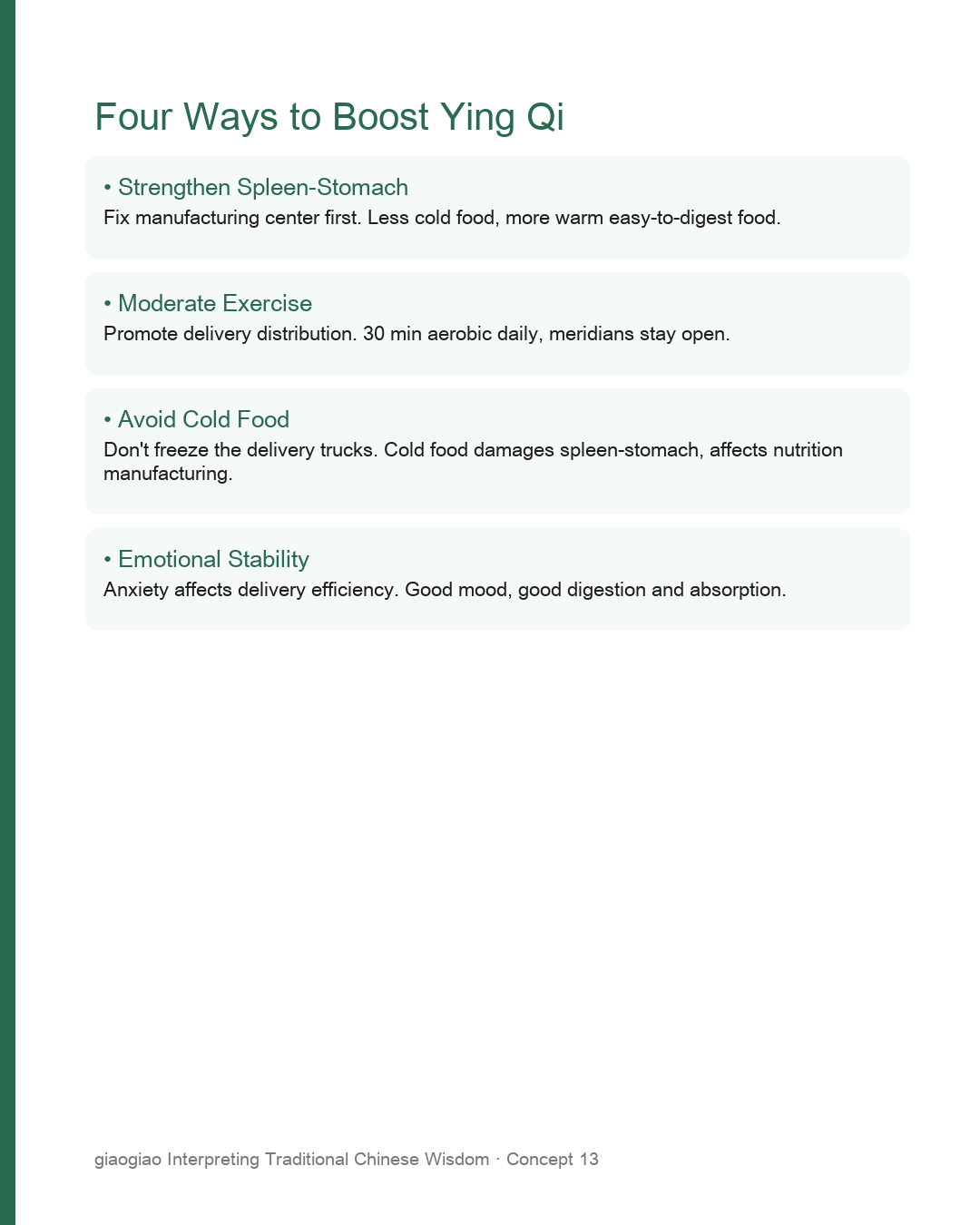
• Strengthen the Spleen-Stomach, first repair the manufacturing center. Millet pumpkin porridge, yam, lotus seeds, Euryale seeds—these seemingly ordinary foods are actually the Spleen-Stomach's favorite "repair tools." They are easy to digest, don't increase burden, and can slowly restore the exhausted Spleen-Stomach to operation. Remember: when Spleen-Stomach is weak, plain porridge is more useful than bird's nest.
• Moderate exercise to promote delivery. Fast walking 30 minutes a day, or practicing Ba Duan Jin, Tai Chi. Exercise promotes blood circulation, equivalent to clearing obstacles on the highway and accelerating delivery trucks. But note: people with severe Ying Qi deficiency, don't do intense exercise, walking is enough. The delivery station hasn't resumed work, and you're demanding next-day delivery, the system will collapse.
• Don't eat cold, don't freeze the delivery trucks. Ice drinks, ice watermelon, cold raw salads, after entering the body, the Spleen-Stomach needs extra energy to "heat them up." This is equivalent to starting a delivery truck in the snow, the engine hasn't warmed up, half the oil is already consumed. People with Ying Qi deficiency especially need to stay away from cold.
• Emotional stability, anxiety affects delivery efficiency. Stress, anxiety, and tension activate the sympathetic nervous system, causing blood to be "redeployed" from the digestive system to the muscles (preparing to fight or flee). At this time, the Spleen-Stomach is blood-deficient, and Ying Qi production directly drops. This is the scientific principle of "so angry you can't eat"—it's not that you don't want to eat, but the distribution center is on strike. Emotional stability is the cheapest maintenance product for Ying Qi.
These methods don't require you to believe in Chinese medicine. You only need to understand: your body is a logistics company, and Ying Qi is logistics efficiency. When the company isn't operating well, it's not that goods aren't enough, but some link in production, transportation, or delivery has a problem.
Part 7One-Minute Summary
🕐 One Minute to Understand "Ying Qi"
Ying Qi = The body's nutrition delivery.
Spleen-Stomach = Central Distribution Center (manufactures nutrition).
Meridians = Highway Network (transportation channels).
Whole body cells = Delivery addresses (end users).
Signs of Ying Qi deficiency: no matter how well you eat you don't gain weight, cold hands and feet, pale complexion, slow post-surgery recovery, no reaction to supplements.
Causes: weak Spleen-Stomach (manufacturing center shut down), prolonged sitting (delivery trucks stuck in traffic), eating cold (freezing delivery trucks), anxiety (affecting delivery efficiency).
Methods: strengthen Spleen-Stomach (millet porridge, yam), moderate exercise (fast walking), avoid cold (warm water as main), emotional stability (don't be anxious).
The ancients called it "Ying Qi"; modern people call it "nutrient transport efficiency."
Different names, but the body knows:
Eating well is not as good as delivering well.
Ying Qi is nutrition delivery, Spleen-Stomach is the distribution center, meridians are the highways.
What you eat doesn't automatically equal what you have.
Between "eating" and "using" lies an entire logistics system.
This is probably the most simple wisdom of the Chinese people:
Don't just ask what you eat,
ask one thing—did it get delivered?
Making money is the art of living; art is life after making money.
giaogiao Decodes Chinese Traditional Wisdom · Concept 13
Using modern scientific language to help the world understand Chinese traditional wisdom.
No mysticism, no superstition, no disrespect.
Understand, rather than merely believe.
Coach Liu
Written in Florence