Why Do the Chinese Say "When Righteous Qi Resides Within, Evil Cannot Intrude"? Your Body Is Not a Fortress — It Is an Immune Wall
Part 1The Question
Have you ever had this experience?
Same office. Colleague on the left is coughing, colleague on the right called in sick with a fever, colleague across from you is blowing their nose into a tissue box. You sit in the middle, typing away like nothing\'s wrong. It\'s not that you\'re cleaner — you just don\'t get infected.
Then there\'s the flip side: everyone else survives the season change just fine, but you get a sore throat the moment the AC turns on. Others walk through rain and nothing happens; you walk through rain and catch a cold for two weeks. Others get discharged three days after surgery; you get repeated infections and stay a month.
You go to the doctor and ask, "Why am I so weak?"
The doctor runs every test and says, "Everything looks normal. Maybe your immunity is a bit low."
You go to a traditional Chinese medicine (TCM) doctor. The old physician takes your pulse and says one sentence: "Insufficient Zheng Qi."
Not a single lab test, yet a diagnosis is made. Do you believe it?
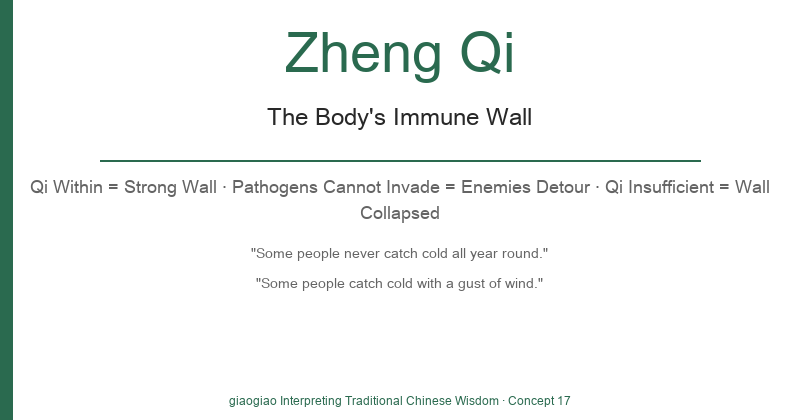
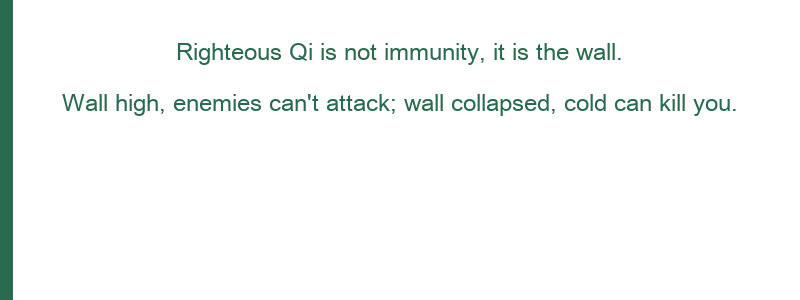
What\'s even more impressive is that this TCM saying isn\'t made up. It comes from the Yellow Emperor\'s Inner Canon, written over two thousand years ago. The original text says: "When Zheng Qi is stored within, evil cannot intrude." It means: as long as the wall is solid enough, the enemy cannot break in. The reverse is also true: when the wall collapses, anyone can walk right through.
So the question becomes — what exactly is this "wall"?
Part 2Traditional Chinese Explanation
The term "Zheng Qi" in TCM is not some abstract moral concept. It is an extremely concrete military metaphor.
——Yellow Emperor\'s Inner Canon · Su Wen
"邪之所凑,其气必虚。" (Where evil gathers, the Qi must be weak.)
——Yellow Emperor\'s Inner Canon · Su Wen
The ancients imagined the body as a city. Outside the city is a wall, soldiers patrol on top of the wall, and guards stand at the gates. The defensive power of this city is called "Zheng Qi."
And "evil Qi" (Xie Qi)? That\'s everything trying to invade — wind, cold, summer heat, dampness, dryness, and fire, plus the modern interpretation: viruses, bacteria, allergens, environmental toxins. The ancients didn\'t know what a virus looked like, but they discovered a pattern: in the same environment, some people get sick and some don\'t. The difference is not how strong the enemy is, but how high the wall is.
TCM divides Zheng Qi into several levels, but for ordinary people, just remember three types:
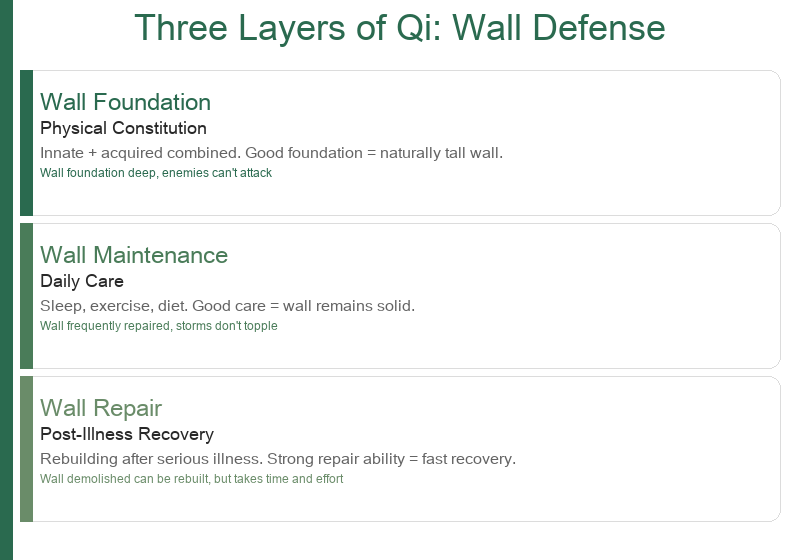
Wei Qi (Defensive Qi) — the patrol guards on the wall. People with strong Wei Qi have intact skin barriers, normal mucous membrane secretion, and rapid immune cell response. People with weak Wei Qi get sick at the slightest breeze, catch a cold every season change, and fall before anyone else. Wei Qi is like the security guard in your neighborhood: when diligent, suspicious characters can\'t even get through the front gate; when slacking off, anyone can climb over the fence.
Ying Qi (Nutritive Qi) — the supply lines inside the wall. People with strong Ying Qi have nutrients delivered to where they\'re needed, tissues repair quickly, and wounds heal like magic. People with weak Ying Qi recover incredibly slowly after illness, wounds don\'t close well, and they feel like their bones have been pulled out. Ying Qi is like the logistics corps: no matter how well the front line fights, without food and ammunition, the city still falls.
Yuan Qi (Original Qi) — the very foundation of the entire city. People with strong Yuan Qi are energetic, stress-resistant, and recover quickly after illness. People with weak Yuan Qi suffer from lingering illness, repeated infections, and the more they\'re treated, the weaker they become. Yuan Qi is like the city\'s bedrock: if the foundation is solid, the wall can be rebuilt even if it falls; if the foundation sinks, the entire city is in danger.
These three types of Qi combined make up Zheng Qi — not a specific substance, but the sum total of all your body\'s defensive and repair capabilities. The ancients used the metaphor of a "wall" to precisely capture what modern medicine needs three separate concepts — immune system, tissue repair, and basal metabolism — to explain.
Part 3giaogiao Modern Translation
Alright, let\'s translate "Zheng Qi" into modern language.
I\'m not going to talk about T cells, B cells, NK cells, or IgA antibodies. Too complicated. You only need to remember one metaphor:
Wei Qi = patrol guards on the wall (first line of defense: skin, mucous membranes, innate immunity)
Ying Qi = supply lines inside the wall (repair capacity: nutrient delivery, tissue regeneration)
Yuan Qi = foundation of the entire city (baseline state: energy, metabolism, stress resilience)
That\'s it. Your "Zheng Qi" is essentially your body\'s comprehensive defensive state — not a single cell or antibody, but the overall effectiveness of all defense systems stacked together.
Specifically:
What does Wei Qi correspond to? It corresponds to your "physical and chemical barriers." Intact skin, moist mucous membranes, normal stomach acid, balanced gut flora — together, these are the patrol guards on the wall. They are the first line of defense, blocking 90% of invaders right here. People with weak Wei Qi have dry skin, damaged oral mucosa, insufficient stomach acid, and imbalanced gut flora — fewer guards on the wall, so enemies march straight in.
What does Ying Qi correspond to? It corresponds to your "tissue repair and regeneration capacity." How fast a surgical wound heals, how quickly you recover after a viral infection, whether chronic inflammation can resolve itself — these depend on blood circulation, nutrient supply, and stem cell activity. People with strong Ying Qi repair quickly; people with weak Ying Qi can\'t heal wounds and inflammation won\'t go away. It\'s like a hole in the wall: some people patch it overnight, others let it crumble.
What does Yuan Qi correspond to? It corresponds to your "overall energy reserves and regulatory capacity." How well you sleep, how energetic you feel, how much stress you\'re under, how stable your emotions are — these determine whether the "city foundation" is solid. People with weak Yuan Qi don\'t have one weak defense system; they have ALL weak systems. Like a sinking foundation: no matter how thick the wall is, it can\'t hold.
So "Zheng Qi" is not mysticism. It is a systemic metaphor — describing the body\'s comprehensive defensive ability from outside to inside, from local to whole.
The ancients had no microscopes, yet they used the metaphor of a "wall" to precisely describe what modern people need three disciplines — immune barriers, tissue repair, and basal metabolism — to explain.
Part 4Real-Life Stories
Four stories to make you instantly understand what Zheng Qi is.
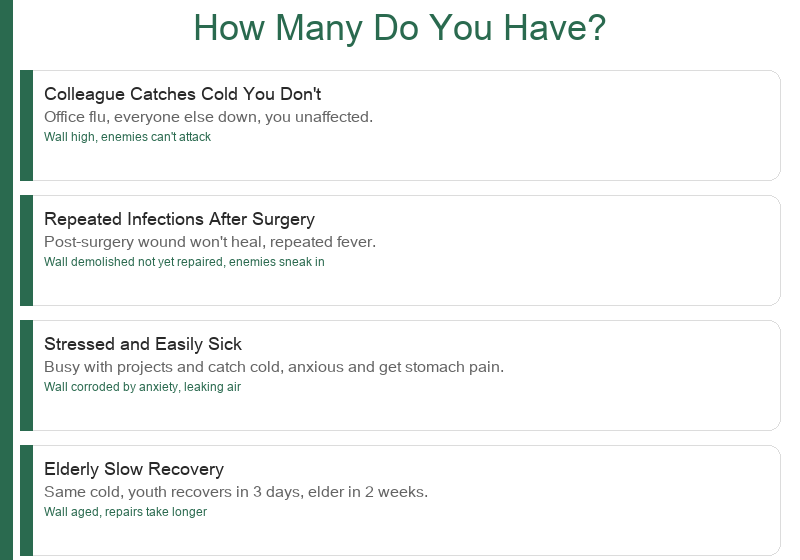
Story One: Everyone else catches a cold, you don\'t.
Flu season turns the office into a virus trading floor. Coughing on the left, wheezing on the right, sneezing across from you without covering the mouth. You mutter to yourself, "I\'m doomed this time." A week passes, and you\'re perfectly fine. It wasn\'t luck — your wall was high enough. Your skin and mucous barriers are intact, your respiratory cilia wave normally, and your innate immune cells (macrophages, neutrophils) react swiftly — the enemy circled beneath your wall, couldn\'t find a ladder, and left.
The truth: The first line of immune defense (physical barriers and innate immunity) blocks most invaders. People with strong Zheng Qi never even let the enemy face their body in direct combat.
Story Two: Repeated infections after surgery.
Someone gets a minor surgery. The doctor says three days and you\'re out. They end up staying a month. The wound won\'t heal, fever keeps coming back, antibiotics are switched repeatedly. The family is frantic and asks the doctor what\'s going on. The doctor can only say, "Post-operative infection, low immunity."
TCM says: "Zheng Qi severely damaged, Wei Qi failing to hold." Surgery itself is like cutting a hole in the wall. People with strong Zheng Qi patch the hole overnight and get back to normal in a few days. People with weak Zheng Qi have a hole in the wall with no one to fix it, and enemies pour in through the gap endlessly.
The truth: Surgical trauma triggers a whole-body stress response, consuming massive amounts of energy and immune cells. If your pre-surgery nutrition is poor, sleep insufficient, and stress high, post-op recovery is like pouring sand into a bottomless pit — it never fills up.
Story Three: Get sick easily when stressed.
Have you noticed that you always catch a cold the week before a deadline? Sore throat before an exam? Stomach pain before a product launch? It\'s not coincidence. Chronic elevation of stress hormones (cortisol) directly suppresses the immune system — NK cell activity drops, antibody production decreases, and inflammatory responses spiral out of control.
TCM says: "Emotions harm Zheng Qi." Anxiety, anger, depression — these are not "all in your head." They are literally corroding your wall. Anxiety is like acid rain: a drop or two is fine, but day after day, the bricks on the wall loosen one by one. When the flu virus comes to attack, defenses that normally hold now fail.
The truth: Immune suppression caused by chronic stress has been confirmed by mountains of research. When cortisol stays high, immune cell function declines across the board. This is the scientific version of "the wall is being corroded by anxiety."
Story Four: Elderly people recover slowly.
Same cold, young people recover in three days, elderly people are still coughing after three weeks. Same surgery, young people are walking in a week, elderly people need a month. It\'s not that the doctor plays favorites — the wall is just aging. Thinning skin, drying mucous membranes, slower immune cell renewal, declining stem cell activity — these are all part of natural aging.
TCM says: "After fifty, Zheng Qi is naturally halved." In plain English: the wall is old, and repairs are harder. So elderly people need to sleep well, eat well, and exercise moderately — not as "health preservation," but as "emergency repairs."
The truth: The thymus begins to shrink after puberty, and T-cell production declines year by year. By age 60, the thymus has basically stopped producing new T cells. The elderly immune wall is maintained by "inventory," not "production." That\'s why elderly people are more prone to infection and harder to recover.
Part 5Modern Research
Is there scientific research on "Zheng Qi"?
Yes, but scientists don\'t use the word "Zheng Qi." They use:
• Immune barrier function. Studies show that people with compromised skin barriers (like atopic dermatitis patients) have infection rates 3–5 times higher than normal. People with imbalanced gut flora have increased intestinal permeability ("leaky gut"), allowing bacteria and endotoxins to enter the bloodstream more easily. This is the molecular-level expression of "Wei Qi failing to hold."
• Chronic stress and immune suppression. Carnegie Mellon University research shows that people under long-term psychological stress have 2–3 times higher risk of catching a cold. The mechanism: sustained cortisol elevation suppresses lymphocyte proliferation and reduces antibody response. This is the scientific version of "emotions harming Zheng Qi."
• Nutrition and wound healing. Protein, vitamin C, zinc, and vitamin A — deficiencies in these nutrients directly reduce collagen synthesis, slow epithelial repair, and weaken immune cell function. This is the microscopic explanation of "insufficient Ying Qi."
• Sleep and immune memory. During deep sleep, the body produces cytokines (like IL-2, IFN-γ) that promote T-cell differentiation and antibody production. Sleep-deprived people have reduced vaccine efficacy and prolonged infection recovery. This is the scientific version of "staying up late damages Yuan Qi."
These studies don\'t directly prove the existence of "Zheng Qi," but they prove a core insight: the body\'s defensive capacity is not singular; it is a holistic state determined by barriers, nutrition, stress, sleep, and metabolism together. The ancients used "wall" to describe this holistic state; modern science uses "immune homeostasis" to study it. Different names, same thing.
Part 6Practical Methods
Now that you understand Zheng Qi, how do you reinforce the wall?
First, let\'s bust a few myths:
• Vitamin C is not a miracle cure. Vitamin C does participate in immune reactions, but taking only C without protein, zinc, or sleep is like painting a layer of paint on the wall while the bricks inside are still loose. Comprehensive nutrition is the building material of the wall.
• Taking antibiotics is not reinforcing the wall; it\'s swapping the wall for an iron fence. Antibiotics kill bacteria but not viruses. More importantly, overusing antibiotics destroys gut flora — and your gut flora is an important garrison on your wall. Removing the garrison for an iron fence works short-term, but long-term the wall becomes even more fragile.
• More exercise is not always better. Moderate exercise boosts immune cell activity, but high-intensity exercise (like marathon running) opens an "immune window" 3–72 hours afterward, increasing infection risk. If your Qi is weak, start with walking. Don\'t jump straight into lifting weights.
Concrete methods:
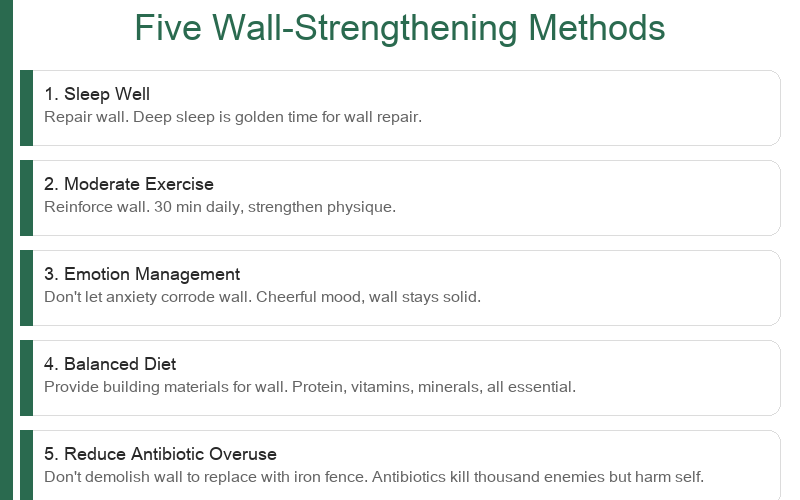
• Sleep well (repair the wall). This is the cheapest and most effective way to reinforce the wall. During deep sleep, the body secretes growth hormone, repairs tissue damage, and clears metabolic waste. No phone for an hour before bed. Keep the bedroom dark, cool, and quiet. Can\'t do it? Start with half an hour before bed. The wall isn\'t built in a day, but you can add a few bricks every day.
• Exercise moderately (reinforce the wall). 150 minutes of moderate-intensity exercise per week (brisk walking, swimming, cycling) boosts immune cell activity and promotes lymphatic circulation. The key is "moderate" — slightly sweating, able to talk but not sing. Too much exercise tears down the wall; moderate exercise builds it up.
• Manage emotions (don\'t let anxiety corrode the wall). Ten minutes of mindful breathing daily, writing down three things you\'re grateful for, spending time with people who make you happy. These methods are not "psychological comfort food" — they lower cortisol levels, reduce inflammatory factors, and directly boost immune cell function. Anxiety corrodes the wall; happiness patches it up.
• Eat a balanced diet (provide building materials for the wall). Protein is the bricks of the wall (the main component of immune cells), vitamin C is the cement (collagen synthesis), zinc is the rebar (immune cell differentiation), and dietary fiber is the garrison\'s rations (food for gut flora). Get enough protein at every meal (a fist-sized portion of meat/eggs/fish/beans), eat vegetables of five colors daily — that\'s delivering building materials to the wall.
• Reduce antibiotic abuse (don\'t swap the wall for an iron fence). Common colds and flu are overwhelmingly caused by viruses; antibiotics are useless. Only use antibiotics for confirmed bacterial infections (like strep throat or bacterial pneumonia). When you do use them, complete the full course. Don\'t stop just because symptoms improve — otherwise you leave half-dead bacteria that develop drug resistance. Remember: antibiotics save lives, they don\'t preserve health.
These methods don\'t require you to believe in TCM. You only need to understand: your body is a city, a city needs maintenance, maintenance needs materials, and materials come from sleep, exercise, diet, and emotions.
Part 7One-Minute Summary
🕐 Understand "Zheng Qi" in One Minute
Zheng Qi = The body\'s immune wall.
Wei Qi = patrol guards on the wall (skin, mucous membranes, innate immunity).
Ying Qi = supply lines inside the wall (repair capacity, nutrient delivery).
Yuan Qi = foundation of the entire city (energy, metabolism, stress resilience).
Signs of strong Zheng Qi: others catch colds, you don\'t; minor illnesses heal fast; you feel energetic.
Signs of weak Zheng Qi: you get sick at the slightest breeze; recovery is slow; you always feel tired.
Causes: staying up late, sitting too much, poor nutrition, chronic stress, antibiotic abuse.
Methods: sleep well, exercise moderately, manage emotions, eat a balanced diet, use antibiotics wisely.
The ancients called it "Zheng Qi"; modern people call it "immune homeostasis."
Different names, but the body knows: when the wall collapses, no one can stop what comes through.
Immunity is just the soldiers on the wall; Zheng Qi is the entire city\'s defense system.
When the wall is high, the enemy cannot break in; when the wall collapses, even a cold can kill you.
Sleep well, eat well, exercise well, live well —
this is what the Chinese call "nourishing Zheng Qi."
It\'s not some profound philosophy; it\'s common sense. But common sense is so ordinary that no one takes it seriously.
Making money is the art of living; art is the life after making money
giaogiao Decodes Chinese Wisdom · Concept 17
Using the language of modern science to help the world understand Chinese wisdom.
No mysticism, no superstition, no belittling.
Understanding, not mere belief.
Coach Liu
Written in Florence