Why Does TCM Have an "Emetic Method"? Vomiting Is the Body's "Emergency Drain"
Part 1A Question
Have you ever noticed that when you eat something bad, your stomach churns and after you vomit, you actually feel better? Have you ever found that someone who drank too much feels much clearer after throwing up?
Even more bizarre, TCM actually treats "vomiting" as a formal treatment method — you ask: "Isn't vomiting the body's instinctive reaction? How can it be used as medicine?"
Another question: You ask a doctor, "What do I do about food poisoning?" A modern doctor says "gastric lavage"; an ancient TCM doctor says "emetic method" — you ask: "What's the difference between gastric lavage and the emetic method?"
One last question: You've heard that "diseases in the upper body should be treated by vomiting" — diseases in the upper burner (above the diaphragm), use the emetic method. You ask: "Why do diseases in the upper body need vomiting? What does this have to do with diarrhea?"
What exactly is vomiting?
Part 2Traditional Chinese Explanation
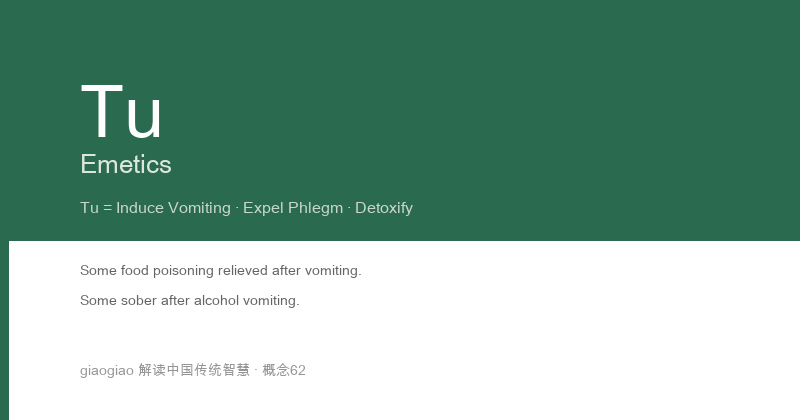
The concept of "emetic method" (吐法) is one of the Eight Methods of TCM. TCM has eight basic methods of treatment: sweating, vomiting, purging, harmonizing, warming, clearing, reducing, and tonifying. The emetic method uses vomiting to expel phlegm-rheum, retained food, and toxins from the stomach and upper burner.
— Huangdi Neijing
"When evil is in the upper stomach, vomiting resolves it."
— Shang Han Lun
"When the disease is in the chest, it is appropriate to vomit."
— Qian Jin Fang
The ancients observed that the body has a "detox system" — toxins in the upper body exit upward (vomiting), toxins in the middle are resolved in the middle (harmonizing), and toxins in the lower body exit downward (purging). The emetic method targets pathogens in the upper burner — phlegm congestion, retained food stagnation, and toxins entering the stomach — expelling them through vomiting as an emergency measure.
Emetic Method = Emergency Drain + Safety Release. It is not random vomiting; it is when the pathogen is still shallow and has not yet penetrated deeply, using vomiting to expel harmful substances.
The position of the emetic method in TCM:
• Gua Di San — the most famous emetic formula. Gua Di (melon stem) is bitter and cold in nature, stimulating the gastric mucosa, causing vomiting, and expelling phlegm-rheum and retained food.
• Salt Soup Induced Vomiting — the simplest emetic method. Drinking a large amount of concentrated salt water stimulates the stomach wall, causing vomiting. An emergency method for food poisoning.
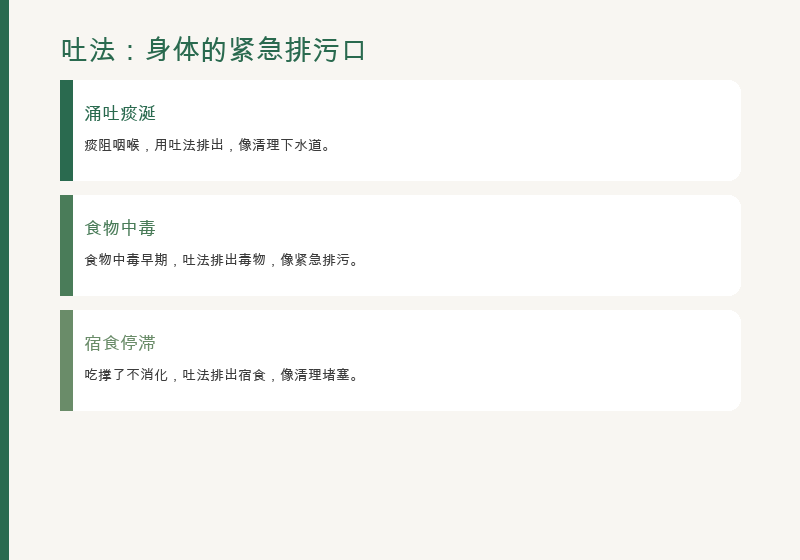
• Diseases in the upper body should be treated by vomiting — diseases in the upper burner (above the diaphragm), such as phlegm obstructing the throat, food poisoning, or retained food stagnation — using the emetic method, like pressing an emergency drain button.
But the emetic method has a characteristic: it is very forceful. Vomiting damages stomach Qi, and frequent use harms righteous Qi. So the ancients used the emetic method very cautiously — "treat the symptoms in acute cases, treat the root in chronic cases" — only used in emergencies.
Modern TCM rarely uses the emetic method now — because gastric lavage is more direct and safer. But understanding the logic of the emetic method is important for understanding TCM's overall approach to "detoxification."
For example: Food poisoning. The toxin has just entered the stomach and has not yet been absorbed — using the emetic method (or gastric lavage), the toxin is expelled. This is the typical application of "diseases in the upper body should be treated by vomiting." If you wait until the toxin is absorbed, the emetic method is useless.
Another example: Phlegm congestion. After a stroke, phlegm blocks the throat, causing difficulty breathing — using the emetic method, the phlegm is expelled, relieving suffocation. This is the typical application of "treat the symptoms in acute cases."
So, the ancients' concept of "vomiting" is not just "throwing up" — it is the body's emergency drain + safety valve, rapidly expelling harmful substances when the pathogen is still shallow.
Part 3giaogiao Modern Translation
Okay, now let's translate "vomiting" into modern language.
I'm not going to talk about the vomiting reflex arc or the vagus nerve. Too complicated. You only need to remember one analogy:
Emetic Method = Stimulating Gastric Wall Receptors + Activating the Vomiting Center + Forcefully Expelling Stomach Contents
Food Poisoning Emetic Method = Toxin Not Yet Absorbed + Emergency Expulsion + Reducing Toxin Entry into Blood
Phlegm Congestion Emetic Method = Upper Respiratory Tract Obstruction + Clearing Secretions + Restoring Ventilation
Retained Food Stagnation Emetic Method = Gastric Emptying Disorder + Reducing Gastric Pressure + Relieving Fullness
Diseases in the Upper Body Should Be Treated by Vomiting = Pathogen in the "Upper" (Stomach / Upper Respiratory Tract) + Expelling at the Nearest Exit + Avoiding Deep Penetration
Emetic Method Harms Righteous Qi = Vomiting Causes Electrolyte Imbalance + Loss of Gastric Acid + Gastric Mucosal Damage
That's it. "Vomiting," in essence, is simply a defensive reflex of the body — like a smoke detector, detecting harmful substances and immediately triggering the alarm to expel the contents.
Specifically:
What does "food poisoning" correspond to? It corresponds to the stage where the toxin has not yet been absorbed. The toxin enters the stomach, and the gastric mucosa has not yet absorbed a large amount — at this point, vomiting (or gastric lavage) can expel most of the toxin, reducing toxin entry into the blood. TCM says "when evil is in the upper stomach, vomiting resolves it" — precisely describing the stage where the toxin is in the stomach and has not yet been absorbed. Once the toxin enters the small intestine, absorption accelerates, and the emetic method is much less effective.
What does "phlegm congestion" correspond to? It corresponds to upper respiratory tract secretion obstruction. In stroke or coma patients, throat secretions increase, obstructing the airway and causing difficulty breathing. The emetic method (or suctioning) clears secretions, restoring ventilation. TCM says "when the disease is in the chest, it is appropriate to vomit" — precisely describing the emergency of upper respiratory tract obstruction.
What does "retained food stagnation" correspond to? It corresponds to gastric emptying disorder + increased gastric pressure. After overeating, too much food in the stomach slows gastric emptying, increases gastric pressure, causing fullness, nausea, and vomiting. The emetic method (natural vomiting or induced vomiting) expels stomach contents, reducing gastric pressure and relieving symptoms. TCM says "when retained food is in the upper body, vomiting cures it" — precisely describing gastric emptying disorder.
What does "emetic method harms righteous Qi" correspond to? It corresponds to the side effects of vomiting. Frequent vomiting leads to loss of gastric acid (hypochloremic alkalosis), electrolyte imbalance (hypokalemia, hyponatremia), gastric mucosal damage, and esophageal cardia tearing. TCM says "the emetic method is forceful and should not be used frequently" — precisely describing the side effects of vomiting.
So, "vomiting" is not mysticism. It is simply a defensive reflex of the body — the ancients used Gua Di San and salt soup to induce it, and modern people use gastric lavage and catharsis to replace it — the core logic is the same: when the pathogen is still shallow, expel harmful substances as an emergency measure.
Part 4Real-Life Cases
Four stories to make you instantly understand what vomiting is.
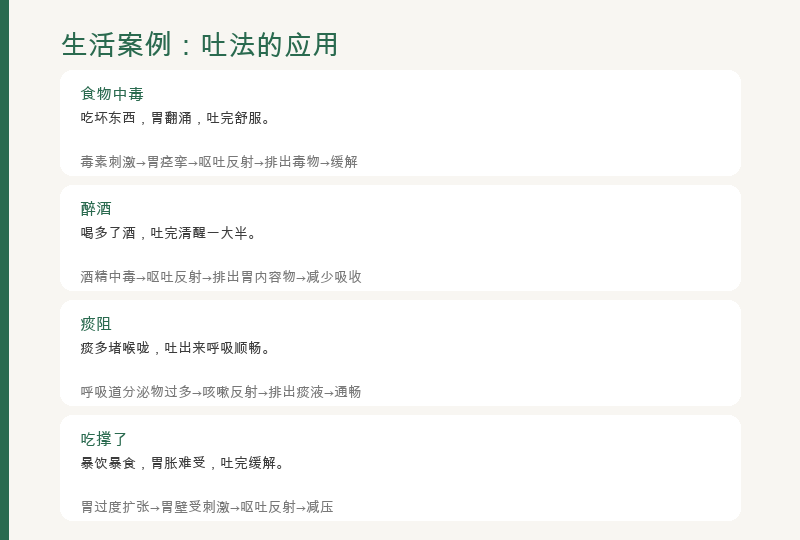
Case 1: Food Poisoning (Emergency Drain).
You eat spoiled seafood, and half an hour later your stomach is churning, you vomit everything clean, and then your symptoms ease. You ask: "Why do I feel better after vomiting?"
Truth: The toxin is in the stomach and has not yet been absorbed in large amounts. Vomiting expels most of the toxin, reducing toxin entry into the blood. TCM says "when evil is in the upper stomach, vomiting resolves it" — the toxin is in the stomach, vomiting it out is good. If you wait until the toxin is absorbed, the emetic method is useless. It is not that "vomiting cures all diseases" — it is that when the toxin is in the stomach, vomiting is the most effective. Modern emergency medicine uses "gastric lavage," with exactly the same logic.
Case 2: Retained Food Stagnation (Gastric Emptying Disorder).
You overeat during the holidays, your stomach is swollen like a drum, and you feel nauseous and want to vomit. After vomiting, your stomach feels much better. TCM says "retained food stagnation, vomiting cures it." You ask: "Why does vomiting relieve stomach bloating?"
Truth: This is gastric emptying disorder. Too much food in the stomach slows gastric emptying, increases gastric pressure, causing fullness, nausea, and vomiting. Vomiting expels stomach contents, reducing gastric pressure and relieving symptoms. It is not that "vomiting is a problem" — it is the body's self-protection mechanism helping you reduce the burden. TCM says "when retained food is in the upper body, vomiting cures it" — precisely describing the stomach's self-protection.
Case 3: Phlegm Congestion (Upper Respiratory Tract Obstruction).
Your grandfather had a stroke, is unconscious, and phlegm blocks his throat, with a gurgling sound when breathing. The doctor uses a suction device to suck out the phlegm, and breathing becomes smooth. TCM says "when phlegm obstructs the throat, it is appropriate to vomit." You ask: "Are suctioning and the emetic method the same thing?"
Truth: This is upper respiratory tract secretion obstruction. Coma patients have weakened cough reflexes, and secretions accumulate in the throat, obstructing the airway. Suctioning (or postural drainage) clears secretions, restoring ventilation. TCM says "when the disease is in the chest, it is appropriate to vomit" — "vomiting" here refers to expelling upper burner secretions. It is not that "the emetic method can only be used for the stomach" — it is that upper burner secretions must be expelled from above.
Case 4: Post-Drinking Induced Vomiting (Myth).
Your friend drank too much, and you persuade him to "just vomit it out," using your finger to induce vomiting. After vomiting, his stomach feels even worse, and the next day his esophagus is burning. You ask: "Why does induced vomiting make it worse?"
Truth: This is when alcohol has already entered the blood. Alcohol is absorbed quickly, and the amount remaining in the stomach is already small, so induced vomiting has limited effect. But induced vomiting causes gastric acid reflux, corroding the esophageal mucosa and causing esophagitis. Frequent induced vomiting can also lead to cardia tearing (Mallory-Weiss syndrome). It is not that "when you drink too much, you should vomit" — it is that once alcohol is absorbed, vomiting is useless and damages the stomach. TCM says "the emetic method is forceful and should not be used frequently" — precisely describing the risks of induced vomiting.
Four cases, one underlying logic: vomiting is the body's emergency drain — effective when the pathogen is still shallow, useless when the pathogen has penetrated deeply, and frequent use harms the body.
Part 5Modern Research
Is there scientific research on "vomiting"?
Yes, and the vomiting reflex is an important part of modern emergency medicine. Scientists do not use the term "emetic method"; they use:
• Vomiting Reflex Mechanism. Vomiting is controlled by the medullary vomiting center, receiving signals from the gastrointestinal tract, vestibular system, and cerebral cortex. Gastric wall receptors are stimulated (such as by toxins or distension), signals are transmitted to the vomiting center, activating the diaphragm, abdominal muscles, and stomach muscles, forcefully expelling stomach contents. This is a defensive reflex of the body.
• Gastric Lavage and Toxin Removal. Modern emergency medicine's standard treatment for oral poisoning is: before the toxin is absorbed (usually within 1–2 hours), perform gastric lavage. Gastric lavage dilutes and expels the toxin by infusing fluid through a gastric tube — logic completely consistent with TCM's "emetic method," just more gentle and controllable. Studies show that gastric lavage is effective for early toxin removal, but ineffective for already absorbed toxins.
• Side Effects of Induced Vomiting. Frequent induced vomiting leads to loss of gastric acid (hypochloremic metabolic alkalosis), electrolyte imbalance (hypokalemia), esophageal cardia tearing (Mallory-Weiss syndrome), esophagitis, and enamel corrosion. These side effects are completely consistent with TCM's description of "emetic method harms righteous Qi."
These studies fully demonstrate that "vomiting" is a concept that can be precisely described using modern scientific language. The ancients used "Gua Di San" to induce vomiting, and modern people use "gastric lavage" to detoxify — the core logic is the same: when the pathogen is still shallow, expel harmful substances as an emergency measure.
Part 6Practical Methods
Now that you understand vomiting, how do you use it?
First, let's bust a few myths:
• "Inducing vomiting after eating too much can help you lose weight." This is an extremely dangerous practice. Frequent induced vomiting leads to gastric acid corroding the esophagus, enamel damage, electrolyte imbalance, and esophageal cardia tearing. Anorexics often use induced vomiting, with severe consequences. It is not that "vomiting it out means you won't get fat" — it is that induced vomiting harms the body; weight loss should rely on diet and exercise.
• "For food poisoning, just induce vomiting yourself." Self-induced vomiting carries risks — possible aspiration (vomitus entering the trachea causing suffocation), esophageal tearing, and electrolyte imbalance. Food poisoning should be treated immediately by a doctor, who will determine whether gastric lavage is needed. It is not that "self-induced vomiting saves trouble" — it is that professional treatment is safer.
Specific methods:
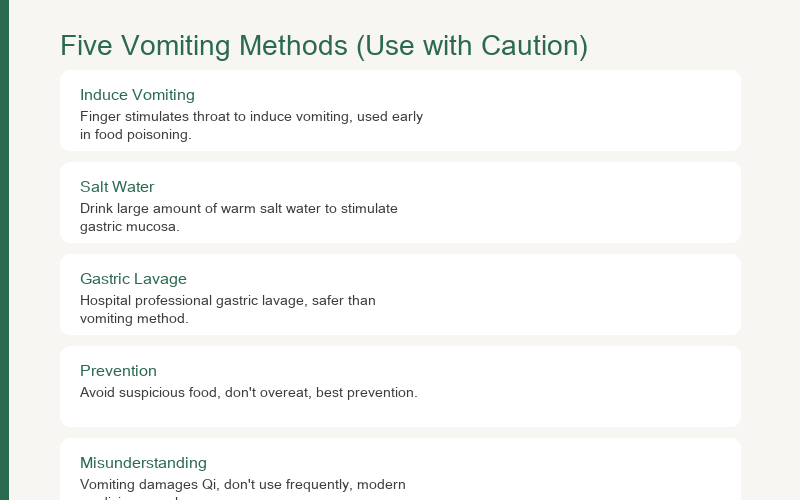
• Food Poisoning: Seek Medical Attention Immediately, Do Not Self-Induce Vomiting. If the toxin has just entered the stomach (within 1 hour), the doctor may choose gastric lavage. If the toxin has already been absorbed, gastric lavage is ineffective, and other detoxification measures are needed. Do not self-induce vomiting to avoid aspiration.
• Retained Food Stagnation: First Let the Body Regulate Naturally. After overeating, the body usually vomits naturally (self-protection). Do not forcibly suppress vomiting; let the stomach expel the excess. After vomiting, fast for 4–6 hours to let the stomach rest. Then drink a small amount of warm water or rice soup, gradually restoring diet.
• Phlegm Congestion: Postural Drainage + Suctioning. For unconscious or frail patients, when phlegm blocks the airway, use the lateral position to utilize gravity to drain secretions. Family members or caregivers can use a suction device to help clear them. This is the modern version of "diseases in the upper body should be treated by vomiting."
• Understand the Logic of "Diseases in the Upper Body Should Be Treated by Vomiting," Do Not Abuse the Emetic Method. The emetic method is only used in emergencies (toxin just entered the stomach, phlegm congestion). For daily discomfort, do not use the emetic method. The emetic method is forceful and harms stomach Qi. It is not that "the emetic method is a cure-all" — it is that understand the logic, use it cautiously.
• Nourish Stomach Qi, Avoid Situations Requiring the Emetic Method. Do not overeat, do not eat unclean food, maintain dietary regularity — this is the best "prevention of the emetic method." TCM says "the best doctor prevents illness" — the best doctor is the one who makes you not need the emetic method.
These methods do not require you to become a TCM doctor. You only need to understand: vomiting is the body's emergency drain — effective in emergencies, but frequent use harms the body.
Part 7One-Minute Summary
🕐 Understand "Vomiting" in One Minute
Vomiting = the Body's Emergency Drain + Safety Valve.
The emetic method expels phlegm-rheum, retained food, and toxins from the stomach and upper burner through vomiting. Food poisoning, phlegm obstructing the throat, retained food stagnation — using the emetic method is like pressing an emergency drain button.
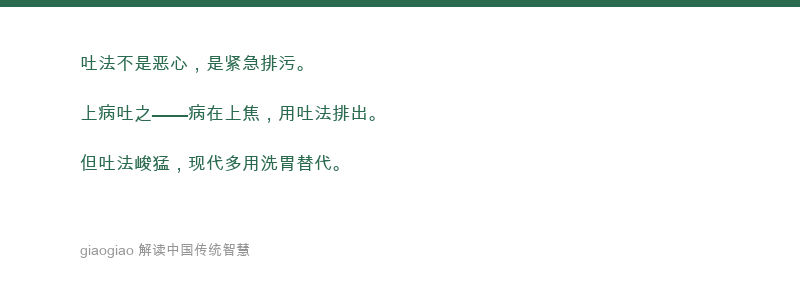
The emetic method is forceful, rarely used in modern times (replaced by gastric lavage), but understanding the logic of "diseases in the upper body should be treated by vomiting" is important.
Food poisoning emetic method = toxin not yet absorbed, emergency expulsion.
Retained food stagnation emetic method = gastric emptying disorder, expelling to reduce pressure.
Phlegm congestion emetic method = upper respiratory tract obstruction, clearing secretions.
Myths: inducing vomiting to lose weight after overeating, self-induced vomiting for food poisoning.
Methods: food poisoning medical care, retained food natural regulation, phlegm postural drainage, understand logic and do not abuse, nourish stomach to prevent.
The ancients called it the "emetic method"; modern people call it "gastric lavage + postural drainage."
Different names, but medicine knows: when the pathogen is in the upper body, expel at the nearest exit; when the pathogen has penetrated deeply, the emetic method is useless.
The ancients had no gastric lavage machine, but they knew "what is high, lift it over and out."
This is probably the simplest wisdom of the Chinese people: vomiting is an emergency button — press it right, it saves lives; press it wrong, it harms the body.
Making money is the art of living; art is the life after making money.
giaogiao Decodes Chinese Traditional Wisdom · Concept 62
Using modern scientific language to help the world understand Chinese traditional wisdom.
No mysticism, no superstition, no belittlement.
Understanding, rather than merely believing.
Coach Liu
Written in Florence