Zhi (zhì) — Emotional States: The Thermometer of the Mind
Part 1A Question
Have you ever noticed that after a violent outburst of anger, you get a headache and your blood pressure spikes? After excessive grief, you feel completely drained, as if the air has been sucked out of you? After prolonged fear, your lower back and knees grow weak, and you find yourself urinating frequently at night?
Have you noticed that emotions aren't just "psychological problems" — they're written directly on your body? When you're stressed, your stomach hurts. When you're anxious, you can't sleep. When you're depressed, your immunity drops. When you're happy, wounds heal faster. Even crazier, modern medicine's terms like "psychoneuroimmunology (PNI)," "HPA axis," "stress hormones (cortisol)," and "emotions and inflammatory cytokines" are actually describing the same thing as Chinese medicine's "the seven emotions injuring the internal organs" and "emotional states causing disease"?
You ask: What exactly are Chinese medicine's "zhi" and "emotional states"? Are they psychology? Psychiatry? Autonomic nervous system dysfunction? Or some mysterious "emotions injuring the internal organs"? If "emotional states" are real, why doesn't Western medicine have concepts like "joy injures the heart" or "anger injures the liver," but instead talks about "stress response," "neuroendocrine disorders," and "inflammatory reactions"?
There's another question: Why does Chinese medicine divide emotions into "seven emotions" — joy, anger, worry, pensiveness, grief, fear, and fright — with each emotion corresponding to an internal organ? Is this the ancients' imagination, or is there really a physiological correspondence? Why does "pensiveness injures the spleen," "grief injures the lungs," and "fear injures the kidneys" — is there really a channel between emotions and internal organs?
What exactly is zhi? Is it the ancients' naive observation of "emotions affecting the body," or is it a body-mind mechanism that can be precisely explained by modern science?
Part 2Traditional Chinese Explanation
The concept of "zhi" and "emotional states" is absolutely central in Chinese medicine. It's not just "emotions" in the ordinary sense — it's a "body-mind unity" disease factor called "the seven emotions injuring the internal organs."
— Huangdi Neijing · Suwen
"The seven emotions injuring the internal organs, when any one is excessively dominant, causes the organ qi to become unbalanced."
— Yizong Jinjian
"The heart is the monarch's organ, from which the spirit shines forth."
— Huangdi Neijing · Suwen
The ancients observed that emotions and the body are deeply bound — when emotions are not good, the internal organs are injured; when the internal organs' functions are disordered, emotions also go wrong. This is not "psychological effect," but real physiological damage. This state is called "emotional states causing disease" and "the seven emotions injuring the internal organs."
Zhi = Emotional States = The Thermometer of the Mind = The correspondence between emotions and internal organs. The "seven emotions" in Chinese medicine include:
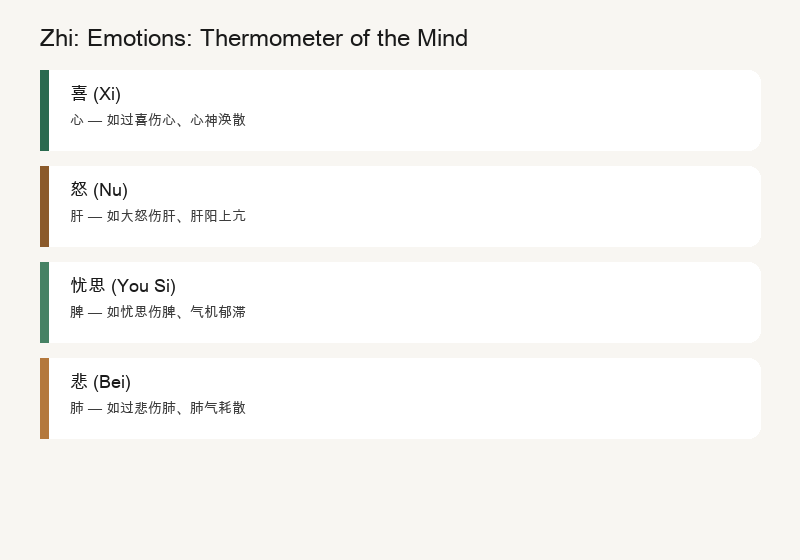
Joy (Heart): Excessive joy injures the heart — the heart spirit becomes scattered, concentration is lost, and in extreme cases, there is mental derangement. Moderate joy is beneficial, but excess is harmful.
Anger (Liver): Great anger injures the liver — liver qi rebels upward, the face turns red and the eyes become bloodshot, there is headache and dizziness, and in extreme cases, vomiting of blood. Violent anger is a "high-pressure event" for the liver.
Worry (Lungs): Worry and grief injure the lungs — worry causes the lung qi to become constrained and closed, qi movement is unsmooth, causing chest tightness, shortness of breath, cough, and weak voice.
Pensiveness (Spleen): Excessive pensiveness injures the spleen — overthinking causes the spleen qi to become knotted, transformation and transportation are abnormal, leading to loss of appetite, abdominal bloating, insomnia, and emaciation.
Grief (Lungs): Excessive grief injures the lungs — grief consumes lung qi, the lung qi becomes dissipated, causing fatigue, shortness of breath, depression of will, and decreased immunity.
Fear (Kidneys): Fear and fright injure the kidneys — fear causes kidney qi to become unstable, essence qi leaks downward, causing lower back soreness, weak legs, nocturnal emission, frequent urination, and diarrhea.
Fright (Heart/Kidneys): Fright causes qi chaos — sudden fright makes the heart spirit unstable and kidney qi unsteady, causing palpitations, insomnia, and incontinence of urine and stool.
So, what the ancients called "emotional states" is not just "emotional management" — it's the precise physiological effect of emotions on the internal organs, a pathological mechanism of the unity of body and mind. It can be acute onset (stroke after violent anger, palpitations after fright), or chronic damage (long-term depression injuring the lungs, long-term anxiety injuring the spleen).
But Chinese medicine has a core principle: the heart governs the spirit and is the monarch's organ. In Chinese medicine theory, the heart is not only the organ of blood circulation, but also the master of mental activities. All emotions ultimately affect the "heart" — when the heart spirit is calm, the seven emotions can be regulated; when the heart spirit is restless, all kinds of diseases arise. Therefore, regulating emotional states must first "nourish the heart and calm the spirit" — restore the heart's governing function. It's not simply "controlling emotions," it's nourishing the heart and calming the spirit + soothing the liver and regulating qi + regulating the spleen and benefiting the kidneys + overall harmonization.
Part 3giaogiao Modern Translation
Okay, now let's translate "zhi" and "emotional states" into modern language.
I'm not going to talk about psychoneuroimmunology, neuroendocrinology, or the autonomic nervous system. Too complicated. You just need to remember one metaphor:
Joy injuring the heart = Excessive dopamine/endorphin release + abnormal heart rate variability + dissipation of the heart spirit
Anger injuring the liver = Excessive sympathetic nervous activation + catecholamine (adrenaline/noradrenaline) surge + blood pressure rise + inflammatory cytokine release
Pensiveness injuring the spleen = Brain-gut axis disorder + abnormal gastric acid secretion + abnormal gastrointestinal motility + reduced digestive enzymes
Grief injuring the lungs = Decreased serotonin levels + immune function suppression + altered breathing pattern (shallow, rapid breathing) + elevated inflammatory cytokines
Fear injuring the kidneys = Excessive HPA axis activation + cortisol surge + altered renal blood flow + pelvic floor/sphincter dysfunction
Fright injuring the heart and kidneys = Excessive amygdala activation + sudden drop in vagal tone + abrupt heart rate change + stress hormone burst
Regulating emotional states = Regulating the HPA axis + Balancing the autonomic nervous system + Improving the brain-gut axis + Psychoimmune modulation + Cognitive-behavioral restructuring
It's that simple. "Zhi" and "emotional states" are essentially the thermometer of the mind — emotions precisely affecting the physiological state of specific organs and systems through the neuro-endocrine-immune network. The ancients described it with "joy injures the heart, anger injures the liver, pensiveness injures the spleen, grief injures the lungs, fear injures the kidneys," while modern people describe it with "psychoneuroimmunology (PNI), HPA axis, autonomic nervous system, brain-gut axis, inflammatory cytokines" — the core logic is consistent: emotions are the body's language, written on the internal organs.
Specifically:
What does "joy injuring the heart" correspond to? It corresponds to cardiovascular and nervous system stress caused by excessive emotional excitement. Excessive joy (such as ecstasy, surprise-induced excitement) causes large amounts of dopamine and endorphins to be released, leading to accelerated heart rate, blood pressure fluctuations, and dissipation of the heart spirit. In extreme cases, excessive excitement can cause cardiac events (such as Takotsubo cardiomyopathy, or "broken heart syndrome"). It's not "joy injuring the heart" mysticism — it's the real effect of emotional stress on the cardiovascular system. Modern research: 90% of Takotsubo cardiomyopathy cases are triggered by emotional stress (mostly negative, but positive surprises can also trigger), manifesting as acute left ventricular dysfunction, with symptoms similar to myocardial infarction, but no coronary artery blockage.
What does "anger injuring the liver" correspond to? It corresponds to excessive sympathetic nervous activation and inflammatory response triggered by anger. Violent anger causes catecholamines (adrenaline, noradrenaline) to surge 10-100 times within seconds, leading to: sharp blood pressure rise, accelerated heart rate, vasoconstriction, increased platelet aggregation. At the same time, anger activates inflammatory cytokines (IL-6, TNF-α, CRP) release, attacking the vascular endothelium. It's not "anger injuring the liver" mysticism — it's real damage to the cardiovascular and immune systems caused by anger. Modern research: Within 2 hours after an anger outburst, the risk of myocardial infarction increases 4.7-fold, and the risk of stroke increases 3.6-fold. Long-term hostile personality has a 2-3 times higher risk of coronary heart disease.
What does "pensiveness injuring the spleen" correspond to? It corresponds to brain-gut axis disorder caused by excessive pensiveness. Overthinking causes the cerebral cortex to remain continuously excited, inhibiting the hypothalamic appetite center and gastrointestinal regulation center. At the same time, anxious pensiveness activates CRF (corticotropin-releasing factor), inhibiting gastric emptying, reducing gastric acid and digestive enzyme secretion, leading to loss of appetite, bloating, constipation or diarrhea. It's not "pensiveness injuring the spleen" mysticism — it's the precise neuro-endocrine mechanism of the brain-gut axis. Modern research: 70% of functional dyspepsia patients have anxiety or depression; long-term anxiety is associated with significantly reduced gut microbiome diversity and decreased short-chain fatty acid (SCFA) production.
What does "grief injuring the lungs" correspond to? It corresponds to immune suppression and altered breathing pattern caused by grief. Grief causes decreased serotonin (5-HT) levels, weakened immune cell (NK cells, T cells) function, and elevated inflammatory cytokines (IL-6, CRP). At the same time, grief alters the breathing pattern — shallow, rapid breathing (hyperventilation) causes excessive carbon dioxide excretion, elevated blood pH, leading to dizziness, fatigue, and numbness in hands and feet. It's not "grief injuring the lungs" mysticism — it's the dual effect of emotions on the respiratory and immune systems. Modern research: Immune suppression after bereavement can last for months, with flu vaccine antibody response reduced by 30-50%. Chronic grief has inflammatory markers 40% higher than normal.
What does "fear injuring the kidneys" correspond to? It corresponds to excessive HPA axis activation and pelvic floor dysfunction triggered by fear. Fear causes the HPA axis to burst instantly, cortisol levels surge within minutes, leading to altered renal blood flow and changes in glomerular filtration rate. At the same time, fear activates tension in the pelvic floor muscles and sphincters, causing frequent urination, urgency, and even incontinence. Long-term fear (such as PTSD) causes chronic HPA axis dysregulation, disrupted cortisol rhythms, leading to: decreased immune function, bone loss (cortisol inhibits osteoblasts), muscle breakdown, and cognitive decline. It's not "fear injuring the kidneys" mysticism — it's the precise effect of fear on the neuroendocrine and urinary systems. Modern research: PTSD patients have abnormal cortisol awakening response (CAR), bone density 5-10% lower than normal, and chronic lower back pain incidence 3 times higher than normal.
So, "zhi" and "emotional states" are not mysticism. They are simply the thermometer of the mind — emotions precisely affecting the physiological state of specific organs and systems through the neuro-endocrine-immune network. The ancients described it with "the seven emotions injuring the internal organs," while modern people describe it with "psychoneuroimmunology, HPA axis, autonomic nervous system, inflammatory cytokines" — the core logic is consistent: emotions are the body's language, written on the internal organs, with different emotions written on different organs.
Part 4Real-Life Cases
Four real-life stories, to make you instantly understand what "zhi" and "emotional states" are.
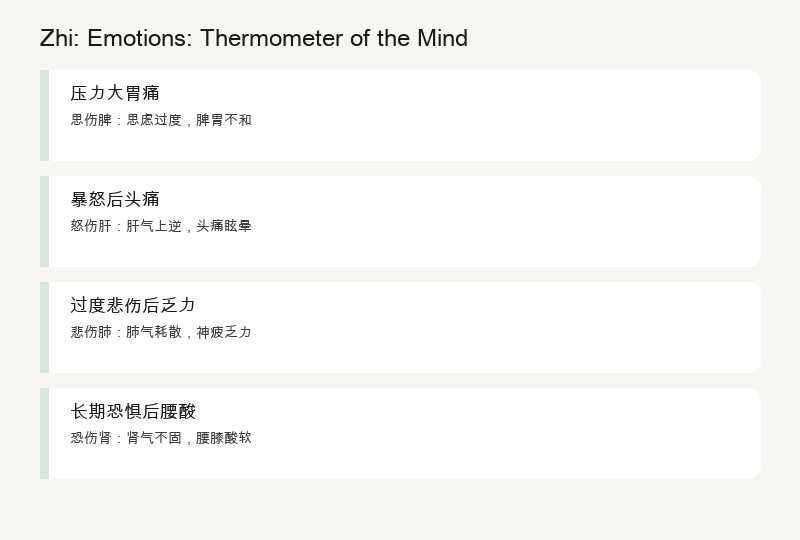
Case One: Pensiveness Injuring the Spleen (Stress-Induced Stomach Pain).
You've been under heavy work pressure lately, a project deadline is approaching, and your mind keeps running through solutions, risk assessment, and cost calculations. Strangely, it's not exhaustion that gets you — it's your stomach that acts up first: bloating, belching, no appetite, feeling full after a few bites, but hungry again shortly after. You ask: "Why does stress cause stomach problems first?"
Truth: This is a classic case of "pensiveness injuring the spleen" — brain-gut axis disorder. Excessive pensiveness causes the cerebral cortex to remain continuously excited, inhibiting gastrointestinal function through the vagus nerve and hypothalamus: elevated CRF (corticotropin-releasing factor), inhibiting gastric emptying and digestive enzyme secretion; excessive sympathetic activation, parasympathetic inhibition, slowed gastrointestinal motility; gut microbiome changes under stress, with increased gas-producing bacteria causing bloating. It's not "thinking too much hurts the stomach" mysticism — it's the precise neuro-endocrine mechanism of the brain-gut axis. Modern research: 70% of functional dyspepsia patients have anxiety or depression; stress can prolong gastric emptying time by 30-50%, and increase intestinal permeability (leaky gut). IBS (irritable bowel syndrome) patients, 50% have anxiety or depression — a modern version of "pensiveness injuring the spleen."
Case Two: Anger Injuring the Liver (Headache After Violent Rage).
You had a huge argument with a business partner, they were being unreasonable, and you exploded on the spot, slammed the table, and walked out. Half an hour later, you find yourself with a splitting headache, red face, racing heart, and blood pressure spiked to 160/100. You ask: "Why does anger cause headache and high blood pressure?"
Truth: This is a classic case of "anger injuring the liver" — excessive sympathetic nervous activation. Violent anger causes catecholamines (adrenaline, noradrenaline) to surge 10-100 times within seconds, leading to: systemic vasoconstriction (blood pressure rise), cerebral vasoconstriction (headache), accelerated heart rate (palpitations), increased platelet aggregation (thrombosis risk). At the same time, anger activates inflammatory cytokine release, attacking the vascular endothelium. It's not "being in a huff" mysticism — it's real damage to the cardiovascular system caused by anger. Modern research: Within 2 hours after an anger outburst, myocardial infarction risk increases 4.7-fold, stroke risk increases 3.6-fold. Japanese research: During anger, systolic blood pressure can rise 30-50 mmHg, lasting for several hours. Long-term angry individuals have carotid intima-media thickness (IMT) 20% thicker than normal, an early sign of atherosclerosis.
Case Three: Grief Injuring the Lungs (Weakness After Excessive Grief).
You experienced the loss of a loved one, and for two weeks were immersed in grief. You find that not only is your mood low, but your whole body is weak, you catch colds easily, and you get short of breath with slight activity, breathing shallowly and rapidly. You ask: "Why does grief make the body weak?"
Truth: This is a classic case of "grief injuring the lungs" — immune suppression + altered breathing pattern. Grief causes decreased serotonin (5-HT) levels, hypothalamic-pituitary-adrenal (HPA) axis dysregulation, abnormal cortisol rhythms, leading to decreased NK cell (natural killer cell) activity, weakened T cell function, and reduced antibody production. At the same time, grief alters the breathing pattern to shallow, rapid breathing (hyperventilation), excessive carbon dioxide excretion, elevated blood pH (respiratory alkalosis), leading to: dizziness, fatigue, numbness in hands and feet, muscle weakness. It's not "a broken heart hurts the body" mysticism — it's the dual blow of grief to the immune and respiratory systems. Modern research: Within 6 months after bereavement, immune suppression can persist, with flu vaccine antibody response reduced by 30-50%, and infection risk significantly increased. Chronic grief has IL-6 levels 40% higher than normal, accelerating inflammaging.
Case Four: Fear Injuring the Kidneys (Lower Back Soreness After Long-Term Fear).
You've been living in an unsafe environment for a long time (such as domestic violence, workplace bullying, financial pressure), and every day you're on tenterhooks. After a few months, you find yourself with sore lower back, weak legs, frequent night urination, poor sleep quality, and decreased memory. You ask: "Why does long-term fear hurt the lower back and kidneys?"
Truth: This is a classic case of "fear injuring the kidneys" — chronic HPA axis dysregulation + pelvic floor dysfunction. Long-term fear causes the HPA axis to remain continuously activated, with persistently high cortisol levels, leading to: decreased renal blood flow (lower back soreness), bone loss (cortisol inhibits osteoblasts), muscle breakdown (cortisol promotes protein catabolism), and immune suppression. At the same time, fear causes continuous tension in the pelvic floor muscles, leading to frequent urination and urgency. It's not "scared out of one's wits" mysticism — it's the chronic damage of fear to the neuroendocrine and musculoskeletal systems. Modern research: PTSD patients have abnormal cortisol rhythms, bone density 5-10% lower than normal, and chronic pain (especially lower back pain) incidence 3 times higher than normal. Long-term fear also causes hippocampal volume shrinkage (memory center damage), leading to decreased memory.
Four cases, one underlying logic: Zhi is "the thermometer of the mind" — different emotions precisely affect different organs and systems through the neuro-endocrine-immune network. It's not a vague statement that "emotions hurt the body," but a measurable, locatable, and intervenable physiological mechanism.
Part 5Modern Research
Does "zhi" and "emotional states" have scientific research?
Yes, and it's very abundant. Scientists don't use terms like "seven emotions" or "emotional states," they use "psychoneuroimmunology (PNI)," "HPA axis," "autonomic nervous system," "inflammatory cytokines," and "heart rate variability (HRV)":
• Psychoneuroimmunology (PNI) and "emotional states causing disease". Modern psychoneuroimmunology confirms that emotions precisely affect immune function through the neuro-endocrine-immune network. Positive emotions (optimism, gratitude, social connection) boost immunity (increased NK cell activity, enhanced vaccine antibody response), while negative emotions (anger, depression, loneliness) suppress immunity (elevated inflammatory cytokines, weakened antiviral capacity). What Chinese medicine calls "the seven emotions injuring the internal organs" corresponds to PNI's "emotion-immune interaction" — not mysticism, but molecular-level precise mechanisms. Modern research: Chronic caregivers of dementia patients (chronic stress) have flu vaccine antibody response 50% lower than normal. Positive emotion intervention (such as gratitude journaling) can increase salivary IgA levels within 4 weeks.
• HPA axis and "fear injuring the kidneys" / "pensiveness injuring the spleen". Modern research confirms that the HPA axis is the core pathway through which emotions affect the body. Fear, anxiety, and chronic stress activate the HPA axis, with abnormal cortisol levels (too high or too low), affecting: immune function, metabolic balance, bone health, cognitive function, and emotional regulation. What Chinese medicine calls "fear injuring the kidneys" (fear damaging the kidneys) corresponds to the effect of HPA axis dysregulation on the kidneys and the whole body — not mysticism, but a pathological state with clear neuroendocrine mechanisms. Modern research: PTSD patients have abnormal HPA axis feedback regulation, with dexamethasone suppression test (DST) abnormality rates as high as 70%. Chronic stress workers have cortisol awakening response (CAR) 40% higher than normal, closely related to burnout and depression.
• Heart rate variability (HRV) and "emotional states disorder". HRV is the gold standard for assessing autonomic nervous function, and also a biomarker of emotional regulation capacity. High HRV indicates flexible autonomic nerves (strong emotional regulation capacity), low HRV indicates rigid autonomic nerves (emotions easily out of control). Chronic anger, anxiety, and depression are associated with significantly reduced HRV. What Chinese medicine calls "emotional states not flowing smoothly" and "qi mechanism disorder" corresponds to reduced HRV — not mysticism, but a measurable indicator of the autonomic nervous system. Modern research: Depression patients have HRV 20-30% lower than normal, and HRV training (such as breathing exercises, meditation) can improve depression and anxiety symptoms. Hostile personality has HRV 15-20% lower than normal personality.
• Inflammatory markers (CRP/IL-6) and "emotional states transforming into fire". Modern research confirms that chronic negative emotions (anger, depression, loneliness) elevate inflammatory cytokines (CRP, IL-6, TNF-α), which attack tissues throughout the body, leading to: cardiovascular disease, diabetes, cognitive decline, and accelerated aging. What Chinese medicine calls "emotional states transforming into fire" and "long-term stagnation transforming into fire" corresponds to chronic elevation of inflammatory cytokines — not mysticism, but the precise mechanism of psychoneuroimmunology. Modern research: Chronic anger has CRP levels 50-100% higher than normal. Depression patients have IL-6 levels 40-60% higher than normal. Anti-inflammatory treatment (such as Omega-3 supplementation) can improve some depressive symptoms.
These studies fully demonstrate that "zhi" and "emotional states" is a concept that can be precisely described in modern scientific language. The ancients described it with "joy injures the heart, anger injures the liver, pensiveness injures the spleen, grief injures the lungs, fear injures the kidneys," while modern people describe it with "psychoneuroimmunology, HPA axis, autonomic nervous system, inflammatory cytokines" — the core logic is consistent: emotions are the body's language, written on the internal organs, with different emotions written on different organs.
Part 6Practical Methods
Now that you understand "zhi" and "emotional states," how do you regulate them?
First, let's debunk a few myths:
• "Emotional problems are personality problems, can't be changed". Emotional regulation capacity is not innate, it can be trained. Neuroplasticity tells us that the brain can change neural circuits through training. It's not "personality determines destiny," but neuroplasticity training.
• "Regulating emotions means just thinking it through". Emotional regulation is not simply "thinking it through," but a long-term process of changing neural circuits. It requires systematic methods: cognitive restructuring, emotional awareness, body relaxation, and behavioral activation. It's not "think it through" mysticism, but psychological training based on neuroscience.
• "Emotional problems only affect the mind, not the body". Emotional states are the unity of body and mind — emotional problems are directly written on the body (headache, stomach pain, insomnia, decreased immunity). Conversely, improving the body (exercise, sleep, diet) can also improve emotions. It's not "mind-body separation," but treating body and mind together.
Specific methods:
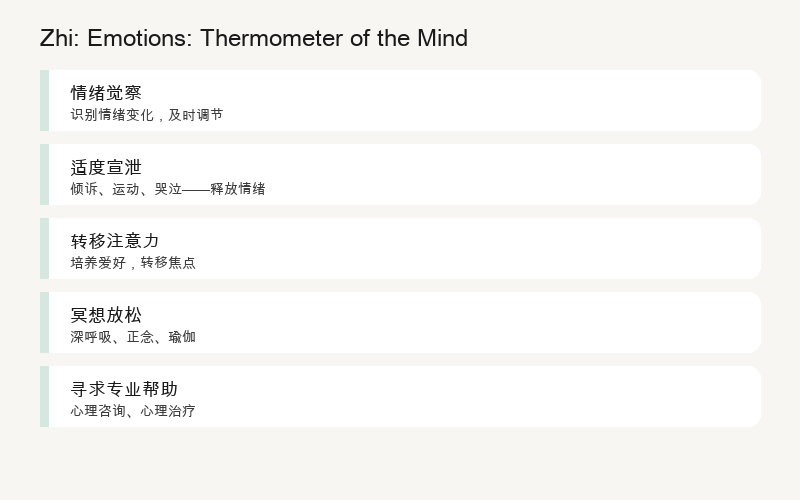
• Emotional Awareness: Recognize Your "Emotional Thermometer". The first step is awareness — knowing what emotion you're feeling right now, and where that emotion is located in your body. Anger is in the head (headache, red face), pensiveness is in the stomach (bloating, loss of appetite), grief is in the chest (chest tightness, shortness of breath), fear is in the lower back (soreness, weak legs). Spend 5 minutes a day doing an "emotional body scan": close your eyes, become aware of the present emotion, and feel where it is in your body. It's not "introspection" mysticism, but interoception training, enhancing emotional recognition capacity. Modern research: People with high interoception capacity have stronger emotional regulation and lower anxiety levels. Mindfulness training for 8 weeks can significantly improve interoception accuracy.
• Moderate Venting: Don't Let Emotions "Get Stuck" in the Body. Emotions need an outlet — long-term suppressed anger (anger-in) is more harmful to the body than moderate expression of anger. People who suppress anger have blood viscosity 25% higher than normal, and coronary heart disease risk 2 times higher than normal. Healthy venting methods: exercise (releases endorphins), writing (expressive writing), confiding (social support), and artistic expression (painting, music). It's not "venting is good enough," but safe emotional release, avoiding harm to the body. Modern research: Expressive writing (15 minutes a day, for 4 consecutive days) can reduce inflammatory cytokines (CRP, IL-6) by 20-30%, and boost immune function.
• Shift Attention: Interrupt the Vicious Cycle of Emotions. When emotions fall into a negative cycle, actively shifting attention is an effective way to interrupt the cycle. Note: it's not "escapism," but "conscious redirection" — do something that requires focused attention (exercise, cooking, crafts, reading, musical instrument), allowing the brain to break free from emotional rumination. It's not "stop thinking about it," but cognitive redirection, changing neural activation patterns. Modern research: Attention shifting can significantly reduce amygdala (fear center) activation levels within 10-20 minutes, and reduce emotional rumination.
• Meditation and Relaxation: Regulate the HPA Axis and Autonomic Nervous System. Mindfulness meditation (10-20 minutes a day) can regulate the HPA axis, lower cortisol, improve HRV, and enhance prefrontal regulation of the amygdala. Progressive muscle relaxation (PMR) can relieve body tension and lower sympathetic nervous excitation. It's not "meditation" mysticism, but autonomic nervous training based on neuroscience. Modern research: 8 weeks of mindfulness training reduces cortisol levels by 15-20%, improves HRV by 20-30%, and reduces depression relapse rate by 50%. MBCT (Mindfulness-Based Cognitive Therapy) is as effective as medication for preventing depression relapse.
• Seek Professional Help: Don't Tough It Out Alone. If emotional problems persist for more than two weeks, seriously affect work and life, or are accompanied by suicidal thoughts, please seek professional help. Psychologists (CBT, ACT, DBT and other therapies) and psychiatrists (medication when necessary) are both effective resources. It's not "weakness," but wisely using professional resources. Modern research: CBT (cognitive behavioral therapy) has an effectiveness rate of over 60% for mild to moderate depression, comparable to medication but without side effects. Early intervention can significantly improve prognosis and prevent chronicity.
• Overall Strategy: Cognitive Behavioral Therapy (CBT) + Mindfulness + Exercise + Sleep. CBT helps you identify and change negative thought patterns, breaking the vicious cycle of "emotion-body-behavior." Mindfulness training helps you become aware of the present moment, reducing automatic reactions to negative emotions. Regular exercise (150 minutes of moderate intensity per week) lowers cortisol, boosts BDNF, and improves HRV. Adequate sleep (7-8 hours) is the "system repair time" for emotional regulation. Combined, these are the most effective emotional regulation programs. It's not "think it through," but systematic training based on neuroplasticity.
These methods don't require you to become a psychologist. You just need to understand: Zhi is "the thermometer of the mind" — what you need to do is learn to read the temperature (emotional awareness), cool down (moderate venting + attention shifting), calibrate (meditation and relaxation), and when necessary, call in a professional for maintenance (seek help).
Part 6 (Continued)Practical Methods: Five Ways to Regulate Emotional States
Part 7One-Minute Summary
🕐 One-Minute Understanding of "Zhi"
Zhi = The Thermometer of the Mind = The precise mechanism by which emotions affect the body through the neuro-endocrine-immune network.
What Chinese medicine calls "the seven emotions injuring the internal organs" is not simply "bad emotions," but the real physiological effect of emotions on the internal organs, a pathological mechanism of the unity of body and mind.
Joy injuring the heart = Excessive dopamine/endorphin release + cardiovascular stress (Takotsubo cardiomyopathy).
Anger injuring the liver = Excessive sympathetic nervous activation + catecholamine surge + blood pressure rise + inflammatory cytokine release.
Pensiveness injuring the spleen = Brain-gut axis disorder + reduced digestive enzymes + abnormal gastrointestinal motility.
Grief injuring the lungs = Decreased serotonin + immune suppression + shallow, rapid breathing + elevated inflammatory cytokines.
Fear injuring the kidneys = Excessive HPA axis activation + cortisol surge + bone loss + pelvic floor dysfunction.
Fright injuring the heart and kidneys = Excessive amygdala activation + sudden drop in vagal tone + stress hormone burst.
Myths: Emotional problems are personality problems that can't be changed; regulating emotions means just thinking it through; emotions only affect the mind, not the body.
Methods: Emotional awareness (body scan) to read the thermometer; moderate venting (exercise/writing/confiding) to release pressure; attention shifting to interrupt the vicious cycle; meditation and relaxation (mindfulness/PMR) to regulate the HPA axis and autonomic nervous system; seek professional help (CBT/medication) instead of toughing it out alone.
The ancients called it "joy injures the heart, anger injures the liver, pensiveness injures the spleen, grief injures the lungs, fear injures the kidneys," while modern people call it "psychoneuroimmunology, HPA axis, autonomic nervous system, inflammatory cytokines."
Different names, but medicine knows: emotions are the body's language, written on the internal organs.
Regulating emotional states is not "thinking it through," but learning to read what the body is saying.
The ancients didn't have words like psychoneuroimmunology, HPA axis, or inflammatory cytokines, but they knew that "anger makes qi rise, joy makes qi slow, grief makes qi dissipate, fear makes qi descend, fright makes qi chaotic, pensiveness makes qi knot."
This is probably the most朴素 wisdom of the Chinese people: emotions and the body are grasshoppers on the same rope — when one end moves, the other must be affected. The doctor's task is not to suppress emotions, but to help people understand what emotions are saying.
Making money is the art of living; art is the life after making money.
giaogiao Decodes Chinese Traditional Wisdom · Concept 100
Using modern scientific language to help the world understand Chinese traditional wisdom.
No mysticism, no superstition, no belittlement.
Understanding, not merely believing.
Coach Liu
Written in Florence