Shí (Food) — Diet: The Gateway to Nutrition
Part 1A Question
Have you ever noticed that eating the same meal, some people feel refreshed afterwards, while others feel bloated, sleepy, or even get acid reflux?
Have you noticed that human appetite changes like the weather—sometimes you're starving, sometimes you look at a table full of delicacies and feel nothing? Even crazier, why do some people binge-eat when stressed, while others completely lose their appetite when anxious? Why does someone suddenly crave sour foods, while another only wants sweet?
You ask: What exactly is "Shí" in Traditional Chinese Medicine? Is it nutrition science? Gastroenterology? Spleen and stomach function? Or some mysterious "foundation of the acquired constitution"? If "Shí" is real, why doesn't Western medicine have concepts like "stomach qi" or "spleen transportation," but instead talks about "calories," "macronutrients," and "gut flora"?
And another question: Why does TCM say "the spleen and stomach are the foundation of the acquired constitution," placing diet in such an important position? Why not "the heart is the foundation of the acquired constitution" or "the kidneys are the foundation of the acquired constitution"? Is diet and nutrition really that important?
What is Shí, after all? Is it the ancients' simple observation of "what to eat, how to eat, and how well you eat," or is it a nutritional state that can be precisely defined by modern science?
Part 2Traditional Chinese Explanation
The concept of "Shí" is extremely important in Traditional Chinese Medicine. It's not just three meals a day—it's "the source of qi and blood production," it's "the foundation of the acquired constitution."
— Huangdi Neijing (Yellow Emperor's Inner Canon)
"Human beings take stomach qi as their foundation; with stomach qi there is life, without stomach qi there is death."
— Yizong Jinjian (Golden Mirror of Medicine)
"When food and drink exceed double the normal amount, the stomach and intestines are injured."
— Huangdi Neijing (Yellow Emperor's Inner Canon)
The ancients observed that after birth, all life activities depend on the nutrition provided by diet. The congenital essence comes from parents; the acquired essence comes from food. Whether the diet is good or not directly determines whether qi and blood are abundant and whether the body is strong. This state is called "Shí," and its core is the transforming and transporting function of the spleen and stomach.
Shí = Diet Transformation = Spleen and Stomach Function = The Gateway to Nutrition. What TCM calls "Shí" includes:
Appetite: Whether you want to eat or not—reflects stomach qi and spleen-stomach function. A strong appetite indicates abundant stomach qi; loss of appetite indicates spleen qi deficiency or dampness encumbering the spleen.
Flavor preference: What tastes you like—reflects organ states. Sour enters the liver, bitter enters the heart, sweet enters the spleen, pungent enters the lungs, salty enters the kidneys. Flavor preferences are signals sent by the organs.
Food intake: How much you eat—reflects the transforming and transporting capacity of the spleen and stomach. Eating a lot but staying thin may indicate stomach fire blazing or hyperthyroidism; feeling full after a few bites may indicate spleen deficiency or liver qi stagnation.
Post-meal response: Whether you feel comfortable after eating—reflects whether the spleen and stomach are coordinated. Post-meal bloating, belching, and irregular bowel movements are all signals of impaired spleen-stomach transformation.
Eating habits: When and how you eat—reflects lifestyle and emotional states. Regular eating nourishes the spleen and stomach; overeating damages the stomach and intestines; emotional eating is an emotional issue.
So what the ancients called "Shí" isn't just "what you eat"—it's a comprehensive body of appetite, flavor preference, food intake, post-meal response, and eating habits, a barometer of spleen-stomach function, the source of qi and blood production, and the body's most basic way of conversing with the world.
But TCM has a core principle: the spleen governs ascending the clear, the stomach governs descending the turbid. The spleen is responsible for transporting the refined substances (nutrients) from food upward to the heart, lungs, and whole body; the stomach is responsible for sending the residue downward to the intestines for elimination. Spleen ascends, stomach descends—one up, one down—and only then can diet be properly transformed. If the spleen doesn't ascend the clear, the person feels dizzy, weak, and malnourished; if the stomach doesn't descend the turbid, the person feels bloated, belches, gets acid reflux, and becomes constipated. Regulating diet isn't simply about "supplementing nutrition"; it's about restoring the coordinated function of spleen-ascending and stomach-descending.
Part 3giaogiao's Modern Translation
Okay, now let's translate "Shí" into modern language.
I'm not going to talk about nutrition science, digestive physiology, or metabolomics. Too complicated. You just need to remember one metaphor:
Appetite = Gastrointestinal hormones (ghrelin, leptin) + Hypothalamic appetite center + Dopamine reward system
Flavor preference = Nutritional deficiency signals + Gut microbiota needs + Neurotransmitter regulation
Food intake = Gastric emptying speed + Insulin sensitivity + Metabolic rate
Post-meal response = Digestive enzyme secretion + Gastrointestinal motility + Gut microbiota fermentation
Eating habits = Circadian rhythm + Stress hormones + Emotional regulation + Sociocultural factors
Regulating diet = Regular eating + Balanced nutrition + Gut microbiota optimization + Stress management + Eating behavior correction
That's it. "Shí," essentially, is the gateway to nutrition—from the moment food enters the mouth, through digestion and absorption, metabolic utilization, to waste elimination. The ancients described it as "spleen-stomach transformation and transportation"; modern people describe it as "digestive physiology, nutritional metabolism, gut microbiome"—the core logic is the same: diet is the body's fuel, and the quality of the fuel determines whether the machine runs normally.
Specifically:
What does "strong appetite" correspond to? It corresponds to blazing stomach fire or hyperthyroidism. Blazing stomach fire = excessive gastric acid secretion + accelerated gastric emptying + overexcited appetite center. Hyperthyroidism = elevated thyroid hormones → increased basal metabolic rate → faster energy consumption → increased appetite. But there's also a "false strong appetite"—stress-induced binge eating, where the dopamine reward system is activated; eating isn't for nutrition, it's for emotional comfort. It's not the "mysticism" of "excessive stomach fire," but precise regulation by neuroendocrine and metabolic systems. Modern research: Binge eating disorder patients have reduced dopamine D2 receptor sensitivity, requiring more food to get the same satisfaction, similar to the neural mechanisms of drug addiction.
What does "loss of appetite" correspond to? It corresponds to spleen deficiency or depression. Spleen deficiency = insufficient digestive enzyme secretion + weakened gastrointestinal motility + decreased nutrient absorption efficiency. Depression = reduced serotonin (5-HT) levels → appetite center inhibition + gastrointestinal dysfunction (brain-gut axis dysregulation). There's also "dampness encumbering the spleen"—endotoxins (LPS) produced by gut dysbiosis enter the bloodstream, triggering systemic low-grade inflammation and suppressing appetite. It's not the "mysticism" of "spleen deficiency," but a comprehensive state of digestive function and neuroendocrine systems. Modern research: Among depression patients, about 70% experience appetite changes (either binge eating or anorexia), and gut microbiota is closely related to appetite regulation.
What do "flavor preferences" correspond to? They correspond to organ function and nutritional demand signals. Liking sour = liver deficiency (needs vitamin C, organic acids) or liver stagnation (sour foods promote liver metabolism); liking bitter = heart fire (bitter foods have anti-inflammatory and antioxidant effects); liking sweet = spleen deficiency (sugar quickly provides energy, but excess damages the spleen); liking pungent = lung cold (pungency promotes blood circulation and warms the body); liking salty = kidney deficiency (sodium ions regulate fluid balance, but excess damages the kidneys). It's not the "mysticism" of "sour enters the liver," but the body transmitting nutritional demand signals through taste preferences. Modern research: Pregnant women's flavor preference changes are related to fetal nutritional needs; people with zinc deficiency may suddenly want to eat dirt (pica)—all are the body's "nutritional distress signals."
What does "post-meal bloating" correspond to? It corresponds to insufficient gastrointestinal motility + lack of digestive enzymes + abnormal gut microbiota fermentation. Food stays too long in the gastrointestinal tract, gets over-fermented by bacteria, producing gases (hydrogen, methane, carbon dioxide), causing bloating and belching. Meanwhile, small intestinal bacterial overgrowth (SIBO) causes food to ferment before reaching the large intestine, producing large amounts of gas and toxins. It's not the "mysticism" of "spleen deficiency and qi stagnation," but the precise mechanisms of gastrointestinal motility and microbial fermentation. Modern research: Among functional dyspepsia patients, 40% have delayed gastric emptying, and 30% have small intestinal bacterial overgrowth.
So "Shí" is not mysticism. It's simply the gateway to nutrition—from appetite to digestion, from absorption to metabolism, from gut microbiota to eating behavior, a complete physiological-psychological-social system. The ancients described it with "spleen-stomach transformation" and "five flavors entering the five organs"; modern people describe it with "nutrigenomics," "gut microbiome," and "dietary inflammatory index"—the core logic is the same: you are what you eat.
Part 4Life Stories
Four stories to make you instantly understand what "Shí" is.
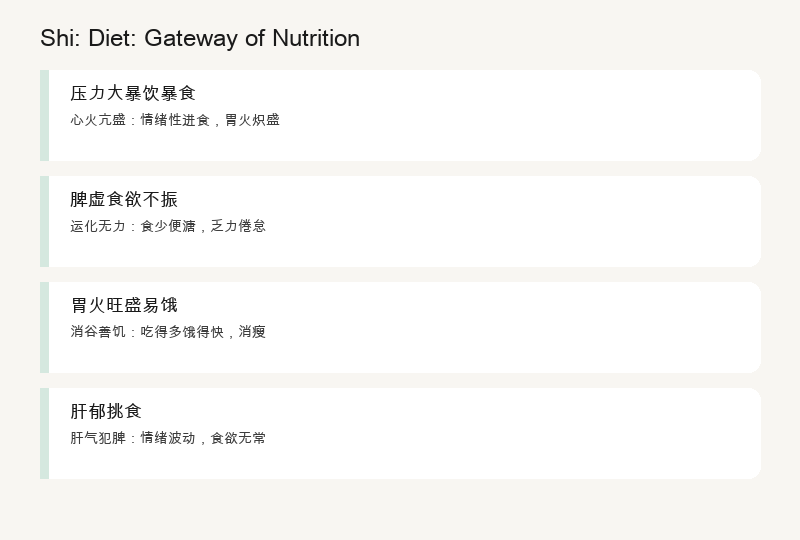
Story One: Strong Appetite (Blazing Stomach Fire / Hyperthyroidism).
You've been eating like a machine lately—hungry two hours after lunch, must have a midnight snack, yet your weight is dropping instead of rising. You ask: "Why am I like a bottomless pit?"
Truth: This is typical "blazing stomach fire" or hyperthyroidism. If it's hyperthyroidism, elevated thyroid hormone (T3/T4) levels raise the basal metabolic rate by 30-50%; the body is running at full throttle like an engine, consuming energy too fast, so it needs constant replenishment. If it's blazing stomach fire, excessive gastric acid secretion and accelerated gastric emptying cause food to be digested rapidly, blood sugar fluctuates quickly, triggering frequent hunger. Another possibility is stress-induced binge eating—work stress makes you secrete large amounts of cortisol, cortisol raises blood sugar, blood sugar crashes trigger hunger, while simultaneously activating the dopamine reward system, making you crave high-calorie foods. It's not the "mysticism" of "blazing stomach fire," but abnormal metabolic rate or neuroendocrine disorder. Modern research: Hyperthyroidism patients can have a basal metabolic rate elevated by 60-100%, requiring 30-50% more calories than normal people; chronic stress workers have elevated cortisol levels, highly correlated with binge eating behavior.
Story Two: Spleen Deficiency and Loss of Appetite (Depression / Anxiety).
Work pressure has been high lately, you're feeling down, and even your favorite braised pork suddenly holds zero appeal. You force a few bites and feel bloated and indigestible. You ask: "Why does a bad mood make me lose my appetite?"
Truth: This is typical "spleen deficiency with loss of appetite"—brain-gut axis dysregulation. Emotional stress affects gastrointestinal function through the vagus nerve and neurotransmitters: reduced serotonin (5-HT) levels inhibit the appetite center; elevated corticotropin-releasing factor (CRF) inhibits gastric emptying and digestive enzyme secretion; gut microbiota changes under stress, reducing short-chain fatty acid (SCFA) production, affecting appetite regulation. It's not the "mysticism" of "bad mood means no appetite," but the precise neuro-endocrine mechanisms of the brain-gut axis. Modern research: Among depression patients, about 65% experience appetite loss; gut microbiota produces 95% of the body's 5-HT, and dysbiosis directly affects appetite and mood. Stress can alter gut microbiota composition and function within 24 hours.
Story Three: Liver Stagnation and Picky Eating (Food Selectivity / Pica).
You've suddenly been craving sour foods like crazy—pickled plums, lemons, yogurt, the sourer the better. Your family finds it strange, and you don't know why either. You ask: "Why do people suddenly crave a specific flavor?"
Truth: This is typical "liver stagnation craving sour"—flavor preferences reflect organ needs and nutritional states. Sour foods are rich in vitamin C and organic acids, promoting liver metabolism and detoxification. When liver stagnation occurs (emotional suppression, stress), the liver's detoxification burden increases, and the body instinctively craves sour foods to assist. Another possibility is iron-deficiency anemia—suddenly craving ice, dirt, or chalk (pica) is a classic signal of iron deficiency. It's not the "mysticism" of "liver deficiency likes sour," but the body transmitting nutritional needs and metabolic states through taste preferences. Modern research: Pica is closely related to iron and zinc deficiency; pica behavior can disappear within weeks after iron supplementation. Pregnant women's flavor preference changes are directly related to fetal nutritional needs and hormonal changes.
Story Four: Blazing Stomach Fire and Easy Hunger (Stress-Induced Binge Eating).
After two weeks of continuous overtime, every night you open the delivery app the moment you get home, ordering fried chicken, milk tea, and cake, eating until you're stuffed. But there's no satisfaction afterwards—only more anxiety and guilt. You ask: "Why does more stress make me crave junk food?"
Truth: This is typical "heart fire / emotional binge eating"—stress activates the dopamine reward system. Chronic stress elevates cortisol levels; cortisol raises blood sugar, blood sugar crashes trigger hunger; meanwhile, stress reduces prefrontal cortex function (responsible for self-control), enhances amygdala (emotions) and reward system (dopamine circuits) activity, creating intense cravings for high-calorie foods. High-sugar, high-fat foods rapidly activate dopamine release, providing momentary "comfort," but then blood sugar crashes and guilt worsen anxiety. It's not the "mysticism" of "blazing heart fire," but a vicious cycle of stress hormones and neural reward systems. Modern research: Chronic stress reduces dopamine D2 receptor sensitivity, requiring more food to get the same satisfaction; binge eating shares similar neural mechanisms with drug addiction (nucleus accumbens dopamine release).
Four stories, one underlying logic: Shí is "the gateway to nutrition"—appetite, flavor preference, food intake, and post-meal response are all signals sent by the body, reflecting spleen-stomach function, metabolic state, neuroendocrine system, and emotional stress. It's not a "mysterious spleen and stomach," but a measurable, intervenable psychosomatic state.
Part 5Modern Research
Does "Shí" have scientific research?
Yes, and it's very well established. Scientists don't use words like "Shí" or "spleen and stomach"; they use "nutrigenomics," "gut microbiome," "metabolomics," and "dietary inflammatory index":
• Nutrigenomics. Modern research confirms that food doesn't just provide energy and nutrients; it can directly regulate gene expression. Certain nutrients (like omega-3 fatty acids, polyphenols, dietary fiber) can activate or inhibit specific genes, affecting inflammation, metabolism, and cell repair. What TCM calls "grains as nourishment, fruits as assistance, meats as benefit, vegetables as filling" corresponds to nutrigenomics' "food-gene interaction"—not mysticism, but molecular-level precise regulation. Modern research: The Mediterranean diet (rich in olive oil, nuts, fish) can change the expression of over 200 genes within 3 months, significantly reducing inflammation levels.
• Gut Microbiome. The human gut contains about 100 trillion microbes, with 150 times the total number of genes as human genes. Gut microbiota participates in digestion, vitamin synthesis, immune regulation, and influences mood and metabolism. What TCM calls "the spleen and stomach are the foundation of the acquired constitution" corresponds to the gut microbiome's "gut is the second brain"—not mysticism, but the ecology of gut microbiota. Modern research: Gut dysbiosis is closely related to obesity, diabetes, depression, anxiety, and autoimmune diseases. Fecal microbiota transplantation (FMT) can treat stubborn intestinal infections and also improve depressive symptoms. Dietary fiber is the "food" for probiotics; 25-30 grams of dietary fiber daily can significantly improve microbiota diversity.
• Dietary Inflammatory Index (DII). Modern research has developed the dietary inflammatory index to assess the impact of different foods on inflammation. High sugar, trans fats, refined carbs, and excess red meat promote inflammation (pro-inflammatory diet); dark vegetables, berries, nuts, fish, and olive oil inhibit inflammation (anti-inflammatory diet). What TCM calls "internal heat" and "damp-heat" corresponds to DII's "pro-inflammatory diet"—not mysticism, but the precise impact of food on inflammatory factors. Modern research: Pro-inflammatory diet eaters have CRP (C-reactive protein) levels 50-100% higher than anti-inflammatory diet eaters; long-term pro-inflammatory diets significantly increase the risk of cardiovascular disease, diabetes, and cancer.
• Metabolomics. Modern metabolomics research confirms that nutrients in food undergo complex metabolic transformations in the body, producing thousands of metabolites. These metabolites are the molecular basis of "post-meal response"—why some people are allergic to shrimp, some get diarrhea from milk, and some feel bloated from soybeans. What TCM calls "food taboos" and "constitution differences" corresponds to metabolomics' "individualized metabolic differences"—not mysticism, but individualized differences in metabolic enzymes, transport proteins, and immune recognition. Modern research: Lactose intolerance is LCT gene variation causing lactase deficiency; alcohol metabolism differences are ALDH2 gene variation; food allergies are IgE-mediated immune responses—all are detectable molecular mechanisms.
These studies fully demonstrate that "Shí" is a concept that can be precisely described in modern scientific language. The ancients described it with "spleen-stomach transformation," "five flavors entering the five organs," and "appetite and flavor preference"; modern people describe it with "nutrigenomics," "gut microbiome," "dietary inflammatory index," and "metabolomics"—the core logic is the same: diet is the body's fuel, and the quality, quantity, and type of fuel determine the body's operating state.
Part 6Practical Methods
Now that you understand "Shí," how do you regulate it?
First, dispel a few misconceptions:
• "Eating more means better nutrition." Nutrition isn't about quantity; it's about quality and absorption efficiency. Eating too much actually increases the burden on the spleen and stomach, leading to indigestion, obesity, and metabolic syndrome. It's not "the more the better," but moderate, balanced, and easily digestible.
• "Supplements can replace a normal diet." Supplements provide single nutrients, but food provides complex nutrition—vitamins, minerals, dietary fiber, phytochemicals, and probiotics working in synergy. It's not "pills are enough," but food first, supplements as auxiliary.
• "Diet and emotions are unrelated." Diet and emotions are bidirectional—emotions affect appetite and digestion (brain-gut axis), and diet also affects emotions (gut microbiota produces neurotransmitters). It's not "mind-body separation," but a triangular relationship of diet-emotion-gut.
Specific methods:
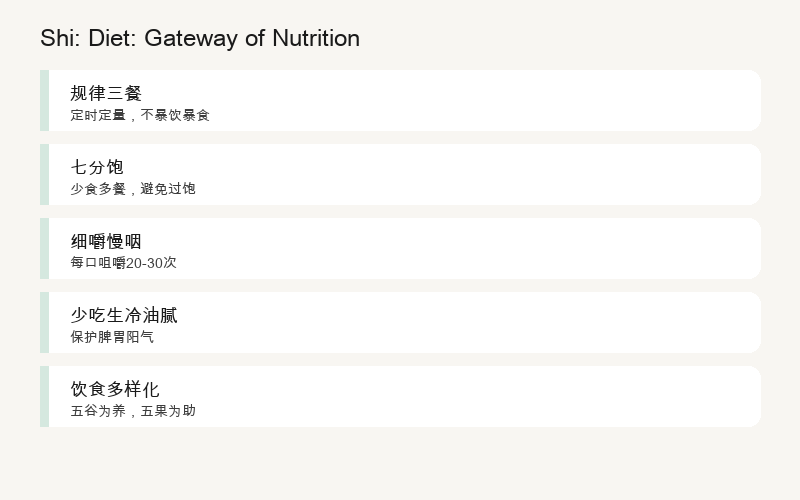
• Regular three meals: Nourishing the spleen-stomach rhythm. The spleen and stomach love regularity. Eating at fixed times every day allows digestive enzymes and gastrointestinal hormones to form a rhythmic secretion pattern. Skipping breakfast damages bile secretion; eating dinner too late damages sleep quality. Recommendation: breakfast 7-8 AM, lunch 12-1 PM, dinner 6-7 PM, no eating 3 hours before bed. It's not "old rules," but the circadian rhythm of digestive physiology. Modern research: Regular eaters have 20% higher insulin sensitivity than irregular eaters, with better weight control.
• Seventy percent full: Leaving space for the spleen and stomach. Eating to seventy percent full leaves the stomach 20-30% space for motility and digestion. Overeating causes excessive stomach expansion, dilutes digestive juices, slows gastrointestinal motility, prolongs food retention time, causes fermentation and gas production, leading to bloating and belching. Meanwhile, overeating activates inflammatory responses and increases oxidative stress. It's not the "mysticism" of "eating less," but the capacity limits of gastrointestinal physiology. Modern research: Caloric restriction (reducing intake by 20-30%) can extend lifespan, reduce inflammation, and improve metabolism—this is the scientific basis for "seventy percent full."
• Chew thoroughly: Starting the first step of digestion. Chewing isn't just grinding food—it's the key signal that initiates digestion. Chewing stimulates saliva secretion (containing amylase and lysozyme), sending a "prepare for digestion" signal to the stomach; thoroughly chewed food is easier to break down by gastric acid and digestive enzymes; longer chewing time also increases satiety and reduces food intake. Recommendation: chew each bite 20-30 times. It's not the old saying "eat slowly," but the precise requirements of digestive physiology. Modern research: Thorough chewers have 30% lower post-meal blood sugar fluctuations than fast eaters, with earlier release of satiety hormone (PYY).
• Eat less cold and greasy food: Protecting spleen-stomach yang energy. Cold foods (iced drinks, sashimi, cold salads) require more energy to heat to body temperature, damaging the spleen-stomach's digestive function; greasy foods (fried food, fatty meat, cream) increase the burden on bile and pancreatic lipase, take a long time to digest, and easily stagnate and ferment. It's not the "superstition" of "can't eat cold things," but the temperature and lipophilicity requirements of digestive physiology. Modern research: Long-term large intake of cold drinks can reduce gastric emptying speed by 15-20%; high-fat diets can reduce gut microbiota diversity by 30%.
• Dietary diversity: Feeding the diversity of gut microbiota. Gut microbiota needs diverse dietary fiber to thrive. Daily intake of at least 30 different plant foods (vegetables, fruits, whole grains, legumes, nuts, seeds) can significantly increase microbiota diversity. Different colored fruits and vegetables provide different phytochemicals (polyphenols, flavonoids, carotenoids), working synergistically to fight inflammation and oxidation. It's not the old saying "a little bit of everything," but the precise requirements of gut ecology. Modern research: People who eat more than 30 types of plant foods per week have 40% higher gut microbiota diversity than those who eat fewer than 10 types, with significantly lower inflammatory markers.
• Pay attention to flavor preferences: Listening to the body's signals. Suddenly craving a certain flavor may be the body sending a signal. Liking sour may reflect liver metabolism needs or vitamin C deficiency; liking sweet may reflect energy deficiency or emotional need for comfort; liking salty may reflect sodium balance disorder or adrenal fatigue. But note: long-term abnormal preferences (like persistent binge eating or pica) require professional evaluation. It's not the "mysticism" of "flavor determines destiny," but interpreting signals of nutritional needs and metabolic states.
These methods don't require you to become a nutritionist. You just need to understand: Shí is "the gateway to nutrition"—what you need to do is choose high-quality fuel (balanced diet), keep the engine clean (regular eating, seventy percent full), maintain gut ecology (diversity, dietary fiber), and pay attention to the impact of emotions on diet (stress management, mindful eating).
Part 6 (continued)Practical Methods: Six Ways to Regulate Your Diet
Part 7One-Minute Summary
🕐 One Minute to Understand "Shí"
Shí = The Gateway to Nutrition = Spleen-Stomach Transforming Function.
What TCM calls "Shí" isn't simply "eating"; it's a comprehensive body of appetite, flavor preference, food intake, and post-meal response, a barometer of spleen-stomach function, the source of qi and blood production.
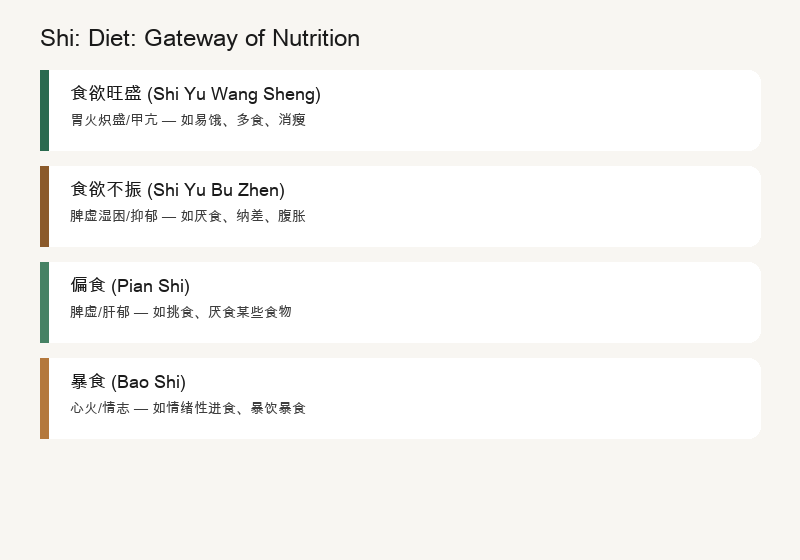
Strong appetite = Blazing stomach fire / hyperthyroidism (abnormal metabolic rate) or stress-induced binge eating (dopamine reward system activation).
Loss of appetite = Spleen deficiency with dampness (insufficient digestive enzymes, weak gastrointestinal motility) or depression (brain-gut axis dysregulation).
Picky eating = Liver stagnation / spleen deficiency (body transmitting nutritional demand signals through taste) or trace element deficiency.
Binge eating = Heart fire / emotions (vicious cycle of stress hormones + neural reward system).
Flavor preferences: Liking sour (liver deficiency / vitamin C needs), liking bitter (heart fire / anti-inflammatory needs), liking sweet (spleen deficiency / energy needs), liking pungent (lung cold / circulation needs), liking salty (kidney deficiency / sodium balance needs).
Misconceptions: Eating more means better nutrition, supplements can replace diet, diet and emotions are unrelated.
Methods: Regular three meals to nourish spleen-stomach rhythm; seventy percent full to leave space for digestion; chew thoroughly to start digestion; eat less cold and greasy to protect spleen-stomach; dietary diversity to feed gut microbiota; pay attention to flavor preferences to listen to body signals.
The ancients called it "spleen-stomach transformation"; modern people call it "nutrigenomics, gut microbiome, dietary inflammatory index."
Different names, but medicine knows: you are what you eat. Diet is the body's most honest conversation with the world.
Regulating diet isn't "supplementing"; it's restoring the spleen-stomach's innate transforming ability.
The ancients didn't have words like nutrigenomics or gut microbiome, but they knew "the spleen and stomach are the officials of the granary, from whom the five flavors emerge."
This is probably the most朴素 wisdom of the Chinese people: you are what you eat. Diet is the body's most basic way of conversing with the world. A doctor's job isn't to force you to eat, but to help you understand what your body is saying.

Making money is the art of living; art is life after making money
giaogiao Decodes Traditional Chinese Wisdom · Concept 99
Using modern scientific language to help the world understand Traditional Chinese Wisdom.
Not mysterious, not superstitious, not belittling.
Understand, not merely believe.
Coach Liu
Written in Florence