Why Do Chinese Say "Yuanqi Badly Damaged"? Your Body Isn't Just Tired — The Factory Battery Is Running Low
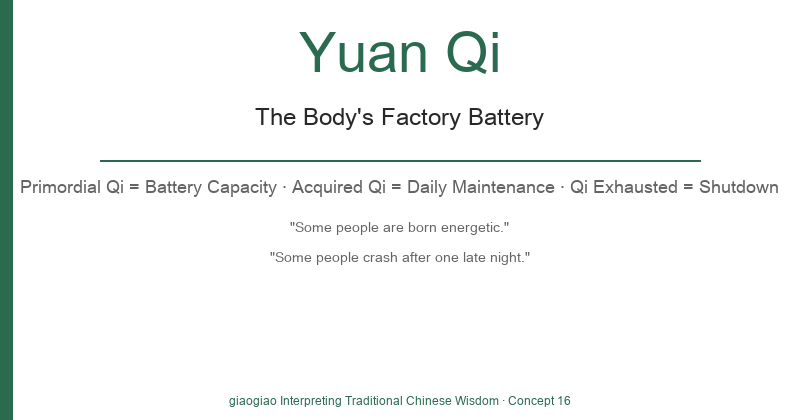
Part 1A Question
Have you ever had this experience?
After a major illness, you feel completely "hollowed out." Not tired — empty. Two steps and you're panting; two sentences and you're short of breath. No appetite, can't sleep. The doctor runs all the tests, tells you everything is normal, you can go home. But you know: the current you and the pre-illness you are not the same person. This "emptiness" can't be explained by trauma, nor recovered by nutrition. It's like a phone that took a fall — screen didn't crack, but the battery can never charge back to 100%.
Chinese people call this feeling "Yuanqi badly damaged."
An even more common scenario: you pull two weeks of consecutive all-nighters, rushing projects, binge-watching shows, scrolling short videos, sleeping at 2 AM and waking at 8 AM. By week three, you look in the mirror and your face has dropped a shade — bags under your eyes like two caterpillars hanging there, skin sallow like overnight leftovers, hair falling out in clumps. You're not "tired" — your Yuanqi has been overdrawn.
Also, observe the elderly around you. Some are eighty and still doing tai chi, visiting parks, trading stocks, and babysitting grandkids, with more energy than young people. Others are just sixty and already shuffling, speaking weakly, drowsy all day. Same species, why such a gap?
TCM would say: congenital Yuanqi differs, and postnatal maintenance differs. In modern terms: factory battery capacity differs, and usage habits differ too.
So the question is: what exactly is this "Yuanqi"? Invisible, intangible; say it exists, you can't detect it; say it doesn't exist, you can clearly feel it draining away. Is it mysticism, or is it science?
Part 2Traditional Chinese Explanation
The term "Yuanqi" is the most fundamental concept in the TCM system. It's not as common as "qi and blood," not as esoteric as "yin and yang," but it is the foundation of everything.
— Yellow Emperor's Inner Canon
"The kidney is the root of congenital constitution, storing essence and generating Yuanqi."
— Required Reading for Medical Practitioners
【Chinese original preserved above; translation: Yuanqi is the primordial life-force endowed by parents and stored in the kidneys.】
TCM breaks Yuanqi into two parts, beautifully easy to understand:
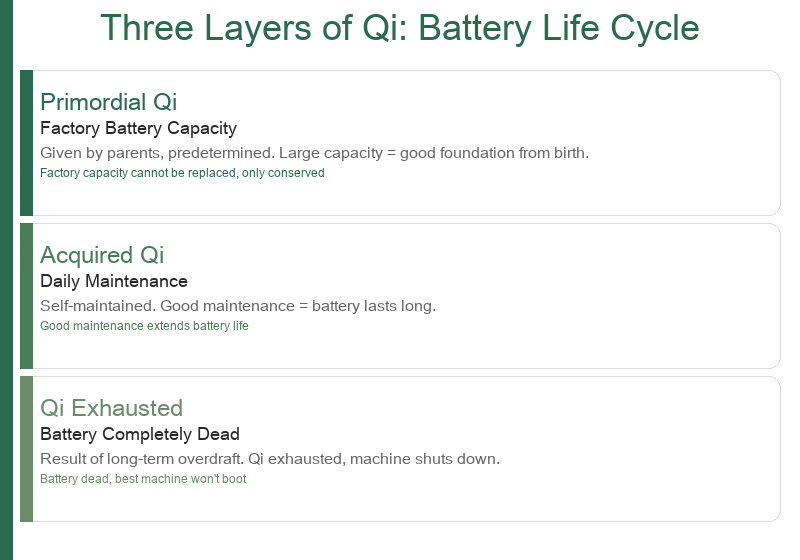
Congenital Yuanqi — your factory battery capacity at birth. This is given by your parents, written in your genes, cannot be changed. People with abundant congenital Yuanqi are like buying the top-tier phone model, 5000 mAh battery, can take a beating and keep going. People with deficient congenital Yuanqi are like buying the base model, 2000 mAh battery, fully charged but doesn't last. But note: battery capacity is fixed, but how you use it determines how long it lasts.
Postnatal Yuanqi — your daily charging and maintenance ability. This is what you can control. Eat regularly, sleep soundly, stay emotionally stable, exercise moderately — postnatal Yuanqi is strong, equivalent to giving your battery good maintenance, slowing aging. Conversely, staying up late, overindulgence, binge eating, emotional drain — these accelerate battery wear. A battery that could last ten years is scrapped in three.
The ancients describing Yuanqi also liked a metaphor: Yuanqi is like lamp oil. More oil, bright flame, burns long. Less oil, weak flame, a gust of wind and it's out. But oil doesn't burn out all at once; it's consumed drop by drop. Every all-nighter you pull, one drop less. Every big tantrum you throw, one chunk less. When the oil's gone, the lamp goes out.
So TCM's attitude toward Yuanqi is extremely conservative: use it sparingly, don't waste it. Because Yuanqi cannot be regenerated, only its consumption can be slowed.
Part 3giaogiao Modern Translation
Okay, now let's translate "Yuanqi" into modern language.
I'm not going to talk about mitochondrial telomeres, ATP synthase, or NAD+ metabolism. Too complicated. Just remember one metaphor, and it will serve you for life:
Congenital Yuanqi = Total battery capacity (from parents, set at birth, unchangeable)
Postnatal Yuanqi = Charging and maintenance ability (self-maintained, determines wear speed)
Yuanqi exhausted = Battery completely dead, machine shuts down
That simple. But this metaphor holds a few key points:
First, battery capacity cannot be replaced. You buy a phone; the battery is 5000 mAh or 2000 mAh, set at the factory. You can't swap a 2000 mAh for a 5000 mAh. Same for people. Those with deficient congenital Yuanqi shouldn't dream of "making it up" — accept reality, then use it sparingly.
Second, battery life depends on usage habits. Same 5000 mAh battery, some use it for five years, some scrap it in two. Why? Different habits. Using while charging, long-term deep discharge, high-temperature use — all accelerate battery aging. Same for people. Even abundant congenital Yuanqi can't withstand daily squandering.
Third, "emptiness" is not out of power; it's battery degradation. You know how an old phone, even fully charged, can't last a day? Not the charger's problem; the battery itself has degraded. As people age, energy drops — not because they "didn't eat enough," but because Yuanqi has degraded. This is the natural law; it can be delayed, not reversed.
Fourth, "major illness" is equivalent to battery short-circuit. A major illness mobilizes all the body's resources to fight the enemy, equivalent to the battery instantly discharging at high current. The illness is cured, but the battery is damaged, capacity permanently decreased. This is "Yuanqi badly damaged" — not that the illness wasn't cured, but the battery was "deep-discharged" once.
So "Yuanqi" is not mysticism. It is a functional metaphor describing your body's total energy reserve and its rate of decay. The ancients had no concept of batteries, but with "Yuanqi" they precisely described a truth that modern people understand: the body is a finite resource; it cannot be squandered recklessly.
Part 4Real-Life Examples
Four stories to make you instantly understand what "Yuanqi" is.
Example 1: The "emptiness" after major illness.
Old Zhang had a major surgery. The doctor says he's recovering well, all indicators normal, can be discharged. But Old Zhang gets home and finds he pants after three flights of stairs, gets tired after two sentences, can't sleep at night, has no energy by day. His wife stews chicken soup, fish soup, ginseng soup — nothing helps. Three months later, Old Zhang is a circle thinner, like he's been "sucked dry."
TCM says: "Yuanqi badly damaged, no medicine can replenish it." Translation: the battery short-circuited once, capacity permanently dropped. No matter how much you charge, you can't charge back to the original capacity. What's needed now is not "major supplementation" but "power saving" — move less, think less, consume less, let the remaining battery slowly recover.
Example 2: The "collapse" from chronic sleep deprivation.
Little Li is an internet worker, used to sleeping at 2 AM and waking at 8 AM, surviving on coffee. At twenty-five, he felt fine — after an all-nighter he was still lively. At thirty, he noticed something wrong: sallow complexion, sagging bags, thinning hair, declining memory. Most terrifying: sleeping the whole weekend couldn't make it up. He went to the hospital and checked liver, kidney, thyroid — all normal. But he knew he was "empty."
This is the classic "postnatal Yuanqi depletion." The battery has been deeply discharged for too long, aging accelerated. The difference between twenty-five and thirty is not age; it's battery health. At twenty-five, battery health 90%, one deep discharge can recover. At thirty, battery health 70%, one deep discharge drops a bar.
Example 3: The "decline" of old age.
Observe the eighty-year-olds around you. Some can still climb mountains, play chess, travel, and are mentally sharp. Others are already unsteady at sixty, slow to react, drowsy all day. Where's the difference? Congenital Yuanqi differs, and postnatal maintenance differs even more.
That eighty-year-old who can still climb mountains — maybe his parents lived long, abundant congenital Yuanqi, and he's spent a lifetime eating regularly, staying calm, and working moderately. Big battery capacity, good usage habits, naturally durable. That sixty-year-old who can't function — maybe congenital Yuanqi deficient, plus long-term smoking, drinking, emotional anxiety, no exercise. Small battery capacity, and daily deep discharge, premature scrap.
Example 4: The athlete's "peak and recovery."
Top athletes peak around twenty-eight, then slowly decline. But you'll notice some can still perform at a high level at thirty-five or six, while others can't at thirty. Why? Training methods differ. The former trains scientifically, rests reasonably, manages nutrition — equivalent to giving the battery the best maintenance. The latter overtrains, competes with injuries, ignores recovery — equivalent to daily deep discharge, premature aging.
But the most striking thing: after retirement, athletes' bodies often age faster than ordinary people. Why? Because at peak they pushed the battery to the limit, capacity exhausted, and the remaining years can only "run on empty."
Four cases, one underlying logic: Yuanqi is a finite resource; every bit consumed is one bit less. Congenital sets the capacity, postnatal determines the lifespan.

Part 5Modern Research
Is there scientific research on "Yuanqi"?
Yes, but scientists don't use the word "Yuanqi." They use:
• Telomere length. The 2009 Nobel Prize in Physiology or Medicine was about telomeres. Telomeres are the "protective caps" at the ends of chromosomes; every time a cell divides, telomeres shorten a bit. Longer telomeres, longer cell life; shorter telomeres, faster aging. Research finds chronic stress, sleep deprivation, and poor diet accelerate telomere shortening. This is the molecular explanation of "Yuanqi consumption."
• Stem cell reserves. Every organ in the body has stem cell reserves for repair and regeneration. When young, stem cells are abundant, wounds heal fast, recovery is strong. When old, stem cells are depleted, repair ability weakens. This is the cellular-level manifestation of "Yuanqi deficiency."
• Mitochondrial function. Mitochondria are the cell's "energy factories." Research finds that chronic disease, fatigue syndrome, and aging patients generally have declined mitochondrial function, reduced ATP production. This is the energy metabolism basis of "Yuanqi weakness."
• NAD+ levels. NAD+ is a key coenzyme for cellular energy metabolism, declining with age. Scientists found that supplementing NAD+ precursors can delay aging signs. This is the modern version of "tonifying Yuanqi" — but note, it tonifies "postnatal Yuanqi"; congenital Yuanqi still cannot be changed.
These studies collectively point to one conclusion: the human body indeed has an "energy reserve pool," its initial size determined by genes, its consumption speed determined by lifestyle. The ancients called it "Yuanqi"; modern people call it "biological age" or "cellular health." Different names, but the same thing.
Part 6Practical Methods
Understanding Yuanqi, how do you maintain it?
First, dispel some myths:
• Supplements cannot increase battery capacity. Ginseng, donkey-hide gelatin, deer antler — these tonify "postnatal Yuanqi," making your existing battery last longer, not swapping you a bigger battery. People with deficient congenital Yuanqi, no matter how many supplements they eat, can't become a boundlessly energetic person; they can only keep their existing battery from decaying too fast.
• Exercise is not the more the better. Moderate exercise activates the body, equivalent to giving the battery a "maintenance cycle." Excessive exercise consumes reserves, equivalent to deep discharge of the battery, accelerating aging. People with deficient Yuanqi, start with walking and tai chi; don't jump into a marathon.
• Sleep is not a universal charger. Sleep quality matters more than duration. During deep sleep, the body's repair efficiency is highest. But if you scroll your phone before bed, ruminate, or drink heavily, ten hours of sleep is not as good as six hours of solid sleep. The key is whether the "system background" has been cleared.
Specific methods:
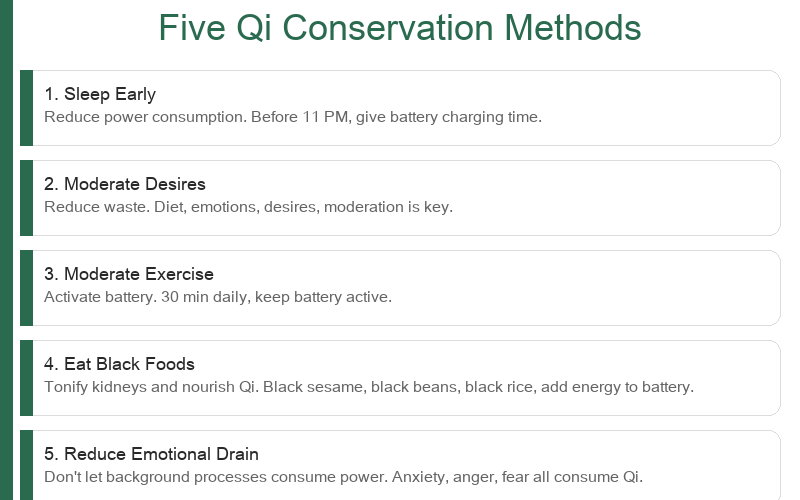
• Don't stay up late. This is the first rule of Yuanqi maintenance. 11 PM to 3 AM is liver-gallbladder repair time; if you're not asleep then, it's equivalent to the battery still discharging when it should be charging. People who chronically stay up late age their batteries 1.5× faster than normal. Not scare tactics — data.
• Moderate desires. Sexual overindulgence, binge eating, heavy drinking — these are all large one-time consumptions of Yuanqi. The ancients said "wine, sex, wealth, and qi" damage Yuanqi; in modern terms: don't overstimulate the dopamine system, because every狂欢 (binge) leaves the body with a debt to pay.
• Moderate exercise. Thirty minutes of moderate-intensity exercise daily — brisk walking, swimming, tai chi — all fine. Exercise activates mitochondria, improves energy production efficiency, equivalent to giving the battery an "activation." But note: light sweat is enough; profuse sweating actually depletes qi.
• Eat black foods. TCM says "black enters the kidney," and the kidney stores Yuanqi. Black sesame, black beans, black rice, mulberry, wood ear — these black foods are rich in anthocyanins, trace elements, and quality fats, good for cell repair. Modern nutrition also supports: dark-colored foods have strong antioxidant capacity, helping delay cellular aging.
• Reduce emotional drain. This is the most hidden form of Yuanqi consumption. Anxiety, anger, indecision, complaining — these emotions don't directly harm the body, but they keep your "system background" running at high load. Like a phone with twenty apps open, screen is off but the battery is still draining. People with emotional drain are consuming Yuanqi even while asleep.
These methods don't require you to believe in TCM. You only need to understand: your body is a factory battery with finite capacity; use it sparingly.
Part 7One-Minute Summary
🕐 One Minute to Understand "Yuanqi"
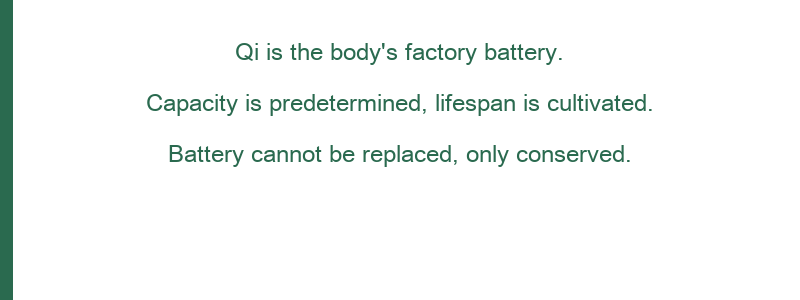
Yuanqi = The body's factory battery.
Congenital Yuanqi = Total battery capacity (from parents, set at birth, unchangeable).
Postnatal Yuanqi = Charging and maintenance ability (self-maintained, determines battery life).
Signs of Yuanqi badly damaged: extreme weakness, very slow recovery, sustained energy decline, no amount of supplementation helps.
Causes: major illness deep discharge, chronic sleep deprivation, overindulgence and binge eating, emotional drain, excessive exercise.
Methods: don't stay up late, moderate desires, moderate exercise, eat black foods, reduce emotional drain.
The ancients called it "Yuanqi"; modern people call it "biological age."
Different names, but the body knows: battery capacity is finite, use it sparingly.
The battery cannot be replaced; it can only be used sparingly.
Every all-nighter you pull, the battery health drops a bar.
Every big tantrum you throw, the charge silently drains away.
So the Chinese ancients said: the way of health lies in consuming less, not in supplementing more.
Supplementing is postnatal; conserving is congenital.
Making money is the art of living; art is the life after making money.
giaogiao Decodes Chinese Wisdom · Concept 16
Using modern scientific language to help the world understand traditional Chinese wisdom.
No mysticism, no superstition, no belittlement.
Understand, rather than merely believe.
Coach Liu
Written in Florence