Why Do Chinese Say "Zongqi Deficiency"? Short of Breath, Weak Voice — Your Central Gas Station Is Broken
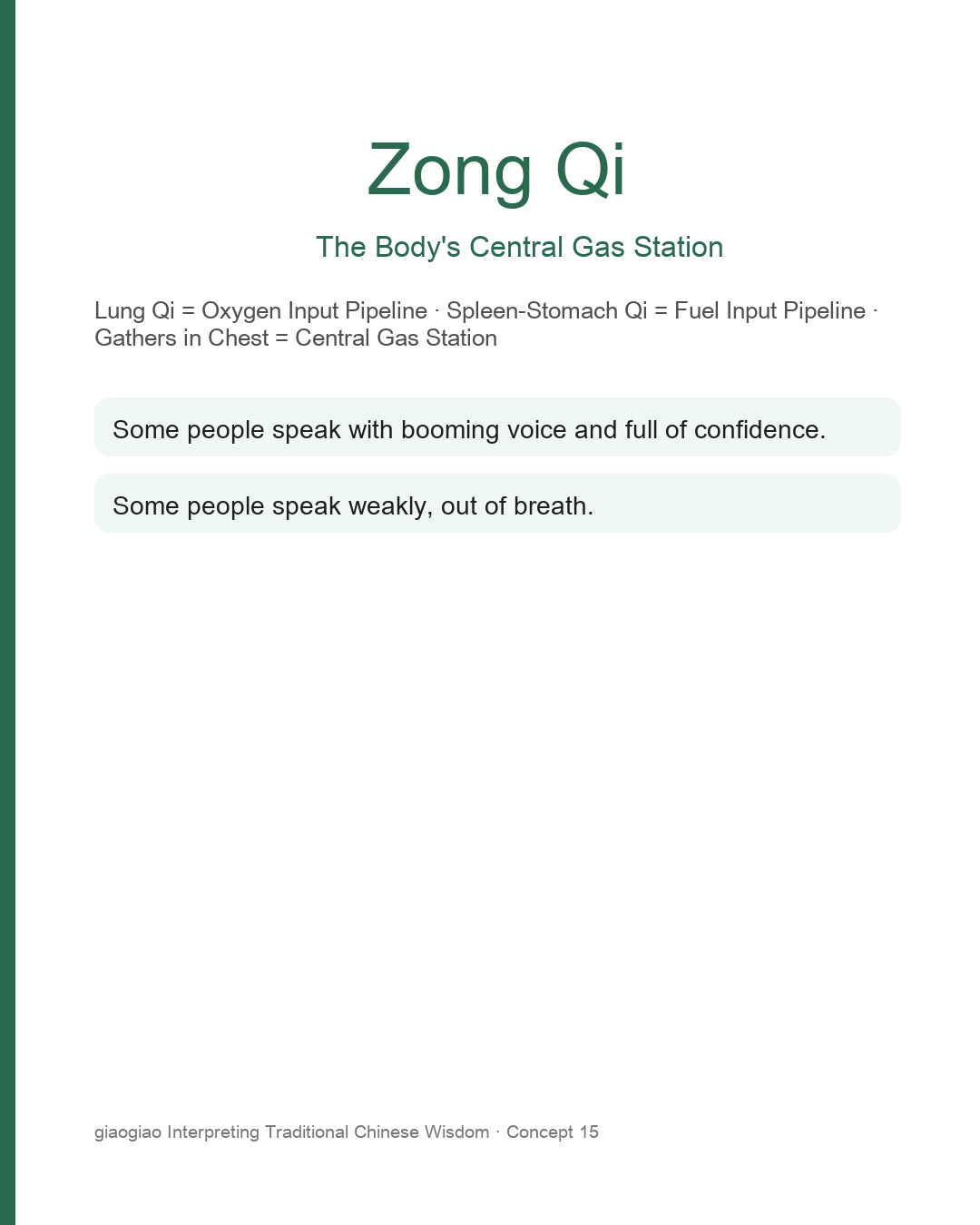
Part 1A Question
Have you ever been in an elevator with someone like this?
He walks in, hasn't even steadied himself, and starts a phone call. Voice booming, full of energy, the whole car echoes with his words. You can hear every project, every client, every dinner plan through your headphones. You silently marvel: where does this guy get so much energy?
Then there's the other kind. In a meeting, sitting in the corner, the boss calls on him to speak. He opens his mouth; his voice is smaller than a mosquito's buzz. The boss leans forward: "Louder." He takes a deep breath, manages to raise half a decibel, and then he's gasping for air, face red. You think: does this guy have a lung problem?
Hospital check: lung CT normal, ECG normal, blood oxygen saturation 99%. Doctor says: "Probably stress. Get some rest."
You go to a TCM doctor. The old physician hears your description and says: "Zongqi deficiency."
You're baffled: Zongqi? Not Yuanqi? Not Zhongqi?
The old physician patiently explains: Zongqi sits in the chest, specifically managing whether your voice has power, whether your breathing is smooth, whether your heartbeat is steady. It is the oxygen your lungs inhale and the nutrients your spleen-stomach digest, mixed together in the chest cavity to form a "central gas station." When this gas station's pressure is too low, your voice goes limp, your breathing gets ragged, and your heartbeat feels hollow.
You listen and think it makes more sense than "probably stress." But you still want to figure out: how exactly does this gas station work?
Part 2Traditional Chinese Explanation
The term "Zongqi" comes from the Yellow Emperor's Inner Canon. "Zong" means gathering, converging. The ancients discovered a type of qi that specifically gathers in the chest (near the Tanzhong acupoint), governing breathing and blood circulation.
— Yellow Emperor's Inner Canon, Ling Shu, Xie Ke
"Tanzhong is the sea of qi."
— Yellow Emperor's Inner Canon, Ling Shu, Hai Lun
【Chinese original preserved above; translation: The chest is where qi converges to power breath and the heart.】
The ancients' understanding of Zongqi was plain but precise:
Zongqi = Lung Qi + Water-Grains Qi.
Lung Qi is what? The "clear qi" the lungs inhale from the air. In modern terms: oxygen. Water-Grains Qi is what? The nutrient essence the spleen-stomach digests from food. In modern terms: glucose, amino acids, fatty acids — energy substances.
These two types of "qi" converge in the chest (Tanzhong) and become Zongqi. Zongqi has two core tasks:
First, driving breathing. People with strong Zongqi breathe deeply, evenly, and speak with a booming voice. People with weak Zongqi breathe shallowly, shortly, rapidly, speak with no strength, and gasp for air.
Second, driving heartbeat and blood circulation. People with strong Zongqi have a strong, steady heartbeat and a rosy complexion. People with weak Zongqi have a weak, irregular heartbeat, pale or bluish face, and cold limbs.
The ancients didn't understand oxygen or glucose, but they observed a crucial fact: the chest region is the "central control room" for breathing and heartbeat. This control room needs two raw materials to run: "clear qi" from the air and "essence" from food. Insufficient raw materials, the control room's output drops, and both breathing and heartbeat suffer.
So they created a beautiful concept — "Zongqi." Meaning: the ancestor where all qi gathers, the master that commands all vessels.
Part 3giaogiao Modern Translation
Okay, now let's translate "Zongqi" into modern language.
I'm not going to talk about alveolar gas exchange, hemoglobin oxygen transport, or the Frank-Starling mechanism of cardiac contraction. Too complicated. Just remember one metaphor:
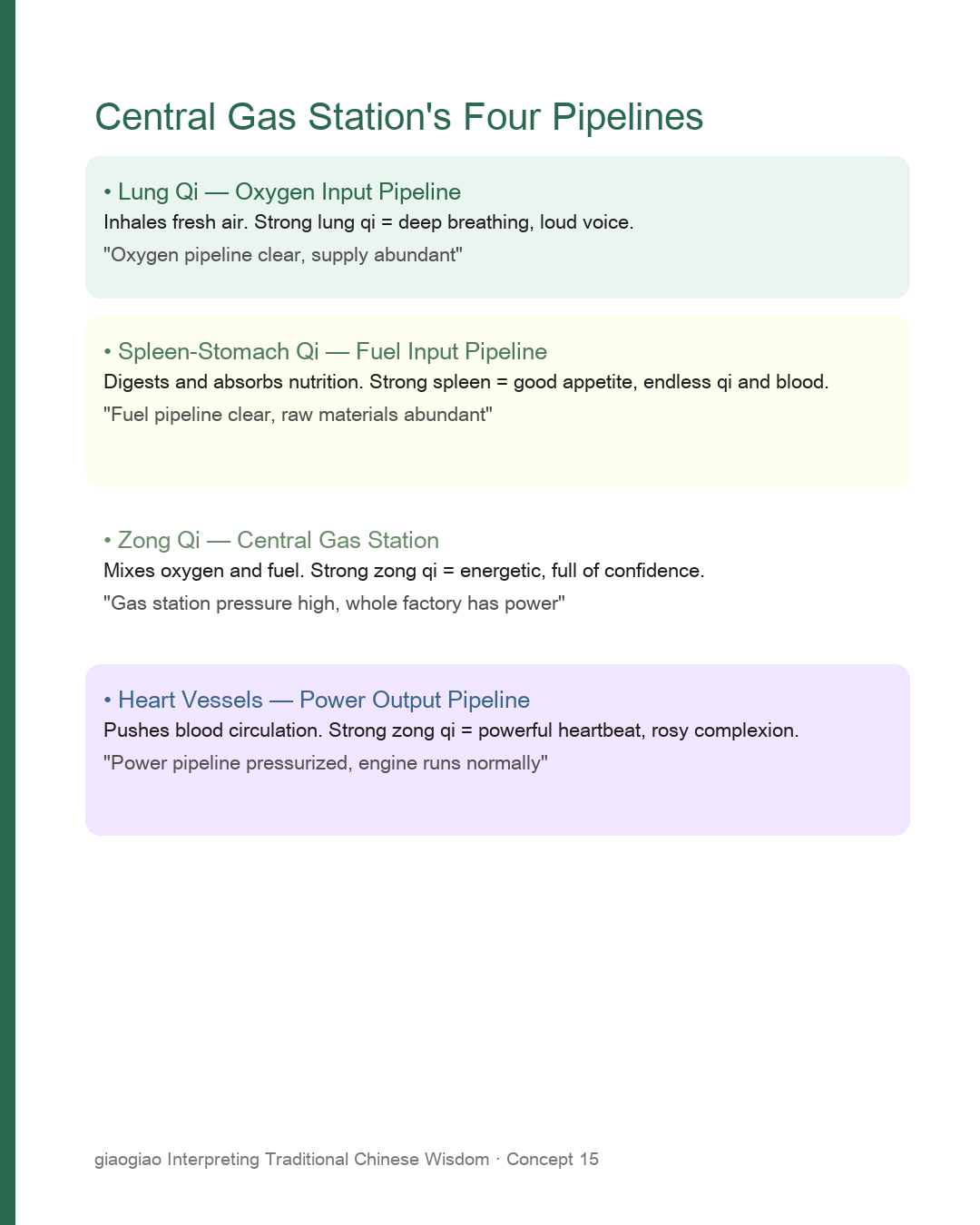
Lung's clear qi = Oxygen input pipeline
Spleen-stomach's water-grains qi = Fuel input pipeline
Converging in the chest = Central gas station
Driving breathing and heartbeat = Powering the engine and boiler
That simple. Your chest has a central gas station. It receives input from two pipelines: one is the oxygen pipeline (lungs), one is the fuel pipeline (spleen-stomach). The two pipelines converge in the chest, mix into high-pressure "power gas," and then deliver to the two most important systems: the respiratory system (lungs and trachea) and the circulatory system (heart and blood vessels).
Specifically:
What does the lung's clear qi correspond to? Your blood oxygen content. Oxygen enters the blood from the alveoli, binds to hemoglobin, and is transported throughout the body. People with low blood oxygen speak with short breath, bluish face, and fatigue easily. This is the "Zongqi deficiency" performance at the oxygen input end.
What does the spleen-stomach's water-grains qi correspond to? Nutrients in your blood — glucose, amino acids, fatty acids. These nutrients are the raw materials for cells to produce energy. People with insufficient nutrition or poor digestion have low blood sugar, weak muscles, and easy fatigue. This is the "Zongqi deficiency" performance at the fuel input end.
What does converging in the chest correspond to? Your chest cavity — the region where the heart and lungs reside. The chest cavity is a relatively enclosed space; diaphragm and intercostal muscle contractions produce breathing movements, and the heart pumps blood to maintain circulation. This region's functional state determines the gas station's output power.
What does driving breathing and heartbeat correspond to? Respiratory muscle contraction force and myocardial contraction force. Strong Zongqi: strong breathing muscles, strong heartbeat. Weak Zongqi: weak breathing muscles, weak heartbeat. This directly affects your voice volume, how winded you get climbing stairs, and how strong your heartbeat feels.
So "Zongqi" is not mysticism. It is a functional metaphor describing the coordinated state of oxygen, nutrition, respiratory muscles, and heart muscle in the chest cavity.
The ancients had no CT, ECG, or pulse oximeter, but with the concept of "Zongqi," they precisely described what modern people need three concepts — "blood oxygen saturation," "cardiac output," and "respiratory muscle function" — to explain.
Part 4Real-Life Examples
Four stories to make you instantly understand what Zongqi is.
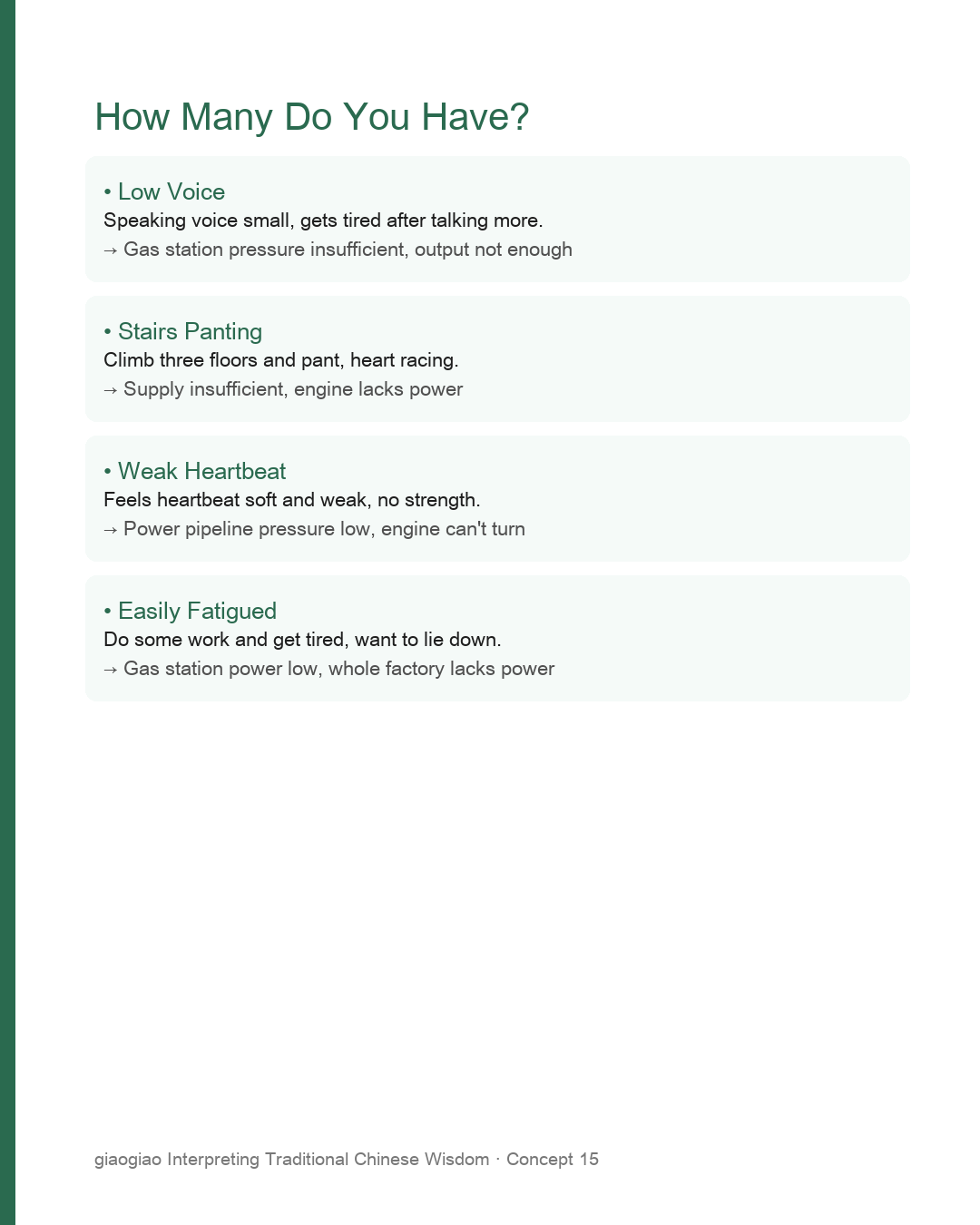
Example 1: Low voice.
You have a colleague at work, usually quiet, speaking like he's holding an olive. In meetings, he sits next to you and you have to cock your ear to hear. He's not unwilling to speak louder — he can't. Raise his voice a bit and his throat tightens, his chest feels stuffy, like a weak air pump.
TCM says: Zongqi deficiency. Vocal cord vibration requires airflow propulsion; weak Zongqi means weak airflow, so the voice is naturally small. Like playing a flute: if your lung capacity isn't enough, the air is weak and soft, and the sound is muted.
Truth: Voice volume depends on exhaled airflow volume and speed. Weak Zongqi means weak respiratory muscle (diaphragm, intercostal muscles) contraction, insufficient expiratory flow, and inadequate vocal cord vibration. It's not that he doesn't want to be loud; it's that his gas station pressure is too low to blow the horn loud.
Example 2: Winded climbing stairs.
You live on the sixth floor, no elevator. Usually fine, but in summer you start panting by the fourth floor. Not leg soreness — you're out of breath. Mouth open, gasping for air, chest still feels stuffy, like someone's pressing on your lungs. You stop, bend over, hands on knees, two minutes to recover.
TCM says: Zongqi deficiency. Climbing stairs is a full-body exercise with a sudden surge in oxygen demand. Strong Zongqi: breathing deepens and quickens, blood oxygen supply keeps up. Weak Zongqi: weak respiratory regulation, oxygen supply can't keep up, the body sounds an alarm — makes you pant.
Truth: During exercise, muscles consume more oxygen, requiring respiratory and circulatory systems to jointly increase output. Weak Zongqi means weak respiratory muscles and low cardiac pumping efficiency, insufficient oxygen supply, so the body activates a compensatory mechanism — increasing respiratory rate (panting). But faster breathing actually reduces breathing efficiency (more shallow breaths, fewer deep breaths), creating a vicious cycle.
Example 3: Weak heartbeat.
Sometimes you lie down, put your hand on your chest, and can't feel your heartbeat. Or even if you do, it's a faint, fluttery kind of beat, not the strong "thump-thump-thump" others have. You get an ECG; the doctor says "sinus rhythm, normal." But you feel your heart has no strength, like someone lightly scratching your chest rather than drumming.
TCM says: Zongqi deficiency. An important Zongqi function is "penetrating the heart vessels" — driving the heart to beat. Strong Zongqi: strong heartbeat, smooth blood flow. Weak Zongqi: weak heart pumping, slow blood flow, insufficient blood supply to the extremities.
Truth: Cardiac output (blood volume pumped by the heart per minute) depends on myocardial contractility and heart rate. Weak Zongqi doesn't mean myocardial disease; it means the heart's energy support is insufficient — oxygen supply insufficient, nutrition supply insufficient, the heart's "work efficiency" drops. Like an engine: fuel is enough, but the air filter is clogged, combustion is incomplete, and power is weak.
Example 4: Easy fatigue.
You sleep eight hours and still wake up tired. You eat lunch and still feel exhausted in the afternoon. You've done nothing and feel utterly hollowed out. Not lazy — it's exhaustion seeping from the bones. You drink coffee, energy drinks, they prop you up for an hour, then you crash even harder.
TCM says: Zongqi deficiency. Zongqi is the total power driving the whole body to run. Total power insufficient, every organ is "low on battery" — brain oxygen-deprived gets sleepy, muscles oxygen-deprived get tired, heart oxygen-deprived gets weak. This isn't a single organ's problem; it's the central gas station power too low, the whole grid voltage insufficient.
Truth: A common cause of chronic fatigue is "insufficient cellular energy production" — mitochondrial function declines, ATP production drops. And mitochondria need two key raw materials to produce ATP: oxygen and glucose. Weak Zongqi means insufficient oxygen and/or nutrition supply, mitochondria's "raw material input" insufficient, energy production falls. To protect you, the body activates power-saving mode — makes you tired, sleepy, unmotivated.
Four cases, one underlying logic: the central gas station in the chest has insufficient output power.
Part 5Modern Research
Is there scientific research on "Zongqi"?
Yes, but scientists don't use the word "Zongqi." They use:
• Cardiorespiratory fitness. Research shows that people with poor cardiorespiratory fitness not only have low exercise endurance but also get tired and short of breath during daily activities. The core indicator of cardiorespiratory fitness — maximum oxygen uptake (VO₂ max) — directly reflects the body's ability to use oxygen. Low VO₂ max is the modern quantitative version of "Zongqi deficiency."
• Respiratory muscle function. The diaphragm and intercostal muscles are the "engine" of breathing. Research finds that people with weak respiratory muscles not only pant easily but also have a small voice, weak cough, and are prone to lung infections. Respiratory muscle training (e.g., deep breathing exercises, blowing balloons) can significantly increase respiratory muscle strength and improve "Zongqi deficiency" symptoms.
• Cardiac output. The amount of blood the heart pumps per minute (Cardiac Output = heart rate × stroke volume) directly determines whole-body oxygen supply. People with low cardiac output, even with normal heart rate, feel "weak heartbeat," cold limbs, and easy fatigue. TCM's "Zongqi penetrating the heart vessels" is essentially a cardiac output issue.
• Posture and breathing. Research shows that hunched posture restricts chest expansion, reduces lung capacity, and decreases oxygen intake. Standing tall and chest out can increase lung capacity by 15–20%. This is why TCM says "Zongqi" gathers in the chest — chest space and posture directly affect the gas station's capacity.
These studies are not numerous, but they point in the same direction: "Zongqi" describes the overall coordinated state of oxygen supply, nutrition supply, respiratory muscle strength, and myocardial contractility in the chest cavity, not a single specific substance.
Part 6Practical Methods
Understanding Zongqi, how do you strengthen it?
First, dispel some myths:
• Deep breathing isn't just any inhale. Many people's "deep breathing" means shrugging shoulders and lifting the chest — this is "chest breathing," very inefficient, and also strains the neck and shoulders. Correct deep breathing is diaphragm descending, belly expanding — this is "abdominal breathing," more efficient, and inhales more oxygen.
• More food isn't better. Zongqi needs "water-grains qi," but overeating actually depletes qi — digestion requires energy, and eating too much makes the spleen-stomach work overtime, consuming more "Zongqi." Seventy percent full is the optimal strategy for supplying fuel to the gas station.
• More exercise isn't better. Intense exercise makes Zongqi-deficient people even weaker — the gas station's power is already low, you suddenly increase demand, it overloads and stalls. Start with low-intensity aerobic exercise and gradually train the gas station's power.
Specific methods:
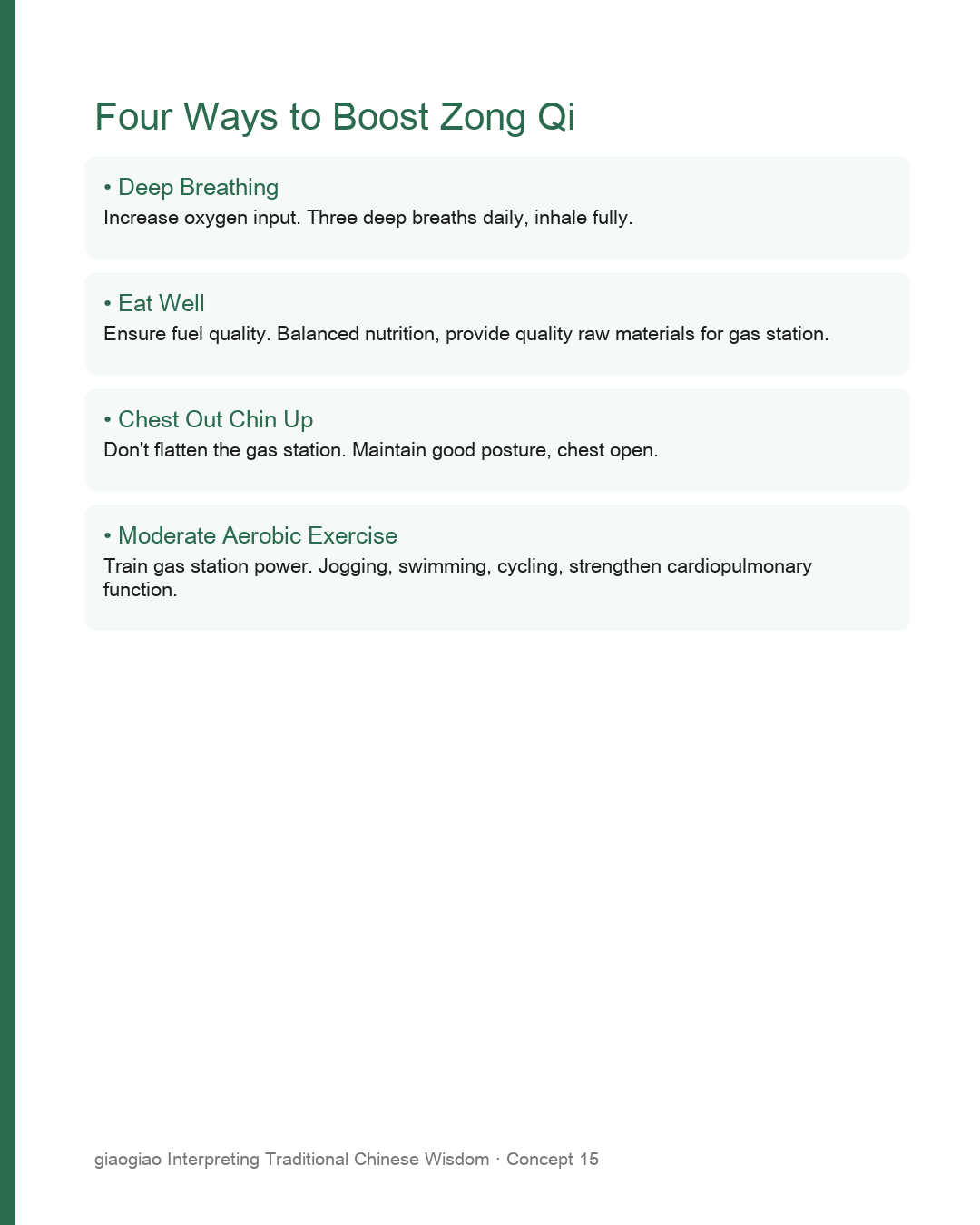
• Deep breathing (increase oxygen input). Three times daily, five minutes of abdominal breathing practice each time. Inhale: belly expands. Exhale: belly contracts. Inhale 4 seconds, hold 2 seconds, exhale 6 seconds. This directly increases blood oxygen content and boosts respiratory muscle strength, equivalent to widening the gas station's oxygen pipeline.
• Eat well (ensure fuel quality). Zongqi needs high-quality water-grains qi. Eat more quality protein (fish, eggs, legumes), complex carbs (whole grains, tubers), fresh vegetables and fruits. Eat less processed food, high-sugar food, fried food — these fuels have "too many impurities," the spleen-stomach works hard to digest them, consuming qi.
• Stand tall (don't flatten the gas station). Hunched posture compresses chest space, reduces lung capacity, and decreases oxygen intake. When sitting, retract and lower the shoulder blades, chest naturally rises. When standing, imagine a string pulling up from the top of your head, body naturally straight. This simple posture adjustment can increase your gas station's capacity by more than 15%.
• Moderate aerobic exercise (train gas station power). Brisk walking, jogging, swimming, cycling — 3–5 times weekly, 30 minutes each time. Heart rate at "can talk but can't sing" intensity. This gradually improves cardiorespiratory fitness, increases maximum oxygen uptake, equivalent to upgrading the central gas station's power.
These methods don't require you to believe in TCM. You only need to understand: your chest has a central gas station that receives oxygen and fuel and drives breathing and heartbeat. Give it better raw materials, more space, and stronger training, and it can output greater power.
Part 7One-Minute Summary
🕐 One Minute to Understand "Zongqi"
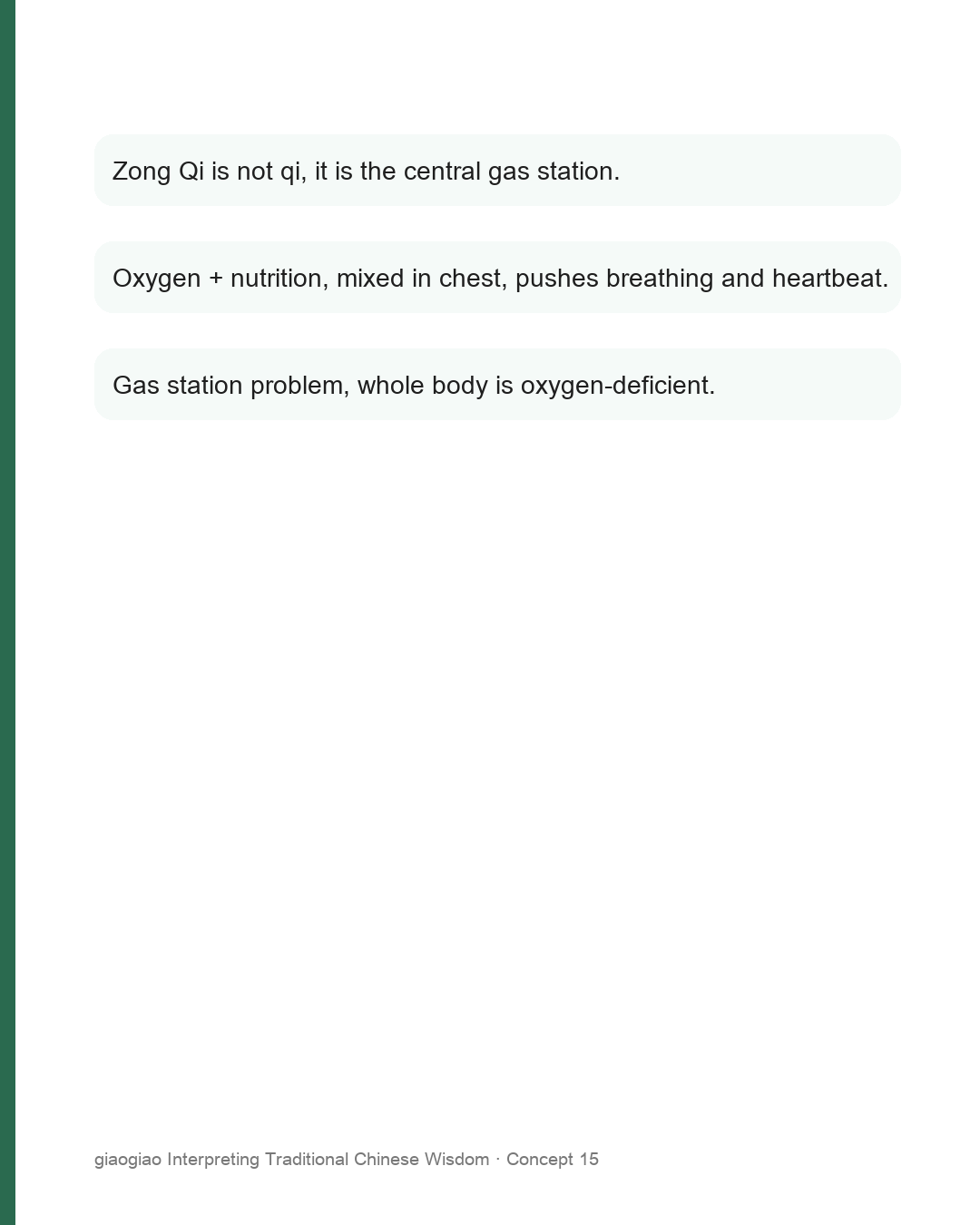
Zongqi = The body's central gas station.
Lung's clear qi = Oxygen input pipeline.
Spleen-stomach's water-grains qi = Fuel input pipeline.
Converging in the chest = Central gas station.
Driving breathing and heartbeat = Powering the engine and boiler.
Signs of Zongqi deficiency: low voice, winded climbing stairs, weak heartbeat, easy fatigue.
Causes: shallow breathing (insufficient oxygen input), poor eating (poor fuel quality), bad posture (gas station flattened), lack of exercise (low gas station power).
Methods: deep breathing (increase oxygen input), eat well (ensure fuel quality), stand tall (don't flatten the gas station), moderate aerobic exercise (train gas station power).
The ancients called it "Zongqi"; modern people call it "cardiopulmonary function."
Different names, but the body knows: when the gas station has a problem, the whole body is oxygen-starved.
Oxygen + nutrition, mixed in the chest, driving breathing and heartbeat.
When the gas station breaks down, the whole body is oxygen-starved.
Weak voice, labored breathing, feeble heartbeat — all its fault.
Tonifying Zongqi is simple: deep breathing, eat well, stand tall, moderate exercise.
When the gas station's power goes up, the whole person thrives.
Making money is the art of living; art is the life after making money.
giaogiao Decodes Chinese Wisdom · Concept 15
Using modern scientific language to help the world understand traditional Chinese wisdom.
No mysticism, no superstition, no belittlement.
Understand, rather than merely believe.
Coach Liu
Written in Florence