Why Do Chinese People Say "Phlegm-Dampness"? Your Body Isn't Dirty—Your Recycling Station Is Clogged
Part 1The Question
Have you ever had this experience?
You wake up in the morning with something like glue stuck in your throat. You cough for half an hour and finally hock up a yellow, sticky blob. You tell yourself it's just a "cold aftermath" and it'll pass in a few days. Three months later, it's still there every morning—your daily "morning phlegm performance," rain or shine.
Or maybe you never cough up phlegm, but you always feel heavy. Not tired—heavy. Like wearing a soaked cotton coat. Like sandbags tied to your legs. Like your whole body is sinking in mud. You go to the hospital, every test comes back normal. The doctor pats your shoulder: "Sub-health. Exercise more."
Then there's the sneakiest kind: your physical exam looks perfect, but the ultrasound shows a tiny thyroid nodule, a speck of fat on the liver, a small calcification in the lung. The doctor says "just observe, no need to worry." But you're freaked out: something is growing inside me—what is it?
A Chinese medicine doctor looks at all this and says one word: "Phlegm-dampness."
You're confused. But I don't cough up phlegm! Where's the phlegm?
That's the sneakiest thing about the concept of "phlegm": in Chinese medicine, it isn't just in your throat. It can be the phlegm you cough up, or every metabolic byproduct in your body that "shouldn't be there but is." The ancients used a single word to describe the state of "garbage accumulation"—and that word is "phlegm."
Part 2Traditional Chinese Explanation
The character "痰" (phlegm) in the Shuowen Jiezi (ancient dictionary) simply means "pathological fluid." Its original meaning was clear: excess water and viscous substances in the body. But as Chinese medicine evolved, "phlegm" became broader and broader, eventually turning into the "universal scapegoat" of TCM—can't figure out the cause? Blame phlegm.
——《丹溪心法》
"Phlegm, as a substance, follows qi up and down, reaching everywhere." —Danxi's Methods of the Heart
"百病多由痰作祟。"
——中医俗语
"Most diseases are caused by phlegm mischief." —Chinese medical saying
Chinese medicine divides "phlegm" into two big categories. Understand these two, and you understand the core metabolic logic of TCM:
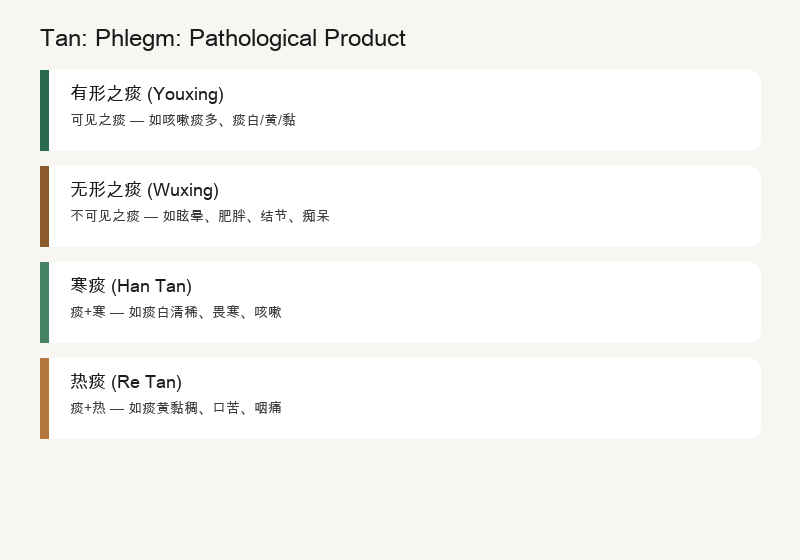
Visible Phlegm (有形之痰)—phlegm you can see, touch, and cough up. This is the secretion of the respiratory tract, the mucus produced when the lungs and airways clean up garbage. Normal people have respiratory mucus too—it traps dust and bacteria so you can cough them out. But when there's too much, too thick, too sticky, it means the cleanup system is overloaded: garbage is being produced faster than it can be hauled away.
Invisible Phlegm (无形之痰)—phlegm you can't see or cough up, but it's definitely there. High blood lipids, fatty liver, subcutaneous fat nodules, thyroid cysts, breast hyperplasia, even certain types of tumors—all fall under "invisible phlegm" in Chinese medicine. They aren't literally phlegm, but their essence is the same: metabolic waste produced by the body that wasn't cleared in time, accumulating into solid form.
And Phlegm-Dampness (痰湿) is the deluxe version of phlegm—so much garbage that it becomes a swamp. Dampness is the abnormal state of water; phlegm is the abnormal state of viscosity. Dampness + phlegm = a "mud pit" inside your body: water can't drain, sticky stuff keeps accumulating, and it's like you're soaked in water. Chinese medicine says "dampness is sticky and lingering"—it means exactly this state: not an acute disease, but it slowly drags you down.
The ancients discovered a pattern: if the body's waste-clearance system works normally, there's no problem. But once cleanup slows down (spleen deficiency), or too much garbage is produced (greasy diet), or the power is insufficient (qi stagnation), waste accumulates. Accumulate in the lungs, and it's visible phlegm. Accumulate in the blood vessels, and it's high lipids. Accumulate in the liver, and it's fatty liver. Accumulate in the glands, and it's nodules. The essence is the same.
Part 3giaogiao's Modern Translation
Alright, let's translate "phlegm" into modern language.
I'm not going to talk about pathological slides, tissue biopsies, or lipid metabolic pathways. Too complicated. Just remember one metaphor:
Visible Phlegm = Garbage you can see (the phlegm you cough up)
Invisible Phlegm = Garbage you can't see (metabolic waste inside the body)
Phlegm-Dampness = So much garbage, it's become a swamp
That's it. Your "phlegm" is essentially metabolic waste produced by the body that wasn't cleared in time.
Specifically:
What does visible phlegm correspond to? It corresponds to the respiratory tract's "mucus-cilia clearance system." The inner walls of your trachea have countless tiny cilia, like little brushes, pushing mucus (and the dust and bacteria trapped in it) upward until you cough it out. This is the body's most efficient "garbage conveyor belt." But when the air is too dirty, you smoke, you get infected, or you have allergies, mucus secretion increases, cilia movement weakens, and the conveyor belt jams—so you start coughing up phlegm.
What does invisible phlegm correspond to? It corresponds to all "metabolic waste accumulation" in the body. Blood lipids are waste from fat metabolism. High blood sugar is abnormal accumulation from sugar metabolism. Uric acid is waste from purine metabolism. Subcutaneous nodules are abnormal local tissue growth. These aren't literally phlegm, but in TCM's view, their "pathological mechanism" is the same as phlegm: what should leave doesn't leave, what should be cleared isn't cleared, and it accumulates into solid form.
What does phlegm-dampness correspond to? It corresponds to the combined state of "chronic inflammation + metabolic syndrome." In chronic inflammation, body tissues are in a low-grade inflamed state for a long time: water retention, tissue swelling, slowed metabolism. Add to that sitting all day, high-sugar diet, and lack of exercise, and fat metabolism almost grinds to a halt. The whole person enters a "swamp survival mode": not sick, but everything is slow, everything is heavy, everything is sticky.
So "phlegm" isn't mysticism. It's a functional metaphor—describing the overall state where the body's waste-clearance system can't keep up and garbage piles up into problems.
The ancients didn't have microscopes, but they used the concept of "phlegm" to precisely describe what modern people need a whole pile of terms—"metabolic syndrome," "chronic inflammation," "lipid metabolism abnormalities," "abnormal tissue proliferation"—to explain.
Part 4Real-Life Stories
Four stories to make you instantly understand what "phlegm" is.
Story One: The Morning Phlegm Marathon.
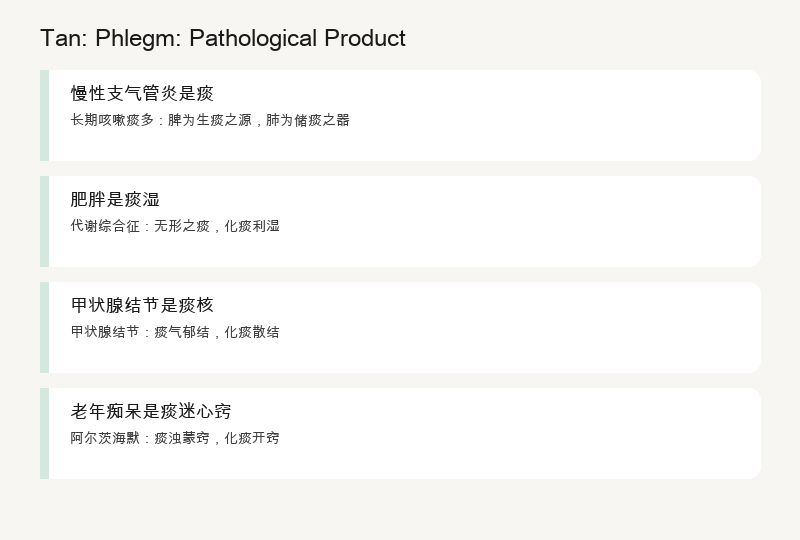
Old Zhang, mid-forties, doesn't smoke, but every morning he wakes up with a throatful of phlegm. Not clear phlegm—yellow, sticky phlegm that takes serious effort to cough up. After he hocks it out, his throat feels clear. But the next morning, the show starts again. Hospital checks: normal lung function, no infection, no asthma. Doctor says "chronic pharyngitis," prescribes some medicine. Useless.
TCM says: "The spleen is the source of phlegm production; the lung is the vessel that stores phlegm." The spleen is responsible for transforming water and dampness. When the spleen is weak, water and dampness stagnate and become phlegm, which gets sent to the lungs for storage. The lung is the warehouse, not the factory. If you keep cleaning the warehouse without fixing the factory, the phlegm will never run out.
The truth: Long-term sweet and greasy diet, plus sitting and lack of exercise, leads to insulin resistance and gut microbiome imbalance. Endotoxins produced by the gut enter the bloodstream, stimulating respiratory mucosa and increasing mucus secretion. Meanwhile, a high-sugar diet makes mucus more viscous, making it harder for cilia to push it along. Coughing up phlegm is just the symptom; the root is metabolic.
Story Two: Feeling Heavy, Like Being Wrapped in a Wet Quilt.
Little Li, in his twenties, normal weight, but every day he says he's "tired." Not sleepy—heavy. The alarm rings three times, but his body feels glued to the bed. By afternoon, his calves are swollen, like they're filled with lead. Gets home, doesn't want to do anything, but can't fall asleep when he lies down. His tongue shows clear teeth marks, with a white, greasy coating.
TCM says: "Phlegm-dampness traps the spleen." The spleen governs the muscles and limbs. When the spleen is trapped by phlegm-dampness, the limbs become heavy. It's like a phone dropped in water—not that the battery is dead, but the circuit board is damp. It powers on, but nothing flows smoothly.
The truth: Mild edema and tissue fluid retention caused by chronic inflammation. High-salt diet, sitting all day, insufficient sleep slow down lymphatic circulation, and tissue fluid can't drain back properly. Meanwhile, chronic inflammation increases capillary permeability, so more fluid leaks into tissue spaces. You feel "wet" because your body really is wet—abnormally high tissue water content.
Story Three: Obesity + High Lipids, a Report Full of Arrows.
Old Wang, fifty, big belly, all four lipid markers off the charts. The doctor says he needs medication or his blood vessels will clog. Wang asks: "I don't eat more than others, so why are my lipids high?" The doctor answers: "Your metabolism slowed down."
TCM says: "Fat people tend to have phlegm-dampness." This isn't fat-shaming—it's observing a pattern: the process of accumulating body fat is remarkably consistent with the process of forming phlegm-dampness. Fat isn't phlegm, but the mechanism of fat accumulation—eating more, burning less, metabolizing slower—is identical to how phlegm forms.
The truth: Insulin resistance is the core. Long-term high-sugar, high-fat diet keeps insulin levels chronically high. Fat cells become insensitive to insulin, fat breakdown is inhibited, blood triglycerides rise, and the liver packages excess fat into VLDL particles, eventually dumping it in the viscera and blood vessels. This is what "invisible phlegm" looks like flowing through your vessels.
Story Four: Thyroid Nodule, the "Surprise" from a Physical Exam.
Little Liu, early thirties, female. Her B ultrasound shows a small thyroid nodule with clear borders. The doctor says it's benign, "just observe." But she's panicked: "Something is growing inside me, how can that be okay?"
TCM says: "Phlegm and qi congeal." Qi stagnates, phlegm gathers, blocks a spot, and over time it becomes something tangible. Thyroid nodules, breast nodules, ovarian cysts, lipomas—all fall under "phlegm nodules" in TCM: nuclei formed by phlegm congealing.
The truth: Nodule formation involves local chronic inflammation, cell proliferation, and fibrosis. Long-term stress, emotional suppression, insufficient sleep lead to immune system dysfunction. Local tissue goes through repeated repair-injury cycles, and over-repair forms a nodule. It's not cancer, but it's a signal from your body: the metabolism here is broken.
Four stories, one underlying logic: the body's metabolic waste, what should be cleared wasn't cleared, and it accumulated into disease.
Part 5Modern Research
Does "phlegm" have scientific research?
Yes, but scientists don't use the word "phlegm." They use:
• Metabolic syndrome. Research finds that people with phlegm-dampness constitution universally show insulin resistance, abdominal obesity, and abnormal blood lipids. This isn't coincidence—it's the precise metabolic counterpart of "invisible phlegm."
• Chronic inflammation. Inflammatory markers like C-reactive protein (CRP) and interleukin-6 (IL-6) are significantly elevated in phlegm-dampness populations. This shows that "phlegm-dampness" isn't an abstract concept—it's a measurable physiological state.
• Gut microbiome. People with phlegm-dampness constitution show reduced gut microbiome diversity and an elevated Firmicutes/Bacteroidetes ratio. This dysbiosis leads to endotoxins entering the bloodstream, stimulating whole-body low-grade inflammation and affecting lipid metabolism. This is the microbiological explanation for "the spleen is the source of phlegm production."
• Mucus research. Modern pulmonology finds that chronic bronchitis and asthma patients have significantly abnormal mucus secretion volume and viscosity. More interestingly, a high-sugar diet directly increases mucus viscosity because glucose molecules embed themselves into the mucin network structure. This is the scientific basis for "eat less sugar, produce less phlegm."
These studies aren't numerous, but they all point in the same direction: "phlegm" describes the overall state of the body's waste-clearance system, not one specific substance.
Part 6Practical Methods
Now that you understand "phlegm," how do you clear it?
First, bust a few myths:
• Phlegm-resolving medicine isn't a panacea. Fritillaria, loquat syrup, dried tangerine peel—these can resolve "visible phlegm," but their effect on "invisible phlegm" is limited. The fat in your blood vessels and the fatty deposits in your liver aren't going to be solved by drinking loquat syrup.
• Dampness-removing tea can't be drunk blindly. Red bean and coix seed water is an internet-famous dampness-removing formula, but for people with cold constitutions or weak spleen-stomach, long-term consumption of coix seed (which is cold in nature) actually damages the spleen. The spleen gets weaker, and you get more phlegm. The prerequisite for removing dampness is protecting the spleen—this "garbage processor."
• Sweating doesn't equal dampness removal. Many people think "sweating more means dampness is coming out," so they run like crazy or sit in saunas. But excessive sweating depletes qi. When qi is deficient, the spleen's ability to transform water and dampness gets even weaker. Sweating is a result, not a method.
Specific methods:
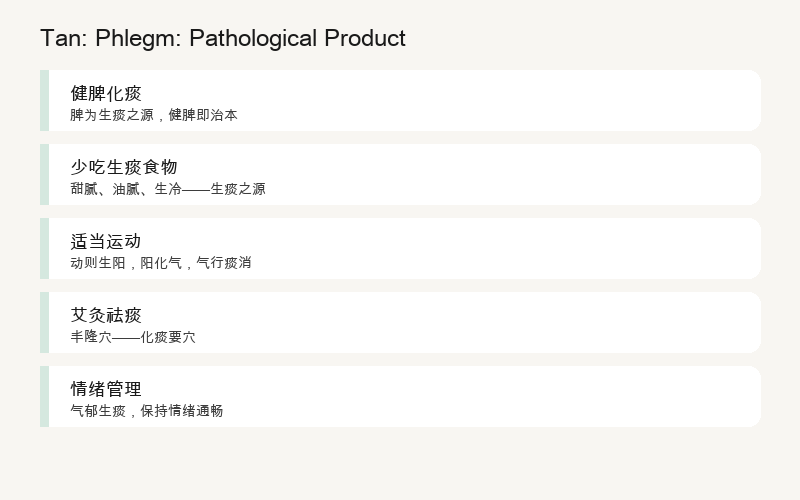
• Eat less sweets and greasy food. Reduce garbage production. Sugar is mucus's best friend; oil is fat's best friend. For phlegm-dampness constitution people, the most taboo things are sweets and fried food. Not saying never eat them—just reduce the frequency. Every slice of cake you skip is one less burden on your body's recycling station.
• Eat more phlegm-resolving foods. Radish (pungent and dispersing, moves qi and resolves phlegm), dried tangerine peel (regulates qi and strengthens the spleen, dries dampness and resolves phlegm), coix seed (promotes urination and drains dampness, strengthens the spleen and removes numbness), winter melon (promotes urination and reduces swelling, clears heat and resolves phlegm). Note: dry-fry coix seed before using to reduce its cold nature; use tangerine peel aged at least three years so its drying nature is milder.
• Moderate exercise. Promote garbage clearance. Exercise is the most direct way to boost metabolic rate. But for phlegm-dampness people, don't start with high intensity. Brisk walking, Baduanjin (eight pieces of brocade), swimming—these low-intensity, long-duration exercises best promote lymphatic circulation and fat metabolism. Thirty minutes daily beats two crazy hours on the weekend.
• Don't stay up late. Let the garbage trucks work the night shift. 1 a.m. to 3 a.m. is the peak period for liver detoxification and metabolism. When you stay up late, the liver's "night-shift garbage trucks" stop working. Garbage piles up overnight, and the next day you keep eating and producing more garbage. The recycling station can never finish cleaning.
• Manage emotions. Anger harms the liver; liver stagnation produces phlegm. Emotional suppression, anger, and anxiety lead to liver qi stagnation. The liver governs free flow and discharge. When liver qi stagnates, the whole body's qi mechanism doesn't flow smoothly. When qi doesn't flow, water and dampness stagnate; when they stagnate long enough, they congeal into phlegm. This is one of the core causes of "invisible phlegm." So sometimes, the first step in resolving phlegm is to "cut yourself some slack."
These methods don't require you to believe in Chinese medicine. You just need to understand: your body is a city, and metabolic waste is garbage. The city's cleaning system needs reduced garbage input, increased hauling output, and guaranteed hauling efficiency. Phlegm is the alarm signal that garbage is accumulating.
Part 7One-Minute Summary
🕐 Understand "Phlegm" in One Minute
Phlegm = Your body's garbage accumulation.
Visible Phlegm = Garbage you can see (the phlegm you cough up).
Invisible Phlegm = Garbage you can't see (high lipids, fatty liver, nodules, cysts).
Phlegm-Dampness = So much garbage, it's become a swamp.
Phlegm isn't snot. It's garbage.
Visible phlegm is garbage you can see; invisible phlegm is metabolic waste you can't.
When garbage isn't cleared, the body becomes a swamp.
Causes: sweet and greasy diet, sitting and lack of exercise, staying up late, emotional suppression.
Methods: eat less sweets and greasy food, eat more radish, tangerine peel, and coix seed, exercise moderately, don't stay up late, manage emotions.
The ancients called it "phlegm"; modern people call it "metabolic waste accumulation."
Different names, but the body knows: when there's too much garbage, it's time to clean up.
It's the phlegm you cough up, and it's also the nodules that can't be detected.
It's the garbage you can see, and it's also the metabolic waste you can't.
But whatever kind of phlegm it is, the essence is the same:
your body is reminding you that the cleanup system needs maintenance.
Don't wait until the garbage has piled into a swamp before you remember to clean.
Making money is the art of living; art is life after making money
giaogiao Decodes Traditional Chinese Wisdom · Concept 19
Using modern scientific language to help the world understand Traditional Chinese Wisdom.
No mysticism, no superstition, no belittling.
Understand, rather than merely believe.
Coach Liu
Written in Florence