Why Do Chinese People Say "Blood Stasis"? Your Body Isn't Aging—It's a Traffic Jam
Part 1The Question
Have you ever had this experience?
You look in the mirror in the morning and notice your lips are dark, not rosy—more on the purple side. You think it's from not sleeping well. You stick out your tongue and see dark purple spots along the edges, like someone sprinkled pepper on it. You think it's from eating spicy food. You sit all day, and when you stand up after work, your legs are so numb they don't feel like yours, taking a few steps to recover. You think it's bad posture. During your period, your belly cramps so hard, and the menstrual blood has dark red clots in it, like jelly. You think it's a "cold uterus."
You go to the hospital, get blood tests, coagulation tests, D-dimer tests, and the doctor says: "Everything looks normal, maybe just poor circulation."
You visit a Chinese medicine doctor. The old physician glances at your tongue and says one word: "Stasis."
Not a single test was done, and a diagnosis was made. Do you believe it or not?
What's even more outrageous is that this character "瘀" (stasis) has countless variations in the TCM dictionary. Blood stasis, qi stagnation, phlegm-stasis, cold stasis, heat stasis... The same "clog" can have so many varieties. What on earth is this thing?
Part 2Traditional Chinese Explanation
The character "瘀" (stasis) in the Shuowen Jiezi means "accumulated blood"—blood pooled there, not moving. The ancients observed very directly: when a person gets injured, the skin turns blue-purple because blood leaked out and got trapped under the skin; when a person gets angry, they feel chest tightness and stabbing pain because qi flow is impaired, leading to blocked blood flow; when a person ages, spots appear on their face because qi and blood circulation slows down, and garbage deposits.
——《医宗金鉴》
"If stagnant blood is not removed, new blood cannot be generated." —Golden Mirror of Medical Orthodoxy
"通则不痛,痛则不通。"
——《黄帝内经》
"If there is free flow, there is no pain; if there is pain, there is no free flow." —Yellow Emperor's Inner Canon
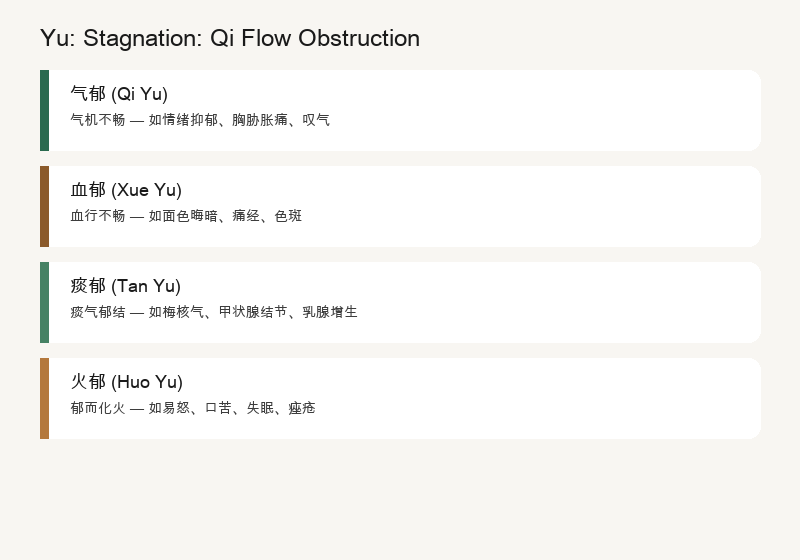
TCM divides "stasis" into several types, but for ordinary people, remembering three is enough:
Blood Stasis (血瘀)—blood flow is too slow, clogged into a parking lot. People with blood stasis have purple lips, spotted tongue, skin dry like fish scales, and fixed stabbing pain somewhere in the body (like menstrual cramps or chest pain). Blood stasis is like all the cars on the road have stopped, with more cars still coming from behind, getting more and more clogged.
Qi Stagnation (气滞)—qi can't move, the traffic lights are broken. People with qi stagnation feel chest tightness, abdominal bloating, emotional depression, and like to sigh. Qi stagnation is like the traffic signals malfunctioning—the cars could move, but the rules are broken, so nobody can move. Worse, when qi doesn't move, blood doesn't move either; qi stagnation inevitably turns into blood stasis over time.
Phlegm-Stasis (痰瘀)—garbage piled in the middle of the road, completely blocking it. People with phlegm-stasis tend to be overweight, have thick greasy tongue coating, feel mentally foggy, and may have plaques in their blood vessels. Phlegm-stasis is like a garbage mountain piled in the middle of the highway—not only can cars not move, but the road itself is occupied.
These three types of stasis together make up what TCM calls "stasis syndrome." It's not one specific disease, but a general term for problems with the body's transport system—blood, gas, metabolic waste, as long as one flow isn't smooth, it's called "stasis."
The ancients had no ultrasound, no angiography, but they used naked eyes and touch to precisely discover the phenomenon of "clogging." Blue-purple skin is blood clog; chest tightness and sighing is qi clog; obesity and mental fog is garbage clog. They used the character "瘀" to summarize what modern medicine needs several different departments to explain clearly.
Part 3giaogiao's Modern Translation
Alright, let's translate "stasis" into modern language.
I'm not going to talk about hemorheology, platelet aggregation rates, or vascular endothelial function. Too complicated. Just remember one metaphor:
Blood Stasis = Blood flow too slow, clogged into a parking lot
Qi Stagnation = Qi can't move, the traffic lights are broken
Phlegm-Stasis = Garbage piled in the middle of the road, completely blocked
That's it. Your "stasis" is essentially microcirculation problems—blood, lymph fluid, and tissue fluid in the capillaries and small vessels are flowing too slowly, or even locally stopped.
Specifically:
What does blood stasis correspond to? It corresponds to increased blood viscosity, slowed blood flow velocity, and capillary stagnation. People who sit for long periods have slower lower limb venous return, blood stagnating in the calf veins, oxygen and nutrients not reaching cells, and metabolic waste not being transported away—numb legs, swelling, even varicose veins. This is blood stasis.
What does qi stagnation correspond to? It corresponds to autonomic nervous system dysregulation and abnormal smooth muscle tension. When angry, the sympathetic nervous system becomes excited, blood vessels constrict, gastrointestinal peristalsis slows, and the whole body enters "fight mode," with blood flow redistributed, causing many areas to be "cut off." People with smooth qi flow have blood vessels that expand when they should expand and contract when they should contract, with normal rhythm. People with qi stagnation have disrupted rhythm—places that should be open are not open.
What does phlegm-stasis correspond to? It corresponds to metabolic waste accumulation, abnormal blood lipids, and atherosclerosis. Low-density lipoprotein cholesterol deposits on blood vessel walls, macrophages engulf it to form foam cells, eventually becoming plaques. This is "garbage blocking the road." The blood vessel lumen gets narrower and narrower, blood flow gets slower and slower, and may eventually be completely blocked—heart attack or stroke.
So "stasis" isn't mysticism. It's a functional metaphor—describing the congested state of the body's internal transportation system. Blood, gas, metabolic waste—whichever one has "poor flow," that's stasis.
The ancients didn't have microscopes, but they used the concept of "stasis" to precisely describe what modern people need three concepts—"microcirculation disorder," "autonomic nervous system dysfunction," and "atherosclerosis"—to explain.
Part 4Real-Life Stories
Four stories to make you instantly understand what "stasis" is.
Story One: Menstrual cramps with blood clots.
Every time your period comes, your lower abdomen feels like someone is wringing a towel inside. The menstrual blood isn't bright red, it's dark red, mixed with jelly-like clots. You take ibuprofen, the pain is relieved, but the clots are still there. TCM says: "Uterine traffic jam."
The truth: Insufficient uterine contraction strength, poor menstrual blood expulsion, some blood staying too long in the uterine cavity or vagina, hemoglobin oxidizing, color turning dark, forming clots. Meanwhile, excess local prostaglandin secretion causes uterine smooth muscle spasms—pain. Ibuprofen inhibits prostaglandins, relieving pain but not "unclogging." TCM's blood-activating and stasis-removing approach is helping the uterus "clear the jam."
Story Two: Bruising after a bump.
You bump your knee, the skin isn't broken, but the next day it's bruised purple and hurts when pressed. You think it's "stagnant blood" and wait for it to disperse on its own. TCM says: "Local parking lot."
The truth: Subcutaneous capillaries rupture, blood leaks into tissue spaces. Normally, the body slowly absorbs this blood. But absorption speed depends on local blood circulation—good circulation, fast absorption; poor circulation, the "parking lot" stays longer. Heat application and blood-activating stasis-removing medicine accelerate this "clearing" process.
Story Three: Long-term sitting, leg numbness.
Eight hours in the office chair, by three or four in the afternoon, your calves start to swell, and when you stand up to walk, it feels like stepping on cotton. You think it's "calcium deficiency." TCM says: "Highway traffic jam in the lower limbs."
The truth: When sitting for long periods, lower limb muscles don't move, lacking the "muscle pump" effect, venous return almost relies on gravity alone. Blood pools in the calf veins, capillary hydrostatic pressure rises, tissue fluid seeps out, legs swell and go numb. In severe cases, venous valves are damaged, developing into varicose veins. This isn't calcium deficiency, it's "clogged."
Story Four: Age spots / liver spots.
After age fifty, brown spots start appearing on the face and hands, more obvious with sun exposure. You think it's "skin aging." TCM says: "Skin microcirculation blockage."
The truth: Blood flow in skin microcirculation slows down, metabolic waste (like lipofuscin) deposits in the epidermal basal layer and dermis. Meanwhile, ultraviolet rays accelerate melanin synthesis. People with good microcirculation can transport metabolic waste away in time; people with poor microcirculation have garbage deposit, forming spots. This is what "stasis" looks like on the skin.
Four stories, one underlying logic: the body's transport system has a problem, not the production system.
Part 5Modern Research
Does "stasis" have scientific research?
Yes, and plenty of it. Scientists don't use the word "stasis." They use:
• Hemorheology. Research finds that blood stasis syndrome patients have significantly higher whole blood viscosity, plasma viscosity, and red blood cell aggregation index than normal people. Simply put, the blood has become "thicker" and can't flow. This is the objective indicator of "blood stasis."
• Microcirculation research. Using nailfold microcirculation detectors, blood stasis syndrome patients show narrowed capillary diameter, slowed blood flow velocity, red blood cell aggregation, and even local blood flow stagnation. This is direct evidence of "stasis" at the microscopic level.
• Vascular endothelial function. Research finds that qi stagnation and blood stasis are closely related to vascular endothelial dysfunction. Under normal conditions, endothelial cells release nitric oxide (NO), causing vasodilation. When endothelial function is impaired, NO decreases, blood vessels constrict, and blood flow resistance increases—this is the molecular mechanism of how "qi stagnation" leads to "blood stasis."
• Blood-activating and stasis-removing medicine research. Tanshinone in salvia miltiorrhiza and ligustrazine in ligusticum chuanxiong have been confirmed to have anti-platelet aggregation, microcirculation improvement, and vascular endothelial protection effects. These traditional medicines aren't mysticism—their active ingredients have been verified by modern science.
These studies fully demonstrate: "stasis" is a phenomenon that can be precisely described in modern scientific language. The ancients used "stasis" as a summary; modern people use "microcirculation disorder," "hemorheological abnormality," and "vascular endothelial dysfunction" to describe it—they're talking about the same thing.
Part 6Practical Methods
Now that you understand "stasis," how do you unclog it?
First, bust a few myths:
• Taking aspirin isn't a cure-all. Aspirin resists platelet aggregation and prevents thrombosis, but it's "preventing car accidents," not "clearing traffic jams." People who already have blood stasis, taking aspirin alone has limited effect and needs to be combined with circulation improvement.
• Massage isn't the harder the better. Blood-activating and stasis-removing massage emphasizes "moderation"—too light, it can't push; too heavy, it causes new damage. Find a professional therapist, don't massage yourself randomly.
• Blood-activating and stasis-removing medicines aren't for everyone. Pregnant women, people with excessive menstrual bleeding, and people with coagulation disorders may have the opposite effect from eating blood-activating foods or medicines. First identify your constitution, then talk about methods.
Specific methods:
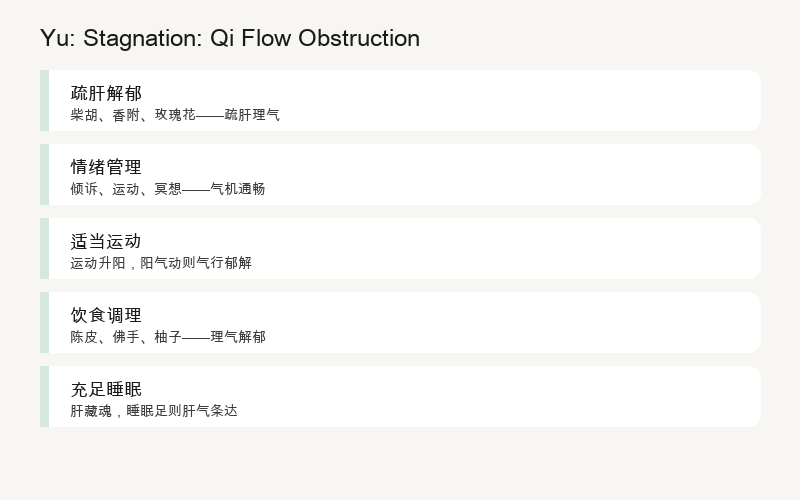
• Moderate exercise. The simplest, free way to unclog. Thirty minutes of brisk walking or jogging daily gets the muscle pump working, accelerates lower limb venous return, and improves whole-body microcirculation. For people who sit a lot, standing up and walking for two minutes every hour beats any medicine.
• Heat application / foot soaking. Things expand with heat and contract with cold. Blood vessels dilate when heated, and blood flow accelerates. Applying a hot water bottle during menstrual cramps, applying heat 48 hours after an injury, and soaking feet in 40°C water for 20 minutes before bed—all are helping the body "melt ice and clear the road."
• Eat blood-activating and stasis-removing foods. Hawthorn (aids digestion and removes stasis), safflower (activates blood and unblocks menstruation), black fungus (resists platelet aggregation), onion (contains prostaglandin A, dilates blood vessels), ginger (warms meridians and dispels cold). These foods aren't medicine, but long-term persistence is like giving your blood vessels a "maintenance service."
• Don't get angry. Emotion is the most hidden "clog." When angry, the sympathetic nervous system becomes excited, whole-body blood vessels constrict, blood flow is redistributed, and gastrointestinal, skin, and limb blood supply decreases. People who are angry for long periods have qi stagnation and blood stasis as standard equipment. Learning "emotional unclogging" is more important than taking any medicine.
• Regular massage. Neck, shoulders, lower back, calves—these places most prone to clogging from sitting, regularly find a professional therapist to unblock meridians, or use a fascia gun or foam roller to relax yourself. Manual unclogging is like hiring a "clearance team" for the body.
These methods don't require you to believe in Chinese medicine. You just need to understand: your body is a city, blood vessels are roads, blood is traffic, and qi and metabolic waste are traffic rules and garbage collection. A city running well doesn't rely on "building more roads," but on "not having traffic jams and cleaning regularly."
Part 7One-Minute Summary
🕐 Understand "Stasis" in One Minute
Stasis = Your body's traffic jam.
Blood Stasis = Blood flow too slow, clogged into a parking lot (purple lips, spotted tongue, menstrual cramps with blood clots).
Qi Stagnation = Qi can't move, the traffic lights are broken (chest tightness, abdominal bloating, likes to sigh).
Phlegm-Stasis = Garbage piled in the middle of the road, completely blocked (overweight, foggy mind, blood vessel plaques).
Stasis isn't aging, it's clogging. Once unclogged, complexion improves, spots fade, pain stops.
Causes: long-term sitting, anger, cold exposure, greasy diet, insufficient sleep.
Methods: exercise, heat application, eat hawthorn/safflower/black fungus, don't get angry, regular massage.
The ancients called it "stasis"; modern people call it "microcirculation disorder."
Different names, but the body knows: when it's clogged, it needs to be unclogged.
Blood clogged is called blood stasis, qi clogged is called qi stagnation, garbage clogged is called phlegm-stasis.
Unclog, rather than clog.
This is probably the most朴素 wisdom of the Chinese people:
Don't let the body stay clogged, let it flow.
Making money is the art of living; art is life after making money
giaogiao Decodes Traditional Chinese Wisdom · Concept 20
Using modern scientific language to help the world understand Traditional Chinese Wisdom.
No mysticism, no superstition, no belittling.
Understand, rather than merely believe.
Coach Liu
Written in Florence