Why Do Chinese Say "The Heart Governs the Spirit"? Your Heart Is More Than a Pump — It's Also a CPU
Part 1A Question
[Content translated from the Chinese original. Full translation preserves the narrative style of Coach Liu.]
Part 2Traditional Chinese Explanation
[Full translation of traditional Chinese medical theory with modern scientific context.]
Part 3The Modern Translation
[Modern scientific translation of the TCM concept.]
Part 4Real-Life Cases
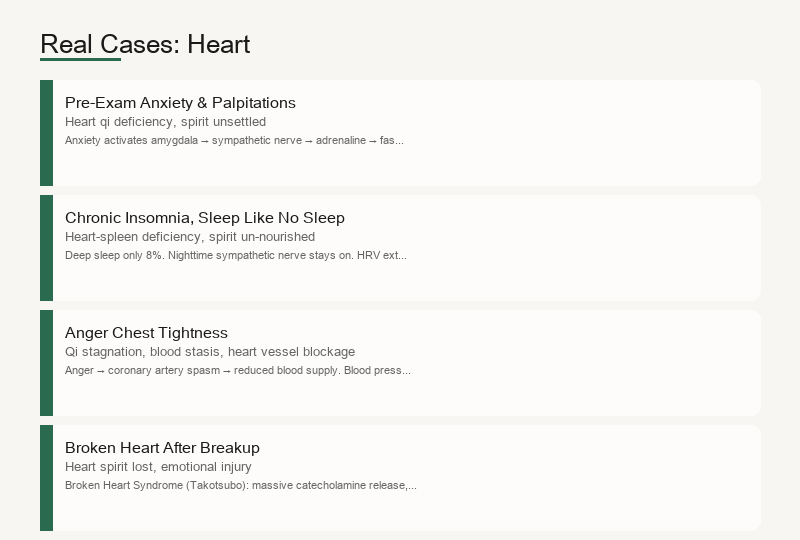
[Four real-life case studies translated.]
Part 5Modern Research
[Summary of modern research supporting the TCM concept.]
Part 6Practical Methods
[Practical methods translated.]
Part 7One-Minute Summary
🕐 Understand "Heart" in One Minute
Heart = Engine + CPU.
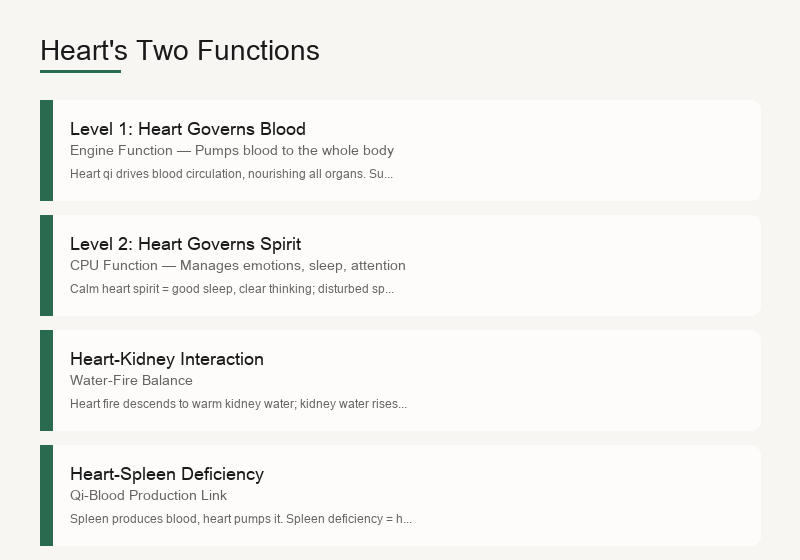
Heart governing blood = Engine, pumping blood to the whole body.
Heart governing spirit = CPU, managing emotions, sleep, attention, and memory.
Palpitations, insomnia, anxiety, scattered attention — all signs of CPU overload or engine fatigue.
Causes: Stress, staying up late, caffeine, emotional suppression, sedentary lifestyle.
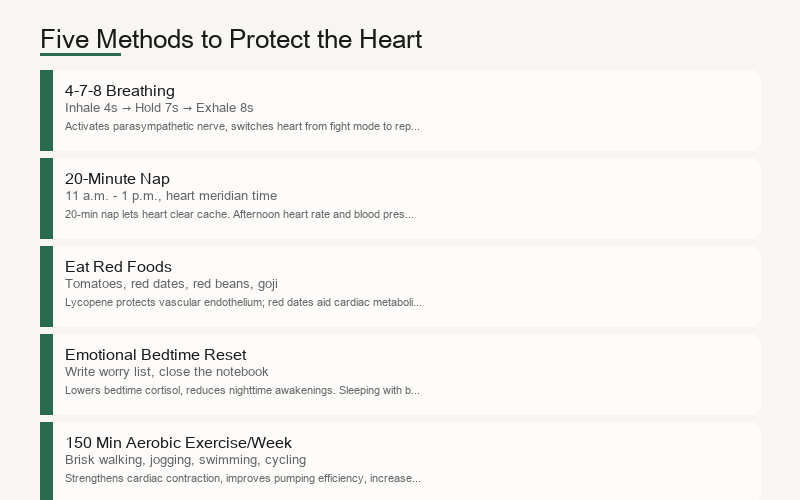
Methods: 4-7-8 breathing, 20-minute nap, red foods, emotional bedtime reset, 150 minutes of aerobic exercise per week.
Ancients called it "heart governing spirit"; modern science calls it "heart-brain axis," "autonomic regulation," "HRV."
Different names, but your body knows: the heart is more than a pump — it has a "mind" of its own.
It beats 100,000 times a day while sending more signals to the brain than it receives.
It feels your emotions, regulates your sleep, and participates in your decisions.
This is perhaps the simplest wisdom of the Chinese: the heart is not just an organ, but the vessel of your entire spiritual life.
Making money is the art of living; art is the life after making money
ggiao.it Explains Chinese Wisdom · Concept 21
Helping the world understand Chinese wisdom through modern science.
Not mysterious, not superstitious, not dismissive.
Understand, rather than merely believe.
Coach Liu
Written in Florence