Why Does TCM Say "When Collaterals Are Blocked, Local Tissue Suffers"? Your Capillaries Do More Than Just Carry Blood
Part 1A Question
Have you ever had this experience?
In winter, your hands and feet are like ice blocks. Thick socks and gloves don't help — the soles of your feet feel like they're standing on frozen bricks. The TCM doctor takes your pulse and says, "The collateral vessels are blocked, Qi and blood cannot reach the four extremities." When a pimple on your face keeps returning to the same spot, like a game of whack-a-mole, Western medicine says "sebaceous glands are overactive," while TCM says "local collateral stasis with damp-heat accumulation." You go for gua sha, the therapist scrapes your back a few times, and purple-red marks appear. Some areas show marks, others don't. The therapist says: "Where sha appears, the collaterals had stagnant blood; where nothing shows up, the flow is still okay." You remain half-skeptical, but you do feel better afterward.
You ask a Western doctor: "What are collaterals?" The doctor replies: "There's no such concept in our system. Probably capillaries."
You ask a TCM doctor: "What exactly are collaterals?" The old master says: "The main channels are the trunk roads; the collaterals are the branch roads; the minute collaterals are as fine as hair threads, spreading throughout the entire body."
One says "capillaries," the other says "branch roads" — are they talking about the same thing?
Even more striking, TCM says "chronic illness enters the collaterals" — minor ailments stay in the meridians, serious ones penetrate the collaterals. A common cold is in the meridians, treated for a few days and gone; diabetes, coronary disease, tumors "enter the collaterals," lingering and hard to resolve. What's going on here?
Part 2Traditional Chinese Explanation
The concept of "Luo" was systematically explained in the Yellow Emperor's Inner Canon. Ancient physicians observed: when someone's skin turns cold and purplish, it's because Qi and blood can't reach the extremities; when dark spots or localized discoloration appear on the face, it's because Qi and blood have stagnated locally; when sha marks appear after gua sha, it's because stagnant blood in the collaterals has been "forced" to the surface. They divided the meridian system into three levels: main channels, collaterals, and minute collaterals.
— Yellow Emperor's Inner Canon · Ling Shu · Ben Zang
"The collaterals are the branches of the channels; what separates from the channels is called collaterals."
— Yellow Emperor's Inner Canon
"Chronic illness enters the collaterals, obstructing the vessels."
— Qing Dynasty · Ye Tianshi, Clinical Guide to Medical Cases
TCM summarizes the function of "Luo" in three words: connect, moisten, and disperse.
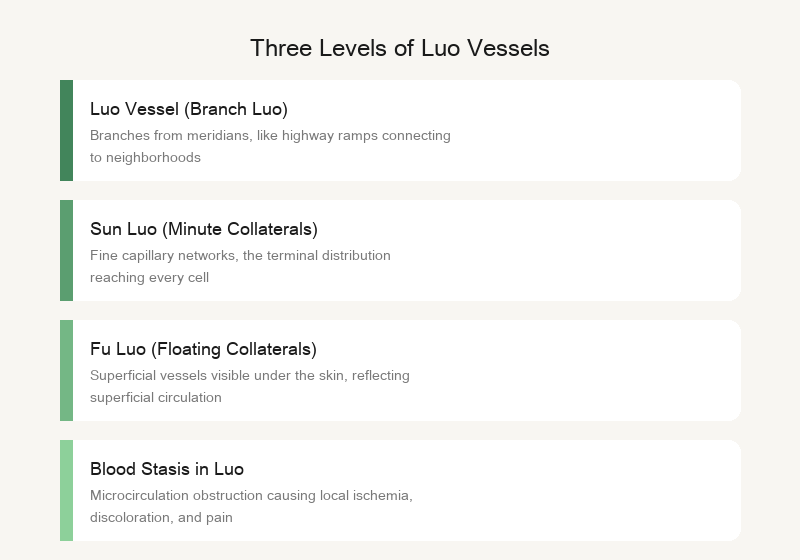
Connect — Collaterals are the branches of the meridian system, like highway ramps and capillaries. The main channels are the trunk roads, the collaterals are the connecting roads, the minute collaterals are the finer capillaries, and the floating collaterals are the superficial visible branches. The collaterals carry Qi and blood from the main channels to every corner of the body — skin, muscles, fascia, and internal organs. Without collaterals, even abundant Qi and blood would never reach the fingertips.
Moisten — The collaterals don't just "transport"; they also "nourish." As Qi and blood reach local tissues through the collaterals, they provide nutrients and energy. When collaterals are blocked, local tissues become ischemic, oxygen-starved, and malnourished. This is what "when collaterals are blocked, local tissue suffers" means.
Disperse — Collaterals also serve to "disperse" — they carry metabolic waste, pathogenic factors, and stagnant blood away from the body. Gua sha, cupping, and collateral pricking all use the collaterals to "disperse" stagnation and pathogens. When collaterals are open, pathogenic factors have an exit; when blocked, they accumulate locally.
TCM states that "chronic illness enters the collaterals" — external diseases like colds first affect the meridians and are short-lived; chronic diseases like diabetes, coronary disease, and cancer penetrate the collaterals and linger. Because collaterals are tiny and deeply distributed, once pathogenic factors enter, they are difficult to expel. This is why "collateral disease" is hard to treat — illness at the surface is easy to treat; illness in the depths is hard.
So what the ancients called "collaterals" is not just the capillaries of modern medicine, but the entire micro-delivery network including capillaries, micro-lymphatic vessels, nerve endings, and fascial spaces. The ancients used the single word "Luo" to describe what modern medicine needs three concepts — "microcirculation," "tissue fluid," and "neural regulation" — to explain.
Part 3Giaogiao's Modern Translation
Okay, let's translate "Luo" into modern language.
I won't bore you with microvascular permeability, tissue fluid exchange, or lymphatic return. Too complex. Just remember one metaphor:
Main channels = national highways (Twelve Regular Meridians)
Collaterals = highway ramps and connecting roads (branches)
Minute collaterals = capillaries and last-mile delivery (terminals)
Floating collaterals = superficial visible fine vessels
That's it. Your "Luo" is essentially the terminal branch of the Qi and blood delivery network — the main road reaches the village entrance, and the village roads deliver the goods to every doorstep.
Specifically:
What do collaterals correspond to? They correspond to the microcirculation system of modern medicine — including capillaries, arterioles, venules, lymphatic vessels, and tissue fluid channels. Collaterals are the "pipes" of microcirculation, responsible for the final leg of transporting blood, oxygen, and nutrients from vessels to tissue cells. When collaterals are blocked, microcirculation is impaired, and local tissues become ischemic and oxygen-starved.
What does "blocked collaterals" correspond to? It corresponds to microcirculation disorder. Capillary blockage, slow blood flow, and increased blood viscosity lead to local tissue ischemia. Symptoms include cold hands and feet (poor peripheral microcirculation), dark skin spots (local blood stasis), edema (impaired tissue fluid return), and recurrent ulcers (insufficient tissue nutrition). It's not some mysterious "Qi and blood blockage" — it's a physical obstruction of microcirculation.
What does "chronic illness enters the collaterals" correspond to? It corresponds to microvascular disease in chronic illness. Long-term high blood sugar in diabetes damages microvessels, leading to diabetic nephropathy and retinopathy; hypertension damages small arteries, causing cerebral small vessel disease; coronary disease involves atherosclerosis of coronary arteries and microvascular narrowing. All these diseases have "entered the collaterals" — it's not the large vessels that are blocked, but the microvessels that are failing. The ancients observed this with remarkable accuracy.
So "Luo" is not mysticism. It's a functional metaphor — describing the terminal branches of the Qi and blood delivery network and the microcirculation system. The ancients used one word to describe what modern medicine needs three concepts to explain.
Part 4Real-Life Cases
Four stories to make you instantly understand what "Luo" is.
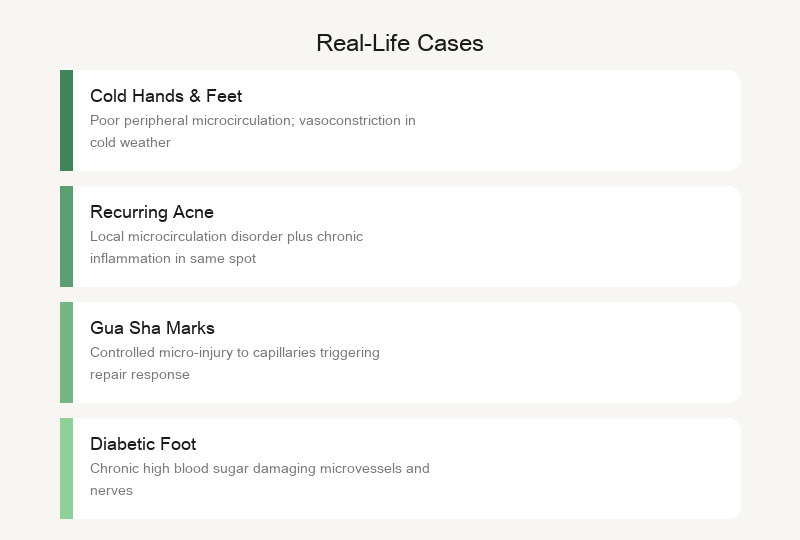
Case One: Cold Hands and Feet.
In winter, your hands and feet are like ice blocks. Thick socks and gloves don't help, and the soles of your feet feel like they're standing on frozen bricks. TCM says "collateral vessels are blocked, Qi and blood cannot reach the four extremities."
The truth: poor peripheral microcirculation. In cold weather, blood vessels constrict, and blood is prioritized to core organs (heart and brain), reducing capillary flow to the extremities. This is more pronounced in women due to estrogen's effect on vascular regulation. It's not "insufficient Qi and blood" — it's vasoconstriction plus microcirculatory regulation. Exercise, warmth, and massage can improve peripheral microcirculation.
Case Two: Recurring Acne.
A pimple on your face keeps returning to the same spot, like a game of whack-a-mole. Western medicine says "sebaceous glands are overactive," while TCM says "local collateral stasis with damp-heat accumulation."
The truth: local microcirculatory disorder plus chronic inflammation. Sebaceous gland blockage leads to bacterial infection, which triggers inflammation, capillary dilation, and blood stasis, causing localized redness and swelling. If local microvessels remain dilated and congested, inflammation keeps recurring in the same spot. It's not "damp-heat" — it's local microcirculatory disorder plus chronic infection. But the "damp-heat" metaphor does accurately describe the inflammatory state of congestion and exudation.
Case Three: Gua Sha Marks.
After gua sha, purple-red marks appear on the skin. The therapist says "that's stagnant blood in the collaterals being released." You remain half-skeptical, but you do feel better.
The truth: gua sha mechanically stimulates and ruptures local capillaries (microvessels), causing subcutaneous micro-bleeding (petechiae). The body's repair response to micro-injury releases anti-inflammatory substances, promotes local blood flow, and activates the immune system. It's not "stagnant blood being expelled" — it's controlled micro-injury plus repair response. But the amount of sha does reflect the state of local microvessels — areas with fragile vessels and more stagnation show darker marks.
Case Four: Diabetic Foot.
In diabetic patients, foot ulcers appear and wounds fail to heal for long periods, sometimes requiring amputation. TCM says "chronic illness has entered the collaterals, collateral vessels are obstructed."
The truth: long-term high blood sugar damages microvessels (capillary basement membrane thickening and lumen narrowing), leading to ischemia and oxygen deprivation in the extremities; simultaneously, nerve damage (peripheral neuropathy) reduces sensation, making injuries more likely. Microvascular disease + neuropathy + infection are the three mechanisms of diabetic foot. It's not "blood stasis" — it's microvascular damage caused by high blood sugar. But the ancient saying "chronic illness enters the collaterals" precisely describes this pathological process.
Four cases, one underlying logic: collaterals are the "last mile" of Qi and blood — when the last mile is blocked, the extremities suffer.
Part 5Modern Research
Does "Luo" have scientific research behind it?
Yes, and plenty. Scientists don't use the word "Luo" — they use:
• Microcirculation system. The total length of human blood vessels is about 100,000 kilometers, of which capillaries account for over 95%. Capillaries are the core of microcirculation, with walls only one endothelial cell thick, responsible for blood-tissue fluid exchange. Microcirculation disorder is the common pathological basis of diabetes, hypertension, coronary disease, and stroke. Scientists use laser Doppler, fluorescence angiography, and microvascular imaging to directly visualize the state of microcirculation. This is the anatomical basis of "collateral vessels."
• Microvascular disease and chronic illness. Diabetic microangiopathy is the core mechanism of diabetic complications — high blood sugar damages microvascular endothelium, thickens the basement membrane, narrows the lumen, leading to ischemia of the retina, kidneys, and nerves. Hypertension causes small artery sclerosis; cerebral small vessel disease is an important cause of cognitive impairment and stroke. Coronary disease involves not just large vessel blockage but also coronary microvascular dysfunction. All these studies validate the ancient observation that "chronic illness enters the collaterals."
• Gua sha and microcirculation. Research shows gua sha can increase local blood flow, reduce blood viscosity, and improve microcirculation. Tissue biopsies of gua sha areas show increased capillary permeability, plasma protein exudation, and immune activation. Gua sha is not "detoxification" — it's improving local microcirculation through mechanical stimulation. But the amount of sha does correlate with the state of local microvessels.
These studies fully demonstrate that "Luo" is a system that can be precisely described in modern scientific language. The ancients used "Luo" as a summary; moderns use "microcirculation," "microvessels," and "tissue fluid exchange" — they're describing the same thing.
Part 6Practical Methods
Now that you understand "Luo," how do you unblock it?
First, clear up some misconceptions:
• The more painful the gua sha, the more effective. Gua sha is not about pain — excessive scraping causes skin damage, excessive capillary rupture, and even infection. Moderate stimulation until sha appears is enough; don't aim for "purple-black all over."
• Bloodletting can detoxify. Collateral pricking (such as ear apex or finger-tip bloodletting) has specific indications in TCM (high fever, heatstroke, acute sore throat). It's not a universal "detox" method. Blind bloodletting can cause infection, anemia, or fainting.
Specific methods:
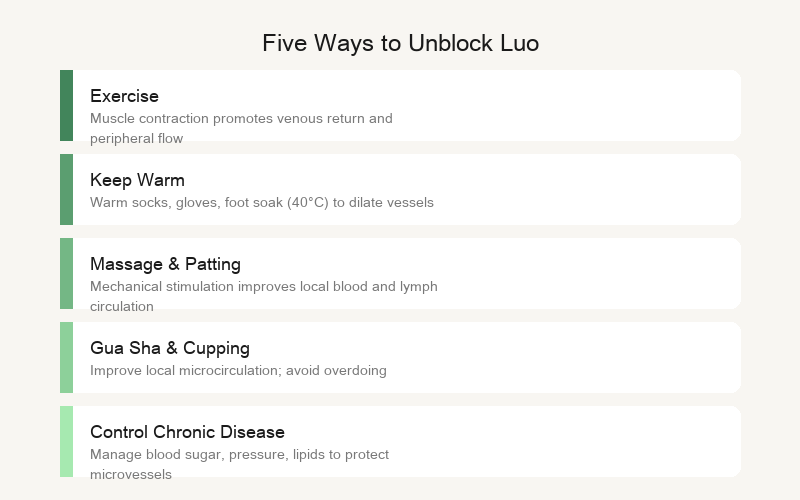
• Moderate exercise. Exercise is the most effective way to improve microcirculation. Muscle contraction squeezes veins and lymphatic vessels, promoting blood return; increased heart rate raises cardiac output and peripheral blood flow. Brisk walking, swimming, and tai chi are excellent "collateral-unblocking" exercises. Thirty minutes a day, and your hands and feet will warm up.
• Keep warm, especially the extremities. In cold weather, blood vessels constrict, and peripheral microcirculation worsens. Wear warm socks and gloves, soak your feet (around 40°C, 15 minutes). But diabetics should be careful with foot soaks — temperature should not exceed 37°C to avoid burns.
• Massage and patting. Local massage and patting promote local blood flow through mechanical stimulation. Patting the "eight hollows" (armpits, elbow creases, groin, and popliteal fossae) promotes local lymphatic and blood circulation. But keep the intensity moderate — don't beat yourself violently.
• Gua sha and cupping. Gua sha improves local microcirculation through mechanical stimulation; cupping promotes local congestion through negative pressure. Both are "external collateral-unblocking" methods. But don't do them too frequently — leave at least a week between sessions on the same area, and avoid them if the skin is broken or you have a bleeding tendency.
• Control chronic diseases. Diabetes, hypertension, and hyperlipidemia are the main causes of "entering the collaterals." Controlling blood sugar, blood pressure, and blood lipids is fundamental to protecting collaterals (microvessels). Blood sugar control reaching target (HbA1c < 7%) can significantly reduce microvascular complications.
These methods don't require you to believe in TCM. You just need to understand: collaterals are the "last mile" of Qi and blood — exercise promotes circulation, warmth reduces constriction, massage improves local flow, and controlling chronic disease protects microvessels.
Part 7One-Minute Summary
🕐 One-Minute Summary of "Luo"
Luo = the capillaries of the meridian system + last-mile delivery.
Main channels = trunk roads, collaterals = branch roads, minute collaterals = capillaries, floating collaterals = superficial fine vessels.
Luo = microcirculation system (capillaries, microvessels, tissue fluid channels); blocked Luo = microcirculation disorder.
Luo is not mysticism; it's the terminal branch of the Qi and blood delivery network.
Causes: cold, prolonged sitting, chronic disease, blood viscosity, local stagnation.
Methods: exercise, warmth, massage, gua sha (moderate), control chronic disease.
The ancients called it "blocked collateral vessels"; moderns call it "microcirculatory disorder."
Different names, but the body knows: when open, it's comfortable.
When open, the extremities are warm; when blocked, local tissue suffers.
Chronic illness entering the collaterals is not mysticism — it's a wise observation of microvascular disease.
This is perhaps the most朴素 wisdom of the Chinese people: when collaterals are open, the whole body is open; when collaterals are blocked, myriad diseases arise.
Making money is the art of living; art is life after making money
Giaogiao Decodes Chinese Traditional Wisdom · Concept 36
Using modern scientific language to help the world understand Chinese traditional wisdom.
No mystery, no superstition, no disrespect.
Understand, not just believe.
Coach Liu
Written in Florence