Why Does TCM Say the "Twelve Meridians" Are the Body's Main Roads? Your Highways Do More Than Just Carry Traffic
Part 1A Question
Have you ever had this experience?
You have a stomachache. Western medicine gives you antacids, but TCM needles your inner forearm (Hand Jueyin Pericardium Meridian) or outer lower leg (Foot Yangming Stomach Meridian). You ask: "The stomach is the problem, why needle the arm?" The doctor says: "The Stomach Meridian passes through the lower leg; needling here can regulate the stomach." Your eyes are dry and blurry from computer use, eyedrops don't help. TCM needles a point on the dorsum of your foot (Zulinqi, Foot Shaoyang Gallbladder Meridian), and your eyes suddenly feel better. You ask: "What do the eyes have to do with the foot?" The doctor says: "The Gallbladder Meridian starts at the outer canthus of the eye and runs to the foot." You feel even more confused. You palpate along the inner side of your forearm from wrist to elbow and find a sore line; pressing it makes the whole line feel comfortable. You ask: "What is this sore line?" The doctor says: "It's the meridian pathway. When blocked, there is pain; when open, pain disappears."
You ask a Western doctor: "What is Jing?" The doctor says: "There's no anatomical equivalent. Probably neurovascular bundles."
You ask a TCM doctor: "What exactly is Jing?" The old master says: "Jing means pathway — the roads through which Qi and blood travel. The twelve regular meridians connect internally to the organs and externally to the limbs."
One says "neurovascular bundles," the other says "Qi and blood roads" — are they talking about the same thing?
Even more striking, TCM says "the liver opens into the eyes" — what does the liver have to do with the eyes? "The lung governs the skin and hair" — what does the lung have to do with the skin? "The kidney opens into the ears" — what does the kidney have to do with the ears? These seemingly unrelated organs are connected through "Jing." What's going on?
Part 2Traditional Chinese Explanation
The concept of "Jing" was systematically defined in the Yellow Emperor's Inner Canon. Ancient physicians observed: when someone had soreness on the inner forearm, it corresponded to chest tightness or stomach discomfort; when the outer lower leg was stiff, it corresponded to migraine or indigestion. They summarized the connections within the human body into twelve main roads — the twelve regular meridians.
— Yellow Emperor's Inner Canon · Ling Shu · Ben Zang
"The twelve meridians connect internally to the organs and externally to the limbs."
— Yellow Emperor's Inner Canon · Ling Shu · Hai Lun
"The Qi and blood of the twelve meridians and three hundred sixty-five collaterals all ascend to the face and enter the orifices."
— Yellow Emperor's Inner Canon · Ling Shu · Xie Qi Zang Fu Bing Xing
TCM summarizes the function of "Jing" in three key words: belong, connect, and circulate.
Belong (internally connect to organs) — Each meridian "belongs to" an organ. The Hand Taiyin Lung Meridian belongs to the lung, the Foot Yangming Stomach Meridian belongs to the stomach, the Foot Shaoyin Kidney Meridian belongs to the kidney. The meridian is the exclusive channel connecting the organ to the body surface. When an organ has problems, it reflects on the body surface through the meridian; stimulating points on the body surface meridian can regulate the organ.
Connect (externally connect to limbs) — The meridian extends from the organ to the limbs, head, and trunk, like a highway extending from the city center to the suburbs. Hand meridians reach the fingers, foot meridians reach the toes. Points along the meridian are like "toll stations" or "service areas" on this road — stimulating a point can regulate the Qi and blood of the entire meridian.
Circulate (fixed circulation route) — Each meridian has a fixed circulation route. The Hand Taiyin Lung Meridian starts from the chest, runs along the inner front edge of the arm, and reaches the thumb. The Foot Yangming Stomach Meridian starts from the head (below the eye), runs along the face, neck, chest, abdomen, and front of the thigh, reaching the second toe. The route is fixed, the direction is fixed, and the connections are fixed. This is not mysticism, but the result of thousands of years of clinical observation.
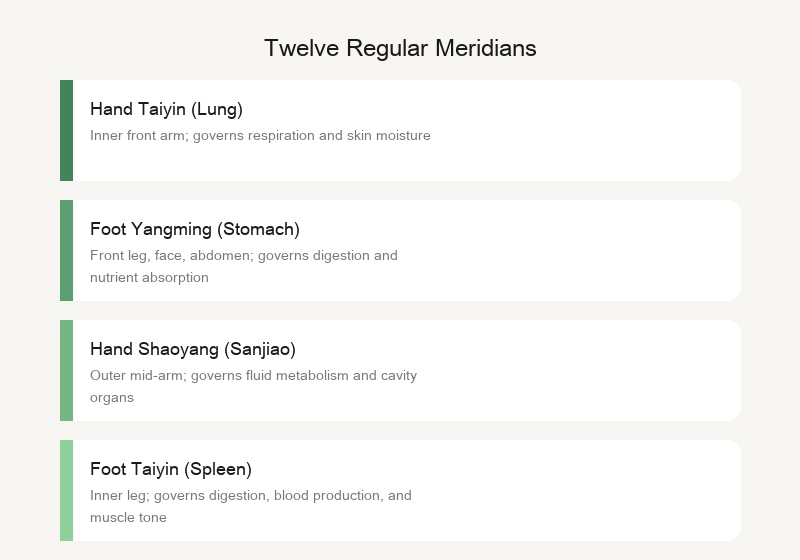
The twelve regular meridians include:
• Hand Three Yin (inner arm): Hand Taiyin Lung, Hand Jueyin Pericardium, Hand Shaoyin Heart
• Hand Three Yang (outer arm): Hand Yangming Large Intestine, Hand Shaoyang Sanjiao, Hand Taiyang Small Intestine
• Foot Three Yang (outer leg, back): Foot Yangming Stomach, Foot Shaoyang Gallbladder, Foot Taiyang Bladder
• Foot Three Yin (inner leg): Foot Taiyin Spleen, Foot Jueyin Liver, Foot Shaoyin Kidney
Yang meridians run on the outer side (where sunlight reaches), Yin meridians run on the inner side (where sunlight does not reach). Hand meridians run on the arms, foot meridians run on the legs. The ancients named them with precision to location and function.
So what the ancients called "Jing" is not just the nerves, blood vessels, or fascia of modern medicine, but a functional connection network — connecting organs with the body surface, the distal with the proximal, and the upper with the lower. The ancients used "Jing" to describe what modern medicine needs three concepts — "neurovascular bundles," "fascial chains," and "viscerosomatic reflex" — to explain.
Part 3Giaogiao's Modern Translation
Okay, let's translate "Jing" into modern language.
I won't bore you with neurovascular bundles, fascial anatomy, or embryonic development. Too complex. Just remember one metaphor:
Organs = city centers
Meridians = highways from city center to suburbs
Acupoints = toll stations and service areas along the highway
Collaterals = highway ramps and capillaries (see Concept 36: Luo)
That's it. Your "Jing" is essentially the body's functional connection channels — connecting organs with the body surface, the distal with the proximal, and the upper with the lower.
Specifically:
What do meridians correspond to? They correspond to the neurovascular-fascial complex of modern medicine. A meridian is not a single anatomical structure, but a comprehensive channel of nerves, blood vessels, lymphatic vessels, and fascial tissue. Stimulating an acupoint (such as Zusanli) can activate local nerve endings, release vasoactive substances, and regulate fascial tension, thereby affecting distant organs. This is the modern scientific basis of "meridians" — not mysterious "Qi," but the composite function of nerves, blood vessels, and fascia.
What does "meridian blockage" correspond to? It corresponds to nerve conduction障碍, vascular spasm, fascial adhesion, and muscle tension. In cervical spondylosis patients, neck muscle tension compresses nerves and blood vessels, causing arm numbness (meridian blockage). In people who sit for long periods, gluteal fascia tension compresses the sciatic nerve, causing posterior leg pain (Foot Taiyang Bladder Meridian blockage). It's not "Qi blockage" — it's physical compression and spasm.
What does "the liver meridian circulates through the rib sides" correspond to? It corresponds to the viscerosomatic reflex. The liver and gallbladder are located in the right rib area, connected to the body surface through the phrenic nerve (C3-C5) and vagus nerve. When there is liver or gallbladder disease, referred pain appears in the right rib area. TCM says "the liver meridian circulates through the rib sides," precisely describing this anatomical relationship. It's not mysticism; it's precise neuroanatomical observation.
So "Jing" is not mysticism. It's a functional metaphor — describing the functional connection channels between the body's organs and body surface, distal and proximal. The ancients used "Jing" to describe what modern medicine needs three concepts to explain.
Part 4Real-Life Cases
Four stories to make you instantly understand what "Jing" is.
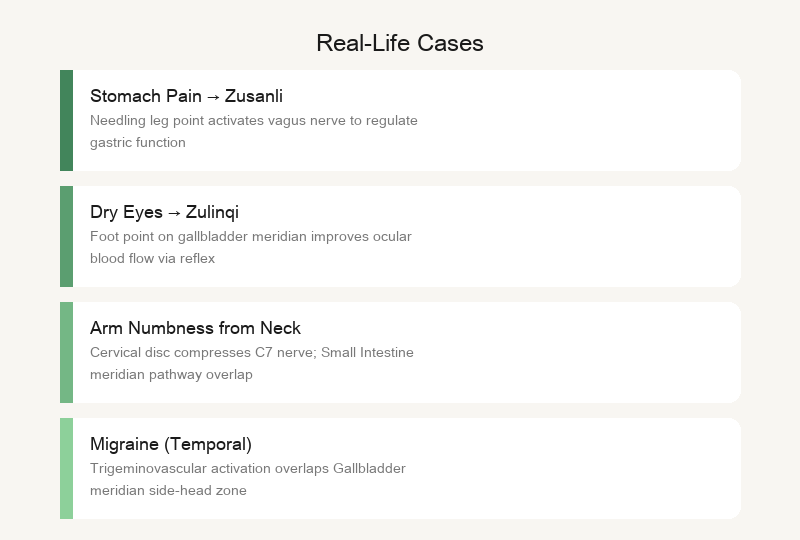
Case One: Stomach Pain Treated by Zusanli.
You have a stomachache. Western medicine gives you omeprazole, but TCM needles a point four finger-widths below the knee (Zusanli, Foot Yangming Stomach Meridian), and your stomach suddenly feels better. You ask: "Why needling the leg can treat the stomach?"
The truth: Zusanli is the He-Sea point of the Foot Yangming Stomach Meridian. Stimulating Zusanli activates local nerve endings, regulates stomach movement and secretion through the vagus nerve and spinal reflex. Research shows that needling Zusanli can increase gastric blood flow, promote gastric emptying, and regulate gastric acid secretion. It's not "Qi reaching the stomach" — it's nerve reflex + blood flow regulation. But the ancients discovered through practice that "needling here treats the stomach" — thousands of years of human experimentation.
Case Two: Dry Eyes Treated by Zulinqi.
You stare at a computer too long, your eyes are dry and sore, eyedrops only relieve for a few minutes. TCM needles a point on the dorsum of the foot (Zulinqi, Foot Shaoyang Gallbladder Meridian), and your eyes suddenly feel better.
The truth: The Foot Shaoyang Gallbladder Meridian starts at the outer canthus of the eye, passes through the head, lateral chest, and lateral lower leg. Stimulating Zulinqi improves ocular blood flow through nerve reflex and vascular regulation. At the same time, the Gallbladder Meridian has anatomical associations with the trigeminal and facial nerves. It's not "Gallbladder Qi reaching the eyes" — it's nerve-vascular reflex. But the ancients observed that "the Gallbladder Meridian and the eyes are related" — precisely.
Case Three: Arm Numbness from Cervical Spine.
You look down at your phone for long periods, your cervical spine is uncomfortable, and later your pinky-side arm becomes numb. Western medicine says "cervical disc herniation compressing the nerve root," TCM says "Hand Taiyang Small Intestine Meridian blockage."
The truth: C6-C7 cervical disc herniation compresses the C7-T1 nerve root, causing numbness on the ulnar side (pinky side) of the arm. The Hand Taiyang Small Intestine Meridian runs along the posterior outer edge of the arm, exactly overlapping with the ulnar nerve distribution area. It's not "meridian blockage" — it's nerve root compression. But the ancients used "Hand Taiyang Small Intestine Meridian blockage" to describe this symptom distribution — precise functional observation.
Case Four: Migraine and Gallbladder Meridian.
You have a migraine, pain on both sides of the head (near the temples), throbbing. Western medicine says "vascular migraine," TCM says "Shaoyang meridian headache, Gallbladder Meridian blockage."
The truth: Migraine involves activation of the trigeminovascular system, cerebral blood vessel dilation, and neurogenic inflammation. Pain on both sides of the head exactly overlaps with the Foot Shaoyang Gallbladder Meridian circulation area (lateral head, around the ear). It's not "wind in the Gallbladder Meridian" — it's trigeminovascular reflex. But the ancients used "Gallbladder Meridian" to describe the distribution of lateral head pain — a summary of clinical experience.
Four cases, one underlying logic: Jing are the body's "main roads" — functional connection channels between organs and body surface, distal and proximal. When blocked, problems arise; when open, function recovers.
Part 5Modern Research
Does "Jing" have scientific research behind it?
Yes, and plenty. Scientists don't use the word "Jing" — they use:
• Neurovascular bundles. Anatomical studies have found that meridian circulation routes highly coincide with the distribution of nerve trunks and blood vessel trunks. For example, the Hand Taiyin Lung Meridian accompanies the musculocutaneous nerve and cephalic vein; the Foot Yangming Stomach Meridian accompanies the deep peroneal nerve and anterior tibial artery. Meridians are not independent structures, but composite channels of nerves, blood vessels, and fascia.
• Fascia research. Fascia is the connective tissue wrapping muscles, organs, and blood vessels, forming a continuous mechanical and signal conduction network. Fascial tension and glide affect muscle function and sensory conduction. Meridian circulation routes are highly similar to myofascial meridians. For example, the Foot Taiyang Bladder Meridian and the superficial back line almost completely overlap. Stimulating fascia can affect distant organs — this is the fascial basis of "meridians."
• Viscerosomatic reflex. Visceral diseases produce pain, tenderness, and muscle tension in specific body surface areas through nerve reflex. For example, heart disease causes left shoulder pain (Heart Shu area), gallbladder disease causes right shoulder pain (Gallbladder Shu area). TCM says the back Shu points on the Foot Taiyang Bladder Meridian precisely correspond to these reflex areas. This is the scientific basis of "internally connecting to organs, externally connecting to limbs."
These studies fully demonstrate that "Jing" is a system that can be precisely described in modern scientific language. The ancients used "Jing" as a summary; moderns use "neurovascular bundles," "fasciology," and "viscerosomatic reflex" — they're describing the same thing.
Part 6Practical Methods
Now that you understand "Jing," how do you open it?
First, clear up some misconceptions:
• Meridian blockage is just Qi blockage. Meridian blockage is not mysterious "Qi blockage," but physical nerve compression, vascular spasm, fascial adhesion, and muscle tension. Understanding this, you won't pursue "energy transmission to open meridians," but target relaxation, stretching, and exercise.
• Patting meridians can detoxify. Moderate patting can promote local blood flow, but excessive patting causes soft tissue damage and subcutaneous bleeding. Patting is not "detoxification," it's mechanical stimulation. Don't believe in "patting out sha for detoxification" — that's damage.
Specific methods:
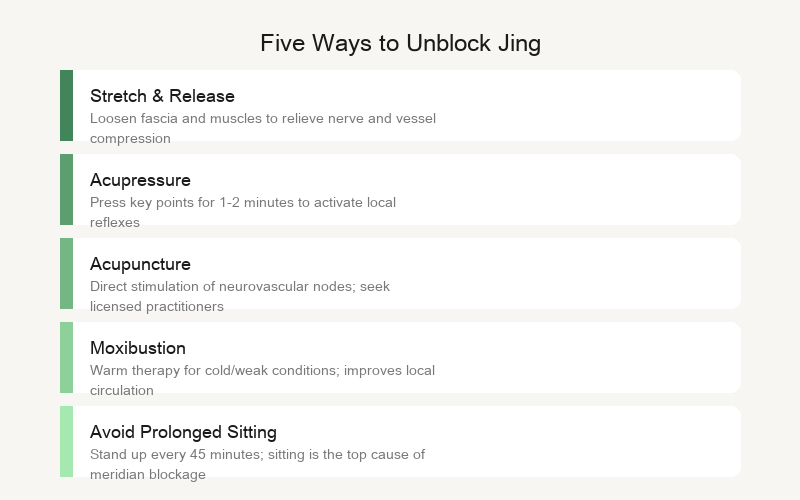
• Stretch and release. Each meridian corresponds to a set of muscles and fascia. Prolonged sitting causes Foot Taiyang Bladder Meridian (superficial back line) tension; stretching the back of the thigh and back can improve lower back pain and leg numbness. Stretching is "opening meridians" — relaxing fascia and muscles, relieving pressure on nerves and blood vessels.
• Acupressure. Find key points on the corresponding meridian and press moderately. For example, Zusanli on the Stomach Meridian (four finger-widths below the knee), Sanyinjiao on the Spleen Meridian (four finger-widths above the inner ankle), Yanglingquan on the Gallbladder Meridian (below the outer knee). Press each point for 1-2 minutes until you feel a sore, swollen sensation. More pain is not better.
• Acupuncture. Acupuncture is the most direct method to "open meridians." Needling acupoints activates nerve reflexes, regulates blood flow, and releases endogenous analgesic substances (endorphins). Modern research confirms that acupuncture has certain effects on chronic pain, indigestion, insomnia, and anxiety. Find a licensed acupuncturist.
• Moxibustion. Moxibustion promotes local blood flow, relaxes muscles, and improves microcirculation through warm stimulation. Suitable for cold and deficiency conditions — cold hands and feet, cold abdominal pain, weak and sore lower back. Be careful with temperature to avoid burns.
• Avoid prolonged sitting and poor posture. Prolonged sitting is the biggest cause of meridian blockage. Sitting compresses the buttocks (Foot Taiyang Bladder Meridian, Foot Shaoyang Gallbladder Meridian), causing waist and leg pain; looking down at the phone compresses the cervical spine (Hand Three Yang), causing shoulder and neck pain. Stand up and move for 5 minutes every 45 minutes of sitting. A simple "meridian-opening" method.
These methods don't require you to believe in TCM. You just need to understand: meridians are the body's "main roads" — stretching relaxes fascia, acupressure promotes blood flow, acupuncture regulates nerves, moxibustion improves circulation, and avoiding prolonged sitting reduces compression.
Part 7One-Minute Summary
🕐 One-Minute Summary of "Jing"
Jing = the body's main roads + national highways.
Twelve regular meridians = twelve functional channels from organs to limbs.
Yang meridians run on the outer side, Yin meridians run on the inner side; hand meridians on the arms, foot meridians on the legs.
Meridians = neurovascular-fascial composite channels; meridian blockage = nerve compression / vascular spasm / fascial adhesion.
Meridians are not mysticism; they are the functional connection network between organs and body surface.
Causes: prolonged sitting, poor posture, muscle tension, fascial adhesion, chronic strain.
Methods: stretch and release, acupressure, acupuncture, moxibustion, avoid prolonged sitting.
The ancients called it "meridian blockage"; moderns call it "neurovascular-fascial dysfunction."
Different names, but the body knows: when open, it's comfortable.
When open, Qi and blood flow freely; when blocked, myriad diseases arise.
The twelve regular meridians are not twelve pipes, but twelve functional connections.
This is perhaps the most朴素 wisdom of the Chinese people: when meridians are open, diseases disappear; when blocked, diseases arise.
Making money is the art of living; art is life after making money
Giaogiao Decodes Chinese Traditional Wisdom · Concept 37
Using modern scientific language to help the world understand Chinese traditional wisdom.
No mystery, no superstition, no disrespect.
Understand, not just believe.
Coach Liu
Written in Florence