Why Does TCM Say "Acupoints" Are the Body's Shortcut Keys? Your Functional Buttons Do More Than Just Sore Spots
Part 1A Question
Have you ever had this experience?
You have a headache and press your temple — it actually feels better. You ask: "What is the temple?" Someone says: "It's just an acupoint." You get motion sickness, feel nauseous, and a friend tells you to press the inner side of your wrist (Neiguan point). After pressing for a few minutes, the nausea lessens. You ask: "Why can pressing the wrist treat nausea?" Your friend says: "Neiguan controls the stomach." You're even more confused. You have insomnia and rub the sole of your foot (Yongquan point) before bed — you actually sleep better. You ask: "What does the foot have to do with sleep?" The doctor says: "Yongquan is the Jing-Well point of the Kidney Meridian, it guides fire back to the origin." You have a toothache and press the Hegu point on the back of your hand — the pain actually eases. You ask: "What does the hand have to do with the face?" The doctor says: "For facial and mouth problems, find Hegu — the face and mouth are connected to Hegu."
You ask a Western doctor: "What is an acupoint?" The doctor says: "There's no anatomical equivalent. Probably nerve-muscle junctions or trigger points."
You ask a TCM doctor: "What exactly is an acupoint?" The old master says: "Acupoints are the places where the Qi of organs and meridians pours into the body surface."
One says "nerve-muscle junctions," the other says "Qi pouring places" — are they talking about the same thing?
Even more striking, TCM says one point can treat multiple diseases, and one disease can be treated with multiple points. For example, Hegu can treat headache, toothache, facial paralysis, cold, and menstrual pain... How can one point have so many functions? What's going on?
Part 2Traditional Chinese Explanation
The concept of "Xue" was systematically defined in the Yellow Emperor's Inner Canon. Ancient physicians observed: when someone pressed a certain point, pain was relieved; when someone needled a certain point, function recovered; when someone moxa-ed a certain point, cold conditions improved. They called these special points on the body Shu Xue — "Shu" means to transport, and "Xue" means an indented cavity.
— Yellow Emperor's Inner Canon
"The Qi points emit, each has its own name and location."
— Yellow Emperor's Inner Canon · Su Wen · Qi Xue Lun
"The key to needling is that when Qi arrives, it is effective."
— Yellow Emperor's Inner Canon · Ling Shu · Jiu Zhen Shi Er Yuan
TCM summarizes the function of "Xue" in three key words: transport, pour, and converge.
Transport (Shu) — Acupoints are the places where the Qi of organs is transported to the body surface. The functional state of the organ is transmitted to the acupoint through the meridian; stimulating the acupoint can reverse-regulate the organ. For example, Zusanli is the He-Sea point of the Stomach Meridian; stimulating Zusanli can regulate stomach function. Acupoints are "bidirectional interfaces" between organs and the body surface.
Pour (Zhu) — Acupoints are places where Qi and blood converge and pour. The Qi and blood along the meridian are particularly concentrated at acupoints. The ancients discovered that the skin temperature, electrical resistance, and pain sensitivity at acupoints differ from surrounding tissues. This is "De Qi" — when needling an acupoint, the sensation of sourness, numbness, swelling, and heaviness is the signal that Qi and blood are being mobilized.
Converge (Hui) — Some acupoints are the convergence points of multiple meridians. For example, Sanyinjiao is the convergence point of the Foot Taiyin Spleen Meridian, Foot Jueyin Liver Meridian, and Foot Shaoyin Kidney Meridian; stimulating Sanyinjiao can regulate three organs simultaneously. Convergence points are like transportation hubs — one point can regulate multiple meridians.
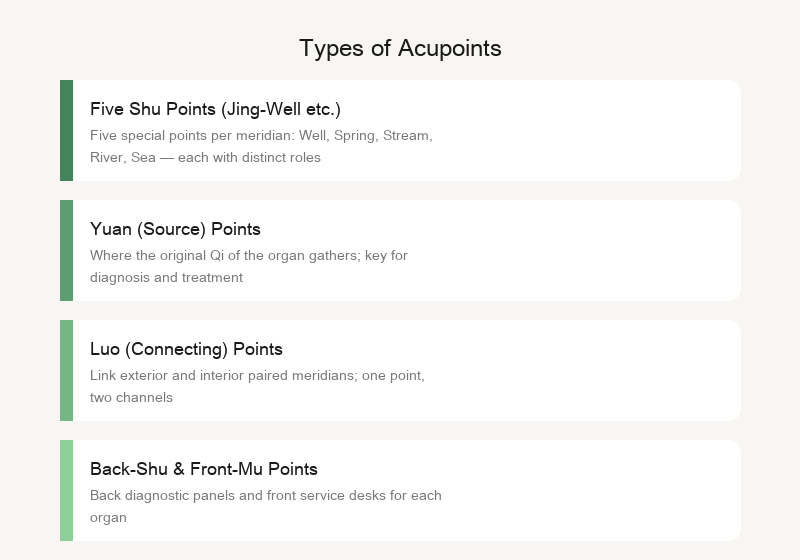
Acupoints are also divided into different types:
• Five Shu Points (Jing, Ying, Shu, Jing, He) — Five special points on each meridian, each with different functions. Jing points are at the ends of the limbs for emergency use; He points are near the elbow and knee joints for treating organ diseases.
• Yuan (Source) Points — Where the original Qi of the organ gathers; key points for diagnosing and treating organ diseases.
• Luo (Connecting) Points — Points that connect the exterior and interior paired meridians.
• Back-Shu Points — Where the Qi of organs pours into the back (see Concept 39: Shu).
• Front-Mu Points — Where the Qi of organs converges in the chest and abdomen (see Concept 40: Mu).
So what the ancients called "Xue" is not just "sore spots" or "indents," but functional nodes on the meridians — with specific locations, specific functions, and specific indications. The ancients used "Xue" to describe what modern medicine needs three concepts — "nerve reflex points," "fascial trigger points," and "bioactive points" — to explain.
Part 3Giaogiao's Modern Translation
Okay, let's translate "Xue" into modern language.
I won't bore you with nerve reflex arcs, fascial trigger points, or bioelectrical characteristics. Too complex. Just remember one metaphor:
Meridians = highways
Acupoints = toll stations and service areas along the highway (with specific functions)
Stimulating acupoints = pressing shortcut keys to call specific functions
Five Shu Points = different shortcut key combinations (Jing = emergency, Ying = clear heat, Shu = relieve pain, Jing = regulate Qi, He = treat organs)
That's it. Your "Xue" is essentially functional nodes on the meridians — stimulating them can activate specific nerve reflexes, regulate blood flow, and affect distant organs.
Specifically:
What do acupoints correspond to? They correspond to nerve reflex points, fascial trigger points, and bioactive points in modern medicine. An acupoint is not a single anatomical structure, but a dense area of nerve endings, a zone where blood vessels and nerves pass through, and an area where fascial tension converges. Stimulating an acupoint activates local nerve endings, which through spinal reflex and brain regulation, affect distant organs. This is the modern scientific basis of acupoints.
What does "De Qi" correspond to? It corresponds to the neuromuscular response. When needling an acupoint, the needle tip stimulates muscles, fascia, and nerve endings, producing mechanoreceptor signals that travel through nerves to the spinal cord and brain. The brain releases endogenous analgesic substances (endorphins, enkephalins), while regulating the autonomic nervous system (sympathetic and parasympathetic). The "sourness, numbness, swelling, and heaviness" is not "Qi arriving," but nerve signal conduction and muscle response.
What does "For facial and mouth problems, find Hegu" correspond to? It corresponds to nerve reflex and blood flow regulation. The Hegu point (Hand Yangming Large Intestine Meridian) is on the back of the hand, innervated by the superficial branch of the radial nerve. Stimulating Hegu, through spinal reflex and trigeminal nucleus, affects facial blood flow and pain sensation. At the same time, the muscles in the Hegu area have fascial connections with the chewing and facial muscles. It's not "Large Intestine Meridian reaching the face" — it's nerve reflex and fascial conduction. But the ancients discovered through practice that "pressing here treats facial and mouth problems" — thousands of years of human experimentation.
So "Xue" is not mysticism. It's a functional metaphor — describing functional nodes on the meridians, where stimulating them can activate specific nerve reflexes and regulatory functions. The ancients used "Xue" to describe what modern medicine needs three concepts to explain.
Part 4Real-Life Cases
Four stories to make you instantly understand what "Xue" is.
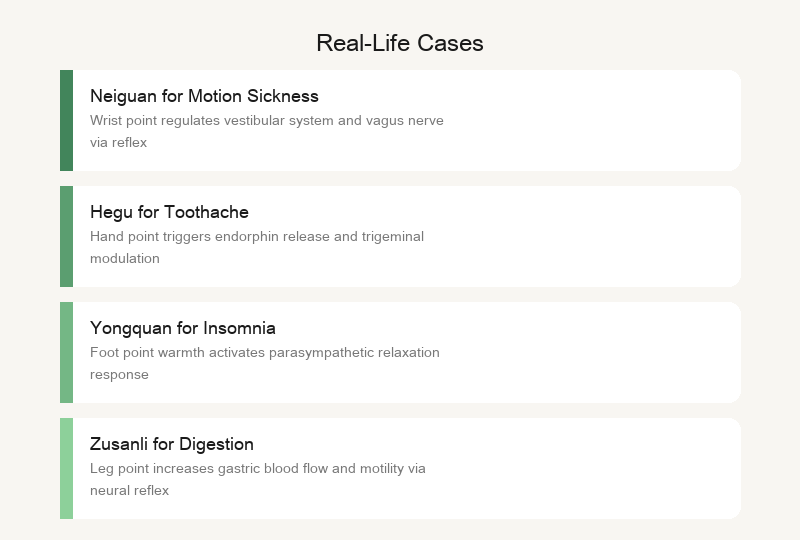
Case One: Neiguan for Motion Sickness.
You get motion sickness, feel nauseous and want to vomit, press the inner side of your wrist (Neiguan point, Hand Jueyin Pericardium Meridian), and after a few minutes, the nausea lessens. You ask: "Why can pressing the wrist treat nausea?"
The truth: The Neiguan point is on the inner forearm, near the median nerve and palmaris longus tendon. Stimulating Neiguan, through nerve reflex, regulates the vestibular system and autonomic nervous system (vagus nerve), inhibiting the nausea reflex. Research shows that acupuncture at Neiguan can significantly reduce nausea and vomiting caused by chemotherapy, postoperative nausea, and motion sickness. It's not "Pericardium Meridian Qi reaching the stomach" — it's nerve reflex + autonomic nervous system regulation. But the ancients discovered "Neiguan treats the stomach" — precisely.
Case Two: Hegu for Toothache.
You have a toothache, press the Hegu point on the back of your hand (the tiger's mouth, Hand Yangming Large Intestine Meridian), and the pain actually eases. You ask: "What does the hand have to do with the face?"
The truth: The Hegu point area is innervated by the superficial branch of the radial nerve. Stimulating Hegu, through spinal and trigeminal nucleus reflex, affects facial blood flow and pain threshold. At the same time, acupuncture at Hegu releases endorphins and other endogenous analgesic substances. Research shows that acupuncture at Hegu has analgesic effects on toothache, headache, and trigeminal neuralgia. It's not "Large Intestine Meridian reaching the tooth" — it's nerve reflex + endogenous analgesia. But the ancient summary "For facial and mouth problems, find Hegu" is the crystallization of clinical experience.
Case Three: Yongquan for Insomnia.
You have insomnia, rub the sole of your foot (Yongquan point, Foot Shaoyin Kidney Meridian) before bed, and you actually sleep better. You ask: "What does the foot have to do with sleep?"
The truth: The Yongquan point is in the anterior one-third depression of the sole, with abundant nerve endings and blood vessels. Rubbing or warming Yongquan, through warm stimulation and mechanical stimulation, promotes foot blood flow, relaxes foot muscles, and through nerve reflex reduces sympathetic nervous system excitation and increases parasympathetic nervous system activity (relaxation response). Research shows that foot massage and warm stimulation can improve sleep quality. It's not "guiding fire back to the origin" — it's warm stimulation + parasympathetic activation. But the metaphor "guiding fire back to the origin" describes the transition from excitement to calm.
Case Four: Zusanli for Digestion.
You have indigestion, bloating, and poor appetite. TCM needles or moxas Zusanli (four finger-widths below the knee, Foot Yangming Stomach Meridian), and after a few sessions, your appetite improves.
The truth: Zusanli is the He-Sea point of the Foot Yangming Stomach Meridian, located below the head of the fibula, near the deep peroneal nerve and anterior tibial artery. Stimulating Zusanli, through vagus nerve reflex and spinal reflex, regulates stomach movement, secretion, and blood flow. Research shows that acupuncture at Zusanli can increase gastric blood flow, promote gastric emptying, regulate gastric acid secretion, and enhance immune function. It's not "Stomach Meridian Qi reaching the stomach" — it's nerve reflex + blood flow regulation + immune regulation. But the ancients called Zusanli the "longevity point" — it does have scientific basis.
Four cases, one underlying logic: acupoints are the body's "shortcut keys" — press the right one, and you call the corresponding function.
Part 5Modern Research
Does "Xue" have scientific research behind it?
Yes, and plenty. Scientists don't use the word "Xue" — they use:
• Nerve reflex and acupoints. The density of nerve endings at acupoints is significantly higher than in non-acupoint areas. Acupuncture at acupoints activates Aβ, Aδ fibers, and C fibers, which travel through the spinal dorsal horn to the brain, releasing endogenous analgesic substances (endorphins, enkephalins, dynorphins). The analgesic effect of acupuncture can be partially blocked by naloxone (opioid receptor antagonist). This shows that acupuncture analgesia has a clear neurochemical basis. It's not the effect of "Qi," but neurochemistry.
• Myofascial trigger points. Modern medicine has found that muscles contain "trigger points" — local areas of tight muscle fiber nodules that produce referred pain (pain radiating to distant areas) when pressed. The distribution of trigger points highly coincides with acupoints. For example, trigger points in the Hegu area can cause facial pain; trigger points in the Zusanli area can cause knee and abdominal discomfort. Stimulating trigger points (acupuncture, pressing) can relieve referred pain. This is the modern explanation of "acupoint indications."
• Biophysical characteristics of acupoints. The skin resistance at acupoints is lower than in surrounding tissues (low-resistance points), the temperature is slightly higher than the surroundings, and blood flow is more abundant. These biophysical characteristics make acupoints "bioactive windows" — stimulation is easier to conduct and effects are easier to manifest. This is the physical basis of "De Qi" — needling at acupoints is more likely to activate nerve and blood flow responses.
These studies fully demonstrate that "Xue" is a system that can be precisely described in modern scientific language. The ancients used "Xue" as a summary; moderns use "nerve reflex points," "fascial trigger points," and "bioactive points" — they're describing the same thing.
Part 6Practical Methods
Now that you understand "Xue," how do you use them?
First, clear up some misconceptions:
• The more painful the acupressure, the more effective. Acupressure should be to the degree of soreness and swelling, not the more painful the better. Excessive pressing can cause soft tissue damage and nerve compression. Especially for neck and waist points, excessive pressing is risky.
• One point can cure all diseases. Acupoints have specific functions, not universal. Hegu treats facial and mouth problems, Neiguan treats chest and stomach problems, Yongquan helps with sleep... each has its specialty. Don't believe the charlatan who says "one point cures all diseases."
Specific methods:
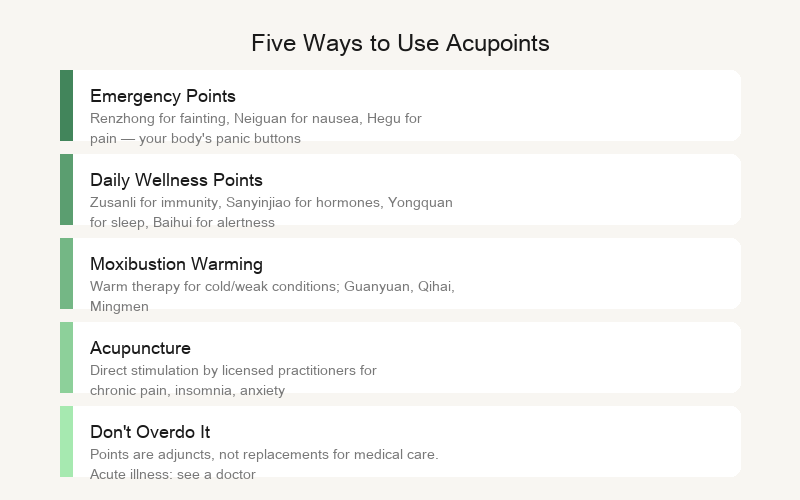
• Common emergency points. Renzhong (Shuigou point) — press when unconscious to stimulate the trigeminal nerve and respiratory center. Neiguan — for nausea, vomiting, and palpitations. Hegu — for toothache, headache, and fever. Shixuan (ten fingertips) — for high fever and unconsciousness. These points are the body's "emergency buttons," useful at critical moments.
• Daily wellness points. Zusanli (four finger-widths below the knee) — regulates the spleen and stomach, enhances immunity, the "longevity point." Sanyinjiao (four finger-widths above the inner ankle) — regulates gynecology and endocrine. Yongquan (anterior one-third depression of the sole) — helps sleep and lowers blood pressure. Baihui (top of the head) — refreshes the mind and relieves headache. Press each point for 1-2 minutes, 1-2 times a day.
• Moxibustion warming. Moxibustion is suitable for cold and deficiency conditions — cold hands and feet, cold abdominal pain, weak and sore lower back. Commonly used points: Guanyuan (four finger-widths below the navel), Qihai (two finger-widths below the navel), Mingmen (midline of the lower back). Moxibustion promotes local blood flow, relaxes muscles, and regulates nerves through warm stimulation. Be careful with temperature to avoid burns.
• Acupuncture. Acupuncture is the most direct method to stimulate acupoints. Acupuncture has certain effects on chronic pain, insomnia, anxiety, indigestion, and menstrual irregularities. But find a licensed acupuncturist; don't needle yourself randomly. Acupuncture is not "needle anywhere"; it requires syndrome differentiation and point selection.
• Don't be superstitious about acupoints. Acupoints are adjunctive means, not replacements for medical treatment. Acute and serious diseases require hospital visits. Acupoints can relieve symptoms, assist in treatment, and maintain daily health, but cannot replace medication and surgery.
These methods don't require you to believe in TCM. You just need to understand: acupoints are the body's "shortcut keys" — find the right button, press moderately, and you can call the corresponding function.
Part 7One-Minute Summary
🕐 One-Minute Summary of "Xue"
Xue = the body's shortcut keys + functional buttons.
Shu Xue = functional nodes on the meridians, with specific locations and specific functions.
Five Shu Points, Yuan Points, Luo Points, Back-Shu Points, Front-Mu Points... each has its own division of labor.
Acupoints = nerve reflex points + fascial trigger points + bioactive points; De Qi = neuromuscular response.
Acupoints are not mysticism; they are the result of thousands of years of human experimentation by the ancients.
Causes: inaccurate point location, pressing too hard, excessive expectations, replacing formal treatment.
Methods: emergency points (Renzhong, Neiguan, Hegu), wellness points (Zusanli, Sanyinjiao, Yongquan), moxibustion, acupuncture (find professionals), don't be superstitious.
The ancients called it "pressing points to regulate Qi"; moderns call it "nerve reflex + blood flow regulation."
Different names, but the body knows: when pressed right, it's comfortable.
Press the right one, and you call the function; press the wrong one, and you just press a dent.
Hegu for face and mouth, Neiguan for chest and heart, Yongquan for sleep, Zusanli for longevity.
This is perhaps the most朴素 wisdom of the Chinese people: acupoints are the body's shortcut keys; those who know how to use them have fewer body problems.
Making money is the art of living; art is life after making money
Giaogiao Decodes Chinese Traditional Wisdom · Concept 38
Using modern scientific language to help the world understand Chinese traditional wisdom.
No mystery, no superstition, no disrespect.
Understand, not just believe.
Coach Liu
Written in Florence