Why Does TCM Say "Front-Mu Points" Are the Organs' Front Desk Service Counters? Your Direct Dialogue Window Is More Than Just Pressing the Belly
Part 1A Question
Have you ever had this experience?
You have a stomachache and go to a TCM doctor. The doctor doesn't press your stomach directly, but presses several times in the center of the belly (Zhongwan point). You cry out — sourness and swelling surge up, but after pressing, the stomach actually feels better. The doctor says: "Zhongwan is the Stomach Mu point; pressing here can regulate the stomach." You have menstrual irregularities and dysmenorrhea. A friend tells you to moxa four finger-widths below the navel (Guanyuan point, Small Intestine Mu), saying "Guanyuan is the root of original Qi, moxa here can regulate menstruation." After several sessions, your menstruation becomes regular. You have chest tightness and shortness of breath, like a stone pressing on your chest. The massage therapist pushes the Danzhong point in the center of the chest (Heart Mu) several times, and you actually take a deep breath and feel better. You get acupuncture for low back pain, but the doctor needles the abdomen (Tianshu point, Large Intestine Mu). You ask: "Why needle the belly for low back pain?" The doctor says: "Front and back pairing, Shu-Mu pairing, the effect is better."
You ask a Western doctor: "What is Mu?" The doctor says: "There's no such concept; probably abdominal reflex zone."
You ask a TCM doctor: "What exactly is Mu?" The old master says: "Mu means curtain, where the Qi of the organs gathers in the chest and abdomen."
One says "abdominal reflex zone," the other says "gathering of the organs' Qi" — are they talking about the same thing?
Even more striking, TCM says "Shu is on the back, Mu is on the abdomen" — the same organ has a Shu point on the back and a Mu point on the abdomen. Why one in front and one in back? What's the difference between pressing the back and pressing the abdomen? What's going on?
Part 2Traditional Chinese Explanation
The concept of "Mu" was systematically defined in the Yellow Emperor's Inner Canon. The ancients observed: when someone had a stomachache, there was tenderness in the center of the belly (Zhongwan); when someone had chest tightness, there was a blocked sensation in the center of the chest (Danzhong); when someone had diarrhea, there was pulsation beside the navel (Tianshu). They correlated specific points in the chest and abdomen with the organs, calling them Front-Mu points — "Mu" means curtain, like a tent where the Qi of the organs gathers.
— Yellow Emperor's Inner Canon
"Stomach Mu is Zhongwan, Large Intestine Mu is Tianshu, Small Intestine Mu is Guanyuan."
— Systematic Classic of Acupuncture and Moxibustion
"Shu is in Yang, Mu is in Yin; Shu-Mu pairing, Yin-Yang harmonization."
— Great Compendium of Acupuncture and Moxibustion
TCM summarizes the function of "Mu" in three key words: gather, diagnose, regulate.
Gather — Mu points are where the Qi of the organs gathers in the chest and abdomen. "Mu" has the meaning of "recruit" and "gather"; the functional state of the organs will be reflected at the Mu points. For example, the stomach's Qi and blood gather at Zhongwan, the heart's Qi and blood gather at Danzhong, the liver's Qi and blood gather at Qimen. Mu points are the "front desk reception area" of the organs on the body surface.
Diagnose — Mu points can diagnose pathological changes in the organs. For example, tenderness at Zhongwan suggests stomach problems, tenderness at Tianshu suggests large intestine problems, softness at Guanyuan suggests small intestine insufficiency. Compared with Shu points (back), Mu points are closer to the organs themselves, with more direct reactions. Shu points are "remote monitoring," Mu points are "close observation."
Regulate — Stimulating Mu points can directly regulate organ function. Because Mu points are located in the projection zone of the organs, stimulation is more easily conducted to the target organ. For example, moxa on Zhongwan can directly warm the stomach, abdominal massage (Tianshu) can promote intestinal peristalsis, rubbing Danzhong can broaden the chest and regulate Qi. Mu points are the "front desk service counter" — direct dialogue, higher efficiency.
Locations of the twelve Front-Mu points:
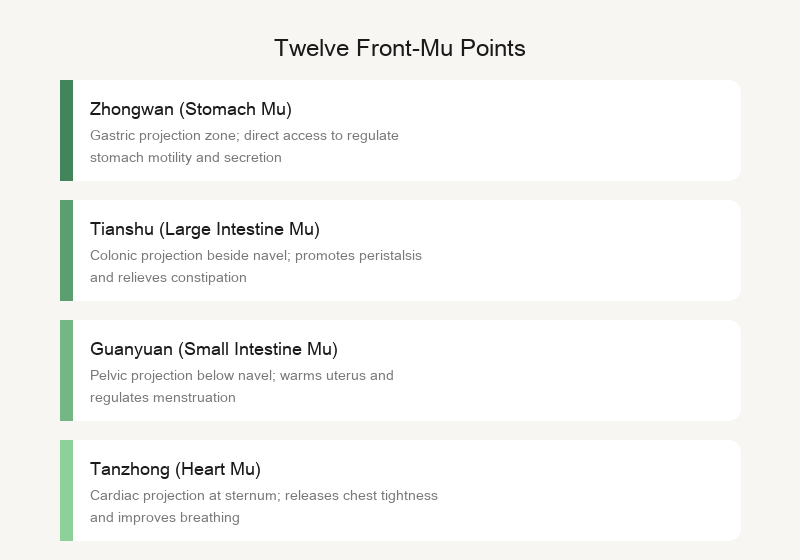
• Zhongwan (4 cun above navel) — Stomach Mu
• Tianshu (2 cun beside navel) — Large Intestine Mu
• Guanyuan (3 cun below navel) — Small Intestine Mu
• Danzhong (center of sternum) — Heart Mu
• Qimen (directly below nipple) — Liver Mu
• Zhangmen (side of abdomen) — Spleen Mu
• Zhongfu (below collarbone) — Lung Mu
• Jingmen (side of waist) — Kidney Mu
• Riyue (right below ribs) — Gallbladder Mu
• Shimen (2 cun below navel) — Triple Burner Mu
• Zhongji (4 cun below navel) — Bladder Mu
Location pattern: Mu points are mostly located in the anatomical projection zone of the corresponding organs. For example, the stomach's Mu point Zhongwan is exactly in the body surface projection zone of the stomach; the large intestine's Mu point Tianshu is beside the navel, corresponding to the location of the large intestine; the heart's Mu point Danzhong is in the center of the sternum, corresponding to the heart area. This is not coincidence; it is functional correspondence of anatomical position.
So what the ancients called "Mu" is not just "abdominal pain points" but front desk service counters and direct dialogue windows of the organs in the chest and abdomen. The ancients used "Mu" to summarize what modern people need three concepts — "abdominal reflex zone," "visceral body surface projection," and "vagus nerve reflex" — to explain.
Part 3Giaogiao's Modern Translation
Okay, let's translate "Mu" into modern language.
I won't bore you with visceral body surface projection, abdominal reflex zones, or vagus nerve reflex. Too complex. Just remember one metaphor:
Organs = company headquarters (internal office area)
Shu points = monitoring room behind headquarters (back end, see Concept 39: Shu)
Mu points = service counter in front of headquarters (front desk)
Stimulating Mu points = direct dialogue at the front desk, higher efficiency
Shu-Mu pairing = communicating with both front and back simultaneously, more comprehensive information
That's it. Your "Mu" is essentially direct regulation windows of the organs in the chest and abdomen — because they are close to the organs, stimulation more easily reaches the target directly.
Specifically:
What do Mu points correspond to? They correspond to the visceral body surface projection zone and abdominal reflex zone in modern medicine. The location of Mu points mostly corresponds to the anatomical position of the organs. For example, Zhongwan is in the body surface projection zone of the stomach, Tianshu is in the body surface projection zone of the large intestine, Danzhong is in the body surface projection zone of the heart. Stimulating these areas, through local nerve reflex (vagus nerve, visceral nerve) and blood flow regulation, directly affects organ function. This is the modern scientific basis of Mu points.
What does "Shu is on the back, Mu is on the abdomen" correspond to? It corresponds to different paths of nerve regulation. Shu points are on the back, regulating organs through sympathetic nerve segments ("back end" path); Mu points are on the abdomen, regulating organs through the vagus nerve and local nerve reflex ("front desk" path). The sympathetic nerve is the "fight or flight" system, the vagus nerve is the "rest and digest" system. Back-Shu points tend to regulate "stress response," while Mu points tend to regulate "digestion and absorption." This is the scientific logic of "Shu-Mu pairing" — simultaneously regulating two nervous systems, the effect is better.
What does "moxa on Guanyuan treats gynecology" correspond to? It corresponds to warm stimulation's regulation of pelvic blood flow and nerves. Guanyuan is 3 cun below the navel, corresponding to the body surface projection zone of the uterus and ovaries. Moxa on Guanyuan, warm stimulation through local nerve reflex and blood flow regulation, improves pelvic blood flow, regulates uterine smooth muscle and ovarian function. At the same time, warm stimulation promotes endorphin release, relieving dysmenorrhea. It's not "moxa heat entering the uterus," it's warm stimulation + blood flow regulation + nerve regulation + analgesia. But the effect of "moxa on Guanyuan to regulate menstruation" is indeed effective.
So "Mu" is not mysticism. It is a functional metaphor — describing direct regulation windows of the organs in the chest and abdomen. The ancients used "Mu" to summarize what modern people need three concepts to explain.
Part 4Real-Life Cases
Four stories to make you instantly understand what "Mu" is.
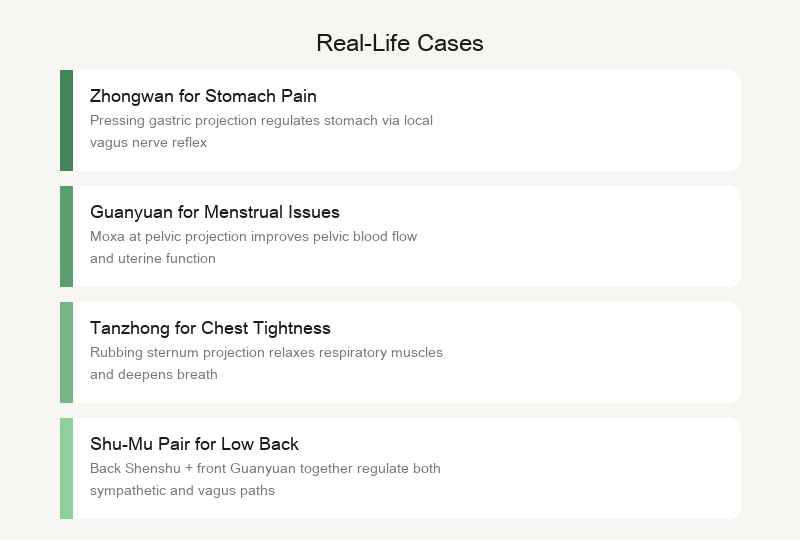
Case One: Zhongwan Treats Stomachache.
You have stomach pain and bloating. The doctor presses several times in the center of the belly (Zhongwan point). You cry out — sourness and swelling surge up, but after pressing, the stomach actually feels better. The doctor says: "Zhongwan is the Stomach Mu point; pressing here can regulate the stomach."
The truth: Zhongwan is in the body surface projection zone of the stomach, corresponding to the anterior wall of the stomach. Pressing Zhongwan, through local mechanical stimulation and nerve reflex (vagus nerve), regulates stomach movement and secretion. At the same time, pressing promotes local blood flow, improving gastric mucosa metabolism. Research shows that acupuncture at Zhongwan can regulate gastric emptying, reduce gastric acid secretion, and relieve stomach spasms. It's not "Qi reaching the stomach," it's local nerve reflex + blood flow regulation. But Zhongwan as the Stomach Mu point, its location and function are both precise.
Case Two: Guanyuan Regulates Menstruation.
You have menstrual irregularities, dysmenorrhea, and cold hands and feet. TCM tells you to moxa four finger-widths below the navel (Guanyuan point), saying "Guanyuan is the Small Intestine Mu point, the root of original Qi." After several sessions, menstruation becomes regular and dysmenorrhea lessens.
The truth: Guanyuan is 3 cun below the navel, corresponding to the body surface projection zone of the uterus and ovaries. Moxa on Guanyuan, warm stimulation through local nerve reflex and blood flow regulation, improves pelvic blood flow, regulates uterine smooth muscle contraction, and relieves dysmenorrhea. At the same time, warm stimulation promotes endorphin release, having an analgesic effect. Research shows that moxa on Guanyuan can regulate female endocrine and improve ovarian function. It's not "moxa heat entering the uterus," it's warm stimulation + blood flow regulation + nerve regulation. But the effect of "moxa on Guanyuan to regulate menstruation" is indeed effective.
Case Three: Danzhong Broadens the Chest.
You have chest tightness and shortness of breath, like a stone pressing on your chest. The massage therapist pushes the Danzhong point in the center of the chest (Heart Mu) several times, and you actually take a deep breath and feel better. The therapist says: "Danzhong is the meeting point of Qi, pushing here can broaden the chest and regulate Qi."
The truth: Danzhong is in the center of the sternum, corresponding to the heart and mediastinum area. The Danzhong area has abundant nerve endings and blood vessels. Pressing Danzhong, through mechanical stimulation and nerve reflex, regulates the tension of respiratory muscles (intercostal muscles, diaphragm), improving breathing depth. At the same time, pressing promotes local blood flow, relieving chest muscle tension. It's not "Qi dispersing," it's respiratory muscle relaxation + blood flow improvement + nerve reflex. But the effect of "Danzhong broadens the chest" is indeed immediate.
Case Four: Shu-Mu Pairing Treats Low Back Pain.
You have low back pain. The doctor needles the back (Kidney Shu) and simultaneously needles the abdomen (Guanyuan or Qihai). You ask: "Why needle the belly for low back pain?" The doctor says: "Shu-Mu pairing, attacking from front and back, better effect."
The truth: Kidney Shu is on the back (L2), regulating the kidney and waist through sympathetic nerve segments; Guanyuan is on the abdomen, regulating the pelvis and waist through the vagus nerve and local nerve reflex. Simultaneously stimulating two paths can simultaneously regulate sympathetic and parasympathetic nerves, improving waist blood flow and muscle state. Research shows that "Shu-Mu pairing" is more effective than using Shu or Mu points alone. It's not "mysterious power of attacking from front and back," it's dual nerve path regulation. But the ancients' "Shu-Mu pairing" is the crystallization of clinical wisdom.
Four cases, one underlying logic: Mu points are the "front desk service counters" of the organs — direct dialogue, higher efficiency.
Part 5Modern Research
Does "Mu" have scientific research behind it?
Yes, and plenty. Scientists don't use the word "Mu" — they use:
• Visceral Somatic Projection. Each internal organ has a corresponding body surface projection zone. For example, the stomach's body surface projection is in the center of the upper abdomen, the large intestine's body surface projection is around the navel, the heart's body surface projection is behind the sternum. The location of Mu points highly coincides with these body surface projection zones. Stimulating Mu points can directly affect the corresponding organs — this is not mysticism, it is functional correspondence of anatomical position.
• Abdominal Reflex Zones. The abdomen is a sensitive area for visceral nerve reflex. Pressing specific areas of the abdomen can cause visceral reactions (e.g., pressing the upper right abdomen causes gallbladder contraction). The areas where Mu points are located are precisely the cores of these reflex zones. For example, pressing Zhongwan (Stomach Mu) can promote stomach peristalsis, pressing Tianshu (Large Intestine Mu) can promote intestinal peristalsis. This is the scientific basis of "Mu points regulate organs."
• Vagal Reflex. The vagus nerve is the "rest and digest" nerve, innervating the stomach, intestines, heart, lungs, and other internal organs. Stimulation of the abdomen and chest can regulate internal organ function through vagus nerve reflex. For example, moxa on Zhongwan, warm stimulation through vagus nerve reflex, inhibits gastric acid secretion and promotes gastric emptying. This is the neural mechanism of "moxa on Zhongwan treats stomach disease." Mu points are located in the sensitive area of vagus nerve reflex, so stimulation effects are more direct.
These studies fully demonstrate that "Mu" is a system that can be precisely described in modern scientific language. The ancients used "Mu" as a summary; modern people use "visceral body surface projection," "abdominal reflex zone," and "vagus nerve reflex" to describe — they are talking about the same thing.
Part 6Practical Methods
Now that you understand "Mu," how do you use it?
First, clear up some misconceptions:
• The more painful the belly pressing, the more effective. Pressing Mu points should be to the degree of sourness and swelling, not the more painful the better. Excessive pressing on the abdomen may cause soft tissue damage and visceral discomfort. Especially after meals or when full, do not press the abdomen forcefully.
• Moxa on the belly cures all diseases. Moxa on the abdomen (Guanyuan, Qihai, Zhongwan) indeed has good effects on cold and deficiency conditions, but it's not universal. For heat conditions, inflammation, and infection, moxibustion is not suitable. Moxibustion is "warm supplementation," not "anti-inflammatory."
Specific methods:
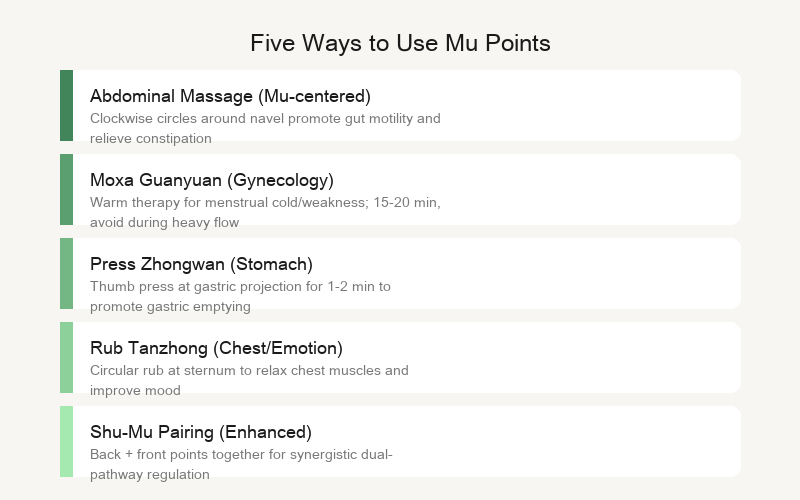
• Abdominal massage (centered on Mu points). Before sleep or after waking, use the palm to massage the abdomen clockwise 100 circles centered on the navel (Shenque), then counterclockwise 100 circles. Abdominal massage can promote intestinal peristalsis, improve digestion, and relieve constipation. Massage centered on Tianshu (Large Intestine Mu) is particularly effective for intestinal dysfunction.
• Moxa on Guanyuan (gynecology, cold deficiency). Women with menstrual irregularities, dysmenorrhea, and cold hands and feet can moxa Guanyuan (3 cun below navel). 15-20 minutes each time, pay attention to temperature. Moxa on Guanyuan improves pelvic blood flow and regulates endocrine. But not suitable during heavy menstrual flow, and not suitable during pregnancy.
• Press Zhongwan (stomach disease). When bloated, indigestion, or stomach pain, use the thumb to moderately press Zhongwan (4 cun above navel, midpoint between sternum and navel), to the degree of sourness and swelling, press for 1-2 minutes. Can promote stomach peristalsis and relieve stomach spasms. Not suitable for forceful pressing within 1 hour after meals.
• Rub Danzhong (chest tightness, emotional imbalance). When chest tightness, shortness of breath, or low mood, use the palm base or thumb to rub Danzhong (center of sternum, midpoint between two nipples), clockwise for 1-2 minutes. Can relax chest muscles, improve breathing, and relieve emotions. Combined with deep breathing, the effect is better.
• Shu-Mu pairing (enhanced effect). For example, for stomach disease, you can simultaneously moxa back Stomach Shu (beside T12) and abdomen Zhongwan (4 cun above navel). For low back pain, you can simultaneously moxa Kidney Shu (beside L2) and Guanyuan (3 cun below navel). Shu-Mu pairing, attacking from front and back, simultaneously regulating sympathetic and vagus nerves, the effect is better.
These methods don't require you to believe in TCM. You just need to understand: Mu points are the "front desk service counters" of the organs — direct dialogue, higher efficiency.
Part 7One-Minute Summary
🕐 One-Minute Summary of "Mu"
Mu = the organs' front desk service counter + direct dialogue window.
Mu points are in the chest and abdomen; each organ corresponds to a point: Zhongwan (stomach), Guanyuan (small intestine), Danzhong (heart), Tianshu (large intestine)...
Mu points are in the body surface projection zone of the organs; location corresponds to anatomy.
Mu = visceral body surface projection + abdominal reflex zone + vagus nerve reflex window.
Mu is not mysticism; it is the direct regulation interface of the organs in the chest and abdomen.
Causes: pressing too hard, pressing immediately after meals, moxa during heat conditions, excessive expectations.
Methods: abdominal massage (centered on Mu points), moxa on Guanyuan (gynecology cold deficiency), press Zhongwan (stomach disease), rub Danzhong (chest tightness), Shu-Mu pairing (enhanced effect).
The ancients called it "Mu points regulate organs"; modern people call it "abdominal reflex zone + vagus nerve regulation."
Different names, but the body knows: front desk dialogue is often the most direct.
Shu points are on the back, the remote monitoring room of the organs.
One in front and one in back, two windows, dialoguing with the same organ.
This is perhaps the most朴素 wisdom of the Chinese people: Shu-Mu pairing, Yin-Yang harmonization; front desk and back end, each performing its function.
Making money is the art of living; art is life after making money
Giaogiao Decodes Chinese Traditional Wisdom · Concept 40
Using modern scientific language to help the world understand Chinese traditional wisdom.
No mystery, no superstition, no disrespect.
Understand, not just believe.
Coach Liu
Written in Florence