Why Does Traditional Chinese Medicine Say "Lao" Is Physical Overdraft? 996 Burnout Isn't Laziness, It's Your Body Sounding the Alarm
Part 1A Question
Have you ever had this experience?
You work overtime for a month straight, sleeping only five hours a day. In the final week, you start getting headaches, your attention scatters, your mood becomes irritable, and you can't even understand the simplest spreadsheets. You go to the hospital for a check-up, and all indicators are normal. The doctor says: "No illness, just rest." But you feel like you're "dying." You ask: "What on earth is going on?" Western medicine says: "Chronic fatigue, possibly burnout." TCM says: "Overexertion depletes Qi, leading to deficiency of both Qi and blood."
One says "burnout," the other says "overexertion depletes Qi"—are they talking about the same thing?
Even more surprisingly, your neighbor Old Wang, who retired and lies around watching TV every day, never going out or exercising, becomes increasingly lethargic, gets winded from walking, and experiences muscle atrophy and osteoporosis. You ask: "He doesn't even work, how can he be tired?" Western medicine says: "Disuse syndrome, muscle atrophy, declining cardiopulmonary function." TCM says: "Prolonged lying down injures Qi; prolonged sitting injures flesh." Both approaches point to the same fact: not exercising also harms the body.
There's another question: you hear about someone who has "excessive sexual activity," with soreness in the waist and knees, dizziness, and tinnitus. You ask: "How can sex harm the body?" Western medicine says: "Moderate sexual activity is harmless; excessive activity may affect sleep and physical strength." TCM says: "Sexual overexertion injures the kidneys, depleting kidney essence." Which statement is correct?
What confuses you even more is that you take tonics (ginseng, ejiao) to replenish your body, but end up with internal heat, insomnia, and increased fatigue. You ask: "Why does tonifying make me more deficient?" TCM says: "The deficient cannot accept tonification; when Qi and blood are depleted, strong tonification actually increases the burden." Modern medicine says: "During chronic fatigue, the body's metabolic capacity declines, and excessive nutritional supplementation actually increases metabolic burden." Once again, the two perspectives align.
What exactly is Lao?
Part 2Traditional Chinese Explanation
The concept of "Lao" is systematically defined in the Yellow Emperor's Inner Canon. The ancients observed that some people who overworked became sallow and emaciated, short of breath and weak; some who remained inactive for long periods experienced muscle atrophy and stagnant Qi flow; some who overthought suffered from insomnia, forgetfulness, and poor appetite; and some who engaged in excessive sexual activity experienced soreness in the waist and knees, dizziness, and tinnitus. The ancients collectively referred to these pathological states caused by "Lao" as Laoshang—"Lao" is excessive depletion, and "Shang" is damage to the organs, Qi, and blood.
— Yellow Emperor's Inner Canon: Suwen
"Prolonged viewing injures blood; prolonged lying down injures Qi; prolonged sitting injures flesh; prolonged standing injures bones; prolonged walking injures tendons."
— Yellow Emperor's Inner Canon: Suwen
"Physical labor without weariness, Qi follows smoothly."
— Yellow Emperor's Inner Canon: Suwen
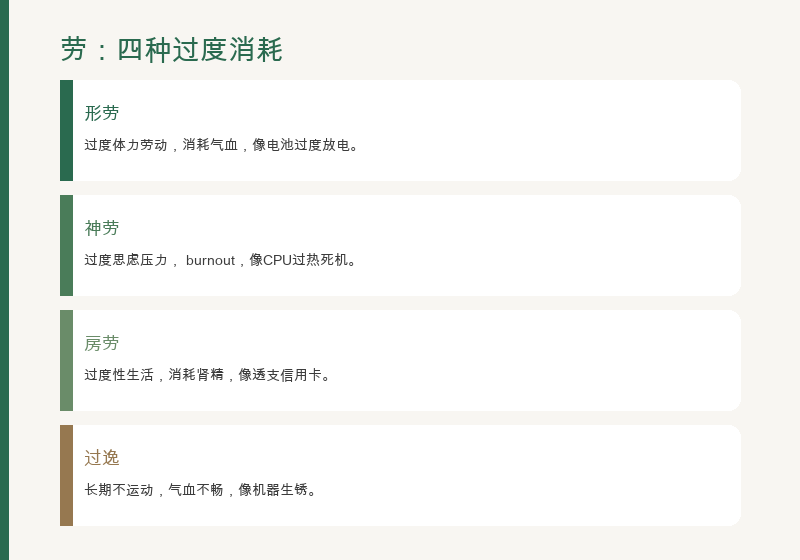
TCM summarizes the causes of "Lao" into three key terms: Xinglao, Shenlao, and Fanglao. At the same time, there is also "Guoyi"—excessive idleness, which is also a form of "Lao" (reverse Lao).
Xinglao (Physical Overexertion)—excessive physical labor consumes Qi and blood. Qi is energy; blood is nutrition. Long-term physical overexertion leads to Qi deficiency (insufficient energy) → blood deficiency (insufficient nutrition) → decline in organ function. Manifestations: fatigue, shortness of breath, spontaneous sweating, sallow complexion, muscle soreness. In modern society, construction workers, delivery couriers, and production line workers are the primary populations affected by Xinglao.
Shenlao (Mental Overexertion)—excessive thinking, mental stress, and emotional exhaustion. TCM says "overthinking injures the spleen"—excessive thinking consumes spleen Qi, leading to poor appetite, indigestion, insomnia, and forgetfulness. Modern medicine says "chronic stress leads to HPA axis dysregulation"—they are describing the same mechanism. Mental overexertion is not just "brain fatigue"; it is a comprehensive depletion of the neuro-endocrine-immune system. Programmers, finance professionals, and executives are the primary populations affected by Shenlao.
Fanglao (Sexual Overexertion)—excessive sexual activity depletes kidney essence. TCM says "the kidneys store essence," and kidney essence is the body's "fundamental energy source." Excessive sexual activity leads to kidney essence depletion, causing soreness in the waist and knees, dizziness, tinnitus, and decreased sexual function. Modern medicine believes that moderate sexual activity is harmless, but excessive sexual activity does affect sleep, physical strength, and mental state. The ancient concept of Fanglao emphasizes "moderation"—not abstinence, but not excess.
Guoyi (Excessive Idleness)—long-term inactivity, prolonged lying down or sitting, leads to poor circulation of Qi and blood. TCM says "prolonged lying down injures Qi"—long-term bed rest leads to insufficient lung Qi, shortness of breath, and weakness. "Prolonged sitting injures flesh"—long-term sitting leads to muscle atrophy, as the spleen governs the muscles. "Running water never grows stale; a door hinge never gets worm-eaten"—the body needs moderate activity for Qi and blood to circulate. In modern society, sedentary office workers, bedridden elderly after retirement, and long-term patients are the primary populations affected by Guoyi.
Therefore, what the ancients called "Lao" is not merely "tiredness," but a category of bodily functional disorders caused by excessive depletion or excessive idleness—including four forms: Xinglao, Shenlao, Fanglao, and Guoyi. The ancients used "Laoshang" to encompass what modern people need a host of concepts—"chronic fatigue syndrome," "burnout," "disuse syndrome," and "adrenal fatigue"—to explain.
Part 3giaogiao's Modern Translation
Alright, now let's translate "Lao" into modern language.
I don't intend to talk about mitochondrial function, ATP synthesis, or cortisol rhythms. Too complex. You only need to remember one metaphor:
Body = A credit card with an overdraft limit
Normal consumption = Normal swiping, paying on time
Overwork = Maxing out the credit card, unable to repay
Xinglao = Physical overdraft, muscle energy depleted
Shenlao = Mental overdraft, neurotransmitter depletion
Fanglao = Kidney essence overdraft, endocrine system fatigue
Guoyi = Not using the card for too long, limit frozen (functional degeneration)
That's it. Your "Lao" is essentially the body's energy system and regulatory system being in a state of chronic overload or disuse, leading to functional decline—like maxing out a credit card or having it frozen for too long, both lead to problems.
Specifically:
What does "overexertion depletes Qi" correspond to? It corresponds to the excessive depletion of the energy metabolism system. Mitochondria are the cell's "energy factories," producing ATP (energy currency) through oxidative phosphorylation. Long-term overwork leads to declining mitochondrial function, reduced ATP production, and insufficient cellular energy. At the same time, oxidative stress increases, and free radicals damage cells. TCM says "Qi depletion"—Qi is energy, and Qi depletion is insufficient energy. Modern medicine says "mitochondrial dysfunction + reduced ATP synthesis"—they are describing the same mechanism.
What does "overthinking injures the spleen" correspond to? It corresponds to neuroendocrine disorders caused by chronic stress. Long-term mental stress activates the HPA axis (hypothalamus-pituitary-adrenal axis), with cortisol remaining chronically elevated. Cortisol inhibits digestive function (reducing gastric acid secretion, slowing gastrointestinal motility), leading to poor appetite and indigestion. At the same time, cortisol damages the hippocampus (memory center), leading to forgetfulness and poor concentration. TCM says "overthinking injures the spleen"—the spleen governs transformation and transportation, and ascending clarity. Modern medicine says "chronic stress leads to decline in digestive and cognitive function"—they are describing the same pathology.
What does "prolonged lying down injures Qi" correspond to? It corresponds to disuse syndrome. Long-term bed rest or sitting means muscles do not receive mechanical stimulation, leading to reduced muscle protein synthesis and increased breakdown, resulting in muscle atrophy. At the same time, cardiopulmonary function declines—reduced lung capacity and cardiac output. TCM says "prolonged lying down injures Qi"—Qi is function, and prolonged lying down leads to functional decline. Modern medicine says "disuse atrophy + decline in cardiopulmonary function"—they are describing the same fact.
What does "burnout" correspond to? It corresponds to the modern version of TCM's "Shenlao." In 2019, the WHO included burnout in the ICD-11, defining it as "a syndrome resulting from chronic workplace stress." Symptoms: energy depletion, mental detachment, and reduced efficiency. This is highly consistent with TCM's description of "Shenlao": excessive thinking, depletion of Qi and blood, listlessness, and declining work efficiency. It is not "lack of willpower"; it is chronic overdraft of the neuro-endocrine-immune system.
Therefore, "Lao" is not mysticism. It is a functional metaphor—describing functional decline caused by the body's excessive depletion or excessive idleness. The ancients used "Laoshang" to encompass what modern people need a host of concepts—"chronic fatigue syndrome," "burnout," "disuse syndrome," and "adrenal fatigue"—to explain.
Part 4Life Cases
Four stories to help you instantly understand what "Lao" is.
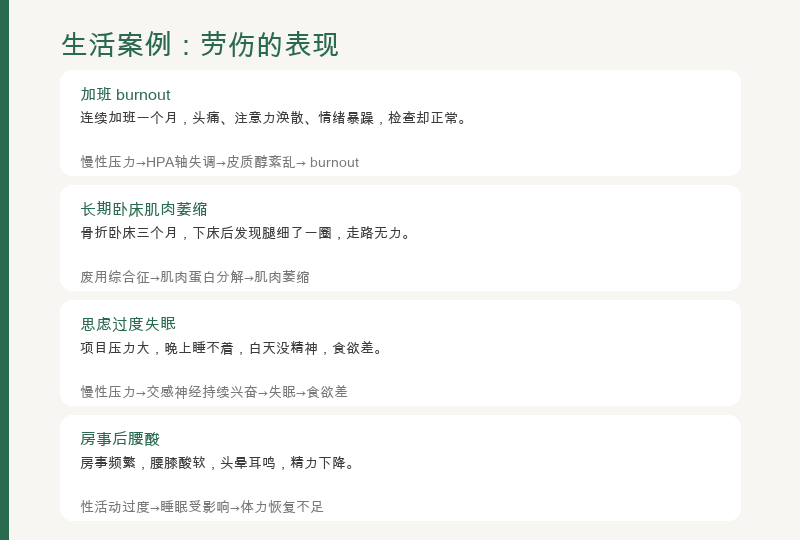
Case One: 996 Burnout.
You work at a major tech company, where 996 is the norm. After three consecutive months, you start experiencing insomnia, headaches, scattered attention, and you can't even write the simplest code. You go to the hospital, and all indicators are normal. The doctor says: "Burnout, rest." You ask: "What is burnout?" Western medicine says: "Chronic work-related stress leading to physical and mental exhaustion." TCM says: "Shenlao, overthinking injures the spleen, deficiency of both Qi and blood."
The truth: Long-term work stress keeps the HPA axis continuously activated, with cortisol chronically elevated. Initially, cortisol provides energy, and you feel like you "can still handle it." But long-term high cortisol leads to: hippocampal damage (declining memory), neurotransmitter depletion (insufficient dopamine and serotonin, low mood), declining immune function (frequent colds), and digestive disorders (poor appetite, stomach pain). This is the neuroendocrine mechanism of burnout. TCM says "overthinking injures the spleen, Shenlao"—precisely describing the pathology of mental overdraft. It is not "lack of willpower"; it is chronic overdraft of the neuro-endocrine system. But the description of "Shenlao" precisely captures the essence of burnout.
Case Two: Post-Retirement Disuse Syndrome.
Your father was an engineer before retirement, walking, climbing stairs, and traveling every day. After retirement, he lies on the sofa watching TV every day, and drives even for short trips. A year later, he gets winded from walking, his legs weaken after climbing one flight of stairs, and his muscles have visibly atrophied. Medical check-ups reveal decreased bone density and declining cardiopulmonary function. You ask: "Why does he get worse the more he rests?" Western medicine says: "Disuse syndrome, muscle atrophy, declining cardiopulmonary function." TCM says: "Prolonged lying down injures Qi; prolonged sitting injures flesh; stagnant Qi and blood."
The truth: Muscles and bones require mechanical stimulation to maintain. Long-term inactivity leads to reduced muscle protein synthesis and increased breakdown, resulting in decreased muscle mass and strength (sarcopenia). Bone density also requires mechanical stimulation to maintain; long-term non-weight-bearing activity leads to osteoporosis. Cardiopulmonary function likewise follows the principle of "use it or lose it"—reduced lung capacity and cardiac output. TCM says "prolonged lying down injures Qi; prolonged sitting injures flesh"—"Qi" is function, and "flesh" is muscle. Modern medicine says "disuse atrophy + decline in cardiopulmonary function"—they are describing the same mechanism. It is not "resting poorly"; it is the body needs moderate activity to maintain function. But the description of "prolonged lying down injures Qi" precisely captures disuse syndrome.
Case Three: Marathon Runner's Overtraining.
You run marathons, and to prepare for a race, you train 20 kilometers every day. After three months, your performance not only fails to improve but actually declines. You feel fatigued, have poor immunity, frequently catch colds, and experience poor sleep quality. Your coach says: "Overtraining; you need to rest." You ask: "Isn't more training always better?" Western medicine says: "Overtraining syndrome; the body has no time to recover." TCM says: "Xinglao, overexertion depletes Qi, deficiency of both Qi and blood."
The truth: The essence of athletic training is "stimulus-recovery-adaptation." Exercise causes micro-damage to muscles; after recovery and repair, the muscles become stronger. But if training volume exceeds recovery capacity, damage accumulates without repair, leading to: muscle breakdown, declining immune function, endocrine disorders, and poor sleep quality. This is overtraining syndrome. TCM says "Xinglao"—excessive physical depletion, deficiency of both Qi and blood. Modern medicine says "training load exceeds recovery capacity"—they are describing the same mechanism. It is not "not training hard enough"; it is recovery is as important as training. But the description of "overexertion depletes Qi" precisely captures the essence of overtraining.
Case Four: The Vicious Cycle of Chronic Insomnia.
You are under high work pressure and start experiencing insomnia. Unable to sleep, you feel mentally drained the next day, work efficiency drops, you work more overtime, stress increases, and you sleep even less. You take sleeping pills, which help you sleep for a few hours, but the next day you feel groggy, and dependency grows stronger. You ask: "Why do I sleep less the more tired I am?" Western medicine says: "Chronic stress leads to disrupted cortisol rhythms, with elevated cortisol at night, inhibiting sleep." TCM says: "Shenlao, deficiency of both heart and spleen, Yang failing to enter Yin."
The truth: Normally, cortisol is high during the day and low at night, while melatonin is high at night and low during the day—this rhythm regulates sleep. Chronic stress dysregulates the HPA axis, cortisol fails to drop at night, inhibiting melatonin secretion and causing difficulty falling asleep. At the same time, neurotransmitters (GABA, serotonin) are depleted, and the nervous system's excitability increases, making it difficult to relax. TCM says "Shenlao, Yang failing to enter Yin"—during the day, Yang should be active; at night, Yin should rest. When Shenlao occurs, Yang becomes hyperactive and cannot enter Yin, so you cannot sleep. Modern medicine says "cortisol rhythm disorder + neurotransmitter imbalance"—they are describing the same mechanism. It is not "thinking too much"; it is neuroendocrine rhythm disorder. But the description of "Yang failing to enter Yin" precisely captures the pathology of insomnia.
Four cases, one underlying logic: Lao is "physical overdraft"—whether it is overwork or excessive idleness, it is a systemic imbalance of the body.
Part 5Modern Research
Is there scientific research on "Lao"?
Yes, and there is a great deal of it. Scientists don't use the term "Laoshang"; they use:
• Chronic Fatigue Syndrome (CFS). A syndrome characterized by severe fatigue lasting more than six months, accompanied by sleep disorders, cognitive impairment, and muscle pain. Research has found that CFS patients exhibit mitochondrial dysfunction, increased oxidative stress, and abnormal immune function. This is consistent with TCM's description of "overexertion depletes Qi"—"Qi" is energy, and "Qi depletion" is an energy metabolism disorder.
• Burnout (Occupational Burnout). In 2019, the WHO included burnout in the ICD-11, defining it as "a syndrome resulting from chronic workplace stress." Symptoms: energy depletion, work detachment, and declining efficiency. Neuro mechanisms: HPA axis dysregulation, disrupted cortisol rhythms, declining prefrontal cortex function, and hyperactive amygdala. This is the modern scientific foundation of "Shenlao"—it is not "lack of willpower"; it is chronic overdraft of the nervous system.
• Disuse Syndrome. Long-term inactivity leads to muscle atrophy, decreased bone density, declining cardiopulmonary function, and reduced metabolic rate. Research has found that one week of bed rest reduces muscle mass by 10-15%. Long-term sedentary behavior increases cardiovascular disease risk by 2 times. This is the modern explanation of "prolonged lying down injures Qi; prolonged sitting injures flesh"—it is not "resting poorly"; it is the body needs moderate activity to maintain function.
These studies fully demonstrate that "Lao" is a concept that can be precisely described in modern scientific language. The ancients used "Laoshang" to describe it; modern people use "chronic fatigue syndrome + burnout + disuse syndrome" to describe it—they are talking about the same thing.
Part 6Practical Methods
Having understood "Lao," how do we address it?
First, dispel several misconceptions:
• "When tired, drink coffee to stay alert." Caffeine in coffee blocks adenosine receptors, temporarily suppressing the sensation of fatigue. But caffeine does not address the root causes of fatigue (energy depletion, neurotransmitter insufficiency) and may actually worsen insomnia and anxiety. It is not "coffee makes you less tired"; it is coffee is borrowing, not saving.
• "When deficient, take strong tonics." During chronic fatigue, the body's metabolic capacity declines, and strong tonics (such as ginseng, ejiao) actually increase metabolic burden, leading to internal heat, insomnia, and indigestion. It is not "the more deficient, the more you need to tonify"; it is the deficient cannot accept tonification; regulation must come before nourishment.
Specific methods:
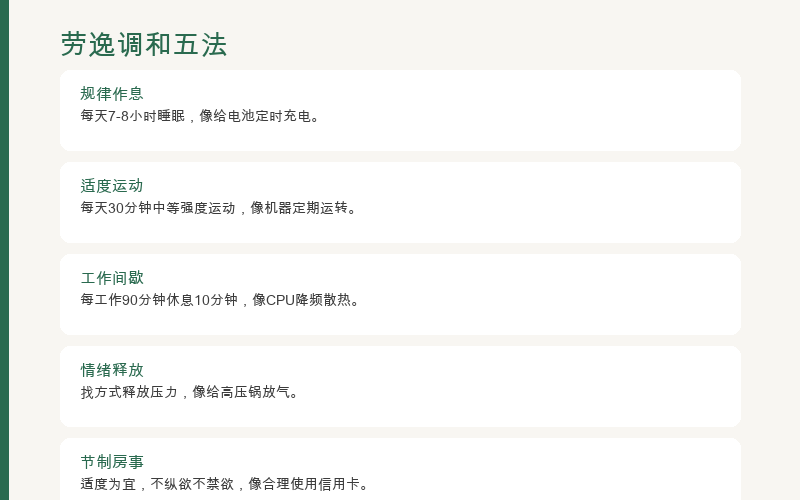
• Prioritize sleep (the foundation of recovery). Sleep is the core mechanism of physical recovery. During deep sleep, the brain clears metabolic waste (via the glymphatic system), muscles repair, and the immune system resets. Adults need 7-9 hours of sleep. For those with chronic fatigue, prioritizing sleep is more effective than any tonic. It is not "sleeping more is laziness"; it is sleep is the most effective recovery method.
• Moderate exercise (activate the body). Moderate exercise (150 minutes of moderate intensity per week) promotes mitochondrial generation, increases ATP production, improves neurotransmitter balance, and reduces cortisol. But excessive exercise worsens fatigue. The key is "moderation"—after exercise, you should feel more energetic, not more tired. TCM says "physical labor without weariness"—exercise to the point of not feeling fatigued.
• Work rhythm management (prevent burnout). Use the Pomodoro Technique (25 minutes of work, 5 minutes of rest) to avoid long periods of continuous work. Set work boundaries and do not handle work messages after work. Take regular vacations, completely detaching from the work environment. Research has found that vacations completely detached from the work environment are more effective than "resting at home but still answering emails."
• Mindfulness relaxation (reduce neural excitation). 10-20 minutes of mindfulness meditation, deep breathing, or yoga daily can reduce sympathetic nervous system excitation and activate the parasympathetic nervous system ("rest and digest" system). Research shows that eight weeks of mindfulness meditation reduces cortisol levels by 20% and significantly improves sleep quality. It is not "cultivating the mind"; it is scientific regulation of the nervous system.
• Nutritional support (don't overdo it). During chronic fatigue, nutritional needs increase, but digestive capacity declines. Choose easily digestible, nutrient-dense foods (high-quality protein, complex carbohydrates, healthy fats, vegetables, and fruits). Avoid high-sugar, high-fat, and processed foods—they increase metabolic burden and worsen fatigue. Regarding supplements, vitamin D, B-complex vitamins, magnesium, and coenzyme Q10 have some evidence-based support, but should be used under a doctor's guidance.
These methods do not require you to believe in TCM. You only need to understand: Lao is "physical overdraft"—sleep recovery, moderate activity, and rhythm management are the most effective forms of regulation.
Part 7One-Minute Summary
🕐 Understand "Lao" in One Minute
Lao = Physical Overdraft / Excessive Depletion.
Lao includes Xinglao (physical overexertion), Shenlao (mental overexertion), Fanglao (sexual overexertion), and Guoyi (excessive idleness).
996 burnout, post-retirement disuse, and overtraining are all manifestations of "Lao."
Lao = Chronic Fatigue Syndrome + Burnout + Disuse Syndrome + Adrenal Fatigue.
Lao is not mysticism; it is an imbalance of the body's energy system and regulatory system.
Misconceptions: using coffee to stay awake instead of resting, taking strong tonics when deficient.
Methods: prioritize sleep, moderate exercise, rhythm management, mindfulness relaxation, nutritional support.
The ancients called it "Laoshang"; modern people call it "burnout."
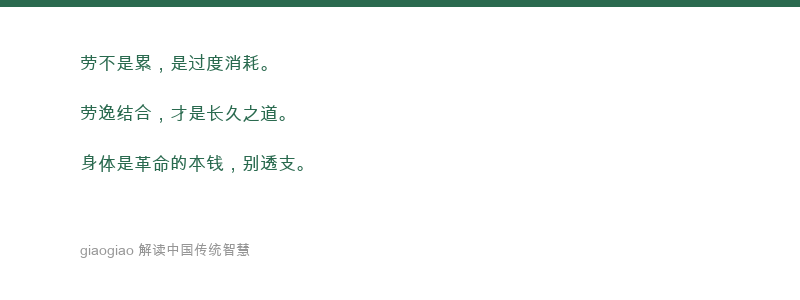
Different names, but the body knows: the body is like a credit card—overdrafts must be repaid, and unused cards get frozen.
Prolonged lying down also injures Qi; prolonged sitting also injures flesh.
The ancients did not have the concept of mitochondria, but they knew "overexertion depletes Qi."
This is probably the most朴素 wisdom of the Chinese people: Balance between tension and relaxation, coordination between work and rest; physical labor without weariness, Qi follows smoothly.
Making money is the art of living; art is life after making money.
giaogiao Decodes Chinese Traditional Wisdom · Concept 50
Using the language of modern science to help the world understand Chinese traditional wisdom.
No mysticism, no superstition, no belittlement.
Understand, rather than merely believe.
Coach Liu
Written in Florence