Why Does Traditional Chinese Medicine Call "Chong" an Intestinal Lodger? The Uninvited Guest in Your Belly Is More Than Just Parasites
Part 1A Question
Have you ever had this experience?
Your child grinds their teeth at night, making creaking sounds. You take them to the dentist, who says the teeth are fine. You take them to a TCM doctor, who says, "Chong Ji — there are parasites." You give them deworming medicine, and indeed several roundworms are passed, and the grinding stops. You ask, "How did the TCM doctor know there were parasites?" Western medicine says: "Grinding is one of the symptoms of parasitic infection, but it is not specific." TCM says: "Chong Ji leads to teeth grinding, abdominal pain, and a sallow complexion."
One says "parasitic infection," the other says "Chong Ji" — are they talking about the same thing?
Even more surprising, some people suffer from long-term abdominal pain, diarrhea, and weight loss. Endoscopies and colonoscopies find nothing. Finally, a stool test reveals a Giardia lamblia infection. In ancient TCM texts, there is no name "Giardia lamblia," but the description of "Chong Ji abdominal pain, diarrhea, and wasting" perfectly matches the symptoms of Giardia infection. How did the ancients know these symptoms were caused by "Chong" without microscopes?
There is another question: modern medicine has discovered that the intestines contain 100 trillion bacteria, some beneficial (probiotics) and some harmful (pathogens). Does TCM's "Chong" also include these bacteria? If so, can the concept of "expelling parasites" be expanded to "regulating intestinal flora"?
Even more confusing, the ancients used "expelling parasites," while modern medicine uses "antiparasitic drugs" — the logic is the same. But today we also have "probiotics" and "fecal microbiota transplantation" — does regulating intestinal flora count as another form of "expelling parasites"? TCM says "Chong Ji," modern medicine says "parasitic infection + intestinal dysbiosis" — how do the two systems align?
What is "Chong," after all?
Part 2Traditional Chinese Explanation
The concept of "Chong" in TCM is an independent category of disease cause. The ancients observed that some people had abdominal pain, wasting, and a sallow complexion, and got better after taking antiparasitic medicine. Some had anal itching, worse at night, which turned out to be pinworms. Some passed worms in their stool and only then realized there were parasites in their belly. The ancients called this pathological state caused by parasites Chong Ji — "Chong" is the parasite, and "Ji" is the accumulation of parasites in the intestines.
—— Essential Prescriptions of the Golden Cabinet (Jin Gui Yao Lue)
"Children's Chong Ji: intermittent abdominal pain, sallow complexion and wasting, craving for strange foods, or vomiting of roundworms."
—— Key to Pediatric Medication (Xiao Er Yao Zheng Zhi Jue)
"All parasites arise from damp-heat and are generated by unclean food, entering with what is eaten."
—— Golden Mirror of Medicine (Yi Zong Jin Jian)
TCM summarizes the characteristics of "Chong Ji" into four keywords: pain, wasting, sallow, and strange.
Pain (abdominal pain) — The most typical symptom of Chong Ji is abdominal pain. Parasites move, burrow, and lay eggs in the intestines, irritating the intestinal wall and causing pain. The characteristics of this pain are: intermittent, without fixed location, and relieved by gentle pressure (because parasite activity decreases). Children's Chong Ji abdominal pain is often around the navel, manifesting as colicky pain. TCM says "when the parasite moves, there is pain; when the parasite is still, the pain stops" — an accurate description of the behavior of parasitic activity.
Wasting (emaciation) — Parasites compete for nutrients in the intestines, leading to malnutrition in the host. Long-term Chong Ji causes a sallow complexion, wasting, weight loss, and developmental delay (in children). TCM says "Chong Ji consumes Qi and injures blood" — it is not that the parasites "suck blood," but that parasites compete for nutrients, causing malabsorption in the host. This is the modern explanation for "wasting due to Chong Ji": parasites reduce nutrient absorption and increase consumption.
Sallow (yellowish complexion) — Patients with Chong Ji have a withered, lusterless yellow complexion. This is due to malnutrition and anemia (parasites cause chronic blood loss or iron absorption disorders). TCM says "Chong Ji causes a sallow complexion" — it is not that parasites "dye the face yellow," but that nutritional deficiency leads to anemia and abnormal liver metabolism. In children with roundworm infection, iron-deficiency anemia is common, naturally leading to a sallow complexion.
Strange (pica) — Children with Chong Ji often exhibit pica — eating dirt, paper, wall plaster, or nail biting. This is caused by nutritional deficiencies (especially zinc deficiency) and neurobehavioral abnormalities from parasitic infection. TCM says "Chong Ji leads to craving for strange foods" — the ancients observed this phenomenon but lacked the concept of trace elements, attributing it to "Chong Ji." Modern medicine finds that pica is related to zinc deficiency, iron deficiency, and parasitic infection.
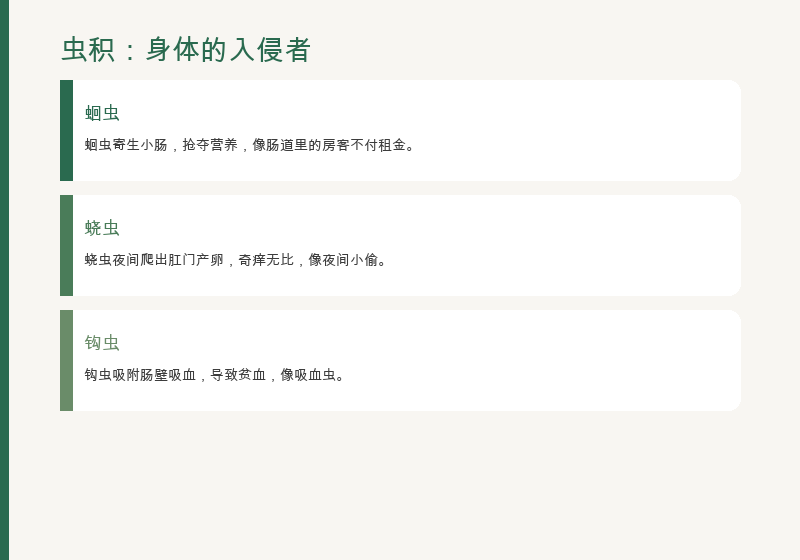
So, the "Chong" spoken of by the ancients first refers to parasites (roundworm, pinworm, hookworm, tapeworm, etc.) — a class of intestinal parasites visible or faintly visible to the naked eye. But the concept of "Chong" in TCM can also be extended to a broader category of foreign biological invasion — including microbes and parasites. The ancients used "Chong Ji" to sum up what modern people need the concepts of "parasitology," "intestinal microbiome," and "malabsorption" to explain.
Part 3giaogiao's Modern Translation
Alright, now let me translate "Chong" into modern language.
I am not going to explain the life cycle of parasites, the morphology of eggs, or fecal examination methods. Too complicated. You only need to remember one metaphor:
Normal intestine = a clean house, with only the owner (your own cells) and good friends (probiotics)
Parasites = bad tenants who force their way in, stealing food and causing damage
Pathogenic bacteria = bad elements who sneak in, releasing toxins
Flora imbalance = the ratio of good to bad people in the house is out of balance, public order deteriorates
Expelling parasites = evicting bad tenants and restoring public order
That simple. Your "Chong" is essentially biological invaders that should not be living in the body — including parasites, pathogenic bacteria, and harmful microorganisms.
Specifically:
What does "Chong Ji" correspond to? It corresponds to parasitic infections in modern medicine (ascariasis, enterobiasis, hookworm disease, taeniasis, giardiasis, amebiasis, etc.). Parasitic infections affect about 2 billion people globally, especially in regions with poor sanitation. Roundworm infection causes abdominal pain and malnutrition; hookworm infection causes chronic blood loss and iron-deficiency anemia; Giardia infection causes diarrhea and malabsorption. The "Chong Ji" described by the ancients is essentially the general term for these parasitic infections. Without microscopes, they accurately described the clinical manifestations of "Chong Ji" through symptom observation.
What does "expelling parasites" correspond to? It corresponds to antiparasitic therapy in modern medicine. Drugs like albendazole, mebendazole, and praziquantel kill or paralyze parasites, allowing them to be expelled with feces. The ancients used "expelling parasite formulas" (such as Shijunzi, Betel nut, and Pumpkin seeds), while modern medicine uses chemical antiparasitic drugs — the logic is the same: both clear parasites. But modern antiparasitic drugs are more precise and more efficient.
What does "wasting from Chong Ji" correspond to? It corresponds to malnutrition caused by parasitic infection. Parasites compete for nutrients in the intestines, damaging the intestinal mucosa and reducing nutrient absorption. For example, hookworms adhere to the intestinal wall and suck blood, causing chronic blood loss and iron-deficiency anemia; tapeworms seize a large amount of vitamin B12, causing megaloblastic anemia. TCM says "Chong Ji consumes Qi and injures blood," while modern medicine says "parasites cause nutrient competition and blood loss" — they are describing the same pathology.
The modern extension of the "Chong Ji" concept — intestinal dysbiosis. Modern medicine has discovered that the intestines contain 100 trillion bacteria, weighing 1.5 kg. Under normal conditions, probiotics dominate, maintaining intestinal health. But improper diet, antibiotic abuse, stress, and other factors lead to dysbiosis, with an increase in harmful bacteria, toxin production, and the triggering of inflammation, allergy, and metabolic diseases. TCM does not have the concept of "flora," but the logic of "Chong Ji" can be expanded — "Chong" is not only parasites but also includes harmful microorganisms. Regulating flora is the modern version of "expelling parasites" — using probiotics, prebiotics, and fecal microbiota transplantation to restore intestinal "public order."
So, "Chong" is not mysticism. It is a functional metaphor — describing biological invaders that should not be living in the body. The ancients used "Chong" to summarize what modern people need the fields of "parasitology," "microbiology," and "intestinal microbiology" to explain.
Part 4Real-Life Examples
Four stories to help you instantly understand what "Chong" is.
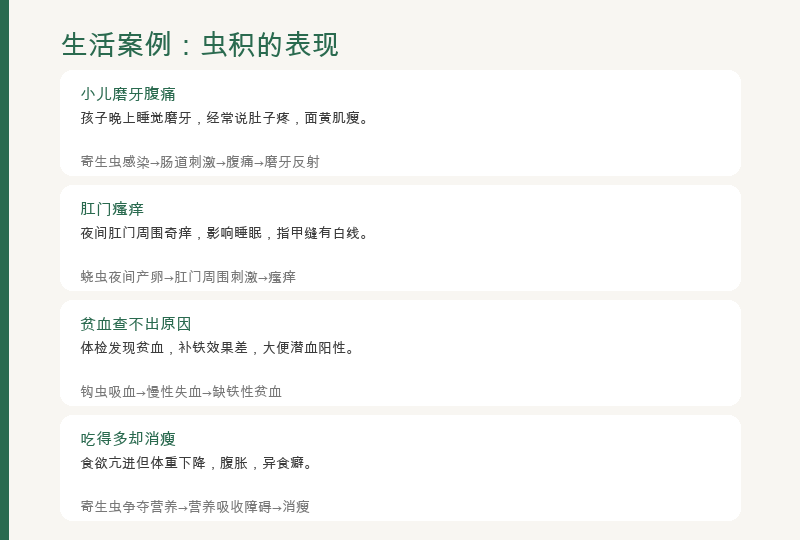
Example 1: Childhood roundworm and teeth grinding.
Your 5-year-old child grinds their teeth at night, making grinding sounds. Sallow and emaciated, with occasional stomach pain and poor appetite. You take them to a TCM doctor, who says, "Chong Ji — there are roundworms." You give them deworming medicine (albendazole), and indeed several roundworms are passed, the grinding stops, and the appetite improves. You ask, "How did the TCM doctor know there were parasites?" Western medicine says: "Grinding is not a specific symptom of roundworms, but roundworm infection can indeed cause neurobehavioral abnormalities." TCM says: "Chong Ji leads to grinding, abdominal pain, and a sallow complexion."
The truth: Roundworm infection affects about 800 million to 1 billion people globally, especially in children. Roundworms parasitize the small intestine, competing for nutrients and causing malnutrition. Metabolic products and toxins from the worms can affect the nervous system, causing neurobehavioral abnormalities (such as grinding, irritability, and restless sleep). At the same time, roundworm infection is often accompanied by trace element deficiencies (zinc and iron), further affecting neurological function. It is not "worms biting in the mouth," but parasite toxins + nutritional deficiency + neurobehavioral abnormalities. But the TCM observation that "Chong Ji leads to grinding" precisely links parasites with neurological symptoms.
Example 2: Traveler's diarrhea and Giardia.
You travel to Southeast Asia, drink local water, and come back with diarrhea lasting two weeks. Loose, foul-smelling stools, bloating, and weight loss. Endoscopies and colonoscopies find nothing. Finally, a stool PCR test reveals a Giardia lamblia infection. You take metronidazole and recover. You ask, "Why couldn't it be detected earlier?" Western medicine says: "Giardia is sometimes missed by routine stool tests and requires special testing." TCM says: "Chong Ji leads to diarrhea and wasting fatigue."
The truth: Giardia lamblia is a protozoan parasite transmitted through contaminated water and food. It parasitizes the upper small intestine, damaging intestinal villi and causing malabsorption and diarrhea. Giardia infection is common in travelers (one of the causes of "traveler's diarrhea"). Symptoms: chronic diarrhea, steatorrhea (foul-smelling stools), bloating, and wasting. Ancient TCM texts do not contain the name "Giardia," but the description of "Chong Ji diarrhea and wasting" closely matches Giardia infection. It is not that "TCM has supernatural powers," but precise summarization of symptom observation. However, the concept of "Chong Ji" indeed encompasses these parasitic infections.
Example 3: Hookworm infection and anemia.
You work in a rural area, walking barefoot in the fields. You gradually feel weak, dizzy, and have palpitations, with a sallow complexion. A checkup reveals hemoglobin of only 8 g/dL (normal for men: 12–16), severe anemia. A stool test finds hookworm eggs. You take deworming medicine and iron supplements, and after three months, hemoglobin returns to normal. You ask, "How does hookworm cause anemia?" Western medicine says: "Hookworms adhere to the intestinal wall and suck blood, causing chronic blood loss." TCM says: "Chong Ji consumes Qi and injures blood, causing a sallow and emaciated appearance."
The truth: Hookworms enter the body through the skin (barefoot contact with contaminated soil) and parasitize the small intestine. Hookworms use their buccal capsule to adhere to the intestinal wall, sucking 0.03–0.2 ml of blood per day. Long-term infection causes cumulative chronic blood loss, leading to iron-deficiency anemia. At the same time, hookworms damage the intestinal mucosa, affecting the absorption of iron and other nutrients. TCM says "Chong Ji consumes Qi and injures blood" — precisely describing the mechanism of hookworm-induced anemia. It is not just a metaphor of "worms sucking blood," but actual chronic blood loss + nutrient absorption disorder. However, the description of "consuming Qi and injuring blood" precisely summarizes the pathological consequences of hookworm infection.
Example 4: Intestinal dysbiosis after antibiotics.
You are treated with broad-spectrum antibiotics for two weeks for pneumonia. The pneumonia is cured, but you start having diarrhea, bloating, and indigestion. You take probiotics and gradually recover. You ask, "How do antibiotics affect the intestines?" Western medicine says: "Antibiotics kill pathogenic bacteria but also kill probiotics, leading to dysbiosis." TCM says: "Medication damages the Spleen and Stomach, and healthy Qi is insufficient."
The truth: Broad-spectrum antibiotics are indiscriminate, killing pathogenic bacteria while also killing large numbers of probiotics. After dysbiosis, harmful bacteria (such as Clostridioides difficile) take the opportunity to multiply, producing toxins that cause diarrhea (antibiotic-associated diarrhea). Probiotic supplementation helps restore flora balance. Although TCM does not have the concept of "flora," the description of "medication damaging the Spleen and Stomach" precisely summarizes the side effects of antibiotics on the intestines. The modern approach of "regulating flora" can be seen as an extension of the "Chong" concept — not expelling parasites, but restoring the public order balance of intestinal microorganisms.
Four examples, one underlying logic: Chong is an "invader in the body" — parasites, pathogenic bacteria, and harmful microorganisms are all "lodgers" that do not belong in the body.
Part 5Modern Research
Is there scientific research on "Chong"?
Yes, and a great deal. Scientists do not use the term "Chong Ji"; they use:
• Parasitology. The study of parasite morphology, life cycles, pathogenic mechanisms, diagnosis, and treatment. About 2 billion people worldwide are infected with parasites, especially in tropical and developing countries. Roundworm, hookworm, whipworm, tapeworm, schistosome, and Plasmodium are all important parasitic pathogens. Parasites cause malnutrition, anemia, growth delay, and cognitive impairment. Deworming treatment is the core of global public health programs (such as the WHO deworming program).
• Gut Microbiome. The intestines contain about 100 trillion bacteria, influencing digestion, immunity, metabolism, and neurological function. Dysbiosis is associated with obesity, diabetes, inflammatory bowel disease, allergy, autism, and depression. Fecal microbiota transplantation (FMT) is an effective treatment for refractory Clostridioides difficile infection and is being studied for other diseases. Regulating flora is the modern version of "expelling parasites" — restoring the microbial balance of the intestines.
• Nutritional Parasitology. The study of how parasitic infections cause malnutrition. Hookworms suck blood and cause iron-deficiency anemia; roundworms compete for nutrients and cause protein-energy malnutrition; tapeworms seize vitamin B12 and cause megaloblastic anemia. Deworming + nutritional supplementation is an effective strategy to improve the nutrition and development of children in parasitic infection areas. This is the modern scientific foundation of "Chong Ji consumes Qi and injures blood."
These studies fully demonstrate that "Chong" is a concept that can be precisely described in modern scientific language. The ancients used "Chong Ji" to summarize it, while modern people use "parasitology + gut microbiome + nutritional parasitology" to describe it — they are talking about the same thing.
Part 6Practical Methods
Now that you understand "Chong," how do you prevent it?
First, dispel a few misconceptions:
• "Taking deworming medicine once a year makes everything safe." Deworming medicine can clear existing parasites but cannot prevent reinfection. The key to preventing parasitic infection is hygiene habits — washing hands before meals, avoiding raw food, and not drinking untreated water. It is not that "taking medicine makes you safe," but that hygiene habits are the foundation.
• "Probiotics can kill parasites." Probiotics regulate flora and are effective for dysbiosis, but they are ineffective against parasitic infections. Parasites require specific antiparasitic drugs (such as albendazole and mebendazole). Do not treat probiotics as a "universal deworming medicine."
Specific methods:
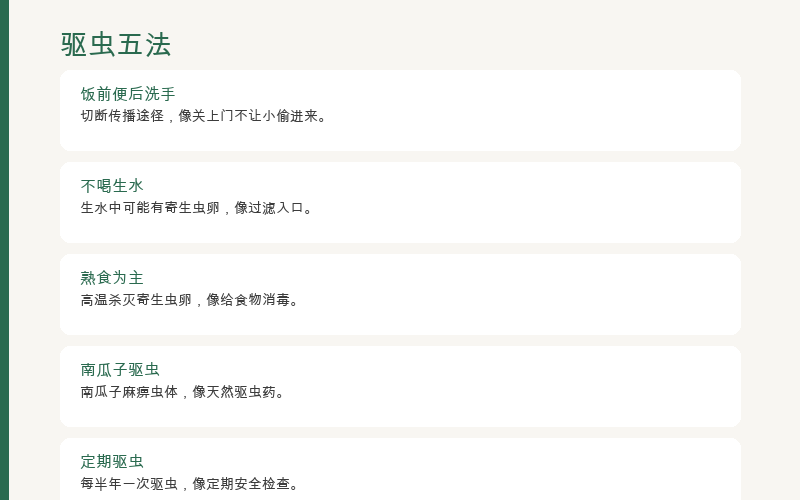
• Wash hands before meals (blocking transmission routes). Parasite eggs are transmitted via the fecal-oral route. Washing hands before meals and after using the toilet is the simplest and most effective method to block transmission. Studies show that proper handwashing can reduce diarrheal diseases and parasitic infections by more than 30%. It is not "making a fuss," but using the simplest method to block the most complex transmission chain.
• Avoid raw food and untreated water (cutting off the entry point). Parasite eggs and cysts are often present in raw vegetables, fruits, meat, and water. Thoroughly cooking food and drinking boiled or bottled water can kill parasites. In parasitic epidemic areas, avoid raw food and untreated water. It is not "being overly cautious," but cutting off the entry point for parasites.
• Regular deworming (high-risk groups). In parasitic epidemic areas, children should be dewormed every 6–12 months. The WHO recommends regular deworming for school-age children in hookworm and roundworm epidemic areas. Deworming drugs (albendazole, mebendazole) are safe, effective, and inexpensive. It is not "over-medicalization," but an effective public health intervention.
• Regulate intestinal flora (modern deworming). A high-fiber diet (vegetables, fruits, whole grains) promotes the growth of probiotics. Fermented foods (yogurt, kimchi, miso) provide probiotics. Avoid the misuse of antibiotics — antibiotics are the biggest killer of flora balance. When flora is balanced, harmful microorganisms are less likely to multiply. This is the modern version of "deworming" — not killing worms, but making the intestinal environment inhospitable to harmful microorganisms.
• Pay attention to pet hygiene (preventing zoonoses). Pets (cats and dogs) can carry parasites (such as roundworms, hookworms, and tapeworms). Regularly deworm pets, clean up pet feces, and prevent children from touching pet feces and then eating without washing their hands. Pets are an important vector for parasite transmission.
These methods do not require you to believe in TCM. You only need to understand: Chong is an "invader in the body" — blocking transmission, cutting off entry, and regular eviction are the most effective defenses.
Part 7One-Minute Summary
🕐 One Minute to Understand "Chong"
Chong = Intestinal lodger / Invader in the body.
TCM's "Chong" includes parasites (roundworm, pinworm, hookworm, tapeworm) and broad microbial infections.
Chong Ji causes abdominal pain, wasting, sallow complexion, and teeth grinding (common in children).
Chong = Parasitology + Gut Microbiome + Nutritional Parasitology.
Chong is not mysticism; it is biological invaders that should not be living in the body.
Misconceptions: taking deworming medicine once a year makes everything safe; probiotics can kill parasites.
Methods: wash hands before meals, avoid raw food, regular deworming, regulate intestinal flora, pay attention to pet hygiene.
The ancients called it "Chong Ji"; modern people call it "parasitic infection + dysbiosis."
Different names, but the body knows: lodgers that do not belong must be promptly evicted.
The ancients had no microscopes but precisely described the abdominal pain, wasting, and sallow complexion of Chong Ji.
Today we have microscopes; we should preserve the wisdom of the ancients' observations.
This is probably the most simple wisdom of the Chinese people: Keep the body clean, preserve healthy Qi within, and parasites cannot invade.
Making money is the art of living; art is the life after making money
giaogiao Decodes Traditional Chinese Wisdom · Concept 49
Using the language of modern science to help the world understand traditional Chinese wisdom.
No mysticism, no superstition, no belittlement.
Understand, rather than merely believe.
Coach Liu
Written in Florence