Dryness (zào) — Dryness Evil: Dryness Damages the Lungs
Part 1One Question
Have you ever noticed that every autumn and winter transition, your skin starts to tighten and peel, your lips crack, and drinking water doesn't help?
Have you realized that dryness isn't just "skin dehydration" — it's a dry throat, dry nose, dry eyes, even dry stools — your whole body is "dry"? And more absurdly, you drink water like crazy, you pee more, but your skin is still dry?
You ask: If dryness is caused by lack of water, why am I still dry after drinking eight glasses a day? If dryness isn't lack of water, then what is it? Why does Traditional Chinese Medicine say "dryness evil" damages the lungs, not the kidneys or stomach?
And another question: Why do northerners cough and get nosebleeds more easily in autumn, while southerners don't get that dry even in winter? Why does staying in an air-conditioned room all day make your skin drier than walking outside in the wind?
What exactly is dryness? Why did the ancients say "when dryness prevails, dryness results," not "when dryness results, dryness prevails"? What's the difference between dryness and being dry?
Part 2Traditional Chinese Explanation
The concept of "dryness" (zào) in Traditional Chinese Medicine belongs to the "Six Excesses" (Liù Yín) — the six external pathogenic factors: wind, cold, summer heat, dampness, dryness, and fire. The characteristic of dryness evil is "dryness and astringency," and it most easily damages body fluids. The ancients said "when dryness prevails, dryness results," meaning that when dryness evil is excessive, it consumes the body's fluids, leading to various dry symptoms.
—— Suwen · Yin-Yang Yingxiang Dalun (Basic Questions · The Great Treatise on the Correspondence of Yin and Yang)
"All astringency, withering, dryness, and cracking belong to dryness."
—— Suwen Xuanji Yuanbing Shi (Basic Questions · The Mystic Mechanism of the Origin of Diseases)
"The lung is a delicate organ; it likes moisture and dislikes dryness."
—— Yizong Jinjian (The Golden Mirror of Medicine)
The ancients observed that in autumn, all things contract and the air becomes dry. The human body easily shows symptoms like dry skin, dry mouth and nose, dry cough with little phlegm. So they summarized the concept of "autumn dryness," believing that dryness is the dominant qi of autumn, and autumn is when dryness evil is most easily contracted.
Dryness is dry and astringent, easily damaging body fluids. Dryness evil is not sticky like dampness evil, nor congealing like cold evil. Its characteristic is "dryness" — like a dryer, it "bakes away" the water in the body. When body fluids are consumed, the skin, mucous membranes, and internal organs lose their moisture, and various dry symptoms appear.
Dryness easily damages the lungs. The lungs govern qi, control respiration, open into the nose, and are externally connected to the skin and hair. The lung is a "delicate organ" that likes moisture and dislikes dryness. Dryness evil enters through the mouth, nose, and skin, directly damaging lung fluids, causing dry cough, little phlegm, dry throat, and dry nose.
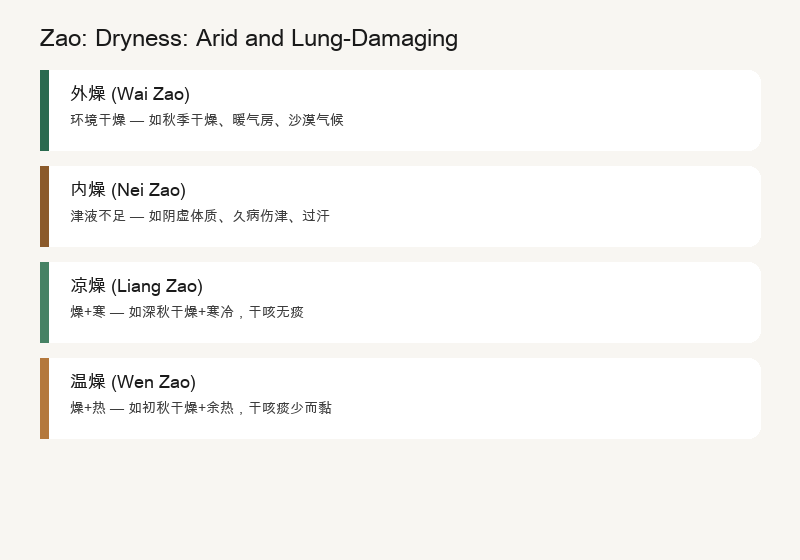
Warm dryness and cool dryness. In early autumn, summer heat has not yet fully dissipated. Dryness evil combined with heat is called "warm dryness" — symptoms tend to be heat-related: dry mouth, sore throat, dry cough with little phlegm. In late autumn, the weather gradually cools. Dryness evil combined with cold is called "cool dryness" — symptoms tend to be cold-related: aversion to cold, absence of sweat, cough with thin phlegm.
So, what the ancients called "dryness" is not just "dryness" — it is an external pathogenic factor characterized by consuming body fluids, mainly damaging the lungs and the body's surface mucous membranes.
But dryness evil has another characteristic: dryness is relative to body fluids; when body fluids are damaged, dryness arises. Not only does external dryness evil cause dryness, but internal body fluid deficiency (yin deficiency) can also produce internal dryness. Just as when a pond runs out of water, the riverbed naturally cracks — internal dryness is the body "lacking water," while external dryness is the environment "pumping water."
Part 3giaogiao Modern Translation
Okay, now let's translate "dryness" (dryness evil) into modern language.
I don't plan to talk about complex pathophysiology. You just need to remember one analogy:
Dryness evil = environmental relative humidity below 40% → accelerated evaporation of water from respiratory/skin mucous membrane surfaces → mucous layer thins, ciliary function declines → barrier is damaged → pathogens invade more easily → inflammatory response (dry cough, sore throat, skin sensitivity)
Lungs governing skin and hair = the lung's mucous immune system is interconnected with the skin barrier function (the lung-skin axis)
Body fluids = mucous secretions (mucus, tears, saliva, digestive fluids) + interstitial fluid
Moistening dryness = restoring mucous barrier function (increasing environmental humidity + replenishing water + repairing epithelium)
Warm dryness = dryness + high temperature → mucous dehydration + vasodilation → sore throat, dry mouth, heat cough
Cool dryness = dryness + low temperature → mucous dehydration + vasoconstriction → nasal congestion, aversion to cold, clear nasal discharge
Dryness evil damaging the lungs = dry air damaging respiratory mucous membranes → reduced mucus secretion → decreased ciliary clearance rate → viruses/bacteria colonize more easily
That's it. "Dryness" (dryness evil), in essence, is damage to the body's mucous barrier system caused by a low-humidity environment — from the respiratory tract to the skin, from outside to inside, layer by layer of dryness.
Specifically:
What does "when dryness prevails, dryness results" correspond to? It corresponds to the relationship between environmental humidity and mucous health. When environmental relative humidity drops below 40%, water evaporates faster from the surface of respiratory mucous membranes. The mucous layer becomes thicker and thinner, ciliary beating frequency decreases, and the ability to clear pathogens weakens. Research shows that when humidity drops below 30%, the transmission efficiency of influenza virus increases threefold, and infection rates rise significantly. It's not the mysticism of "dryness evil damaging body fluids," but the physiology of low humidity causing mucous barrier function degradation.
What does "the lung is a delicate organ, liking moisture and disliking dryness" correspond to? It corresponds to the physiological characteristics of respiratory mucous membranes. The surface of the alveoli and the inner wall of the respiratory tract are covered by a mucous-ciliary system, which needs to maintain appropriate moisture to function normally. Dry air directly damages this barrier, reducing the lung's "self-protection" ability. It's not the mysticism of "the lungs fear dryness," but an anatomical fact that respiratory mucous membranes need a moist environment to maintain function.
What do "warm dryness and cool dryness" correspond to? They correspond to different temperature combinations in dry environments. High-temperature dryness (warm dryness) → mucous dehydration + local vasodilation → manifests as heat symptoms (dry mouth, sore throat, yellow phlegm). Low-temperature dryness (cool dryness) → mucous dehydration + local vasoconstriction → manifests as cold symptoms (nasal congestion, clear nasal discharge, white phlegm). It's not the mysticism of "heat and cold properties," but the physiology of temperature and humidity jointly affecting the vascular state of mucous membranes.
What does "internal dryness" correspond to? It corresponds to the dry state caused by insufficient body fluids internally. In the elderly, people with yin deficiency constitution, those who stay up late chronically, or those with chronic disease consumption — in these cases, the body's ability to secrete mucus declines, interstitial fluid decreases, and even without a dry environment, dry symptoms appear. It's not the mysticism of "yin deficiency generating internal heat," but a syndrome of glandular secretion decline + cellular dehydration + slowed metabolism.
So, "dryness" is not mysticism. It is simply a process of low-humidity environments damaging the mucous barrier, or insufficient internal body fluids causing cellular dehydration — the ancients described it as "dryness evil damaging body fluids," while modern people describe it as "humidity-mucous barrier-inflammatory response" — the core logic is consistent: dryness is a problem with the body's "lubrication system."
Part 4Real-life Cases
Four stories to make you instantly understand what "dryness" (dryness evil) is.
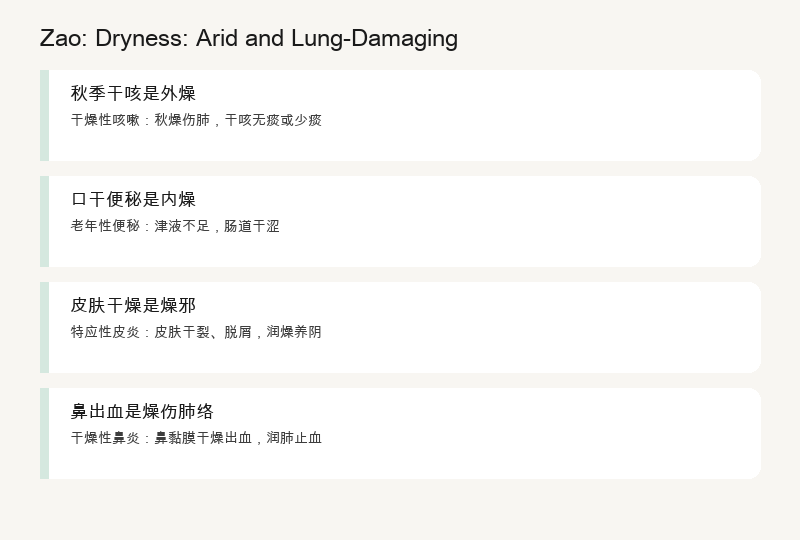
Case One: Dry skin in autumn and winter (skin barrier damage).
Every October, the skin on your lower legs starts to flake white, your lips crack. Applying moisturizer helps a bit, but without it, it's dry again. You ask: "Why doesn't drinking water help, but applying oil does?"
Truth: Dry skin isn't just "lack of water" — it's damage to the sebum film and stratum corneum barrier. In autumn, air humidity drops. The water on the skin surface evaporates faster. The stratum corneum water content drops from the normal 20-30% to below 10%. The intercellular lipid structure is destroyed, and barrier function is lost. Simply drinking water can only replenish internal water, but the skin barrier needs lipids (sebum) to "seal in" the water — just like a pond without silt cover, no matter how much water there is, it will evaporate. The function of moisturizer is to replenish the sebum film and reduce water loss. It's not the mysticism of "dryness evil damaging body fluids," but skin barrier physiology. Modern research: For every 10% decrease in environmental humidity, transepidermal water loss (TEWL) increases by 15-20%.
Case Two: Dry cough without phlegm (respiratory mucous membrane dryness).
As soon as autumn arrives, you start coughing. No phlegm, dry and itchy throat, especially bad when you wake up in the morning. Cough medicine doesn't work well, but turning on a humidifier makes it much better. You ask: "Why doesn't cough medicine work for a dry cough?"
Truth: This is a "protective cough" caused by dry respiratory mucous membranes. Dry air makes the mucous layer on the surface of the trachea and bronchial mucosa thicker. The cilia can't move effectively. Irritants (dust, pathogens) can't be cleared in time, stimulating cough receptors and triggering a dry cough. Cough medicine suppresses the cough center but doesn't solve the problem of mucous membrane dryness — it's like turning off the fire alarm but not putting out the fire. Increasing humidity restores the fluidity of the mucus, the cilia start working again, irritants are cleared, and the cough naturally stops. It's not the mysticism of "dryness evil invading the lungs," but the physiology of the respiratory mucous-ciliary clearance system. Modern research: When humidity is maintained at 40-60%, respiratory ciliary clearance is highest and infection risk is lowest.
Case Three: "Artificial dryness evil" in air-conditioned rooms (artificial low-humidity environment).
In summer, you stay in an air-conditioned room all day. Your skin tightens, your eyes are dry, your throat is uncomfortable — worse than walking outside. You ask: "Isn't summer humid? Why is the air-conditioned room so dry?"
Truth: The process of air conditioning cooling is also the process of "dehumidifying." Air conditioning cools the indoor hot air, water vapor in the air condenses into water and is drained out. Relative humidity can drop below 30% — more severe than natural autumn dryness. This is "artificial dryness evil" — you create an environment drier than the desert (desert humidity is about 20-30%), and stay in it for eight hours a day. Skin, eyes, and respiratory mucous membranes are continuously dehydrated in this environment. It's not the mysticism of "weak constitution," but damage caused by low-humidity environments created by air conditioning dehumidification. Modern research: When humidity in air-conditioned rooms is below 30%, tear evaporation speed from the eye surface increases by 50%, and the incidence of dry eye syndrome rises significantly. Respiratory mucous membranes dry out, and the risk of colds and flu increases.
Case Four: Constipation in the elderly (internal dryness: insufficient intestinal body fluids).
Your grandfather is eighty years old. His stools are dry like sheep droppings, only once every few days. Eating bananas and drinking honey water works sometimes and sometimes not. You ask: "Why are old people prone to constipation, and why are their stools so dry?"
Truth: This is "internal dryness" — insufficient intestinal body fluids. With age, intestinal gland secretion function declines, digestive fluids decrease, intestinal peristalsis slows, and stools stay in the intestines too long. Water is excessively absorbed, making the stools hard and dry. It's not the mysticism of "yin deficiency causing intestinal dryness," but the physiology of age-related glandular degeneration + slowed intestinal peristalsis + excessive water absorption. Modern research: In people over 60, the incidence of chronic constipation exceeds 30%, mainly due to decreased intestinal secretion function and prolonged colonic transit time. Simply drinking water has limited effect. You need to increase dietary fiber (to lock in water) and measures to promote intestinal peristalsis.
Four cases, one underlying logic: dryness is a malfunction of the "lubrication system" — whether it's external low-humidity environments damaging mucous membranes or internal body fluid deficiency causing cellular dehydration, the core is that water is lost in the wrong places, or is insufficient where it's needed.
Part 5Modern Research
Is there scientific research on "dryness" (dryness evil)?
Yes, and it's very thorough. Scientists don't use the term "dryness evil damaging body fluids." They use "environmental humidity and mucous immunity":
• Low humidity and respiratory viral infections. A 2019 study from Yale University published in the Annual Review of Virology confirmed: when environmental humidity drops below 40%, respiratory mucous-ciliary clearance decreases, viruses survive longer in dry air, and dryness damages respiratory epithelial cells, making it easier for viruses to invade. Research shows that the high incidence of winter flu is not only due to low temperatures, but even more due to low indoor and outdoor humidity — heating systems reduce indoor humidity to 20-30%, creating an ideal environment for virus transmission. It's not the mysticism of "winter dryness invading the lungs," but the precise science of humidity-virus-mucous immunity.
• Humidity and skin barrier function. Dermatological research confirms that the stratum corneum needs to maintain 20-35% water content to maintain normal barrier function. When environmental humidity is below 40%, transepidermal water loss (TEWL) significantly increases, stratum corneum lipid structure is disrupted, and the skin barrier is damaged, leading to sensitivity, itching, and inflammation. Humidifiers can increase indoor humidity to around 50%, significantly improving dry skin. It's not the mysticism of "dryness evil damaging skin and hair," but the precise mechanism of skin barrier physiology.
• Dryness and inflammatory response. Modern immunology has found that mucous dryness not only reduces barrier function but also directly activates inflammatory responses. Osmotic stress activates the NF-κB pathway in epithelial cells, releasing inflammatory factors such as IL-6 and TNF-α, causing local redness, swelling, heat, and pain. This is why dryness doesn't just make you "dry," but also makes you "itchy," "painful," and "red" — dryness itself is an inflammatory stimulus. It's not the mysticism of "dryness evil transforming into fire," but the molecular biology of the dryness stress → inflammatory signaling pathway.
• Internal dryness and modern chronic diseases. Sjögren's Syndrome is an autoimmune disease whose main symptoms are dry mouth and dry eyes — corresponding to "internal dryness" in Chinese Medicine. Research has found that patients' salivary glands and lacrimal glands are attacked by their own immune cells, and secretion function is severely reduced. There's also diabetes (a typical example of yin deficiency with dryness-heat) and hyperthyroidism (metabolism too fast, excessive fluid consumption) — these modern medical diagnoses, in the framework of TCM theory, all belong to the category of "internal dryness" or "yin deficiency." It's not the mysticism of "yin deficiency generating internal heat," but the pathophysiology of glandular hypofunction + metabolic disorder.
These studies fully demonstrate that "dryness" is a concept that can be precisely described in modern scientific language. The ancients described it as "dryness evil, body fluids, and lung damage." Modern people describe it as "humidity, mucous barrier, and inflammatory response." The core logic is consistent: dryness is a malfunction of the body's lubrication system.
Part 6Practical Methods
Now that you understand "dryness" (dryness evil), how do you prevent it? How do you treat it?
First, dispel a few misconceptions:
• "Dryness means lack of water, just drink more water." Simply drinking water can only replenish blood volume, but it cannot directly moisturize the skin and mucous membranes. The skin needs a sebum film to lock in water, and the respiratory tract needs an appropriate humidity environment. It's not "not drinking enough water," but water evaporating too fast or the barrier's ability to lock in water being too weak.
• "Moistening dryness means nourishing yin, eat more cold and cool foods." Moistening dryness requires distinguishing between warm dryness and cool dryness. Warm dryness (heat-type dryness) needs cool moistening (pears, lilies, tremella mushrooms). Cool dryness (cold-type dryness) needs warm moistening (almonds, perilla leaves, sesame seeds). It's not "moistening all the way," but distinguishing between heat and cold, and applying moistening according to symptoms.
Specific methods:
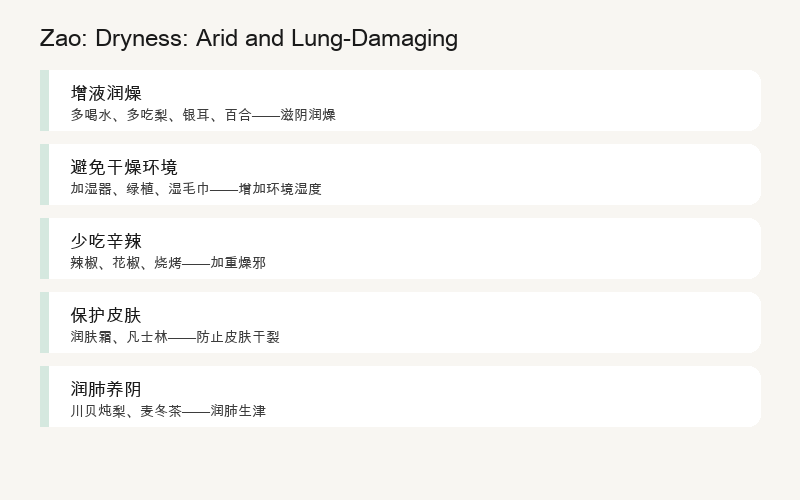
• Environmental humidification (preventing external dryness evil). In autumn and winter, indoor humidity is best maintained at 40-60%. Use a humidifier, or place wet towels or water basins on the radiator. Use a humidifier or place a basin of water in air-conditioned rooms. It's not "being fussy," but a necessary condition for maintaining mucous barrier function. Note: change the humidifier water daily and clean it weekly to prevent bacterial growth.
• Dietary moistening (generating internal body fluids). For warm dryness (early autumn, dry mouth and sore throat): eat pears, lilies, tremella mushrooms, lotus roots, water chestnuts, honey — cool and moistening, generating body fluids. For cool dryness (late autumn, nasal congestion and clear nasal discharge): eat almonds, sesame seeds, walnuts, glutinous rice porridge, perilla leaves — warm and moistening, dispelling cold. In daily life, eat more foods rich in mucilage (Chinese yam, wood ear mushrooms, okra) — mucilage can form a protective film in the digestive tract, locking in water. It's not "eating supplements," but using food to replenish and lock in body fluids.
• Skin moisturizing (repairing the barrier). Don't make bath water too hot (not exceeding 40°C), and don't bathe for more than 15 minutes — hot water and prolonged soaking destroy the sebum film. Apply moisturizer within 3 minutes after bathing (when the stratum corneum water content is highest, the locking effect is best). Choose a moisturizer containing ceramides, cholesterol, and fatty acids — these are components of the lipids between stratum corneum cells and can repair the barrier. It's not "applying more oil," but precisely replenishing the lipids missing from the skin barrier.
• Respiratory protection (protecting the lungs and preventing dryness). Wear a mask when going out in autumn and winter — it keeps you warm and moist, reducing the direct stimulation of dry cold air on the respiratory tract. Drink a glass of warm water in the morning (not ice water) — it wakes up the digestive tract and replenishes the water lost overnight. Use saline spray or nasal rinse — keep the nasal cavity moist and enhance the nasal filtering function. It's not "being delicate," but adding a layer of protection to the respiratory mucous membrane.
• Internal dryness regulation (elderly / yin deficiency constitution). For elderly constipation: increase dietary fiber (oats, sweet potatoes, vegetables) + moderate exercise + develop a regular bowel habit. Use laxatives under medical guidance if necessary. For yin deficiency constitution (long-term dry mouth, dry eyes, dry skin): TCM pattern differentiation and yin nourishment, commonly using ophiopogon, adenophora, polygonatum, and dendrobium. But it needs to be used under the guidance of a professional physician, don't self-supplement. It's not "eating supplements will do," but identifying the constitution and applying targeted regulation.
These methods don't require you to become a TCM doctor. You just need to understand: dryness is a malfunction of the "lubrication system" — either the environment is too dry, or the body's ability to lock in water is too poor. External defense (humidification), internal conservation (water locking), and repair (barrier) — tackle it from three directions.
Part 6 (continued)Practical Methods: Five Tricks to Prevent and Moisturize Dryness
Part 7One-Minute Summary
🕐 Understand "Dryness" in One Minute
Dryness = low-humidity environment + damaged mucous barrier + inflammatory response.
Dryness is not simply "being dry." It is one of the external Six Excesses, characterized by consuming body fluids, and most easily damaging the lungs.
External dryness: environmental humidity below 40% → mucous water evaporation → barrier function decline → pathogens easily invade.
Internal dryness: insufficient body fluids internally (yin deficiency, old age, chronic consumption) → reduced glandular secretion → cellular dehydration.
Warm dryness = dryness + heat (early autumn: dry mouth, sore throat, yellow phlegm); Cool dryness = dryness + cold (late autumn: nasal congestion, clear nasal discharge, white phlegm).
The lung is a delicate organ, liking moisture and disliking dryness = respiratory mucous membranes need a moist environment to maintain ciliary clearance function.
When dryness prevails, dryness results = low humidity → skin/mucous membrane barrier damage → inflammatory response.
Misconceptions: dryness means lack of water (not drinking enough); moistening dryness means nourishing yin (not distinguishing between heat and cold).
Methods: environmental humidification (40-60%), dietary moistening (distinguish between warm and cool), skin moisturizing (repair barrier), respiratory protection (wear masks, saline nasal rinse), internal dryness regulation (identify constitution).
The ancients called it "dryness evil damaging body fluids." Modern people call it "low humidity damaging the mucous barrier."
Different names, but medicine knows: moisture is the底色 of life, and dryness is the breeding ground for disease.
The ancients didn't have hygrometers, but they knew to "moisten dryness and protect the lungs in autumn and winter."
This is probably the most朴素的 wisdom of the Chinese people: adapt to nature and protect the most vulnerable membrane of the body.

Making money is the art of living; art is life after making money
giaogiao Decodes Chinese Traditional Wisdom · Concept 85
Using the language of modern science to help the world understand Chinese traditional wisdom.
No mysticism, no superstition, no belittlement.
Understand, rather than merely believe.
Coach Liu
Written in Florence