Fire (huǒ) — Fire Evil: Flaming Upward, Scorching Body Fluids
Part 1One Question
Have you ever noticed that after every hot pot or barbecue meal, the next day brings mouth ulcers, swollen gums, dry stools, and dark yellow urine?
Have you realized that "getting fire" is not a whole-body fever, but local "fire breaking out" — mouth sores, red eyes, sore throat, acne on the face, with all symptoms concentrated in the upper body? Even more absurdly, you eat a lot of "cold" things (ice cream, cold drinks), the fire doesn't go down, but your stomach hurts instead?
You ask: If "fire" is heat, does fever count as fire? Why do some people have hot palms and soles, night sweats, but normal body temperature, yet Chinese Medicine also says this is "fire"? Why do some people have acne all over their face, bad breath and constipation, which is "fire"; while others have dry mouth and throat, tidal fever and red cheeks, which is also "fire"? Two completely different manifestations, how can both be fire?
And another question: Why does Chinese Medicine say "extreme emotions can all transform into fire" — anger, overthinking, worry, fear, and great joy can all become "fire"? How do emotions turn into fire? Why does Western medicine say stress causes inflammation, while Chinese Medicine says "qi stagnation transforming into fire" — is this the same thing?
What exactly is fire? Why did the ancients say "fire nature flames upward," why not "fire nature flames downward"? What's the difference between fire and heat?
Part 2Traditional Chinese Explanation
The concept of "fire" (huǒ) in Chinese Medicine belongs to the "Six Excesses" (wind, cold, summer heat, dampness, dryness, fire), but fire is somewhat special — it is both one of the external Six Excesses and one of the "Five Movements" (wood, fire, earth, metal, water), and also the extreme expression of the body's "yang qi." The ancients said: "Fire is the extreme of heat; heat is the gradual development of fire" — fire is the upgraded version of heat, more intense, more concentrated, and more destructive.
—— Suwen · Yin-Yang Yingxiang Dalun (Basic Questions · The Great Treatise on the Correspondence of Yin and Yang)
"All pain, itching, and sores belong to the heart."
—— Suwen · Zhizhen Yao Dalun (Basic Questions · The Great Treatise on the Essential Truth)
"Extreme emotions can all transform into fire."
—— Linzheng Zhinan Yian (Clinical Guide Medical Cases)
"Excess fire can be purged; deficiency fire can be nourished."
—— Jingyue Quanshu (Jingyue's Complete Works)
The ancients observed that there is a kind of "upward" pathogenic factor in the body — symptoms are concentrated in the head and face (mouth, tongue, throat, eyes, skin), characterized by redness, swelling, heat, and pain, like fire burning upward. This "fire" can not only consume body fluids (scorching fluids), but also stir blood, generate wind, and cause sores.
Fire nature flames upward, easily disturbing the heart spirit. Fire's characteristic is "upward" — like flames burning upward. Fire evil diseases have symptoms concentrated in the upper part of the body (head, face, mouth, tongue, throat). Fire also easily disturbs the heart spirit, causing restlessness, insomnia, agitation, and even mania.
Fire easily damages body fluids and consumes qi. Fire is like a furnace, "baking dry" the body fluids — causing thirst, dry throat, constipation, and dark yellow urine. When severe, fire evil can also "recklessly drive blood to flow," causing bleeding (vomiting blood, nosebleeds, blood in urine, blood in stool).
Fire easily generates wind and stirs blood. When fire evil is too strong, it "generates wind from extreme heat" — causing convulsions, spasms, and opisthotonus (like febrile seizures). Fire evil can also scorch blood vessels, causing various bleeding.
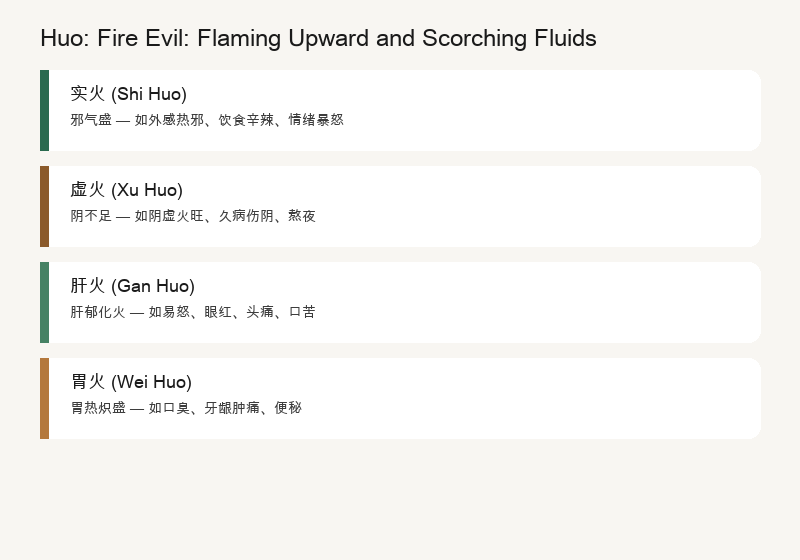
Excess fire and deficiency fire. Excess fire is "surplus fire" — caused by external heat, spicy diet, or emotional rage. It comes on suddenly, with severe symptoms and short duration, requiring "purging" (clearing heat and detoxifying). Deficiency fire is "insufficient fire" — yin deficiency cannot restrain yang, and yang qi is relatively hyperactive, like a lamp running out of oil, the flame flickering unstable. It comes on slowly, with lingering symptoms and long duration, requiring "nourishing" (nourishing yin and reducing fire).
So, what the ancients called "fire" is not just "heat" — it is a pathogenic factor that is "upward, burning, fluid-consuming, and blood-damaging," divided into excess fire (surplus) and deficiency fire (insufficiency).
But fire has another source: emotions transforming into fire. Extreme emotions (anger, joy, overthinking, worry, fear) can be transformed into internal "fire" — anger damages the liver, joy damages the heart, overthinking damages the spleen, worry damages the lungs, fear damages the kidneys. When emotions are extreme, they stagnate and transform into fire. This is the earliest "psychosomatic medicine" — emotions directly affect the body's "inflammatory state."
Part 3giaogiao Modern Translation
Okay, now let's translate "fire" (fire evil) into modern language.
I don't plan to talk about complex immunology and pathology. You just need to remember one analogy:
Excess fire = acute inflammatory response (infection, trauma, immune response) → local vasodilation (redness) + increased vascular permeability (swelling) + accelerated metabolism (heat) + nerve stimulation (pain) + functional disorder
Deficiency fire = chronic inflammation/metabolic disorder (low-grade inflammation, hormonal fluctuation, neuroendocrine disorder) → persistent low-grade cytokine release → local abnormal vasomotion → hot flashes, night sweats, dry mouth, restlessness
Fire nature flaming upward = inflammatory response concentrated in the head and face (mouth, throat, eyes, skin) → gravity + blood flow distribution + mucosal exposure → symptoms are "upwardly" concentrated
Scorching body fluids = inflammation causes metabolic hyperactivity + water evaporation + tissue damage → thirst, constipation, dark urine, dry mucous membranes
Recklessly driving blood to flow = severe inflammation damages vascular endothelium → increased permeability → bleeding
Generating wind = high fever/inflammation affects the central nervous system → abnormal nerve excitability → convulsions, spasms
Emotions transforming into fire = chronic stress → hypothalamic-pituitary-adrenal axis (HPA axis) continuous activation → elevated cortisol → immune disorder → low-grade inflammation → various "getting fire" symptoms
Fire = the body's "red alert system" — acute inflammation is "big fire" (excess fire), chronic inflammation is "dark fire" (deficiency fire)
That's it. "Fire" (fire evil), in essence, is the body's inflammatory response — from the "raging fire" of acute inflammation to the "dark fire scorching" of chronic inflammation.
Specifically:
What does "excess fire" correspond to? It corresponds to acute inflammatory response. When you're infected by bacteria or viruses, or eat a lot of spicy stimulating food, or are in a rage — the body initiates an acute inflammatory response: local vasodilation (redness), increased vascular permeability (swelling), accelerated metabolism (heat), nerve ending stimulation (pain), and impaired tissue function (functional disorder). This is what Chinese Medicine calls "excess fire" — it comes on suddenly, with severe symptoms, and requires "purging fire" (anti-inflammatory, anti-infection, removing the stimulus). It's not the mysticism of "heat toxin," but the pathophysiology of acute inflammation. Modern research: during acute inflammation, large amounts of cytokines (IL-1, IL-6, TNF-α) are released, causing systemic inflammatory response.
What does "deficiency fire" correspond to? It corresponds to chronic inflammation or metabolic disorder. When you stay up late chronically, are under stress, have menopausal hormonal fluctuations, or chronic disease consumption — the body is in a state of low-grade inflammation: cytokines are continuously released at low levels, metabolic rate is mildly elevated, and vasomotion is abnormal. This is what Chinese Medicine calls "deficiency fire" — it comes on slowly, with lingering symptoms, and requires "nourishing yin" (repairing, regulating, supplementing). It's not the mysticism of "yin deficiency with vigorous fire," but chronic inflammation and neuroendocrine regulatory disorder. Modern research: chronic inflammation is closely related to diabetes, cardiovascular disease, depression, and autoimmune diseases — C-reactive protein (CRP) is the marker.
What does "fire nature flaming upward" correspond to? It corresponds to the distribution characteristics of inflammatory response. The head and face (mouth, throat, eyes, skin) are the most exposed areas of the body, with the richest nerve and blood vessel distribution, most susceptible to stimulation and infection. Inflammatory response is concentrated in these areas, and with gravity causing blood to distribute upward when standing, the symptoms of "fire" appear to be "upward." It's not the mysticism of "flames go upward," but the physiology of anatomy + blood flow distribution + exposure frequency.
What does "emotions transforming into fire" correspond to? It corresponds to the relationship between chronic stress and inflammation. Modern psychoneuroimmunology confirms: chronic stress activates the HPA axis, cortisol is chronically elevated, leading to immune system disorder and continuous release of pro-inflammatory cytokines (IL-6, TNF-α) — this is the scientific mechanism of "stress causing inflammation." Anger, anxiety, and depression are all chronic stress, and they all "transform into fire." It's not the mysticism of "emotions turning into fire," but the precise mechanism of psychoneuroimmunology.
So, "fire" is not mysticism. It is simply the body's inflammatory response — acute inflammation is "excess fire," chronic inflammation is "deficiency fire," and emotional stress is "transforming into fire" — the ancients described it as "flaming upward, scorching fluids, generating wind, and stirring blood," while modern people describe it as "inflammation, metabolism, cytokines, and vascular permeability" — the core logic is consistent: fire is the body's "red alert system."
Part 4Real-life Cases
Four stories to make you instantly understand what "fire" (fire evil) is.
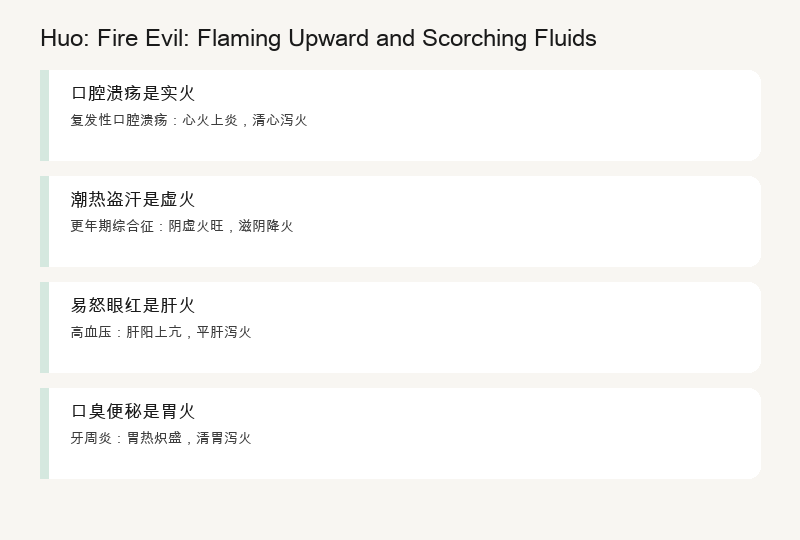
Case One: Mouth ulcers after staying up late (excess fire: acute inflammation).
You sleep at 2 a.m. for three consecutive days, and on the fourth morning, three ulcers grow in your mouth, hurting so much you can't eat, and drinking cold water feels painful. You ask: "Why does staying up late 'get fire'?"
Truth: This is an acute inflammatory response. Sleep deprivation leads to immune system dysfunction, the oral mucosal immune barrier is damaged, latent viruses (such as herpes simplex virus) or bacteria take the opportunity to become active, and local immune cells release large amounts of inflammatory factors (IL-1, IL-6, TNF-α), causing vasodilation, tissue edema, and nerve ending stimulation — redness, swelling, heat, and pain. The "fire" you feel is the "chemical storm" of local acute inflammation. It's not the mysticism of "staying up late damages yin," but the science of sleep deprivation → immune disorder → acute inflammation. Modern research: sleeping less than 6 hours continuously increases oral inflammatory markers by more than 40%, with significantly increased infection risk.
Case Two: Menopausal hot flashes and night sweats (deficiency fire: hormonal fluctuation causing abnormal vasomotion).
Your mother is fifty years old. Suddenly, a wave of heat rushes from her chest to her face, she's drenched in sweat, lasting several minutes, happening several times a day, worse at night. Her body temperature is normal, but she says "it feels like there's a ball of fire inside my body." You ask: "She doesn't have a fever, why does she feel hot?"
Truth: This is "deficiency fire" — estrogen level fluctuations cause hypothalamic thermoregulatory center disorder. When estrogen declines, it affects the balance of serotonin and norepinephrine, causing the thermoregulatory center's "set point" to become unstable — the body mistakenly thinks it's overheating and initiates heat dissipation response (vasodilation, sweating). This is "hot flashes." It's not the mysticism of "yin deficiency with vigorous fire," but the endocrinology of hormonal fluctuation → neurotransmitter imbalance → thermoregulatory disorder. Modern research: about 75% of menopausal women experience hot flashes, which is the direct result of estrogen withdrawal causing functional changes in arcuate nucleus neurons in the hypothalamus.
Case Three: Blood pressure spikes and splitting headache after anger (emotions transforming into fire: stress response).
You had an argument with someone, your face is red and your neck is swollen with anger, your temples are throbbing, your blood pressure spikes from 120 to 160, you can't sleep at night, and the next day you have blisters in your mouth. You ask: "Why does anger make you 'fire shooting up to the head'?"
Truth: This is an acute stress response — the "fight or flight" response. Anger activates the sympathetic nervous system, releasing large amounts of adrenaline and norepinephrine, causing accelerated heart rate, vasoconstriction, and elevated blood pressure; simultaneously, cortisol rises and pro-inflammatory cytokines are released. The "fire" you feel is stress hormones + inflammatory factors "burning" in your blood vessels. It's not the mysticism of "anger damages the liver and transforms into fire," but the physiology of acute stress → sympathetic excitation → inflammatory response. Modern research: one intense anger episode increases myocardial infarction risk by 4.7 times and stroke risk by 3.6 times — "fire" can really be fatal.
Case Four: Long-term spicy food causing acne (diet-induced chronic inflammation).
You love spicy hot pot, barbecue, and fried chicken. Your face and back have acne year-round, one after another. After avoiding spicy food for two weeks, the acne is half gone. You ask: "Why does eating spicy food cause acne?"
Truth: This is diet-induced inflammatory response. High-sugar, high-fat, and spicy food rapidly elevates blood sugar and insulin, activating the IGF-1 signaling pathway, stimulating sebaceous gland secretion; simultaneously promoting inflammatory factor release, causing chronic inflammation around hair follicles. Capsaicin in chili peppers doesn't directly cause acne, but it dilates blood vessels and stimulates nerve endings, worsening the redness and pain of inflammation. It's not the mysticism of "damp-heat rising upward," but the endocrinology of diet → insulin/IGF-1 → sebum secretion + inflammatory response. Modern research: high-glycemic-index diet is significantly positively correlated with acne severity; anti-inflammatory diet (low GI, high Omega-3) can reduce acne by 30-50%.
Four cases, one underlying logic: fire is the body's "inflammation alarm" — acute inflammation is "big fire" (excess fire), chronic inflammation is "dark fire" (deficiency fire), and emotional stress is "heart fire" (stress response). It's not that the body really has "fire" burning, but the immune system and nervous system are issuing red alerts.
Part 5Modern Research
Is there scientific research on "fire" (fire evil)?
Yes, and it's very thorough. Scientists don't use the term "fire evil scorching body fluids." They use "inflammation and immune response":
• The five characteristics of inflammation and their correspondence to "fire." In 1858, German pathologist Rudolf Virchow proposed the five characteristics of inflammation: redness (Rubor), swelling (Tumor), heat (Calor), pain (Dolor), and loss of function (Functio Laesa). These five characteristics almost perfectly correspond to the symptoms of "fire" in Chinese Medicine: redness = fire color, swelling = fire gathering, heat = fire nature, pain = fire scorching, loss of function = fire disturbance. It's not "coincidence," but the ancients observing the clinical manifestations of inflammation and precisely describing them with the vivid concept of "fire." Modern research: The core mechanism of inflammation is immune cells releasing cytokines (IL-1, IL-6, TNF-α), leading to vasodilation, increased permeability, and leukocyte infiltration — this is the molecular biology essence of "fire."
• Low-grade inflammation and chronic diseases (deficiency fire). Modern chronic pathology has found that obesity, diabetes, cardiovascular disease, depression, and Alzheimer's disease are all closely related to "low-grade chronic inflammation." C-reactive protein (CRP) is mildly elevated in the blood, and IL-6 is continuously released at low levels — the body has no obvious "big fire," but "dark fire" is always burning. This is the scientific basis for "deficiency fire" in Chinese Medicine: it's not pathogen invasion, but metabolic disorder, oxidative stress, and cellular damage leading to chronic inflammation. Modern research: chronic inflammation is called "the common soil of chronic diseases;" controlling inflammation is the core strategy for preventing and treating chronic diseases.
• Dietary Inflammatory Index (DII) and "getting fire." Scientists have developed the "Dietary Inflammatory Index" to quantify the impact of different foods on inflammation. Pro-inflammatory foods: red meat, refined sugar, trans fats, alcohol, excess Omega-6 vegetable oils — corresponding to what Chinese Medicine calls "spicy and rich foods generating fire." Anti-inflammatory foods: deep-sea fish, leafy greens, berries, nuts, olive oil, turmeric — corresponding to what Chinese Medicine calls "clearing heat and reducing fire." It's not "food temperature" mysticism, but the precise regulation of food components on cytokine release. Modern research: adhering to an anti-inflammatory diet can reduce inflammatory marker CRP by 20-30%, significantly lowering chronic disease risk.
• Psychoneuroimmunology and "emotions transforming into fire." In the 1990s, scientists discovered that the brain and immune system communicate directly through the neuro-endocrine-immune network. Chronic stress activates the HPA axis, cortisol is chronically elevated, leading to immune suppression + inflammation imbalance; simultaneously, the sympathetic nervous system is continuously activated, releasing norepinephrine, which directly stimulates immune cells to release inflammatory factors. This is the complete pathway of "stress causing inflammation." It's not "emotions turning into fire" mysticism, but the precise mechanism of psychoneuroimmunology. Modern research: people with long-term depression and anxiety have significantly higher blood IL-6 and CRP levels than normal people, with 2-3 times increased cardiovascular disease risk.
These studies fully demonstrate that "fire" is a concept that can be precisely described in modern scientific language. The ancients described it as "flaming upward, scorching body fluids, excess fire, and deficiency fire." Modern people describe it as "inflammation, cytokines, metabolic hyperactivity, and vascular permeability" — the core logic is consistent: fire is the body's red alert system.
Part 6Practical Methods
Now that you understand "fire" (fire evil), how do you extinguish it?
First, dispel a few misconceptions:
• "Getting fire means taking anti-inflammatory drugs." Anti-inflammatory drugs (antibiotics) are only effective against bacterial infections, and are ineffective against viral "fire," emotional "fire," or hormonal "fire." Abusing antibiotics also destroys gut flora, causing more problems. It's not "extinguish fire whenever there's fire," but identify the fire source and treat it accordingly.
• "Deficiency fire also needs clearing heat and purging fire." Excess fire can be "purged" (anti-inflammatory, removing the stimulus), but deficiency fire cannot be randomly purged — purging fire further damages healthy qi, the more you purge, the more deficient you become. Deficiency fire needs "nourishing" (nourishing yin, repairing, regulating). It's not "extinguish fire whenever you see fire," but excess fire can be purged, deficiency fire should be nourished.
Specific methods:
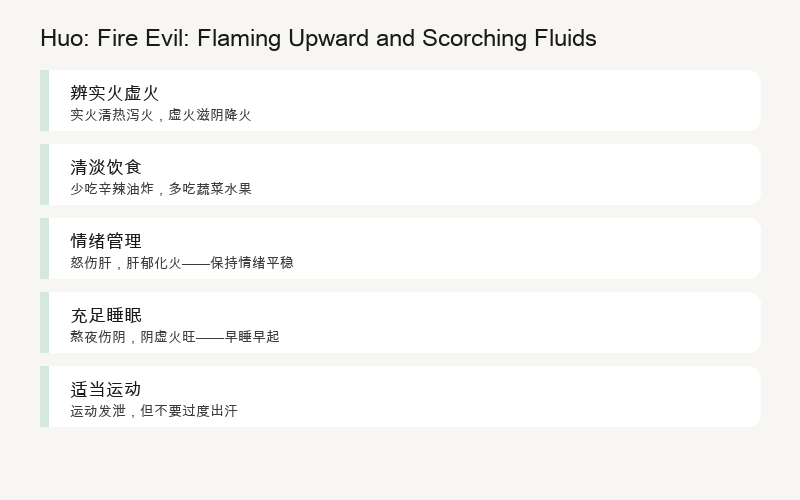
• Excess fire: remove the stimulus + anti-inflammatory (extinguish fire). For diet-induced fire (spicy, fried, alcohol): stop the stimulus, drink more water, eat a light diet, and supplement dietary fiber (helping the intestines expel toxins). For infection-induced fire (oral inflammation, pharyngitis, tonsillitis): use antibiotics or antiviral drugs under medical guidance, and use local anti-inflammatory mouthwash. For emotion-induced fire (rage, anxiety): deep breathing, leave the stimulating environment, exercise to release — interrupt the "fight or flight" response. It's not "clearing heat and detoxifying with Chinese medicine," but finding the fire source and precisely extinguishing it.
• Deficiency fire: nourish yin and repair + regulate metabolism (regulate fire). For menopausal hot flashes: hormone replacement therapy (HRT) must be conducted under medical guidance; non-drug methods: regular exercise, weight control, avoiding spicy and stimulating foods, wearing multiple layers for easy adjustment. For chronic fatigue + low-grade fever: check chronic inflammation markers (CRP, IL-6, TNF-α); adjust lifestyle (sleep, stress reduction, anti-inflammatory diet); if necessary, nourish yin under TCM guidance (ophiopogon, raw rehmannia, anemarrhena, etc.). For long-term dry mouth and eyes: check for Sjögren's syndrome, diabetes, thyroid function; increase water intake, use artificial tears and saliva substitutes. It's not "eating supplements will do," but identify the deficiency fire source and regulate accordingly.
• Anti-inflammatory diet (prevent fire from starting). Eat more Omega-3 fatty acids (deep-sea fish, flaxseed, walnuts) — inhibit pro-inflammatory cytokines. Eat more polyphenols (green tea, blueberries, dark chocolate, turmeric) — antioxidant and anti-inflammatory. Eat more dietary fiber (whole grains, vegetables, legumes) — feed gut probiotics, producing short-chain fatty acids (anti-inflammatory substances). Eat less pro-inflammatory foods: red meat, processed meat, refined sugar, trans fats, excess alcohol, excess Omega-6 vegetable oils (corn oil, soybean oil). It's not "eating cold foods to reduce fire," but using scientifically proven anti-inflammatory ingredients to lower the body's inflammation baseline.
• Emotion management (prevent emotions from transforming into fire). Chronic stress is the main source of "transforming into fire." Meditate 10-15 minutes daily — lower cortisol levels. Exercise regularly (150 minutes of moderate intensity per week) — release stress, promote anti-inflammatory factor release. Ensure sleep (7-9 hours) — sleep is the key time for immune system repair. Build a social support system — loneliness and social isolation elevate inflammatory markers. It's not "self-cultivation" mysticism, but the scientific application of psychoneuroimmunology.
• Regular routine (prevent staying up late from generating fire). Staying up late is the number one cause of modern people "getting fire." Fixed bedtime (recommended before 23:00). Stay away from electronic screens 1 hour before bed (blue light suppresses melatonin, affecting sleep quality and immune repair). Keep bedroom temperature at 18-20°C (comfortable temperature promotes deep sleep). Avoid large meals and alcohol before bed (affects sleep structure). It's not the slogan of "early to bed and early to rise makes a healthy man," but letting the immune system repair normally at night to prevent inflammation from getting out of control.
These methods don't require you to become a doctor. You just need to understand: fire is the body's inflammation alarm — excess fire needs to be "extinguished" (removing the stimulus), deficiency fire needs to be "regulated" (repairing and regulating), and daily life needs "prevention" (anti-inflammatory diet + regular routine + emotion management).
Part 6 (continued)Practical Methods: Five Tricks to Extinguish and Prevent Fire
Part 7One-Minute Summary
🕐 Understand "Fire" in One Minute
Fire = inflammatory response + metabolic hyperactivity + tissue damage.
Fire is not really fire burning; it's the ancients' vivid description of the inflammatory response.
Excess fire = acute inflammation (infection, trauma, dietary stimulation, emotional rage) → redness, swelling, heat, pain, loss of function.
Deficiency fire = chronic inflammation/metabolic disorder (low-grade inflammation, hormonal fluctuation, yin deficiency) → hot flashes, night sweats, dry mouth, restlessness.
Emotions transforming into fire = chronic stress → HPA axis activation → elevated cortisol → immune disorder → inflammation.
Fire flaming upward = inflammatory response concentrated in the head and face (mouth, throat, eyes, skin) → anatomy + blood flow + exposure.
Scorching body fluids = metabolic hyperactivity + water evaporation + tissue damage → thirst, constipation, dark urine.
Generating wind = high fever/inflammation affecting the central nervous system → abnormal nerve excitability → convulsions.
Forcing blood to flow recklessly = severe inflammation damaging vascular endothelium → bleeding.
Misconceptions: getting fire means taking anti-inflammatory drugs (antibiotic abuse); deficiency fire also needs clearing heat and purging fire (the more you purge, the more deficient you become).
Methods: excess fire extinguishing (remove stimulus + anti-inflammatory), deficiency fire regulation (nourish yin and repair + regulate metabolism), daily fire prevention (anti-inflammatory diet + regular routine + emotion management).
The ancients called it "fire evil flaming upward," modern people call it "inflammatory response."
Different names, but medicine knows: fire is the body's red alert. When you hear the alarm, first find the source, then extinguish the fire.
Excess fire can be purged, deficiency fire should be nourished, emotions transforming into fire require a calm mind.
This is probably the most朴素 wisdom of the Chinese people: the body's alarm is not the enemy, but a guide — it tells you where needs repair.
Making money is the art of living; art is life after making money
giaogiao Decodes Chinese Traditional Wisdom · Concept 86
Using the language of modern science to help the world understand Chinese traditional wisdom.
No mysticism, no superstition, no belittlement.
Understand, rather than merely believe.
Coach Liu
Written in Florence