Mián (Sleep): The Alternation of Yin and Yang
Part 1A Question
Have you ever noticed that the quality of your sleep isn't just about "getting enough hours"—it determines whether you can work efficiently the next day, whether you have any creativity left, and even whether you snap at people for no reason?
Have you ever noticed that sometimes you sleep eight hours but wake up feeling like you've been run over by a truck; other times you only sleep five hours and feel refreshed? Even more mind-blowing: modern medicine talks about "REM sleep," "melatonin," "circadian rhythm genes," and "sleep apnea," while TCM says "sleep is the alternation of yin and yang"—and they're actually talking about the same thing. Sleep is the body's self-repair switch?
You ask: What exactly is "mián" in TCM? Is it rest, or is it the body's repair program? Is it "lying flat," or is it "the alternation of yin and yang"? If "mián" is a real physiological rhythm, why doesn't Western medicine have a "sleep regulation" department—instead, they talk about "sleep medicine," "sleeping pills," and "cognitive behavioral therapy"?
Here's another question: Why do some people fall asleep the moment their head hits the pillow, while others toss and turn for hours? Why do some people sleep through the night, while others wake up three times? Why does sleeping in after staying up late actually make you feel more tired? Is it a difference in constitution, or is it a difference in the ability to "alternate between yin and yang"?
What is mián, really? Is it the ancients' naive observation of "sleeping," or is it a physiological rhythm that can be precisely defined by modern science?
Part 2The Traditional Chinese Explanation
The concept of "mián" has a long history in TCM. It's not just a "resting behavior"—it's an "alternation of yin and yang," with the core being "the balanced expression of organ function."
—The Yellow Emperor's Inner Canon, Spiritual Pivot
"The defensive qi circulates through the yang during the day and through the yin at night. Therefore, when yang qi is exhausted, one lies down; when yin qi is exhausted, one wakes up."
—The Yellow Emperor's Inner Canon, Spiritual Pivot: Oral Questions
"When a person lies down, blood returns to the liver. The liver receives blood and can see; the feet receive blood and can walk; the palms receive blood and can grasp; the fingers receive blood and can hold."
—The Yellow Emperor's Inner Canon, Plain Questions: The Generation of the Five Viscera
The ancients observed that sleep is the alternation of yin and yang—yang is abundant during the day, so we are awake; yin is abundant at night, so we sleep. The balance of organ function determines the quality of sleep. This state is called "mián."
Mián = the alternation of yin and yang = the balance of organ function. What TCM calls "mián" includes:
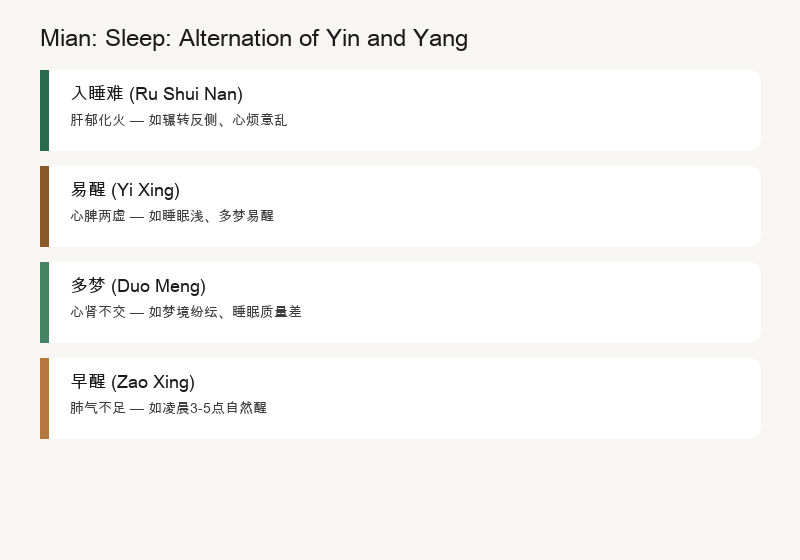
Insomnia: Yang fails to enter yin, the spirit of the heart is restless. Specifically divided into:
• Difficulty falling asleep: Liver qi stagnation transforms into fire, disturbing the heart spirit—manifested as lying in bed with a mind racing like a movie, emotional irritability, and rib-side distension.
• Easy to wake up: Heart and spleen deficiency, blood fails to nourish the spirit—manifested as shallow sleep, waking up at the slightest noise, difficulty falling back asleep after waking, and a sallow complexion.
• Excessive dreaming: Heart and kidney fail to communicate, deficient fire disturbs the heart—manifested as a whole night of vivid dreams, waking up exhausted, heart palpitations, forgetfulness, and weak sore lower back and knees.
• Waking up early: Lung qi deficiency, the yin period (3-5 AM) is when it's in charge—manifested as waking up at 3-5 AM without being able to fall back asleep.
Excessive sleepiness: Yin is abundant while yang is weak, the spirit is sluggish. Specifically divided into:
• Phlegm-dampness trapping the spleen: Drowsy and sleepy, head heavy as if wrapped, body heavy and sluggish, thick greasy tongue coating—spleen deficiency generates dampness, dampness accumulates into phlegm, obscuring clear yang.
• Yang deficiency: Aversion to cold and drowsiness, low spirit, cold extremities, prefers quiet and dislikes movement—life-gate fire declines, yang qi is sluggish.
So, what the ancients called "mián" is not just "sleeping"—it's the comprehensive expression of "the alternation of yin and yang, organ function, and the state of the spirit." It can be an emotional issue (liver qi stagnation transforming into fire), a nutritional issue (heart and spleen deficiency), or an energy metabolism issue (yang deficiency, phlegm-dampness)—the core is whether yin and yang can smoothly alternate.
But TCM has a core principle: Mián is inseparable from the spirit; the heart governs the spirit of the mind. In TCM theory, the heart governs the "spirit of the mind"—it commands consciousness, mental activity, and sleep. When the heart spirit is nourished, it is at peace; when the heart spirit is disturbed, sleep is disrupted. So "regulating sleep" first requires "nourishing the heart and calming the spirit"—not simply "taking some sleeping pills," but soothing the liver and regulating qi + tonifying the heart and spleen + harmonizing the heart and kidney + regulating lifestyle.
Part 3giaogiao's Modern Translation
Okay, now let's translate "mián" into modern language.
I'm not going to talk about polysomnography or circadian rhythm genes. Too complicated. You just need to remember one analogy:
Sleep cycle = NREM (non-rapid eye movement) + REM (rapid eye movement)
NREM deep sleep = physical repair (growth hormone secretion, protein synthesis, tissue repair)
REM sleep = brain repair (memory consolidation, emotional processing, synaptic remodeling)
Difficulty falling asleep = excessive sympathetic nerve excitement + HPA axis activation + elevated cortisol + delayed melatonin secretion (corresponds to "liver qi stagnation transforming into fire")
Easy to wake up = fragmented sleep structure + lowered arousal threshold + reduced slow-wave sleep (corresponds to "heart and spleen deficiency"—neurotransmitter/nutrient deficiency)
Excessive dreaming = abnormal REM sleep proportion + hyperactive amygdala + enhanced emotional memory processing (corresponds to "heart and kidney fail to communicate"—limbic system-hypothalamus imbalance)
Waking up early = advanced circadian rhythm + premature cortisol awakening response + insufficient sleep pressure (corresponds to "lung qi deficiency"—biological clock regulation abnormality)
Excessive sleepiness (phlegm-dampness trapping the spleen) = obstructive sleep apnea (OSA) + excessive but poor-quality slow-wave sleep + elevated inflammatory factors (TNF-α, IL-6) (corresponds to "phlegm-dampness trapping the spleen"—hypoxia + metabolic disorder)
Excessive sleepiness (yang deficiency) = hypothyroidism + reduced metabolic rate + abnormal temperature regulation (corresponds to "yang deficiency"—low energy metabolism)
Regulating sleep = regulating the circadian rhythm (light management) + balancing the autonomic nervous system (relaxation training) + repairing sleep structure (sleep restriction + stimulus control) + improving the sleep environment (temperature/sound/light)
That's it. "Mián," in essence, is the alternation of yin and yang—the rhythmic repair process of the neuro-endocrine-immune system.
Specifically:
What does "difficulty falling asleep" correspond to? It corresponds to "excessive sympathetic nerve excitement + HPA axis activation + delayed melatonin secretion." When you're under long-term stress or use blue-light devices (phones/computers) before bed, the HPA axis stays activated, cortisol and adrenaline are elevated, inhibiting the pineal gland's secretion of melatonin. At the same time, the brain is in "fight or flight" mode and can't switch to "rest and digest" mode. Manifested as lying in bed with a mind racing like a movie, heart racing, irritability. It's not the mysticism of "liver qi stagnation transforming into fire"—it's an imbalance between excitation and inhibition in the neuroendocrine system. Modern research: using blue-light devices for 2 hours before bed can delay melatonin secretion by 1.5-3 hours, extending average sleep onset time by 20 minutes.
What does "easy to wake up" correspond to? It corresponds to "fragmented sleep structure + lowered arousal threshold + reduced slow-wave sleep." When you're undernourished (lacking tryptophan, B vitamins, magnesium), anxious, or in pain, your sleep is shallow and you are easily awakened by slight stimuli. Slow-wave sleep (deep sleep) is the key stage for physical repair; a reduction in slow-wave sleep means insufficient repair. It's not the mysticism of "heart and spleen deficiency"—it's fragmentation of sleep structure. Modern research: the proportion of slow-wave sleep drops from 20% of total sleep time at age 20 to 5% at age 60, which is why older people are more likely to "wake up easily."
What does "excessive dreaming" correspond to? It corresponds to "abnormal REM sleep proportion + hyperactive amygdala + enhanced emotional memory processing." REM sleep is responsible for the processing and integration of emotional memories. When the REM proportion is abnormal or the amygdala (the emotional center) is hyperactive, dreams increase and become more emotionally intense. Anxiety, depression, and post-traumatic stress disorder (PTSD) patients often have excessive dreams. It's not the mysticism of "heart and kidney fail to communicate"—it's an imbalance in the interaction between the limbic system and the sleep network. Modern research: depressed patients have a shortened REM sleep latency (entering REM faster) and increased REM density, which is highly consistent with the symptom of "excessive dreaming."
What does "waking up early" correspond to? It corresponds to "advanced circadian rhythm + premature cortisol awakening response." As people age, the suprachiasmatic nucleus (SCN, the biological clock center) declines in function, melatonin secretion decreases and its phase advances. At the same time, the cortisol awakening response (CAR) comes earlier, leading to natural waking at 3-5 AM. It's not the mysticism of "lung qi deficiency"—it's age-related decline of the biological clock. Modern research: the peak melatonin secretion in people over 60 is 50% lower than in young people, and the phase advances by 1-2 hours, which is the core mechanism behind "older people waking up early."
What does "excessive sleepiness" correspond to? It corresponds to "obstructive sleep apnea (OSA) + hypoxia + elevated inflammatory factors" or "hypothyroidism + reduced metabolic rate." OSA patients repeatedly experience hypoxia at night, leading to fragmented sleep. Although their sleep duration is long, the quality is poor, and they feel drowsy during the day. People with hypothyroidism have a reduced basal metabolic rate and lower body temperature, leading to drowsiness. It's not the mysticism of "phlegm-dampness trapping the spleen" or "yang deficiency"—it's an objective障碍 in respiratory function and energy metabolism. Modern research: moderate-to-severe OSA patients have a daytime sleepiness score (ESS) 3-4 times higher than normal people, and hypothyroid patients can have a metabolic rate reduced by 30-40%.
So, "mián" is not mysticism. It's just the alternation of yin and yang—the rhythmic repair process of the neuro-endocrine-immune system. The ancients used "liver qi stagnation transforming into fire, heart and spleen deficiency, heart and kidney fail to communicate, lung qi deficiency, phlegm-dampness trapping the spleen, yang deficiency" to describe it; modern people use "HPA axis disorder, reduced slow-wave sleep, REM abnormality, advanced circadian rhythm, sleep apnea, hypothyroidism" to describe it—the core logic is consistent: when the alternation of yin and yang is not smooth, sleep is not deep.
Part 4Real-Life Stories
Four stories to help you instantly understand what "mián" is.
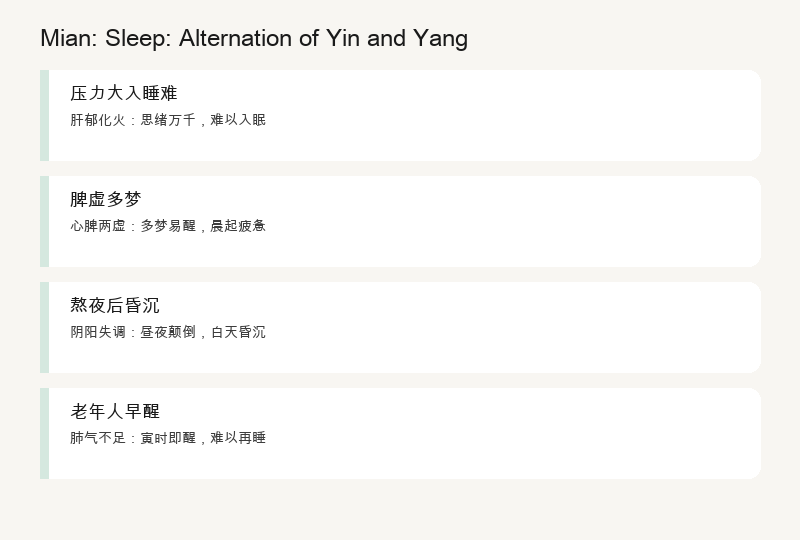
Story 1: Difficulty falling asleep due to stress.
You have an important presentation tomorrow. You lie in bed at 11 PM, your mind racing like a movie, repeatedly rehearsing your slides, heart racing, palms sweating, tossing and turning until 2 AM before you finally doze off. You ask: "Why can't I sleep when I'm stressed?"
The truth: This is a classic case of "liver qi stagnation transforming into fire"—HPA axis activation + sympathetic nerve excitement. Stress raises cortisol and adrenaline, inhibiting melatonin secretion; the prefrontal cortex stays active and can't enter relaxation mode. It's not "thinking too much"—it's the excited state of the neuroendocrine system that can't be turned off. Modern research: acute psychological stress can raise cortisol by 50% within 30 minutes and increase heart rate by 10-20 beats per minute, significantly delaying sleep onset latency.
Story 2: Spleen deficiency leading to excessive dreaming.
You're on a diet to lose weight, eating little at night, and busy with work during the day. As a result, you dream all night, the dreams are vivid, and you wake up exhausted, as if you've been running a marathon all night. You ask: "Why do I dream more when I eat less?"
The truth: This is a classic case of "heart and spleen deficiency"—insufficient nutrition leads to limited neurotransmitter synthesis. Tryptophan (a precursor to 5-HT) mainly comes from protein foods; dieting leads to insufficient tryptophan intake, affecting serotonin and melatonin synthesis; blood sugar fluctuations cause nocturnal hypoglycemia awakenings, further disrupting sleep structure. It's not "weakness"—it's insufficient raw materials leading to limited neurotransmitter synthesis. Modern research: a low-tryptophan diet can reduce brain 5-HT levels by 40% within 5 days, increasing REM sleep fragmentation by 25%.
Story 3: Grogginess after staying up late.
You pull an all-nighter gaming on the weekend, take Monday off to make up for sleep, sleep 12 hours, but wake up with a foggy head, as if stuffed with cotton. You ask: "Why am I still tired after catching up on sleep?"
The truth: This is a classic case of "phlegm-dampness trapping the spleen"—sleep deprivation + circadian rhythm disorder. Staying up all night leads to adenosine accumulation (a sleep pressure substance), elevated inflammatory factors (TNF-α, IL-6), and decreased cognitive function; blue light suppresses melatonin, leading to a delayed circadian rhythm phase. Although daytime catch-up sleep makes up for some sleep duration, it can't compensate for the disrupted sleep rhythm—the proportions of deep sleep and REM are disrupted. It's not "not enough sleep"—it's the rhythm is off, so the quality is poor. Modern research: 24 hours of continuous sleep deprivation results in cognitive performance equivalent to a blood alcohol concentration of 0.1% (drunk driving level).
Story 4: Older people waking up early.
Your mom is 60 years old and wakes up at 4 AM every day without being able to fall back asleep, then feels drowsy during the day. You ask: "Why do older people wake up so early?"
The truth: This is a classic case of "lung qi deficiency"—advanced circadian rhythm + reduced melatonin secretion. As people age, the number of neurons in the suprachiasmatic nucleus (SCN) decreases, the peak melatonin secretion is reduced, and the phase advances by 1-2 hours. At the same time, the cortisol awakening response (CAR) comes earlier, leading to natural waking in the early morning. It's not "older people need less sleep"—it's the hardware of the biological clock is aging. Modern research: melatonin secretion in people over 60 is more than 50% lower than in 20-year-old young people, and SCN function decline leads to an advanced sleep phase, which is the core mechanism behind "older people waking up early."
Four stories, one underlying logic: Mián is the alternation of yin and yang—the rhythmic repair of the neuro-endocrine-immune system. It's not "mysterious yin and yang"—it's a measurable, intervenable physiological rhythm.
Part 5Modern Research
Is there scientific research on "mián"?
Yes, and it's very extensive. Scientists don't use the word "mián"; they use "polysomnography," "melatonin," "circadian rhythm genes," "sleep apnea," and "glymphatic system":
• Polysomnography (PSG). The gold standard of modern sleep medicine. PSG simultaneously records electroencephalogram (EEG), electrooculogram (EOG), electromyogram (EMG), electrocardiogram (ECG), respiratory airflow, and blood oxygen saturation. It can precisely distinguish NREM (N1/N2/N3) and REM sleep, and diagnose sleep apnea, periodic limb movement disorder, and REM behavior disorder. What TCM calls "excessive dreaming," "easy to wake up," and "excessive sleepiness" corresponds to increased REM density, increased number of awakenings, and decreased sleep efficiency on PSG—it's not mysticism, it's a precise state with measurable electrophysiological indicators.
• Melatonin and circadian rhythm. Melatonin is secreted by the pineal gland and strictly regulated by light. Blue light (460-480nm) inhibits melatonin secretion through retinal ipRGCs (intrinsically photosensitive retinal ganglion cells). Melatonin supplements (0.5-5mg) can regulate jet lag and advanced/delayed sleep phase syndrome. What TCM says "yang enters yin and then sleep occurs" corresponds to melatonin secretion (darkness signal) promoting sleep—it's not mysticism, it's a precise pathway of light-chemistry-nerves. Modern research: using an iPad for 2 hours before bed can inhibit melatonin secretion by up to 50% and delay the phase by 1.5 hours.
• Circadian rhythm genes (CLOCK, BMAL1, PER, CRY). These genes form a transcription-translation feedback loop (TTFL) that regulates the biological clock of cells throughout the body. The CLOCK/BMAL1 heterodimer activates PER/CRY expression; after PER/CRY accumulates, it feedback-inhibits CLOCK/BMAL1. Gene mutations are associated with familial advanced sleep phase syndrome (FASPS), delayed sleep phase disorder (DSPD), metabolic syndrome, and depression. What TCM says "the human body corresponds to heaven" corresponds to the synchronization of the molecular biological clock with the Earth's rotation rhythm—it's not mysticism, it's a precise mechanism of molecular genetics.
• Sleep apnea (OSA) and "phlegm-dampness trapping the spleen." OSA patients repeatedly experience upper airway collapse during the night, leading to apnea and hypopnea, with repeated drops in blood oxygen saturation. This causes excessive sympathetic activation, high blood pressure, insulin resistance, and cognitive decline. What TCM says "phlegm-dampness traps the spleen, leading to drowsiness and sleepiness" corresponds to the nighttime hypoxia and daytime drowsiness of OSA—it's not mysticism, it's a precise pathology of respiratory physiology and gas exchange. Modern research: moderate-to-severe OSA patients have a cardiovascular disease risk 3 times that of normal people, and continuous positive airway pressure (CPAP) treatment can significantly reduce the risk.
• The Glymphatic System and deep sleep. The glymphatic system, discovered in 2012, is the brain's channel for clearing metabolic waste (such as beta-amyloid and tau proteins). During deep sleep, cerebrospinal fluid flow increases by 60%, accelerating the clearance of these proteins associated with Alzheimer's disease. What TCM says "when a person lies down, blood returns to the liver" corresponds to the redistribution of brain blood flow and the clearance of metabolic waste during sleep—it's not mysticism, it's a cutting-edge discovery confirmed by neuroimaging and fluid mechanics. Modern research: one night of sleep deprivation increases brain beta-amyloid deposition by 5%.
• Sleep and immunity. During deep sleep, immune cells (such as T cells and NK cells) redistribute, and cytokines (such as IL-2 and IFN-γ) secretion increases. Sleep deprivation triples the risk of infection and reduces vaccine antibody response by 50%. What TCM says "adequate sleep preserves the right qi" corresponds to the restorative effect of sleep on the immune system—it's not mysticism, it's a precise mechanism of psychoneuroimmunology.
These studies fully demonstrate that "mián" is a concept that can be precisely described in the language of modern science. The ancients used "liver qi stagnation transforming into fire, heart and spleen deficiency, heart and kidney fail to communicate, lung qi deficiency, phlegm-dampness trapping the spleen, yang deficiency" to describe it; modern people use "HPA axis disorder, reduced slow-wave sleep, REM abnormality, advanced circadian rhythm, sleep apnea, hypothyroidism" to describe it—the core logic is consistent: when the alternation of yin and yang is not smooth, sleep is not deep.
Part 6Practical Methods
Now that you understand "mián," how do you regulate it?
First, let's debunk a few myths:
• "Can't sleep? Take sleeping pills." Benzodiazepines and non-benzodiazepine sleeping pills (such as zolpidem) can shorten sleep onset time, but they suppress deep sleep and REM sleep, and long-term use leads to dependence, tolerance, and rebound insomnia. It's not "take medicine as soon as you can't sleep"—it's cognitive behavioral therapy for insomnia (CBT-I) is the first-line treatment for chronic insomnia.
• "Catching up on sleep on the weekend can make up for it." Catching up on sleep on the weekend disrupts your usual circadian rhythm, leading to "social jetlag," which makes it even harder to get up on Monday. It's not "make up for lost sleep"—it's a regular schedule is more important than duration.
• "Snoring means sleeping well." Snoring is a sign of airway narrowing and may be obstructive sleep apnea (OSA)—repeated nighttime hypoxia, leading to high blood pressure, arrhythmia, and cognitive decline. It's not "sleeping well"—it's a danger signal that requires a PSG check.
Specific methods:
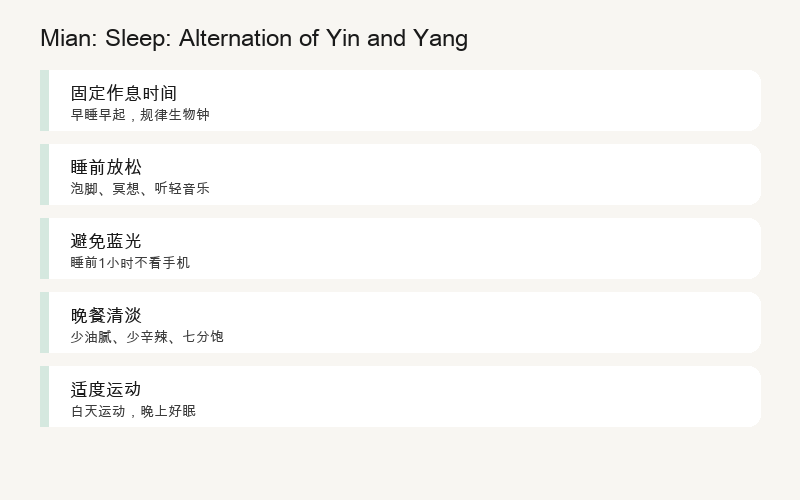
• Fixed sleep schedule: get up at the same time every day, even on weekends. A stable wake-up time is the most powerful signal for resetting the biological clock. Even if you slept late last night, get up on time, don't nap during the day, and you'll naturally feel sleepy earlier at night. It's not "early to bed and early to rise"—it's stabilizing the phase of the biological clock.
• Relax before bed: meditation, breathing exercises, progressive muscle relaxation. Relaxation training 30 minutes before bed reduces sympathetic excitement and enhances parasympathetic activity (increased HRV). The 4-7-8 breathing method (inhale for 4 seconds, hold for 7 seconds, exhale for 8 seconds) can quickly induce drowsiness. It's not "don't think too much"—it's actively regulating the balance of the autonomic nervous system.
• Avoid blue light: no phone/computer use 1-2 hours before bed. Blue light inhibits melatonin secretion and delays sleep onset. If you must use them, turn on blue light filtering mode (such as Night Shift) or wear blue-light-blocking glasses. Use warm lights in the bedroom (color temperature <3000K). It's not "use your phone less"—it's protecting melatonin secretion through light environment management.
• Light dinner: avoid high-fat, high-protein late-night snacks. High-fat diets delay gastric emptying, increase the burden on the gastrointestinal tract at night, and easily trigger reflux. Although alcohol can help with sleep, it disrupts sleep structure (suppresses REM), leading to waking up early. The half-life of caffeine is about 5-6 hours; avoid coffee/strong tea after 2 PM. It's not "don't eat dinner"—it's reducing the metabolic burden at night.
• Moderate exercise: daytime exercise increases sleep pressure. 150 minutes of moderate-intensity aerobic exercise per week (brisk walking, jogging, swimming) can significantly increase the proportion of deep sleep. But avoid strenuous exercise 3 hours before bed—exercise raises core body temperature and cortisol, which actually delays sleep onset. It's not "exercise more to sleep better"—it's increasing sleep pressure at the right time.
• Light management: get natural light in the morning, dim light at night. Get natural light as soon as possible after getting up (10,000 lux or more, for 20-30 minutes), which can inhibit melatonin, boost cortisol, and reset the biological clock. Spend more time outdoors during the day and reduce bright light at night. It's not "get more sun"—it's light as a zeitgeber (time-giver) for the biological clock.
• Environment optimization: bedroom temperature 18-20°C, blackout curtains, white noise. A drop in core body temperature is a signal for sleep onset, and a cool environment promotes sleep. Blackout curtains ensure darkness and promote melatonin secretion. White noise (such as the sound of a fan) masks environmental noise and reduces awakenings. It's not "just be quiet"—it's multi-dimensional sleep environment design for temperature, light, and sound.
Part 6 (continued)Practical Methods: Seven Tricks to Fix Your Sleep
Part 7One-Minute Summary
🕐 Understand "Mián" in One Minute
Mián = the alternation of yin and yang = the rhythmic repair of the neuro-endocrine-immune system.
What TCM calls "mián" is not simply "lying flat and sleeping"—it's a comprehensive expression of the rhythmic balance of organ function and the neuroendocrine system.
Difficulty falling asleep = HPA axis activation + sympathetic nerve excitement + delayed melatonin secretion (corresponds to "liver qi stagnation transforming into fire").
Easy to wake up = fragmented sleep structure + reduced slow-wave sleep + lowered arousal threshold (corresponds to "heart and spleen deficiency").
Excessive dreaming = abnormal REM proportion + hyperactive amygdala + enhanced emotional memory processing (corresponds to "heart and kidney fail to communicate").
Waking up early = advanced circadian rhythm + premature cortisol awakening response + reduced melatonin secretion (corresponds to "lung qi deficiency").
Excessive sleepiness (phlegm-dampness trapping the spleen) = obstructive sleep apnea + nighttime hypoxia + elevated inflammatory factors.
Excessive sleepiness (yang deficiency) = hypothyroidism + reduced metabolic rate + abnormal temperature regulation.
Myths: Can't sleep? Take sleeping pills. Catching up on sleep on the weekend can make up for it. Snoring means sleeping well.
Methods: Fixed sleep schedule (get up at the same time every day), relax before bed (4-7-8 breathing method), avoid blue light (no phone 1-2 hours before bed), light dinner (avoid high-fat late-night snacks and alcohol), moderate exercise (exercise during the day), light management (20 minutes of natural light in the morning), environment optimization (18-20°C + blackout curtains + white noise).
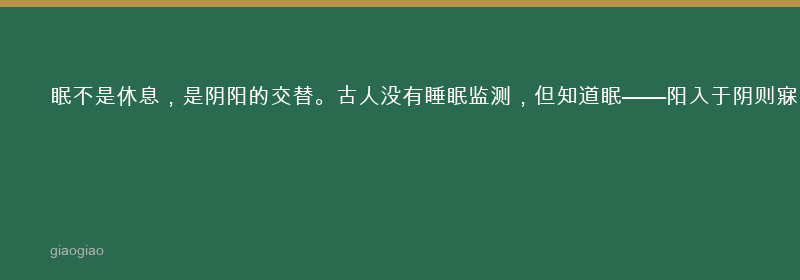
The ancients didn't have PSG or melatonin, but they knew that "when yang enters yin, sleep occurs; when yang exits yin, one wakes up."
This is probably the most down-to-earth wisdom of the Chinese people: Sleep is not laziness, but the alternation of yin and yang; poor sleep is not a lack of willpower, but a rhythm that needs adjustment.
The ancients didn't have polysomnography or circadian rhythm genes, but they knew that "when yang qi is exhausted, one lies down; when yin qi is exhausted, one wakes up."
This is probably the most down-to-earth wisdom of the Chinese people: Sleep is not laziness, but the body's self-repair switch; poor sleep is not a lack of willpower, but the alternation of yin and yang that needs adjustment. The doctor's task is not to replace the body, but to help regulate this rhythm.
Making money is the art of life; art is the life after making money
giaogiao Decodes Traditional Chinese Wisdom · Concept 98
Helping the world understand Traditional Chinese Wisdom through the language of modern science.
No mysticism, no superstition, no belittlement.
Understanding, not merely believing.
Coach Liu
Written in Florence