Why Do Chinese Say "Weiqi Deficiency"? Your Body Isn't Weak — It's Just Short on Security Guards
Part 1A Question
Do you have a colleague like this?
The office AC is set to 18°C. Someone's in a T-shirt complaining it's too hot. Meanwhile, you're wrapped in a jacket, clutching hot water, and still feel a draft sneaking in behind your neck. You switch seats, add a blanket, and still feel like "something's leaking."
You go to a TCM doctor. The old physician glances at you and says: "Weiqi deficiency, loose cou li."
You don't know what "cou li" means, but you know what "drafty" means — it's like every inch of your skin has a window that won't close tight, and the wind outside chills you straight to the bone.
Even more annoying: some people walk out of the shower without drying off and they're fine. You dry yourself carefully, blow-dry your hair, and still catch a cold the next day. You ask why. TCM says: their security team has twenty people; yours has three. Three people guarding a neighborhood versus twenty people guarding a neighborhood — does that sound the same?
So what exactly is this "Weiqi" organizational chart?
Part 2Traditional Chinese Explanation
The term "Weiqi" comes from the Yellow Emperor's Inner Canon. The ancients divided qi into several types, and Weiqi is the most "field-operational" one. It doesn't live inside the internal organs; it dwells in the skin, muscles, and pores — in short, it's your body's front line.
— Yellow Emperor's Inner Canon, Ling Shu
"If Weiqi is not secure, one easily catches wind and cold."
— Golden Mirror of Medicine
【Chinese original preserved above; translation: Weiqi regulates skin temperature, pore function, and external defense.】
The ancients summarized Weiqi's job as three things:
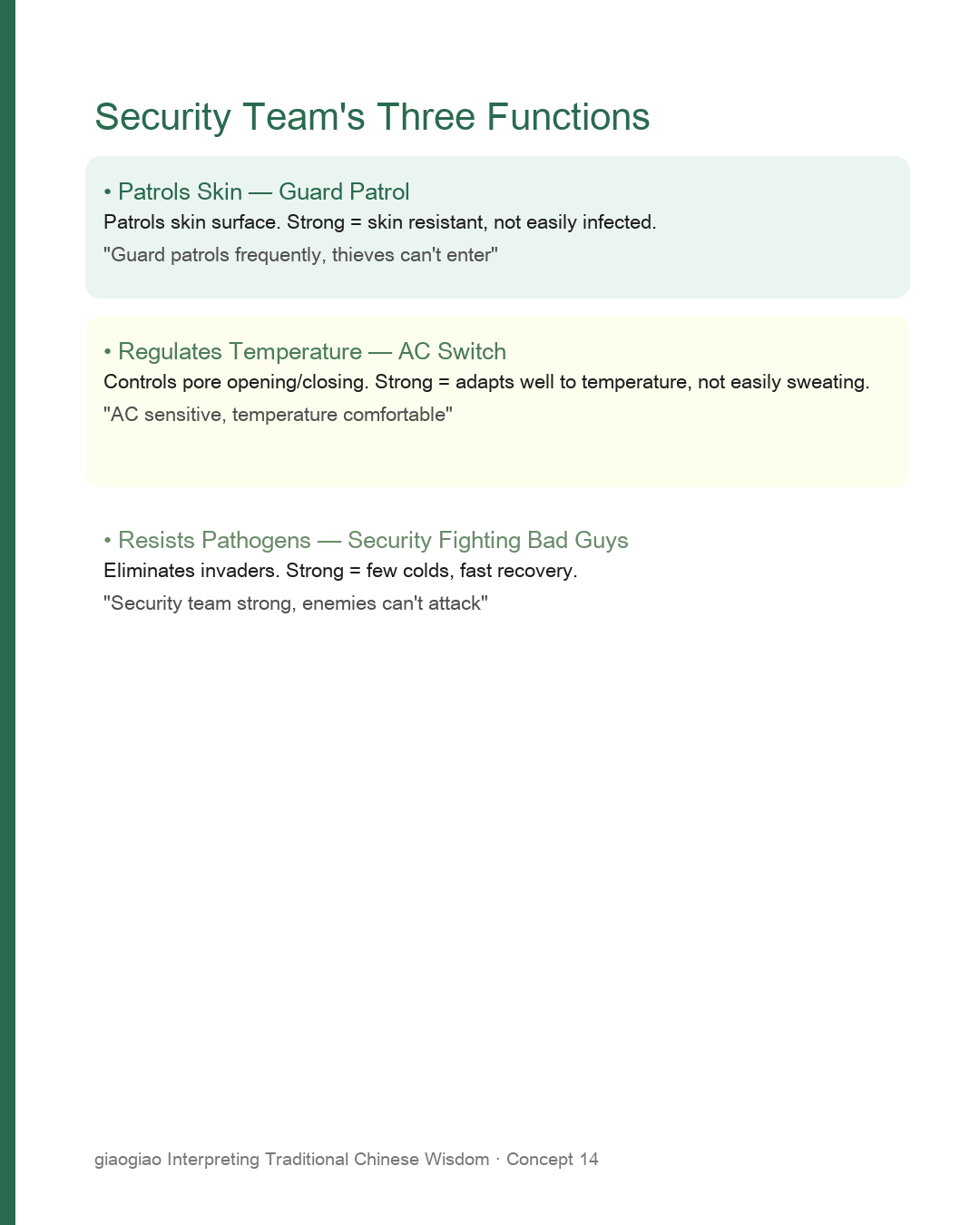
Patrolling the skin — Weiqi circulates beneath your skin, keeping surface temperature even. People with strong Weiqi have warm hands and feet. People with weak Weiqi have cold hands and feet — not because they forgot socks, but because the "patrol squad" never made it there.
Regulating body temperature — Weiqi controls pore opening and closing. Hot? It opens pores to let sweat out and cool you down. Cold? It closes pores to lock in heat. Strong Weiqi means your body is like an automatic thermostat. Weak Weiqi means the thermostat is broken — you're either sweating buckets or shivering, never comfortable.
Resisting external pathogens — Wind, cold, summer heat, dampness, dryness, and fire: TCM calls these the "Six Excesses," six kinds of bad weather. Weiqi is the security guard standing at the door blocking these troublemakers. Strong Weiqi: viruses, bacteria, cold wind — all stopped at the door. Weak Weiqi: the guard falls asleep, intruders stroll right in, and you get sick.
And Weiqi works on a shift system: patrolling by day, guarding the gate by night. That's why night owls damage Weiqi the most — the security team is supposed to work the night shift, but you make them work overtime for daytime duties too. They're exhausted, they doze off at midnight, and the bad guys hop the fence.
Where does Weiqi come from? It doesn't fall from the sky. Weiqi is the "fierce qi of water and grains" — the strongest energy produced after the food you eat is digested. So people who eat poorly or digest poorly naturally have weak Weiqi. Your security team is underfed, and you expect them to be brave warriors?
Part 3giaogiao Modern Translation
Okay, now let's translate "Weiqi" into modern language.
I'm not going to talk about immunoglobulins, T-cells, or macrophages. Too complicated. Just remember one metaphor:
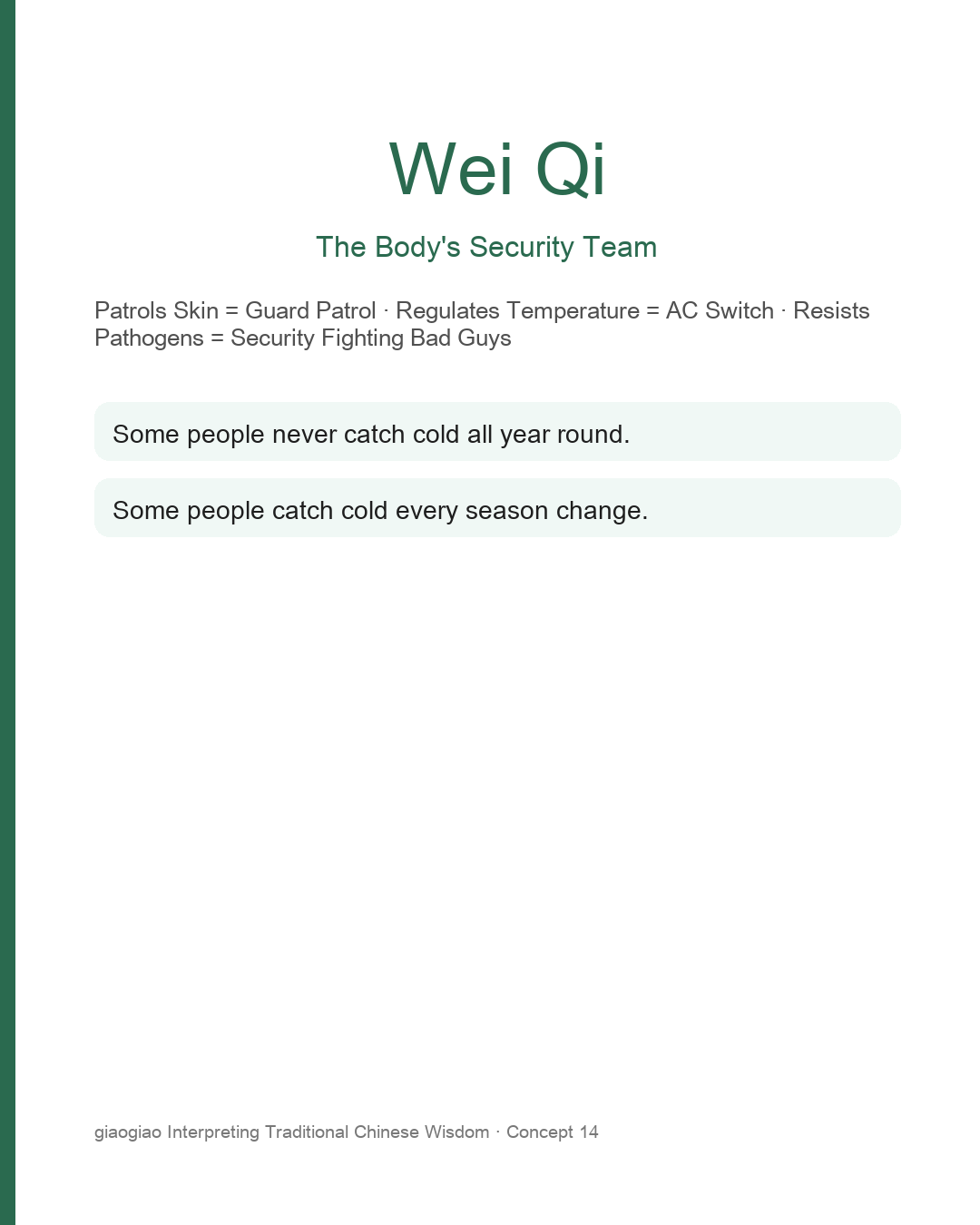
Patrolling skin = Gatekeeper patrol
Regulating temperature = Thermostat switch
Resisting pathogens = Security guards beating up bad guys
That's it. Weiqi isn't a single organ, nor a single cell type. It is the sum of the body's surface-level defense and regulation systems.
Specifically:
What does patrolling the skin correspond to? Subcutaneous microcirculation and nerve regulation. People with strong Weiqi have good subcutaneous vasodilation, evenly distributed warmth. People with weak Weiqi have poor peripheral circulation, cold hands and feet — not because they lack clothes, but because "blood can't get there."
What does regulating temperature correspond to? The thermoregulatory center and sweat gland control. Healthy people sweat when hot and get goosebumps when cold — that's the autonomic nervous system automatically adjusting temperature. People with weak Weiqi have a system that reacts too slowly or too intensely: either they don't sweat when they should, or they sweat buckets when they shouldn't.
What does resisting external pathogens correspond to? Skin and mucosal barriers (first line of defense) and the innate immune system's rapid response (second line). Strong Weiqi: intact skin barrier, fast immune response. Weak Weiqi: leaky barrier, sluggish immune response, or overreaction — the former leads to infection, the latter to allergies.
So "Weiqi" is not mysticism. It is a functional metaphor describing the overall capacity of the body's outermost defense and regulation systems.
The ancients had no thermometers, but they could feel: this person's skin is warm and elastic = strong Weiqi; that person's skin is cold and flabby = weak Weiqi. The ancients had no microscopes, but with three words — "security team" — they captured immunology, microcirculation, and nerve regulation all at once.
Part 4Real-Life Examples
Four stories to make you instantly understand what Weiqi is.
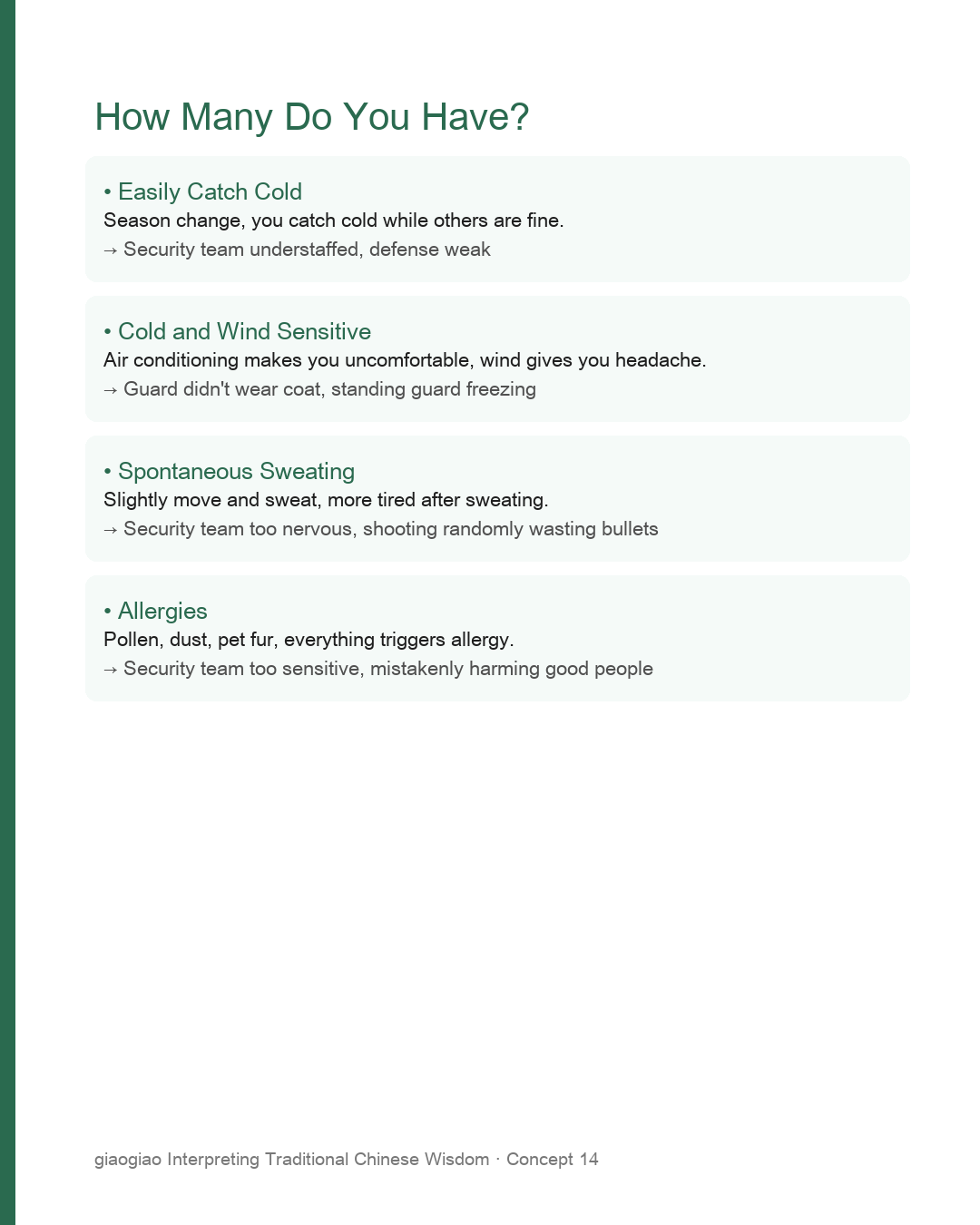
Example 1: Catching a cold every season change.
Every spring and autumn, while everyone else is fine, you get a cold. You take vitamin C, get the flu shot, and still can't prevent it. You think it's "weak constitution." TCM says: your security team is "understaffed."
Truth: During seasonal changes, temperature fluctuates wildly. Weiqi needs to constantly adjust pore opening and closing to adapt. People with strong Weiqi adapt quickly; their bodies switch gears seamlessly. People with weak Weiqi can't keep up: pores that should be closed stay open, cold wind rushes in, the body gets chilled, and the immune system is passively activated — you "catch a cold." It's not that the virus is so powerful; it's that your guard left the door open.
Example 2: Fear of cold and wind.
Summer office AC at 24°C, and you're in long sleeves still shivering. Others can spend a day at the mall no problem; you last half an hour and your whole body tenses up, needing a hot bath at home to recover. You're not "being dramatic"; you're "the guard isn't wearing a jacket."
Truth: People with weak Weiqi can't retain subcutaneous heat and are abnormally sensitive to external temperature changes. Healthy people have a layer of "qi" beneath their skin acting as insulation, like an invisible down jacket. People with weak Weiqi? This jacket has holes. They feel cold at 26°C.
Example 3: Spontaneous sweating.
Some people sweat without moving, break out in a full sweat while eating, and wake up with damp sheets. TCM calls this "spontaneous sweating" — not from heat, but because Weiqi is "too tense," pores can't close tight, and sweat leaks out on its own. Like the security team hearing a rustle in the bushes and firing wildly, when there's no intruder at all.
Truth: A key Weiqi function is "governing opening and closing" — controlling pores. Weak Weiqi means this control malfunctions: pores that should close can't, and fluids leak out inexplicably. You can drink all the water you want and still not plug this leak.
Example 4: Allergic constitution.
Some people sneeze the moment spring arrives — pollen, dust mites, cat fur, they're allergic to everything. Western medicine says the immune system overreacts. TCM says: Weiqi is "too sensitive," and the security team mistakes the delivery guy for a burglar.
Truth: Weiqi itself has a "recognition" function — distinguishing friend from foe. People with strong, stable Weiqi recognize accurately, only attacking real bad guys. People with weak Weiqi either fail to recognize (immunodeficiency) or misrecognize (allergies). Allergic constitution is essentially Weiqi being "overly tense," attacking everyone it sees.
Four cases, one underlying logic: the body's outermost defense and regulation system is malfunctioning.
Part 5Modern Research
Is there scientific research on "Weiqi"?
Yes, but scientists don't use the word "Weiqi." They use:
• Skin barrier function. Research shows that atopic dermatitis (eczema) patients have significantly reduced expression of skin barrier proteins (filaggrin) and increased transepidermal water loss. This is the molecular expression of "Weiqi not secure, cou li not dense."
• Autonomic nervous regulation. Thermoregulation is controlled by the sympathetic and parasympathetic nervous systems. Chronic fatigue syndrome patients often have autonomic dysfunction, showing large temperature fluctuations and sensitivity to temperature changes. This is the scientific version of "Weiqi cannot govern opening and closing."
• Mucosal immunity. Respiratory and digestive tract mucosal surfaces are covered with secretory IgA antibodies. This is the immune system's first line of defense, the "gatekeeper." People under long-term stress or sleep deprivation have reduced secretory IgA levels, making them more susceptible to colds and diarrhea. This is the microscopic explanation of "Weiqi not secure, easily catching external pathogens."
• Gut microbiome and skin. Recent research proposes the "gut-skin axis" theory — gut dysbiosis affects skin barrier function. This echoes the TCM saying: "Weiqi emerges from the middle burner" — the security team's rations come from the digestive system.
These studies are not numerous, but they point in the same direction: "Weiqi" describes the overall state of the body's surface defense and regulation system, not a single specific substance.
Part 6Practical Methods
Weiqi is weak — how do you strengthen it?
First, dispel some myths:
• Vitamins alone won't fix it. Vitamin C is ammunition, but if there are no security guards, who uses the ammo? Weiqi is a "personnel" problem, not a "weapon" problem. Build the team first, then issue the weapons.
• More exercise isn't always better. Sweat-dripping exercise "depletes qi" — your security team is already short-staffed, and you make them do daily drills. They dwindle even more. Weak Weiqi calls for gentle exercise, not intense exercise.
• More clothes aren't always better. Weak Weiqi makes you feel cold, but wrapping up too much prevents sweating, pores never get exercised, and Weiqi gets weaker. Let the body be exposed to moderate temperature changes to gradually train the security team's response capability.
Specific methods:
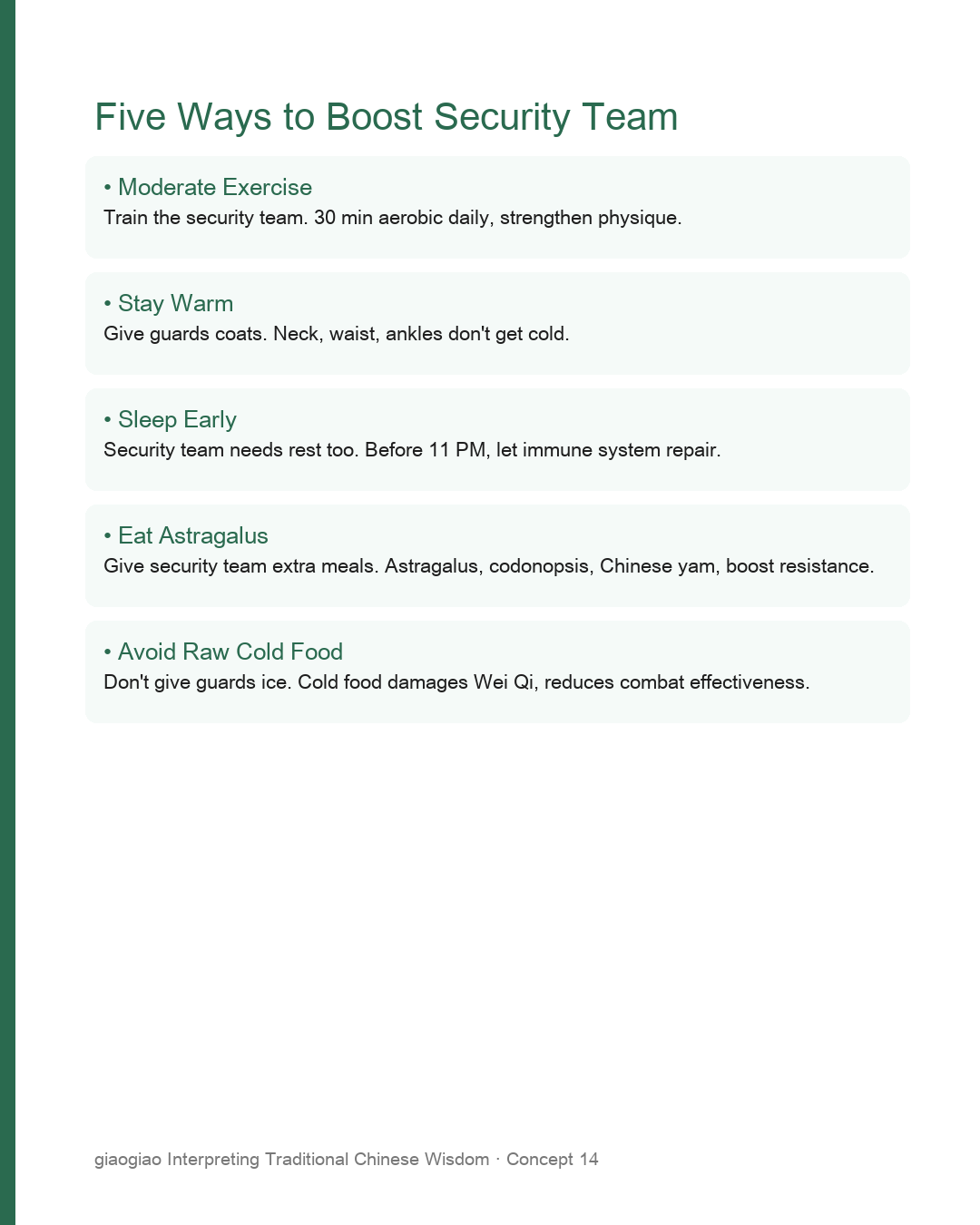
• Moderate exercise. Train the security team. Brisk walking, tai chi, ba duan jin — stop when you get a light sweat, don't drench yourself. The amount of exercise should feel like "you broke a sweat, but your body feels lighter." If you feel more tired after exercise, you overdid it — the security team took casualties.
• Stay warm. Issue jackets to the guards. Weak Weiqi? Protect three key areas: the back of the neck (Fengchi, Fengfu acupoints), the navel (Shenque acupoint), and the ankles (Sanyinjiao acupoint). These are where wind most easily enters. In summer AC rooms, a thin scarf is more effective than ten bags of isatis root.
• Don't stay up late. The security team needs rest too. Weiqi circulates in the yang (body surface) by day and retreats into the yin (interior) by night. Staying up late forces the security team to work both day and night shifts. Even iron men can't take that. Sleeping before 11 PM is the simplest way to recharge Weiqi.
• Eat astragalus. Give the security team a bonus meal. Astragalus is TCM's number one herb for "tonifying qi and securing the exterior." Modern research confirms that astragalus polysaccharides enhance macrophage activity and promote antibody production. Boil it in water or add a few slices to soup — it gently boosts Weiqi. But note: don't take astragalus during a cold — the enemy is already at the door, this is no time to hand out bonuses.
• Eat less cold/raw food. Don't give the security team ice water. Weiqi comes from "qi of water and grains" — the energy transformed from the food you eat. Cold and raw foods consume digestive system energy, cutting off the security team's rations. Weak Weiqi? Drink warm water, eat cooked food. This is the most basic nourishment.
These methods don't require you to believe in TCM. You only need to understand: your body needs a lean, effective security team, and your lifestyle determines the team's headcount and morale.
Part 7One-Minute Summary
🕐 One Minute to Understand "Weiqi"
Weiqi = The body's security team.
Patrolling skin = Gatekeepers keeping the surface warm.
Regulating temperature = Thermostat switch controlling pore opening and closing.
Resisting pathogens = Security guards beating up viruses and cold wind.
Signs of Weiqi deficiency: easily catching colds, fear of cold/wind, spontaneous sweating, allergies.
Causes: staying up late, sitting too long, eating cold/raw food, overexertion, poor digestion.
Methods: moderate exercise, keep warm, sleep early, eat astragalus, eat less cold/raw food.
The ancients called it "Weiqi"; modern people call it "surface defense and regulation capacity."
Different names, but the body knows: whether you have enough guards, you feel it best.
Immunity is the weapon; Weiqi is the person wielding it.
The most advanced weapon is useless without someone to wield it.
A strong security team keeps burglars out; a weak team means even the wind can make you sick.
Don't just upgrade the weapons — build up your team first.
Making money is the art of living; art is the life after making money.
giaogiao Decodes Chinese Wisdom · Concept 14
Using modern scientific language to help the world understand traditional Chinese wisdom.
No mysticism, no superstition, no belittlement.
Understand, rather than merely believe.
Coach Liu
Written in Florence