Why Does TCM Call "Wind" the Chief of All Diseases? A Pathogenic Factor as Pervasive as a Delivery Driver
Part 1A Question
Have you ever had this experience?
You catch a cold. Day one: itchy throat. Day two: headache. Day three: runny nose. The symptoms come like a relay race, taking turns. The doctor says: "Wind evil attacking the exterior." You ask: "Wind evil? Isn't wind just moving air?" The doctor says: "Wind is the chief of all diseases; it moves and changes rapidly." You get hives. The red rash on your skin disappears here and reappears there, as if alive and wandering across your skin. The doctor says: "Wind evil attacking the exterior, blood heat generating wind." You suddenly feel dizzy, your vision goes black, and you nearly fall. The doctor says: "Liver wind stirring internally." You stare blankly: "Wind is inside the body?" Your grandfather has a stroke. One second he's talking, the next half his body can't move. The doctor says: "Wind evil hitting the channels."
You ask a Western doctor: "What is wind?" The doctor says: "There's no such concept. It's probably a viral infection or allergic reaction."
You ask a TCM doctor: "What exactly is wind?" The senior doctor says: "Wind moves and changes rapidly; it is the chief of all diseases."
One says "viral infection," the other says "wind evil"—are they talking about the same thing?
Even more surprisingly, TCM says wind comes in two types: external wind (colds, allergies) and internal wind (stroke, tremors). External wind is understandable—air moving, right? But what is "wind" inside the body? Liver wind stirring internally? Blood heat generating wind? What on earth is going on?
Part 2Traditional Chinese Explanation
The concept of "wind" was systematically defined in the Yellow Emperor's Inner Canon. Ancient observers noticed: some people had cold symptoms that wandered unpredictably; some had skin rashes that came and went; some suddenly collapsed from stroke; some had trembling limbs that wouldn't stop. They summarized this pathogenic characteristic of "coming without a shadow and leaving without a trace, wandering unpredictably, changing rapidly" as wind evil—"Wind is the chief of all diseases" (Basic Questions: Wind Discussion).
—Basic Questions: Wind Discussion
"Wind moves and changes rapidly; when the pores open, one feels a chill; when they close, one feels feverish and stifled."
—Basic Questions: Wind Discussion
"All wind-induced trembling and dizziness belong to the liver."
—Basic Questions: Essential Truth and the Great Law
TCM summarizes the function and characteristics of "wind" with four keywords: light, mobile, changeable, and moving.
Light (light and upward, opening and discharging) — Wind is a yang evil, naturally light and upward. Wind evil usually attacks the upper parts of the body (head, face, throat) and the exterior (skin, pores). That's why colds start with itchy throat, headache, and stuffy nose—all upper body symptoms. Wind evil opens the pores (interstitial spaces), causing sweating and aversion to wind.
Mobile (tending to move and wander) — Wind is mobile by nature. One of its pathogenic characteristics is wandering unpredictably. Hives appear here and disappear there; joint pain moves from one place to another today—all are manifestations of "wind evil wandering." TCM says "when wind prevails, there is movement"—wherever wind goes, symptoms follow.
Changeable (changing rapidly) — Wind changes rapidly, and its pathogenic manifestations change quickly. Cold symptoms shift from headache today to cough tomorrow; stroke strikes without warning—all are manifestations of "wind evil's rapid changes." Ancient observers noticed the unpredictable nature of wind and used it to describe the sudden onset and variability of disease.
Moving (shaking and unstable) — When wind prevails, there is movement. Wind evil causes unstable, shaking symptoms: tremors, convulsions, dizziness, itching. Internal wind (liver wind) manifests as limb tremors, dizziness, and stroke paralysis. External wind manifests as itchy skin and hives that come and go.
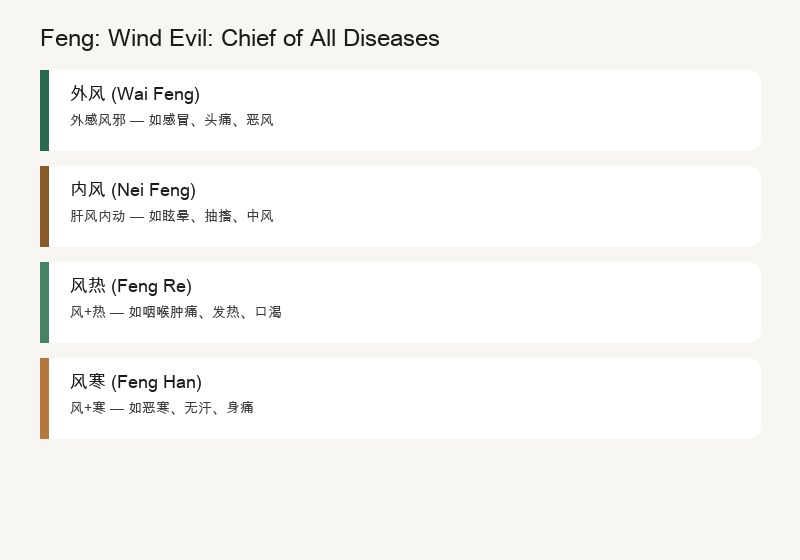
Wind is also divided into external wind and internal wind:
• External wind — external wind evil invading through the skin and pores. Common cold (wind evil attacking the exterior), hives (wind evil attacking the exterior), wandering joint pain (wind evil obstructing channels), facial paralysis (wind evil hitting the channels).
• Internal wind — "wind" generated inside the body, closely related to the liver. Liver yang rising (dizziness, headache), liver wind stirring internally (tremors, stroke), extreme heat generating wind (high fever convulsions), blood deficiency generating wind (dry skin, itching).
So, what the ancients called "wind" is not just the movement of air in nature, but a functional metaphor describing pathogenic characteristics—light, mobile, changeable, and moving. The ancients used "wind" to summarize what modern people need multiple concepts like "viral invasion," "allergic reaction," "neurovascular spasm," and "immune inflammation" to explain.
Part 3giaogiao Modern Translation
OK, now let's translate "wind" into modern language.
I'm not going to talk about viral infections, nerve conduction, or immune responses. Too complicated. You only need to remember one metaphor:
External wind = Courier invading from outside (viruses, allergens, cold air)
Internal wind = Uninvited guest inside the body (nerve abnormalities, vascular spasms, inflammatory factors)
Moving and changing rapidly = The courier runs everywhere; the package (symptoms) is delivered to unpredictable locations
Light and upward nature = The courier likes to deliver to upper floors first (head, upper body)
When wind prevails, there is movement = The uninvited guest arrives, and the body system starts "shaking"
That's it. Your "wind" is essentially a metaphor describing the dynamic characteristics of pathogenic factors—it emphasizes not "what" but "how" it causes disease: wandering, changing, sudden, and shaking.
Specifically:
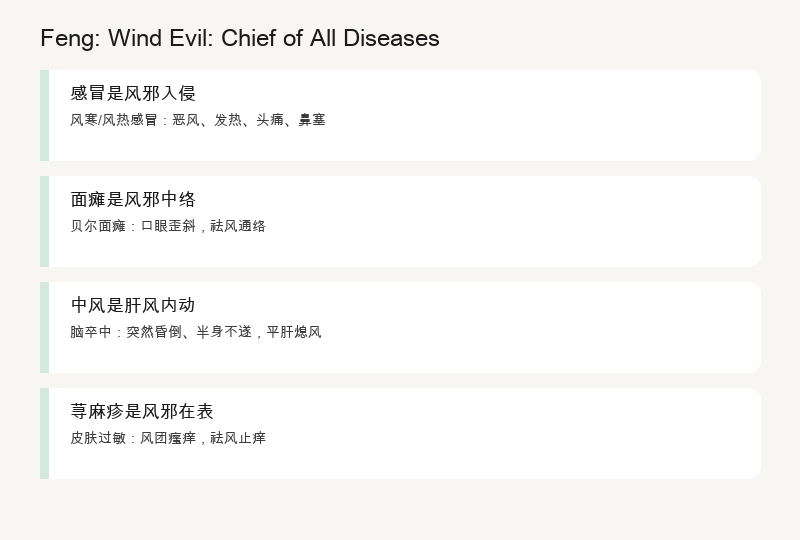
What does external wind correspond to? It corresponds to viral infections, allergic reactions, and temperature stimuli in modern medicine. A cold is a virus invading the upper respiratory tract; hives are the release of allergic mediators; facial paralysis is inflammation and edema of the facial nerve after exposure to cold or viral infection. The common feature of these diseases is: relatively sudden onset, wandering or changing symptoms, and predilection for the body surface and upper parts. The ancients couldn't see viruses, but they observed these characteristics and summarized them with "wind."
What does internal wind correspond to? It corresponds to neurovascular abnormalities in modern medicine. Liver yang rising corresponds to hypertension and cerebral vascular spasms; liver wind stirring internally corresponds to Parkinson's tremors and cerebellar ataxia; extreme heat generating wind corresponds to febrile convulsions; blood deficiency generating wind corresponds to dry skin and itching (sensitive nerve endings). The essence of internal wind is functional disorder of the nervous system and vascular system—abnormal nerve signal discharges, abnormal vascular contraction and dilation, leading to "shaking and unstable" symptoms.
What does "wind is the chief of all diseases" correspond to? It corresponds to the concept in modern medicine that "wind evil" acts as a leading factor. When catching a cold, wind evil (cold air/temperature changes) first opens the pores and lowers local immunity, then viruses take the opportunity to invade. During allergies, wind evil (temperature changes/pollen) first stimulates the respiratory tract or skin, then the immune system overreacts. "Wind" is not the root cause of disease, but the leading condition of disease—it is like the courier's knock; it is not the package itself, but it opens the door.
So, "wind" is not mysticism. It is a functional metaphor describing the dynamic characteristics of pathogenic factors. The ancients used "wind" to summarize what modern people need multiple concepts like "viral infection," "allergic reaction," "neurovascular spasm," and "immune inflammation" to explain.
Part 4Real-Life Cases
Four stories to help you instantly understand what "wind" is.
Case One: The Cold Symptom Relay Race.
You catch a cold. Day one: itchy throat. Day two: headache. Day three: runny nose. Day four: cough. The symptoms come like a relay race, each taking its turn. The doctor says: "Wind evil moves and changes rapidly; symptoms wander unpredictably."
Truth: A cold is a viral infection of the upper respiratory tract. The virus replicates and causes inflammatory reactions in different locations with time differences: first the pharynx (itchy), then the sinuses (headache), then the nasal cavity (runny nose), then the trachea (cough). The "wandering" of symptoms is not wind running around, but the temporal sequence of infection progression in different anatomical locations. However, the ancients' description of "wind evil's mobility" was remarkably precise in capturing this feature.
Case Two: Hives That Run.
You develop red rashes on your body. They disappear here and reappear there, as if alive and wandering across your skin. The doctor says: "Wind evil attacking the exterior, blood heat generating wind."
Truth: Hives are caused by mast cells releasing histamine and other allergic mediators, leading to skin blood vessel dilation and increased permeability. The distribution of histamine in the skin is uneven, and its release is fluctuating, so the rashes come and go. The "wandering" is not wind blowing, but the uneven release and diffusion of allergic mediators. However, the description "when wind prevails, there is movement" captures the core characteristic of the symptoms very accurately.
Case Three: Grandpa's Stroke.
Your grandfather was talking one second, and the next he suddenly collapsed, half his body couldn't move, and his mouth was crooked. The doctor says: "Liver wind stirring internally, wind evil hitting the channels."
Truth: Stroke (cerebral apoplexy) is a sudden blockage or rupture of a cerebral blood vessel, leading to brain tissue ischemia or hemorrhage. The onset is abrupt ("wind changes rapidly"), and symptoms appear suddenly ("wind evil hits the channels"). Hypertension and arteriosclerosis are internal causes; emotional fluctuations and cold stimuli are triggers. It is not "wind blowing inside the body," but an acute cerebrovascular event. However, the metaphor of "internal wind" precisely describes this sudden, body-shaking pathological state.
Case Four: The Young Person with Shaking Hands.
Your hands shake after staying up late, after drinking coffee, when you're nervous. The doctor says: "Liver wind stirring internally, blood deficiency generating wind."
Truth: Hand tremors are caused by increased excitability of the neuromuscular system. Staying up late and caffeine stimulate the sympathetic nervous system, increasing neuromuscular excitability; during stress, adrenaline secretion also enhances neuromuscular excitability. It is not "wind blowing inside the body," but muscle involuntary contractions caused by neurotransmitter imbalance. However, the metaphor of "blood deficiency generating wind" (blood = nutrition, blood deficiency = insufficient nerve nutrition) connects nutritional deficiency with nerve function very wisely.
Four cases, one underlying logic: wind is not a disease-causing entity, but a disease-causing dynamic characteristic—wandering, changing, sudden, and shaking.
Part 5Modern Research
Is there scientific research on "wind"?
Yes, and quite a lot. Scientists don't use the word "wind"; they use:
• Temperature changes and immunity (Thermal Immunology). Cold stimuli ("wind evil") can cause respiratory mucosal blood vessel contraction, lower local immunoglobulin A (IgA) levels, and reduce ciliary clearance ability, creating conditions for viral invasion. This is the scientific basis for "wind evil first attacks the exterior"—temperature changes do not directly cause disease, but lower local defenses, giving viruses an opportunity.
• Neurovascular coupling. The nervous system and vascular system are tightly coupled. Abnormal nerve discharges can cause abnormal vascular contraction (such as in migraines and stroke), and vascular abnormalities can in turn affect nerve function. This is the scientific basis for "internal wind" (liver wind)—it is not "wind blowing," but functional disorder of the neurovascular system.
• Histamine and mast cells. Hives, allergic rhinitis, and other "wind evil"-related diseases are essentially mast cells releasing histamine and other mediators. Histamine causes blood vessel dilation, increased permeability, and sensitive nerve endings, leading to itching, rashes, and runny nose. Research shows that antihistamines (such as loratadine) can effectively control these "wind evil" symptoms. It is not "dispelling wind," but blocking the release of allergic mediators. However, the ancients' use of "wind" to describe the dynamic characteristics of these symptoms was very accurate.
These studies fully demonstrate that "wind" is a system that can be precisely described in modern scientific language. The ancients summarized it with "wind"; modern people describe it with "viral infection," "allergic reaction," and "neurovascular spasm"—they are describing the same pathogenic characteristic.
Part 6Practical Methods
Now that you understand "wind," how do you use it?
First, dispel a few misconceptions:
• Wind evil is just air conditioning. Wind evil is a functional concept in TCM, not simply "cold air blowing." Air conditioning may induce a cold (because it lowers local immunity), but the root cause of a cold is a virus, not wind. Wind is the trigger, not the cause.
• Dispelling wind means taking wind-dispelling medicine. "Wind-dispelling herbs" in TCM (such as Fangfeng and Jingjie) do not "drive wind out" of the body, but regulate immunity, reduce inflammation, counteract allergies, and improve blood circulation. Understanding the mechanism of drug action is more important than memorizing "dispel wind."
Specific methods:
• Avoid wind and keep warm (prevent external wind). During cold season, pay attention to keeping the neck and head warm. TCM says "the head is the meeting place of all yang"; head exposure to cold easily invites wind evil. Modern medicine confirms: the neck has large blood vessels and abundant nerves; cold stimuli can cause blood vessel contraction and decreased immunity. A scarf is not a decoration, it is "wind-protection equipment."
• Stabilize blood pressure (prevent internal wind). Hypertension is the primary risk factor for stroke (internal wind). Monitor blood pressure regularly, maintain emotional stability, and avoid intense emotional fluctuations. TCM says "anger causes qi to rise, liver yang rises"—when angry, blood pressure rises, increasing the risk of cerebrovascular events. Modern medicine confirms: emotional stress activates the sympathetic nervous system, blood pressure spikes, and this is a direct trigger for stroke.
• Moderate exercise (balance nerves). Regular aerobic exercise (brisk walking, swimming) can improve neurovascular coupling, regulate autonomic nerve balance, and reduce the risk of "internal wind." TCM says "movement generates yang"—exercise does not directly "dispel wind," but improves neurovascular function and reduces functional disorder.
• Identify allergies (manage external wind). If you have hives, allergic rhinitis, and other "wind evil"-related diseases, identify the allergens and avoid contact. Antihistamines (such as loratadine) can effectively control symptoms. It is not "dispelling wind," but blocking the release of allergic mediators. However, understanding allergens is more important than taking any "wind-dispelling medicine."
• Adequate sleep (nourish blood and calm wind). Staying up late causes nerve fatigue, vascular functional disorder, and increases symptoms like hand tremors and dizziness ("blood deficiency generating wind"). Ensuring 7-8 hours of sleep is the best method to "calm wind." It is not that sleep can blow away "wind," but that sleep restores the homeostasis of the neurovascular system.
These methods do not require you to believe in TCM. You only need to understand: wind is not a disease-causing entity, but a disease-causing dynamic characteristic—wandering, changing, sudden, and shaking. Preventing and managing these characteristics is "dispelling wind."
Part 7One-Minute Summary
🕐 Understand "Wind" in One Minute
Wind = the body's courier / uninvited guest, the chief of the six excesses, the leader of all diseases.
Wind is light, mobile, changeable, and shaking—it is not a disease-causing entity, but a disease-causing dynamic characteristic.
External wind = external pathogenic factors (viruses, allergens, temperature stimuli); internal wind = internal neurovascular functional disorder.
Wind = the leading characteristics of viral infection + allergic reaction + neurovascular spasm + immune inflammation.
Wind is not mysticism; it is a functional metaphor describing disease-causing dynamic characteristics.
Reasons for failure: treating wind as an entity, neglecting root causes (such as viruses), over-relying on "wind-dispelling medicine," not distinguishing external wind from internal wind.
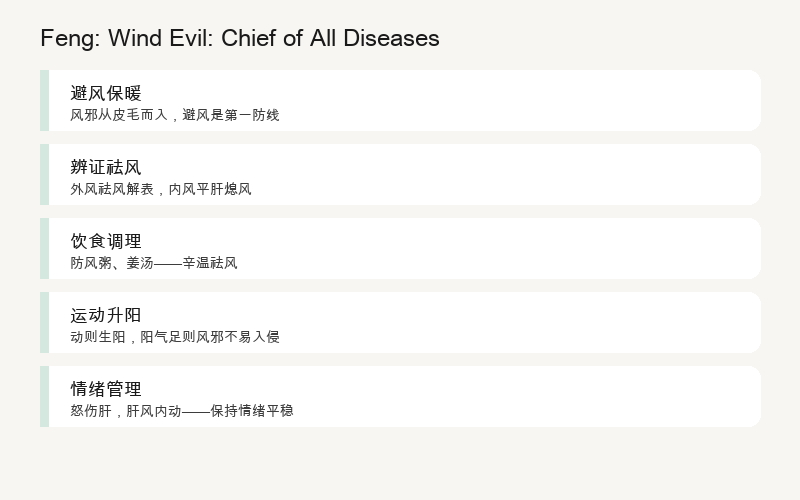
Methods: avoid wind and keep warm (prevent external wind), stabilize blood pressure (prevent internal wind), moderate exercise (balance nerves), identify allergies (manage external wind), adequate sleep (nourish blood and calm wind).
The ancients called it "wind is the chief of all diseases"; modern people call it "temperature stimuli lower immunity + viral invasion + neurovascular functional disorder." Different names, but the body knows: wind is not the cause, it is the one who opens the door.
but an ancient wisdom describing pathogenic dynamics.
External wind opens the pores; internal wind stirs the nerves.
Understanding the essence of wind is understanding how the body is disturbed by "uninvited guests,"
and how it finds balance again amid the disturbance.
This is probably the most simple wisdom of the Chinese: Wind is the beginning of all diseases; preventing wind is not preventing air, but preventing that moment when the door opens.
Making money is the art of living; art is the life after making money.
Giaogiao Decodes Chinese Traditional Wisdom · Concept 41
Using modern scientific language to help the world understand Chinese traditional wisdom.
No mysticism, no deification, no negation.
Understanding, not believing.
Coach Liu
Written in Florence