Why Does TCM Call "Cold" the Pathogen of Stagnation? Like an Ice Sculptor Freezing the Body
Part 1A Question
Have you ever had this experience?
You go out in winter without gloves, your fingers become numb from the cold, your joints stiffen, and after returning home it takes half a day to warm up. You eat a big bowl of iced watermelon, and your stomach immediately cramps, sending you running to the bathroom. During your period you drink cold beverages, and your lower abdomen aches as if there were ice cubes inside. In winter your knees ache faintly, getting worse when exposed to cold and easing with heat. Every doctor says: "Cold evil stagnates; where there is no free flow, there is pain." You ask: "Isn't cold just low temperature? How did it become a pathogenic evil?"
You ask a Western doctor: "What is cold?" The doctor says: "There is no such concept; it might be blood vessel contraction or muscle spasm."
You ask a TCM doctor: "What exactly is cold?" The senior doctor says: "Cold stagnates and causes pain. Cold causes qi to contract, and blood does not flow smoothly."
One says "blood vessel contraction," the other says "cold stagnation"—are they talking about the same thing?
Even more surprising, TCM says cold also comes in two types: external cold (colds, frostbite, joint pain) and internal cold (yang deficiency, uterine cold, ice-cold limbs). External cold is understandable—it's cold, right? But what is the "cold" inside the body? Yang deficiency? Uterine cold? What on earth is going on?
Part 2Traditional Chinese Explanation
The concept of "cold" was systematically defined in the Yellow Emperor's Inner Canon. Ancient observers noticed: some people had joint pain after being exposed to cold; some had stomach pain after eating cold food; some had ice-cold hands and feet in winter; some had menstrual cramps after being exposed to cold during their period. They summarized this pathogenic characteristic of "contraction, stagnation, and pain" as cold evil—"Cold stagnates and causes pain" (Basic Questions: Bi Syndrome Discussion).
—Basic Questions: Bi Syndrome Discussion
"Cold causes qi to contract."
—Basic Questions: Pain Discussion
"Where there is pain, there is no free flow; where there is free flow, there is no pain."
—Yellow Emperor's Inner Canon
TCM summarizes the function and characteristics of "cold" with three keywords: contract, stagnate, pain.
Contract (contraction) — "Cold causes qi to contract." Cold makes pores contract, blood vessels contract, and muscles contract. When exposed to cold, skin gets goosebumps (pore contraction), hands and feet become ice-cold (blood vessel contraction), and muscles stiffen (muscle contraction). This is the body's self-protection—reducing heat loss. But excessive contraction leads to poor flow of qi and blood.
Stagnate (stagnation) — "Cold stagnates." Cold slows the movement of qi and blood, like water freezing. Blood viscosity increases, flow speed slows, and metabolic products accumulate. After joints are exposed to cold, synovial fluid viscosity increases, and joint movement becomes less flexible. This is "stagnation"—not actually freezing, but slowing and thickening of physiological activity.
Pain — "Causes pain." The pain caused by cold evil is the most typical. Because qi and blood stagnate, there is no free flow, and therefore pain. Blood vessel contraction causes tissue ischemia, metabolic products (lactic acid, bradykinin) accumulate and stimulate nerve endings, producing pain. After heat application, blood vessels dilate, blood flow improves, and pain eases—"where there is free flow, there is no pain."
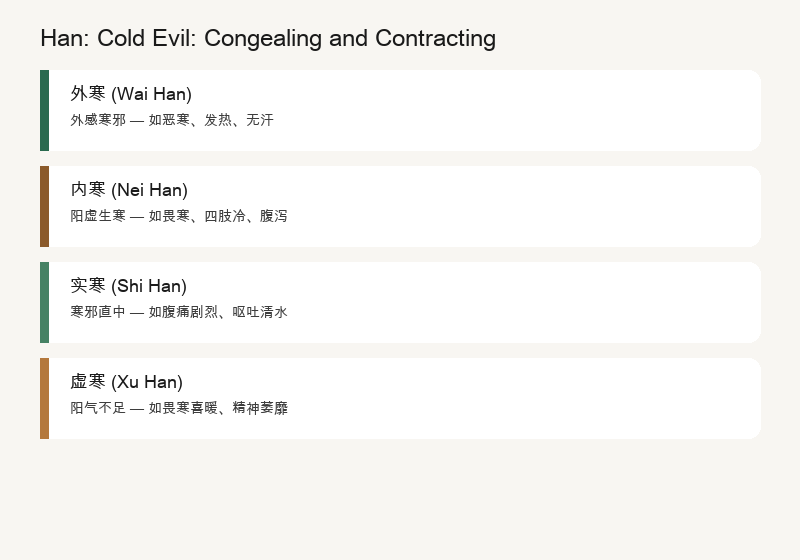
Cold is also divided into external cold and internal cold:
• External cold — external cold evil invading through the skin. Wind-cold cold (aversion to cold, no sweating, headache), frostbite (pale skin, numbness), cold bi syndrome (cold joint pain, worsening with cold), cold-congealing stomach pain (abdominal pain and diarrhea after eating cold food).
• Internal cold — insufficient yang qi inside the body, reduced warming function. Yang deficiency (aversion to cold, ice-cold limbs, low spirits), uterine cold (menstrual cramps, irregular menstruation, infertility), stomach cold (stomach pain relieved by warmth, vomiting of clear water), kidney yang deficiency (sore and weak lower back, frequent nighttime urination).
So, what the ancients called "cold" is not just low temperature, but a functional metaphor describing pathogenic characteristics—contraction, stagnation, and pain. The ancients used "cold" to summarize what modern people need multiple concepts like "blood vessel contraction," "muscle spasm," "metabolic slowing," and "inflammatory mediator accumulation" to explain.
Part 3giaogiao Modern Translation
OK, now let's translate "cold" into modern language.
I'm not going to talk about blood vessel contraction, nerve conduction, or inflammatory mediators. Too complicated. You only need to remember one metaphor:
External cold = Putting you in a freezer (external low temperature stimulus)
Internal cold = Your body's heating system is broken (yang deficiency, reduced metabolism)
Cold causes qi to contract = The freezer door closes, and the body contracts to protect itself
Cold stagnates = Blood thickens, like oil becoming sticky at low temperature
Causes pain = The frozen part is ischemic and hypoxic, sending pain signals
That's it. Your "cold" is essentially a metaphor describing "low temperature inhibiting physiological function"—it emphasizes not the temperature itself, but the effect of temperature on physiological function: contraction, stagnation, and pain.
Specifically:
What does external cold correspond to? It corresponds to the temperature stimulus response in modern medicine. Cold stimuli cause skin blood vessel contraction (reducing heat loss), muscle contraction (generating heat), and pore closure (reducing evaporation). If these reactions are excessive, they lead to: colds (reduced immunity + viral invasion), frostbite (tissue ischemia and necrosis), and joint pain (increased synovial fluid viscosity + inflammatory response). External cold is not "cold evil" drilling into the body, but the negative effect of low temperature on physiological systems.
What does internal cold correspond to? It corresponds to reduced metabolic function in modern medicine. Yang deficiency corresponds to hypothyroidism (reduced metabolic rate), autonomic nervous dysfunction (thermoregulation disorder), and anemia (insufficient heat production). Uterine cold corresponds to insufficient pelvic blood flow and reduced endometrial function. Stomach cold corresponds to reduced gastric mucosal blood flow and decreased digestive function. The essence of internal cold is reduced metabolic and circulatory function—the body's "heat production" and "transportation" capacity is insufficient.
What does "where there is pain, there is no free flow; where there is free flow, there is no pain" correspond to? It corresponds to ischemic and hypoxic pain. Blood vessel contraction reduces tissue blood flow, cells become hypoxic, metabolic products accumulate (lactic acid, bradykinin, substance P), and nerve endings are stimulated to produce pain. Heat application or exercise dilates blood vessels, improves blood flow, metabolic waste is cleared, and pain is relieved. This is the scientific basis for "where there is free flow, there is no pain"—not "qi is flowing freely," but blood is flowing, oxygen supply is sufficient, and metabolic waste is cleared.
So, "cold" is not mysticism. It is a functional metaphor describing the inhibitory effect of low temperature on physiological function. The ancients used "cold" to summarize what modern people need multiple concepts like "blood vessel contraction," "muscle spasm," "metabolic slowing," and "inflammatory mediator accumulation" to explain.
Part 4Real-Life Cases
Four stories to help you instantly understand what "cold" is.
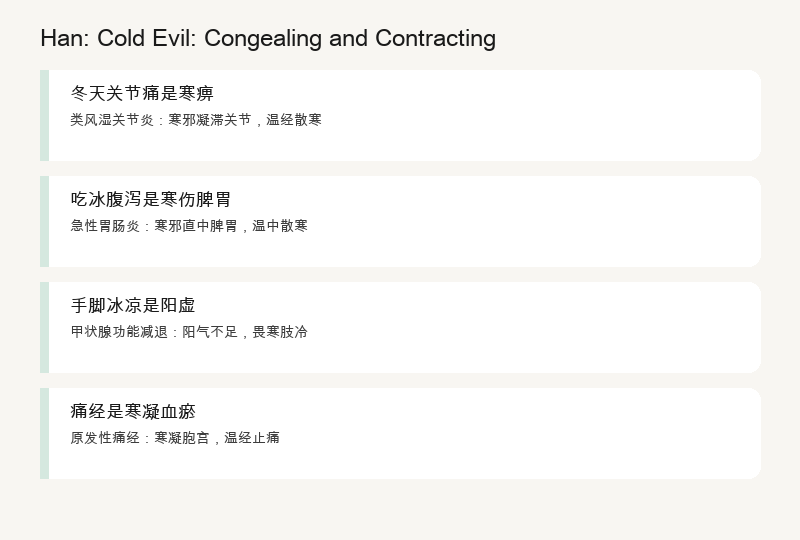
Case One: Winter Joint Pain.
In winter your knees ache faintly, getting worse when exposed to cold and easing with heat application. The doctor says: "Cold evil stagnates, blocking the channels and collaterals."
Truth: Cold stimuli cause blood vessel contraction around the joints, increased synovial fluid viscosity, and reduced blood supply to joint cartilage. At the same time, cold makes muscles and ligaments stiff, increasing friction during joint movement. Metabolic products accumulate and stimulate nerve endings, producing pain. Heat application dilates blood vessels, restores synovial fluid flow, and relieves pain. It is not "cold qi in the joints," but physiological changes in blood vessels, synovial fluid, and muscles caused by low temperature. However, the metaphor of "cold stagnation" precisely describes this process.
Case Two: Diarrhea from Eating Iced Watermelon.
In summer you eat a big bowl of iced watermelon, and your stomach immediately cramps, sending you running to the bathroom. The doctor says: "Cold evil strikes directly, spleen yang is damaged."
Truth: Cold drinks cause gastric and intestinal mucosal blood vessel contraction, reduced digestive juice secretion, and intestinal peristalsis disorder (first slowing then accelerating). Low temperature also stimulates the intestinal vagus nerve, causing intestinal spasms and increased secretion. The result is abdominal pain and diarrhea. It is not "cold evil entering the spleen," but direct stimulation of low temperature on the digestive system. However, the description "cold evil strikes directly" very vividly explains how cold drinks directly harm the digestive system.
Case Three: Uterine Cold Menstrual Cramps.
During your period you eat cold food, and your lower abdomen hurts severely, as if there were ice cubes inside. The doctor says: "Uterine cold with blood stasis; where there is no free flow, there is pain."
Truth: Cold stimuli cause pelvic blood vessel contraction and reduced uterine blood flow. Endometrial ischemia and hypoxia increase prostaglandin secretion, causing strong uterine smooth muscle contraction (menstrual cramps). Heat application or drinking hot water dilates pelvic blood vessels, improves blood flow, and relaxes uterine smooth muscle, relieving pain. It is not "cold qi in the uterus," but pelvic blood vessel contraction and uterine smooth muscle spasm caused by low temperature. However, the metaphor of "uterine cold" precisely describes this pathological process.
Case Four: The Elderly with Ice-Cold Hands and Feet.
Your grandmother's hands and feet are ice-cold in winter, and even two quilts can't warm her up. The doctor says: "Yang deficiency with excessive cold, the four limbs lose warmth."
Truth: Elderly people have enhanced peripheral blood vessel contraction reactions and reduced skin blood flow. Thyroid function may be reduced, and basal metabolic rate drops. Autonomic nervous regulation function declines, and thermoregulation ability decreases. Anemia or malnutrition may also lead to insufficient heat production. Ice-cold hands and feet are the combined result of insufficient metabolic heat production + peripheral blood vessel contraction + reduced thermoregulation function. It is not "yang qi deficiency," but the metaphor of "yang deficiency" very vividly describes the reduced metabolic and circulatory function.
Four cases, one underlying logic: cold is not the temperature itself, but the inhibitory effect of low temperature on physiological function—contraction, stagnation, and pain.
Part 5Modern Research
Is there scientific research on "cold"?
Yes, and quite a lot. Scientists don't use the word "cold"; they use:
• Blood vessel contraction and blood flow. Cold stimuli cause blood vessel contraction through the sympathetic nervous system, and skin blood flow can be reduced by more than 80%. Tissue ischemia leads to hypoxia, metabolic product accumulation, and inflammatory mediator release, producing pain. This is the scientific basis for "cold stagnates and causes pain." Research shows that Raynaud's patients (fingers turning white and painful when exposed to cold) have abnormally sensitive finger blood vessel contraction reactions. It is not "cold evil stagnation," but ischemic pain caused by excessive blood vessel contraction.
• Low temperature and digestion. Animal experiments show that gastric perfusion with 4°C cold water can reduce gastric mucosal blood flow by 40%, reduce gastric acid secretion, and delay gastric emptying. After intestinal mucosa is exposed to cold, peristalsis is first inhibited then hyperactive, and secretion increases. This is the scientific basis for "cold evil strikes directly, spleen yang is damaged." It is not "cold evil harming the spleen," but direct physiological effects of low temperature on the digestive system.
• Temperature and inflammation. Cold environments can activate certain inflammatory pathways (such as the NLRP3 inflammasome), increasing pro-inflammatory factor release. After joints are exposed to cold, chondrocyte metabolism slows down, and inflammatory factors (IL-1β, TNF-α) accumulate in joint fluid, aggravating pain. Heat application increases blood flow, accelerates inflammatory factor clearance, and relieves pain. This is the scientific basis for "where there is free flow, there is no pain"—not "qi is flowing freely," but blood flow improves, inflammatory mediators are cleared, and pain is relieved.
These studies fully demonstrate that "cold" is a system that can be precisely described in modern scientific language. The ancients summarized it with "cold"; modern people describe it with "blood vessel contraction," "muscle spasm," "metabolic slowing," and "inflammatory mediator accumulation"—they are describing the same pathogenic mechanism.
Part 6Practical Methods
Now that you understand "cold," how do you use it?
First, dispel a few misconceptions:
• Eating ginger can dispel all cold. Ginger can indeed dilate blood vessels and promote digestion, but "dispelling cold" is not universal. When there is heat syndrome (inflammation, infection), eating ginger may worsen symptoms. Ginger is "warm," not "universal."
• Hot water foot soak cures all diseases. Hot water foot soaks can dilate foot blood vessels and improve peripheral blood flow, which is effective for ice-cold hands and feet and mild fatigue. But it cannot treat diabetic foot (may cause burns), varicose veins (may worsen), or severe heart disease (may increase cardiac burden). Understanding indications is more important than blindly "dispelling cold."
Specific methods:
• Keep warm (prevent external cold). In winter, pay attention to keeping the head, neck, and feet warm. The head accounts for 30% of the body's heat loss, the neck has large blood vessels, and the feet are the farthest from the heart. Wearing hats, scarves, and thick socks is not "old-fashioned," it is "scientific cold prevention." TCM says "cold starts from the feet"—when the feet are cold, the whole body's blood vessels contract.
• Avoid cold drinks (protect the spleen and stomach). Especially on an empty stomach, during menstruation, and after exercise, do not drink cold beverages. Cold drinks cause gastric mucosal blood vessel contraction, reduced digestive juice secretion, and gastrointestinal function disorder. TCM says "cold body and cold drink harm the lungs"—cold food and drink harm the digestive system. Modern medicine confirms: when gastric temperature drops, digestive enzyme activity decreases, and gastrointestinal peristalsis becomes disordered.
• Heat application (where there is free flow, there is no pain). For joint pain, menstrual cramps, and stomach cold pain, heat application is an effective relief method. Heat application dilates local blood vessels, increases blood flow, clears metabolic waste, and relaxes muscles. It is not "hot air driving away cold qi," but blood flow improves, oxygen supply is restored, and pain is relieved. But the temperature should not be too high (40-45°C is appropriate), and the time should not be too long (15-20 minutes).
• Moderate exercise (generate heat and free the yang). Exercise is a natural "cold-dispelling" method. During exercise, muscle heat production increases, blood vessels dilate, blood flow accelerates, and metabolism rises. TCM says "movement generates yang"—exercise does not directly "dispel cold," but improves the "cold stagnation" state by increasing metabolism and blood flow. 3-5 times per week of moderate-intensity exercise, 30 minutes each time.
• Warm-nourishing diet (support yang qi). People with yang deficiency constitution (aversion to cold, ice-cold limbs, low spirits) can appropriately consume warm-nourishing foods: lamb, ginger, jujube, longan. These foods are rich in calories, iron, and B vitamins, which can improve metabolism and blood circulation. It is not that "food has yang qi," but nutrition supports metabolism, and calories support body temperature. But during heat syndrome or inflammation, warm-nourishing foods are not appropriate.
These methods do not require you to believe in TCM. You only need to understand: cold is not the temperature itself, but the inhibitory effect of low temperature on physiological function—contraction, stagnation, and pain. Preventing and managing this inhibition is "dispelling cold."
Part 7One-Minute Summary
🕐 Understand "Cold" in One Minute
Cold = ice sculptor / freezer, the pathogen of stagnation, the master of pain.
Cold contracts and stagnates—it is not low temperature, but the inhibitory effect of low temperature on physiological function.
External cold = external low temperature stimulus; internal cold = yang deficiency, reduced metabolic and circulatory function.
Cold = blood vessel contraction + muscle spasm + metabolic slowing + inflammatory mediator accumulation.
Cold is not mysticism; it is a metaphor describing the physiological effects of low temperature.
Reasons for failure: treating cold as an entity, over-relying on "cold-dispelling" folk remedies, warming and nourishing during heat syndrome, neglecting root causes.
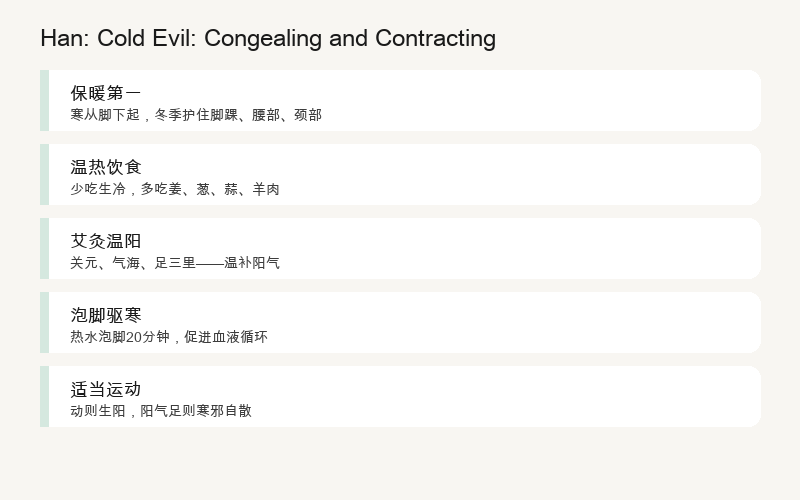
Methods: keep warm (prevent external cold), avoid cold drinks (protect spleen and stomach), heat application (where there is free flow, there is no pain), moderate exercise (generate heat and free the yang), warm-nourishing diet (support yang qi).
The ancients called it "cold stagnates and causes pain"; modern people call it "blood vessel contraction + ischemia and hypoxia + metabolic waste accumulation." Different names, but the body knows: cold is not the enemy; the contraction and stagnation it brings are.
but the inhibition of bodily function by low temperature.
Cold causes qi to contract, blood flow slows; cold stagnates, where there is no free flow, there is pain.
Understanding the essence of cold is understanding how the body is "frozen,"
and how it flows again in warmth.
This is probably the most simple wisdom of the Chinese: Cold evil stagnates, where there is free flow, there is no pain; it is not the temperature, it is the flow.
Making money is the art of living; art is the life after making money.
Giaogiao Decodes Chinese Traditional Wisdom · Concept 42
Using modern scientific language to help the world understand Chinese traditional wisdom.
No mysticism, no deification, no negation.
Understanding, not believing.
Coach Liu
Written in Florence