Why does TCM say "Shu" is not simply heat? The heat assassin in sauna days
Part 1One Question
Have you ever had this experience?
You walk outdoors for half an hour in summer, feeling dizzy, nauseous, sweating all over, and incredibly thirsty. The doctor says: "Heatstroke. Shu evil has injured your fluids." You ask: "Isn't Shu just heat? What's the difference between heat and Shu?" You stay in an air-conditioned room all day, step outside into a heatwave, and feel dizzy and swollen—catching a cold instead. The doctor says: "Yin Shu, damp-heat trapped at the surface." You are even more confused: "Can air conditioning cause heatstroke?" On a scorching day, you drink a cup of iced cola, and your stomach cramps, sending you running to the toilet. The doctor says: "Summer heat injures the spleen, cold drinks promote dampness." You are completely lost: "Aren't cold drinks supposed to relieve heat?"
You ask Western medicine: "What is Shu?" The doctor says: "There is no such concept as Shu; it might be heatstroke or heat exhaustion."
You ask TCM: "What exactly is Shu?" The old doctor says: "Shu is a yang pathogen, characterized by intense heat, consuming qi and injuring fluids. Shu is often accompanied by dampness."
One says "heatstroke," the other says "Shu evil"—are they talking about the same thing?
Even more surprisingly, TCM says Shu comes in two forms: Yang Shu (heatstroke on hot days) and Yin Shu (air conditioning sickness, cold drinks injuring the spleen). Heatstroke on a hot day is understandable, but why does "Shu" also occur in an air-conditioned room? What exactly is going on?
Part 2Traditional Chinese Explanation
The concept of "Shu" was systematically defined in the "Yellow Emperor's Inner Canon." The ancients observed that the unique summer climate—high temperature and high humidity—causes a series of distinctive symptoms: profuse sweating, thirst, fatigue, dizziness, nausea, diarrhea. These are not simply "heat" but Shu evil—"Shu is a yang pathogen, characterized by intense heat, consuming qi and injuring fluids" ("Suwen · On Heat").
— "Suwen · On Heat"
"Shu qi connects with the heart."
— "Suwen · On the Five Elements"
"Shu causes qi to leak, hence profuse sweating."
— "Medical Gate Law"
TCM summarizes the functions and characteristics of "Shu" into four key words: Heat, Depletion, Dampness, Seasonality.
Heat (Intense Heat)—Shu is a yang pathogen, characterized by intense heat. Shu evil causing disease first manifests as heat signs: high fever, flushed face, thirst, irritability. But the heat of Shu is different from ordinary "heat evil"—Shu is the unique combination of high temperature plus high humidity in summer, not merely high temperature alone.
Depletion (Consuming Qi and Injuring Fluids)—"Shu causes qi to leak, hence profuse sweating." In summer, high temperatures cause the body to sweat heavily to dissipate heat, losing water and electrolytes. At the same time, high temperatures accelerate metabolism, increasing energy consumption. The result is "dual injury of qi and fluids"—thirst (fluid injury), fatigue (qi deficiency), dizziness (qi and blood insufficiency). During heatstroke, profuse sweating carries away sodium and potassium, causing electrolyte imbalance—this is precisely the manifestation of "consuming qi and injuring fluids."
Dampness (Accompanied by Dampness)—"Shu is often accompanied by dampness." Summer's high temperatures are accompanied by high humidity (sauna days), and dampness obstructs qi movement, trapping spleen yang. Manifestations include: heaviness of the body, chest tightness, poor appetite, diarrhea, thick greasy tongue coating. Shu and dampness are a "pair"—Shu's nature is to rise and disperse, opening the pores; dampness is sticky and stagnant, obstructing qi movement. Combined, they both deplete and trap.
Seasonality (Seasonal Nature)—Shu is a pathogenic factor unique to summer. TCM says "before the summer solstice is warm, after the summer solstice is Shu"—Shu has a strict time limitation. This does not mean there is no high temperature in other seasons, but that the combination of high temperature plus high humidity in summer has unique disease-causing characteristics. Modern medicine also confirms: the summer high-temperature and high-humidity environment indeed causes unique health problems (heatstroke, heat cramps, heat exhaustion).
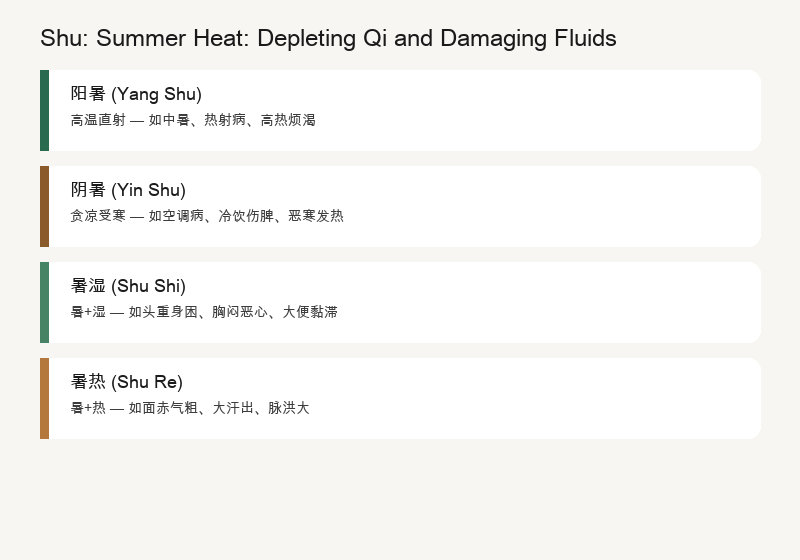
Shu is also divided into Yang Shu and Yin Shu:
• Yang Shu—Direct heatstroke on extremely hot days. In a high-temperature environment, the body's heat dissipation is insufficient, and core body temperature rises. Manifestations: high fever, profuse sweating, thirst, fatigue, dizziness, and in severe cases, altered consciousness (heatstroke).
• Yin Shu—In summer, craving coolness, instead receiving cold-dampness. Catching cold in an air-conditioned room, cold drinks injuring the spleen, catching a cold after cold showers. Manifestations: dizzy and swollen head, nasal congestion and runny nose, abdominal pain and diarrhea, heaviness of the body. Not "heatstroke," but summer's "cold wrapping fire" or "cold-dampness trapping the spleen."
So what the ancients called "Shu" is not just "heat," but a summer-specific combination of high temperature and high humidity as a pathogenic factor—consuming qi and injuring fluids, accompanied by dampness trapping the spleen. The ancients used "Shu" to summarize what modern people need multiple concepts—"heatstroke," "heat exhaustion," "electrolyte imbalance," "high-temperature high-humidity environmental disease"—to explain clearly.
Part 3giaogiao Modern Translation
Okay, now let's translate "Shu" into modern language.
I don't intend to talk about heatstroke, electrolyte imbalance, or thermoregulation. Too complicated. You only need to remember one metaphor:
Yang Shu = The oven temperature is too high, your body's heat dissipation system is overloaded (heatstroke)
Yin Shu = Switching back and forth between the oven and the refrigerator, your body system is confused (air conditioning sickness)
Consuming Qi and Injuring Fluids = Sweating too much, your body is like a leaking bucket, losing water and electrolytes
Shu Accompanied by Dampness = Sauna mode—high temperature plus high humidity, heat dissipation efficiency is extremely low
Dampness Trapping the Spleen = Dampness makes your body feel like wearing wet clothes—heavy, sticky, uncomfortable
That's it. Your "Shu" is essentially a comprehensive challenge of the summer high-temperature and high-humidity environment to the physiological system—not only hot, but also humid; not only depleting water, but also depleting energy.
Specifically:
What does Yang Shu correspond to? It corresponds to heat-related illnesses in modern medicine. Heat exhaustion—profuse sweating, thirst, fatigue, dizziness—corresponds to "Shu injuring qi and fluids." Heatstroke—core body temperature exceeding 40°C, altered consciousness—corresponds to "summer heat internally trapped." Heat cramps—electrolyte imbalance after profuse sweating, muscle cramps—correspond to "Shu injuring fluids and nutrients, sinews and vessels losing nourishment." The essence of Yang Shu is in a high-temperature environment, the thermoregulation system is overloaded and heat dissipation is insufficient.
What does Yin Shu correspond to? It corresponds to summer "temperature shock" and "improper diet." The air-conditioned room temperature is too low, the indoor-outdoor temperature difference is large, and when entering and exiting, the thermoregulation system frequently switches, making it easy to catch a cold. Cold beverages cause constriction of blood vessels in the gastrointestinal mucosa, digestive dysfunction, and diarrhea. After a cold shower, the pores suddenly close, heat dissipation is blocked, and dizziness results instead. The essence of Yin Shu is "temperature shock" and digestive dysfunction caused by craving coolness in summer—not a "heat" problem, but a "cold" problem.
What does "consuming qi and injuring fluids" correspond to? It corresponds to dehydration and electrolyte imbalance. Under high temperatures, profuse sweating occurs, losing water and electrolytes such as sodium, potassium, and chloride. Insufficient water leads to decreased blood volume and lowered blood pressure (dizziness). Insufficient sodium causes muscle cramps and fatigue. Insufficient potassium causes arrhythmias. At the same time, high temperatures accelerate metabolism, increasing energy consumption (ATP consumption), producing a feeling of fatigue. This is the scientific basis for "dual injury of qi and fluids"—not that "qi" and "fluids" are injured, but water-electrolyte and energy metabolism disorder.
What does "Shu often accompanied by dampness" correspond to? It corresponds to the effect of high-temperature and high-humidity environments on thermoregulation. When humidity is high, sweat evaporation slows, and heat dissipation efficiency decreases. The thermoregulation system needs to work harder (more sweating), but the effect is worse. The result is: more fluid loss, more energy consumption, but insufficient heat dissipation. At the same time, high-humidity environments favor microbial reproduction, increasing infection risk. This is the scientific basis for "summer dampness"—not "dampness evil" invading, but high humidity reducing heat dissipation efficiency and increasing metabolic burden.
So, "Shu" is not metaphysics. It is a functional metaphor—describing the combined effects of the summer high-temperature and high-humidity environment on the physiological system. The ancients used "Shu" to summarize what modern people need multiple concepts—"heatstroke," "heat exhaustion," "electrolyte imbalance," "high-temperature high-humidity environmental disease"—to explain clearly.
Part 4Life Cases
Four stories to help you instantly understand what "Shu" is.
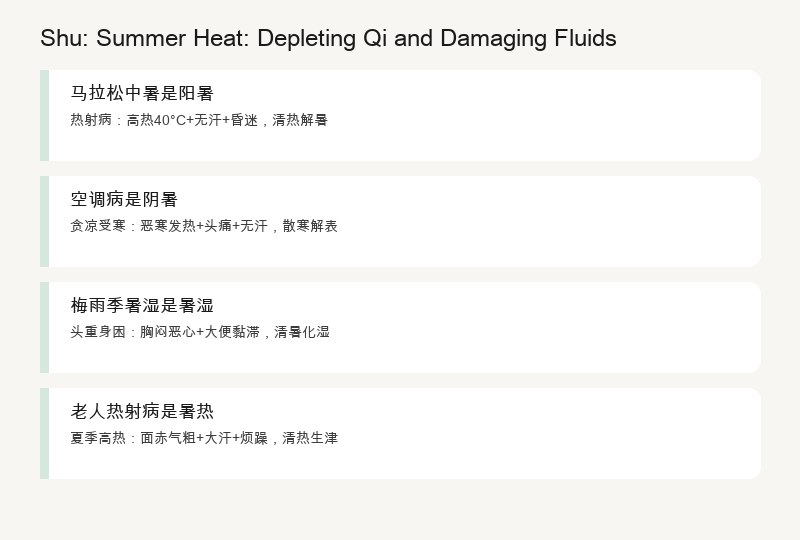
Case One: Heatstroke at a construction site.
You work outdoors at a construction site in summer, under the blazing sun, rain-like sweat, suddenly feeling dizzy and nauseous, almost fainting. Your coworker pulls you into the shade, you drink a lot of water, and slowly recover. The doctor says: "Yang Shu, Shu evil injuring fluids."
The truth: In a high-temperature environment, the body dissipates heat through sweating. But excessive sweating causes large losses of water and electrolytes (sodium, potassium). Decreased blood volume leads to lowered blood pressure, insufficient blood supply to the brain (dizziness). Electrolyte imbalance affects neuromuscular function (nausea, muscle cramps). Core body temperature rises, the thermoregulation center is overloaded. It is not "Shu evil invading," but thermoregulation overload in a high-temperature environment plus water-electrolyte imbalance. Yet the description of "Shu injuring qi and fluids" precisely summarizes this process.
Case Two: Air conditioning sickness.
You stay in an air-conditioned room all day in summer, step outside into a heatwave, and feel dizzy and swollen, nasal congestion and runny nose, like catching a cold. The doctor says: "Yin Shu, summer dampness trapped at the surface."
The truth: The air-conditioned room is low (20-22°C), outdoor temperature is high (35°C+), the temperature difference exceeds 10°C. Frequent entering and exiting, the thermoregulation system frequently switches modes, sympathetic and parasympathetic nerves alternately excite, causing dizziness and fatigue. Air-conditioned room air is dry, nasal mucosa dries, lowering local immunity. Cold wind directly blowing on the face may induce facial nerve paralysis (Bell's palsy). It is not "Yin Shu invading," but temperature shock plus dry air plus decreased immunity. Yet the metaphor of "Yin Shu" precisely describes the consequences of craving coolness in summer.
Case Three: Drinking ice-cold beer on a hot summer day.
You drink a few bottles of ice-cold beer on a scorching day, feeling great at the moment, but after a while, abdominal pain and diarrhea, no appetite. The doctor says: "Summer heat injures the spleen, cold drinks promote dampness."
The truth: Under high temperatures, gastrointestinal blood flow is already reduced (blood is allocated to the skin for heat dissipation). Cold drinks cause further constriction of gastrointestinal mucosal blood vessels, reduced blood flow, decreased digestive enzyme activity. Low temperature stimulates intestinal nerves, causing increased intestinal peristalsis and secretion, leading to diarrhea. Alcohol itself suppresses the central nervous system, affecting thermoregulation. It is not "dampness evil" invading, but direct low-temperature stimulation of the digestive system plus alcohol's suppressive effect. Yet the description of "summer heat injuring the spleen" captures the core problem of improper summer diet.
Case Four: Muscle cramps during summer exercise.
You go running in summer, after 5 kilometers, your calf suddenly cramps, severe pain. The doctor says: "Shu injures fluids and nutrients, sinews and vessels losing nourishment."
The truth: Exercising under high temperatures, profuse sweating, loss of electrolytes such as sodium, potassium, and magnesium. Insufficient sodium affects the potential balance of muscle cell membranes, leading to spontaneous muscle contraction (cramp). At the same time, dehydration reduces muscle blood flow, metabolic products accumulate. It is not "fluids and nutrients injuring sinews and vessels," but electrolyte imbalance plus dehydration causing muscle cramps. Yet the metaphor of "Shu injuring fluids and nutrients" precisely describes this physiological process.
Four cases, one underlying logic: Shu is not simply heat, but a comprehensive challenge of summer high-temperature and high-humidity to the physiological system—Heat, Depletion, Dampness, Seasonality.
Part 5Modern Research
Is there scientific research on "Shu"?
Yes, and a lot. Scientists don't use the word "Shu"; they use:
• Heat-Related Illnesses. WHO and CDC both have clear classifications of heat-related illnesses: heat cramps, heat exhaustion, heatstroke. Heatstroke mortality exceeds 50%. Pathogenesis: under high temperatures, the thermoregulation center is overloaded, heat dissipation is insufficient, core body temperature rises, cellular damage occurs, inflammatory response, multiple organ dysfunction. This is the scientific basis for "Yang Shu"—not "Shu evil trapping the orifices," but thermoregulation system collapse.
• High Temperature and High Humidity with Mortality. Epidemiological studies show that when wet-bulb temperature exceeds 35°C, the human body cannot dissipate heat even at rest, and mortality rises sharply. The synergistic effect of high-temperature and high-humidity environments is more dangerous than high temperature alone. This is the scientific basis for "Shu often accompanied by dampness"—not "dampness evil" invading, but high humidity reducing heat dissipation efficiency and increasing thermoregulation burden.
• Air Conditioning and Health. Studies show that air-conditioned room temperatures that are too low (<20°C) or temperature differences that are too large (>8°C) increase the risk of respiratory infections. If air conditioning filters are not cleaned, they breed pathogens such as Legionella, causing "air conditioning sickness." Cold wind blowing directly on the face may induce facial nerve inflammation (Bell's palsy). This is the scientific basis for "Yin Shu"—not "Yin Shu invading," but temperature shock plus microbial exposure plus nerve stimulation.
These studies fully demonstrate: "Shu" is a system that can be precisely described in modern scientific language. The ancients used "Shu" to summarize, modern people use "heat-related illnesses," "electrolyte imbalance," "high-temperature high-humidity environmental disease" to describe—they are talking about the same summer-specific health problem.
Part 6Practical Methods
Understanding "Shu," how do you use it?
First, dispel a few misconceptions:
• Heatstroke is just fainting from heat, drink some water and you'll be fine. Mild heat exhaustion can be relieved by drinking water, but heatstroke is an emergency requiring immediate cooling (ice packs, cold baths) and medical attention. Drinking water alone cannot solve the problem of rising core body temperature.
• Drink more cold beverages in summer to relieve heat. Cold beverages temporarily lower oral temperature, but stimulate constriction of gastrointestinal blood vessels, affecting digestion. At the same time, cold beverages may cause pores to constrict, instead hindering heat dissipation. What truly relieves heat is warm or room-temperature beverages, which do not stimulate the gastrointestinal tract or hinder pore heat dissipation.
Specific methods:
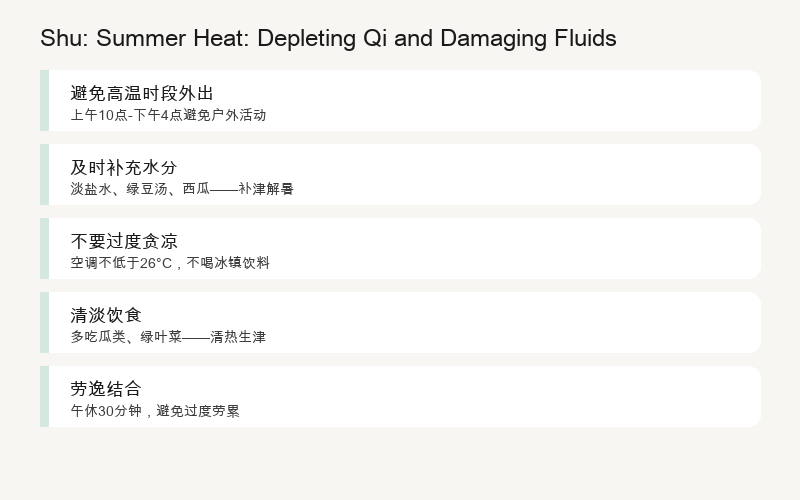
• Avoid going out during high-temperature periods (prevent Yang Shu). From 10 a.m. to 4 p.m. is the hottest period of the day. Try to avoid outdoor activities during this time. If you must go out, wear a hat, light-colored breathable clothing, and use an umbrella. Not "avoiding evil," but reducing heat exposure.
• Replenish water and salt (prevent consuming qi and injuring fluids). Under high temperatures, sweating is heavy, so you need to replenish not only water but also electrolytes. Sports drinks, light salt water, and coconut water are all good choices. Drinking large amounts of plain water alone may dilute sodium in the blood, leading to hyponatremia (water intoxication). Water replenishment should be "small amounts, multiple times," not gulping down several liters at once.
• Air conditioning temperature appropriate (prevent Yin Shu). Set air conditioning temperature at 26-28°C, with an outdoor temperature difference not exceeding 8°C. Avoid cold wind blowing directly on the body, especially the face and abdomen. Open windows regularly for ventilation to keep air fresh. Clean air conditioning filters regularly to prevent microbial growth. Not "preventing Yin Shu," but reducing temperature shock and microbial exposure.
• Light diet (prevent summer dampness trapping the spleen). In summer, appetite decreases and digestive function weakens. Diet should be light and easily digestible: porridge, noodles, vegetables, fruits. Avoid greasy, spicy, and cold foods. Moderately consume "heat-relieving" foods: mung beans, watermelon, cucumber, bitter melon. These foods are rich in water and electrolytes, not "heat-relieving," but supplementing water and nutrients, reducing digestive burden.
• Recognize heatstroke signs (respond in time). Early signs of heatstroke: profuse sweating, thirst, fatigue, dizziness, nausea. If these signs appear, immediately move to a cool place, loosen clothing, use wet towels or ice packs to cool down, and replenish electrolyte-containing beverages. If body temperature exceeds 40°C, consciousness is blurred, or the person is unconscious, immediately call emergency services. This is heatstroke, and it can be fatal.
These methods do not require you to believe in TCM. You only need to understand: Shu is not simply heat, but a comprehensive challenge of summer high-temperature and high-humidity to the physiological system—Heat, Depletion, Dampness, Seasonality. Preventing and managing these challenges is "relieving Shu."
Part 7One Minute Summary
🕐 One Minute to Understand "Shu"
Shu = Heat Assassin / Summer Oven, a summer-specific pathogenic factor.
Shu is characterized by intense heat, consuming qi and injuring fluids, accompanied by dampness—not simply heat, but a comprehensive challenge of high temperature plus high humidity.
Yang Shu = Heat dissipation system overloaded in a high-temperature environment; Yin Shu = Temperature shock caused by craving coolness in summer.
Shu = Heatstroke / Heat exhaustion + Water-electrolyte imbalance + High-temperature high-humidity heat dissipation障碍.
Shu is not metaphysics; it is an ancient description of summer environmental physiology.
Causes: Treating Shu as simple heat, ignoring humidity effects, over-relying on cold drinks, not paying attention to early heatstroke signs.
Methods: Avoid going out during high-temperature periods (prevent Yang Shu), replenish water and salt (prevent consuming qi and injuring fluids), appropriate air conditioning temperature (prevent Yin Shu), light diet (prevent summer dampness trapping the spleen), recognize heatstroke signs (respond in time).
The ancients called it "Shu is a yang pathogen, consuming qi and injuring fluids"; modern people call it "high-temperature high-humidity environment plus thermoregulation overload plus water-electrolyte imbalance."
Different names, but the body knows: summer's greatest enemy is not heat, but heat and humidity together.
but a comprehensive attack on the body by heat and humidity together in summer.
Yang Shu is the oven overheating; Yin Shu is alternating between hot and cold.
Understanding the essence of Shu means understanding how the body battles heat and humidity in summer,
and how it maintains balance between water and energy.
This is probably the most simple wisdom of the Chinese: Shu is often accompanied by dampness, consuming qi and injuring fluids; summer's enemy is never heat alone.
Making money is the art of living; art is the life after making money
giaogiao Explains Traditional Chinese Wisdom · Concept 43
Using modern scientific language to help the world understand traditional Chinese wisdom.
No mysticism, no superstition, no belittlement.
Understanding, not just believing.
Coach Liu
Written in Florence