Why does TCM say autumn needs to guard against "Zao"? The dryness evil like a dryer
Part 1One Question
Have you ever had this experience?
Your lips are chapped in autumn, and lip balm doesn't help with the peeling. Your nose is dry, and when you blow it, there is blood in the mucus. Your throat is dry and itchy, you cough incessantly, no phlegm, like sandpaper grinding. Your skin is dry, after a shower it feels tight, like it's about to crack. You are constipated in autumn, stool is hard and dry, like sheep dung. The doctor says: "Autumn Zao has injured your fluids." You ask: "Isn't Zao just dryness? Doesn't drinking more water help?" You drink eight glasses of water, and still feel dry. The doctor says: "Zao evil is not a lack of water, but a disorder of fluid distribution." You are even more confused.
You ask Western medicine: "What is Zao?" The doctor says: "There is no such concept as Zao; it might be Sjögren's syndrome or environmental dryness."
You ask TCM: "What exactly is Zao?" The old doctor says: "Zao is dry and astringent by nature, easily injuring fluids. Autumn Zao injures the lungs, and the lungs govern the skin and hair."
One says "environmental dryness," the other says "Zao evil injuring fluids"—are they talking about the same thing?
Even more surprisingly, TCM says Zao also comes in two forms: Warm Zao (early autumn, heat plus dry) and Cool Zao (late autumn, cold plus dry). It's the same dryness, so why are there hot dryness and cold dryness? What exactly is going on?
Part 2Traditional Chinese Explanation
The concept of "Zao" was systematically defined in the "Yellow Emperor's Inner Canon." The ancients observed that autumn's unique climate—dry and cool—causes a series of distinctive symptoms: dry mouth, dry nose, dry skin, dry cough, constipation. These are not simply "dryness" but Zao evil—"When dryness prevails, there is dryness" ("Suwen · On the Correspondence of Yin and Yang").
— "Suwen · On the Correspondence of Yin and Yang"
"In autumn, injury from dryness causes upward counterflow and cough."
— "Suwen · On the Variations of Qi in the Atmosphere"
"For dryness, moisten it."
— "Suwen · On the Great Treatise of the Ultimate Truth"
TCM summarizes the functions and characteristics of "Zao" into three key words: Dry, Injure, Seasonal.
Dry (Dry and Astringent)—"When dryness prevails, there is dryness." Zao evil causing disease first manifests as dryness: dry mouth, dry nose, dry throat, dry skin, dry stool. Zao evil causes depletion of body fluids, and mucous membranes and skin lose moisture. But Zao's "dryness" cannot be solved by simply drinking water—it is a problem of fluid distribution and mucosal barrier.
Injure (Injure Fluids)—"Zao is dry and astringent by nature, easily injuring fluids." Zao evil directly damages the body's fluid system. Fluids are a TCM concept, including water, mucus, lubricating fluid, etc. Zao evil causes insufficient fluid production or impaired distribution. The lungs are the "upper source of water," governing diffusion and depuration, and distributing fluids. Autumn Zao first injures the lungs, and when lung fluids are insufficient, there is dry mouth, dry nose, and dry cough.
Seasonal (Seasonal Nature)—Zao is a pathogenic factor unique to autumn. Autumn's climate is dry, humidity drops, and the temperature difference between morning and evening is large. TCM says "autumn Zao"—the Zao evil of autumn. Modern medicine also confirms: autumn air humidity drops, respiratory mucosa dries, increasing the risk of respiratory infections. Autumn is the high season for rhinitis, pharyngitis, and dry skin.
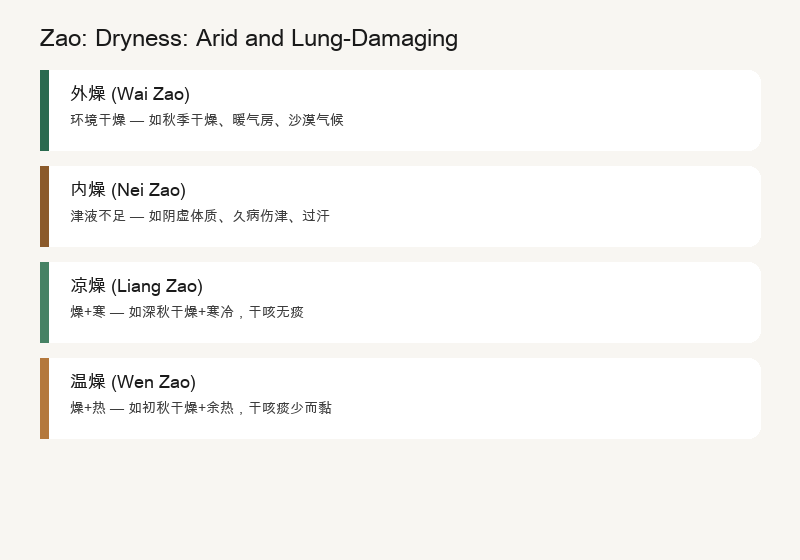
Zao is also divided into External Zao and Internal Zao:
• External Zao—Dry climatic conditions from the outside invade. In autumn, air is dry, humidity is low (<40%), directly damaging respiratory and skin mucosa. Manifestations: dry mouth, dry nose, dry throat, dry skin, dry cough.
• Internal Zao—Insufficient body fluids. Yin-deficient constitution, long-term staying up late, excessive voice use, chronic diseases (such as diabetes) cause fluid depletion. Manifestations: dry mouth and tongue, dry skin, constipation, dry eyes, five-center heat.
External Zao is further divided into Warm Zao and Cool Zao:
• Warm Zao—Early autumn, summer heat has not yet completely subsided, Zao plus heat. Manifestations: dry mouth, dry nose, dry cough with little phlegm, blood-streaked phlegm, sore and swollen throat, slight fever. Like a "hot dryer."
• Cool Zao—Late autumn, weather turns cool, Zao plus cold. Manifestations: dry mouth, dry nose, dry cough, little clear thin phlegm, aversion to cold, no sweating. Like a "cold blow dryer."
So what the ancients called "Zao" is not just "dryness," but autumn's dry climate causing damage to the fluid system—dry and astringent, injuring fluids, seasonal. The ancients used "Zao" to summarize what modern people need multiple concepts—"environmental dryness," "mucosal barrier damage," "fluid metabolism disorder"—to explain clearly.
Part 3giaogiao Modern Translation
Okay, now let's translate "Zao" into modern language.
I don't intend to talk about mucosal barriers, tear secretion, or stratum corneum water content. Too complicated. You only need to remember one metaphor:
External Zao = The dryer is blowing at you (environmental dryness, low humidity)
Internal Zao = The body's own water pipe system is leaking (insufficient fluid production or impaired distribution)
Warm Zao = Hot dryer (early autumn, heat plus dry)
Cool Zao = Cold blow dryer (late autumn, cold plus dry)
Zao injuring the lungs = The respiratory tract is the first line of defense, first to be "dried out"
That's it. Your "Zao" is essentially damage to mucous membranes and skin caused by dry environment or insufficient fluids—not simply a lack of water, but a disorder of mucosal barrier and moisture mechanisms.
Specifically:
What does External Zao correspond to? It corresponds to the environmental dryness effect in modern medicine. Autumn air humidity drops (<40%), the mucus layer on the surface of respiratory mucosa thins, ciliary movement weakens, and the ability to clear pathogens decreases. Skin stratum corneum water content drops, and barrier function weakens. Tear evaporation from the eyes accelerates, dry eye symptoms worsen. Nasal mucosa dries, capillaries become fragile and easily bleed. The essence of External Zao is mucosal and skin barrier function decline caused by low environmental humidity.
What does Internal Zao correspond to? It corresponds to mucosal secretion disorders and abnormal body fluid metabolism in modern medicine. Diabetes (high blood sugar causes osmotic diuresis, fluid loss), Sjögren's syndrome (autoimmune attack on exocrine glands), hyperthyroidism (metabolism accelerates, water consumption increases), long-term staying up late (autonomic nerve disorder, mucosal secretion decreases). The essence of Internal Zao is insufficient body fluid production or excessive consumption, causing mucous membranes and skin to lack moisture.
What do "Warm Zao" and "Cool Zao" correspond to? They correspond to climate characteristics of different autumn stages. Early autumn (September), summer heat has not yet completely subsided, temperatures are still high (25-30°C), but humidity has already dropped. At this time, Zao is "heat plus dry"—respiratory mucosa dryness plus mild inflammatory response (sore and swollen throat). Late autumn (October-November), temperature drops (15-20°C), humidity further decreases. At this time, Zao is "cold plus dry"—respiratory mucosa dryness plus vasoconstriction plus reduced mucosal blood flow. The difference between Warm Zao and Cool Zao is essentially temperature's different effects on mucosal vascular status and inflammatory response.
So, "Zao" is not metaphysics. It is a functional metaphor—describing damage to mucous membranes and skin caused by dry environment or insufficient fluids. The ancients used "Zao" to summarize what modern people need multiple concepts—"environmental dryness," "mucosal barrier damage," "fluid metabolism disorder"—to explain clearly.
Part 4Life Cases
Four stories to help you instantly understand what "Zao" is.
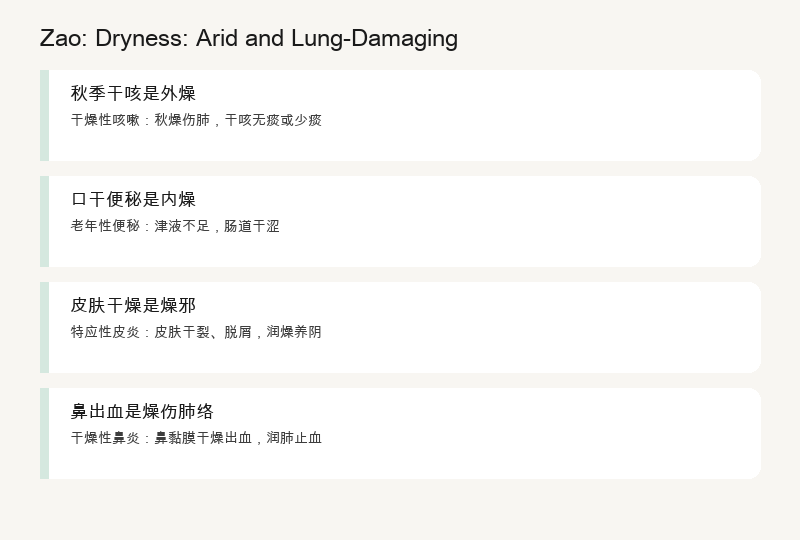
Case One: Nosebleed in autumn.
When you blow your nose in autumn, you find blood in the mucus. The doctor says: "Autumn Zao injures the lungs, the nose is the orifice of the lungs."
The truth: In autumn, air humidity is low, and nasal mucosa dries out. Nasal mucosa has abundant capillaries, and dryness makes mucosa fragile, so capillaries easily rupture. At the same time, autumn allergens (pollen, dust mites) increase, allergic rhinitis causes frequent sneezing and nose blowing, further damaging mucosa. It is not "Zao evil injuring the lungs," but environmental dryness plus fragile mucosa plus mechanical irritation causing capillary rupture. But the metaphor of "autumn Zao injuring the lungs" precisely describes this process.
Case Two: Incessant dry cough in autumn.
In autumn, your throat is dry and itchy, you have a dry cough, no phlegm, coughing so much you can't sleep. The doctor says: "Zao evil invades the lungs, the lungs lose moisture."
The truth: In autumn, air is dry, and the mucus layer on the surface of respiratory mucosa thins. The mucus layer is the protective barrier of the respiratory tract, which can adsorb dust and pathogens and clear them through ciliary movement. After the mucus layer thins, the respiratory tract loses protection, nerve endings are exposed, and stimulated, they cause the cough reflex. At the same time, dry air directly stimulates the trachea, triggering a dry cough. It is not "the lungs being dried by Zao evil," but decline in respiratory mucosal barrier function causing irritative cough. But the metaphor of "the lungs losing moisture" very vividly describes this pathological process.
Case Three: Constipation in autumn.
In autumn, your stool is hard and dry, like sheep dung, only once every few days. The doctor says: "Autumn Zao injures fluids, the intestines lose moisture."
The truth: In autumn, water intake may decrease (not as thirsty as in summer). At the same time, autumn diet tends to be dry (nuts, roasted foods), with insufficient dietary fiber intake. Intestinal water absorption increases, stool water content decreases, becoming hard and dry. In the elderly, intestinal peristalsis slows, making autumn constipation more likely. It is not "Zao evil drying out the intestines," but insufficient water intake plus insufficient dietary fiber plus slowed intestinal peristalsis combined. But the metaphor of "the intestines losing moisture" precisely describes the pathology of dry, hard stool.
Case Four: Dry eyes and dry mouth after staying up late.
You stay up late working overtime for several consecutive days, your eyes are dry, your mouth is dry, your skin is dry. The doctor says: "Yin deficiency with internal Zao, insufficient fluids."
The truth: Staying up late causes autonomic nervous system disorder, with sympathetic nerves continuously excited, inhibiting parasympathetic nerves (responsible for secretion). Tear and salivary gland secretion decreases, causing dry eyes and dry mouth. At the same time, staying up late raises cortisol, promoting water excretion, worsening dehydration. The skin repairs at night, and staying up late impairs repair function, weakening barrier function. It is not "yin deficiency," but autonomic nervous system disorder plus hormone imbalance plus impaired repair function causing dry mucous membranes and skin. But the metaphor of "yin deficiency with internal Zao" describes the nervous-endocrine-immune system disorder very vividly.
Four cases, one underlying logic: Zao is not simply "dryness," but damage to mucous membranes and skin caused by dry environment or insufficient fluids—barrier function decline, reduced secretion, exposed nerve endings.
Part 5Modern Research
Is there scientific research on "Zao"?
Yes, and a lot. Scientists don't use the word "Zao"; they use:
• Low Humidity and Respiratory Health. Studies show that when indoor humidity is below 40%, the mucus layer on the surface of respiratory mucosa thins, and ciliary clearance function drops by more than 50%. Influenza viruses survive longer in low-humidity environments, increasing infection risk. After nasal mucosa dries, IgA (local immunoglobulin) secretion decreases, making it easier for pathogens to invade. This is the scientific basis for "autumn Zao injures the lungs"—not "Zao evil invading the lungs," but low humidity causing respiratory barrier function decline, increasing infection risk.
• Skin Barrier and Transepidermal Water Loss (TEWL). When skin stratum corneum water content drops below 10%, barrier function significantly declines, and TEWL increases. In dry environments, stratum corneum lipid structure changes, intercellular connections loosen, and external irritants and allergens penetrate more easily. Autumn dry skin, itching, and allergies increase for this reason. Studies show that using moisturizers can restore stratum corneum water content and reduce TEWL. This is the scientific basis for "moistening Zao"—not "moistening medicine" being magical, but moisturizers restoring skin barrier function.
• Tear Secretion and Dry Eye. Autumn air humidity drops, and tear evaporation accelerates. Studies show that for every 10% decrease in environmental humidity, tear evaporation rate increases by 15%. At the same time, autumn allergens increase, allergic conjunctivitis causes reduced tear secretion. Dry eye syndrome is more common in autumn—not "Zao evil injuring the eyes," but low environmental humidity plus allergen irritation plus accelerated tear evaporation.
These studies fully demonstrate: "Zao" is a system that can be precisely described in modern scientific language. The ancients used "Zao" to summarize, modern people use "environmental dryness," "mucosal barrier damage," "skin barrier dysfunction" to describe—they are talking about the same autumn health problem.
Part 6Practical Methods
Understanding "Zao," how do you use it?
First, dispel a few misconceptions:
• Drinking more water can moisten Zao. Drinking water can replenish body fluids, but "moistening Zao" is not just about hydrating. Mucosal moisture requires the combined action of mucus secretion, blood supply, and nerve regulation. Simply drinking water, if the body cannot effectively distribute it, may still result in dryness. This is why some people "drink eight glasses of water and still feel dry."
• Eating spicy food in autumn to "dispel dampness". Autumn is already dry, and spicy food causes mucosal congestion and accelerates water evaporation, worsening dryness. Capsaicin stimulation makes nasal and oral mucosa even more uncomfortable. Autumn diet should be mainly moistening and light.
Specific methods:
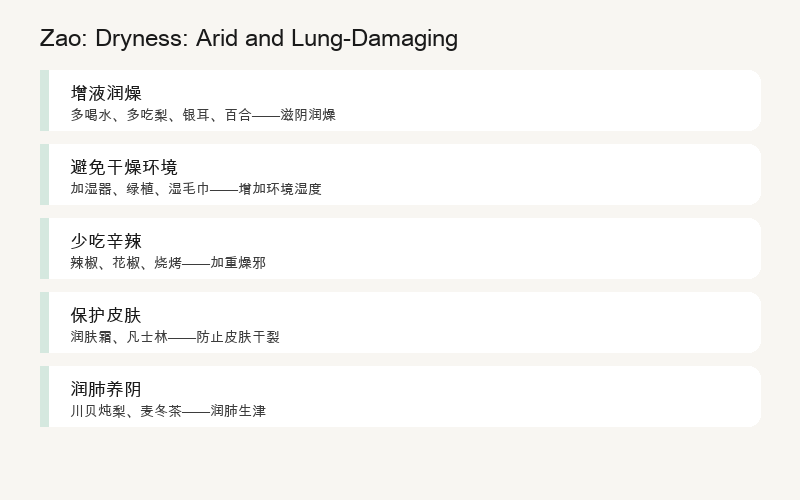
• Humidify (prevent External Zao). When indoor humidity in autumn is below 40%, use a humidifier to maintain humidity at 50-60%. If you don't have a humidifier, you can place a basin of water indoors, or hang wet towels on the radiator. Not "preventing Zao evil," but maintaining environmental humidity to protect the mucosal barrier.
• Moisturize skin (protect skin barrier). Within 3 minutes after a shower in autumn, apply moisturizer to lock in moisture. Choose moisturizing products containing ceramides, hyaluronic acid, and glycerin. Avoid using alkaline soaps, switch to gentle body wash. Not "moistening Zao," but repairing skin stratum corneum barrier, reducing TEWL.
• Moisten throat (protect respiratory tract). For autumn dry cough and dry throat, you can use warm salt water to gargle (cleaning plus moisturizing), or use honey-containing throat lozenges. Honey has mild anti-inflammatory and moisturizing effects. You can place a glass of water by the bedside indoors to increase local humidity through evaporation at night. Avoid talking loudly for a long time, let your vocal cords rest. Not "moistening the lungs," but protecting respiratory mucosa, reducing irritation.
• Moistening diet (replenish fluids). In autumn, eat more foods rich in water and mucus: pear, white fungus, lily bulb, lotus root, honey, sesame. These foods are rich in water, vitamins, and polysaccharides, which can moisten mucosa and improve intestinal function. The fructose and sorbitol in pears have a mild laxative effect. The polysaccharides in white fungus have moisturizing and immune-regulating effects. Not "nourishing yin and moistening Zao," but nutritional support for mucosal and skin health.
• Regular routine (prevent Internal Zao). Staying up late is the biggest trigger for "Internal Zao." Ensure 7-8 hours of sleep, let the parasympathetic nerves dominate, and restore mucosal secretion function. Use fewer electronic devices before bed, blue light suppresses melatonin, affecting sleep quality and mucosal repair. Not "nourishing yin," but letting the nervous system and repair system function normally.
These methods do not require you to believe in TCM. You only need to understand: Zao is not simply "dryness," but damage to mucous membranes and skin caused by dry environment or insufficient fluids. Preventing and managing this damage is "moistening Zao."
Part 7One Minute Summary
🕐 One Minute to Understand "Zao"
Zao = Dryer / Dehydrator, the dry and astringent evil, easily injuring fluids.
Zao is dry and astringent, injuring fluids—not simply a lack of water, but a disorder of mucosal barrier and moisture mechanisms.
External Zao = environmental dryness; Internal Zao = insufficient fluid production or impaired distribution.
Warm Zao = early autumn heat plus dry; Cool Zao = late autumn cold plus dry.
Zao = low humidity environment + decline in mucosal barrier function + skin barrier damage + accelerated tear evaporation.
Zao is not metaphysics; it is an ancient description of autumn environmental physiology.
Causes: Treating Zao as simply a lack of water, eating spicy food in autumn, ignoring environmental humidity, excessively relying on drinking water.
Methods: Humidify (prevent External Zao), moisturize skin (protect skin barrier), moisten throat (protect respiratory tract), moistening diet (replenish fluids), regular routine (prevent Internal Zao).
The ancients called it "When dryness prevails, there is dryness"; modern people call it "low humidity + mucosal barrier damage + skin barrier dysfunction."
Different names, but the body knows: autumn's greatest enemy is not cold, but dryness.
but a process by which the environment or the body "extracts" water dry.
Autumn Zao injures the lungs, skin peels, nose bleeds—all are the barrier's cry for help.
Understanding the essence of Zao means understanding how the body protects itself in dryness,
and how it becomes soft again in moisture.
This is probably the most simple wisdom of the Chinese: For dryness, moisten it; autumn is not about drinking water, but preserving every drop of moisture in the body.
Making money is the art of living; art is the life after making money
giaogiao Explains Traditional Chinese Wisdom · Concept 44
Using modern scientific language to help the world understand traditional Chinese wisdom.
No mysticism, no superstition, no belittlement.
Understanding, not just believing.
Coach Liu
Written in Florence