Why does TCM call "Fire" a pathogen of flaming upward? The fire scene inside your body
Part 1A Question
Have you ever had this experience?
You have a mouth ulcer; your tongue tip is bright red like a strawberry, and it hurts so much you can barely speak. The doctor says: "Excessive heart fire." Your eyes are red and swollen, with sticky discharge, and your temper is particularly explosive, easily triggered. The doctor says: "Liver fire flaming upward." Your gums are swollen and painful, you have bad breath, and eating cold food feels better. The doctor says: "Intense stomach fire." You are coughing yellow phlegm, and your throat hurts like it is on fire. The doctor says: "Excessive lung fire." You ask: "What exactly is fire? How can there be fire inside the body?"
You ask Western medicine: "What is fire?" The doctor says: "There is no concept of fire; it might be inflammation or infection."
You ask TCM: "What exactly is fire?" The senior doctor says: "Fire is a yang pathogen; its nature is to flame upward, easily generating wind and moving blood."
One says "inflammation," the other says "fire pathogen" — are they talking about the same thing?
Even more confusingly, TCM says fire also comes in two types: excess fire (like a blazing inferno, with something to burn) and deficient fire (like smoldering charcoal, nothing left to burn but still smoking). The same "fire" — why is it divided into excess and deficient? And all five organs have fire: heart fire, liver fire, stomach fire, lung fire, kidney fire… how many fires are there in the body? What is going on?
Part 2Traditional Chinese Explanation
The concept of "Fire" was systematically defined in the Huangdi Neijing. The ancients observed: some people had mouth ulcers, some had red swollen eyes, some had swollen gums, some coughed yellow phlegm, some were restless and sleepless. The common characteristics of these symptoms were: redness, swelling, heat, and pain, concentrated in the head and face. The ancients summarized this "flaming upward" pathogenic feature as fire pathogen — "Fire is a yang pathogen; its nature is to flame upward" (Suwen · Yin Yang Ying Xiang Da Lun).
— Suwen · Yin Yang Ying Xiang Da Lun
"All fevers with clouded vision and convulsions are attributed to fire."
— Suwen · Zhi Zhen Yao Da Lun
"The five qi cause disease… the heart causes belching, the lung causes coughing, the liver causes talking, the spleen causes swallowing, the kidney causes yawning."
— Suwen · Xuan Ming Wu Qi
TCM summarized the functions and characteristics of "Fire" into four keywords: Flame, Upward, Urgent, Disturb.
Flame (scorching heat) — Fire is a yang pathogen; its nature is scorching. Fire pathogen causes disease with manifestations of heat: fever, red face, thirst, preference for cold drinks. The "heat" of fire is more intense than the "heat pathogen" — fire is "burning," heat is "warmth." Fire has "destructive power"; heat is merely "high temperature."
Upward (flaming upward) — "The nature of fire is to flame upward." Flames burn upward, and fire pathogen disease also manifests mainly in the upper body. Heart fire → mouth ulcers; liver fire → red eyes and headache; stomach fire → swollen gums; lung fire → coughing yellow phlegm; kidney fire → tinnitus and dizziness. Fire pathogen moves upward, attacking the head and face — this is the most distinctive feature of fire pathogen.
Urgent (pressing) — Fire pathogen disease has an acute onset, rapid changes, and severe symptoms. Excess fire is like a blazing inferno; it starts suddenly and the symptoms are severe. High fever, severe pain, heavy bleeding — all are characteristics of fire pathogen. Fire pathogen also easily "generates wind and moves blood" — high fever with convulsions (extreme heat generating wind), bleeding (reckless blood movement due to heat).
Disturb (disturbing the heart spirit) — Fire pathogen disturbs the heart spirit, causing restlessness, insomnia, and delirious speech. Excessive heart fire → restlessness and insomnia; phlegm-fire disturbing the heart → clouded consciousness. The "disturbance" of fire pathogen is rare among other pathogenic factors — it affects not only the body but also the mind.
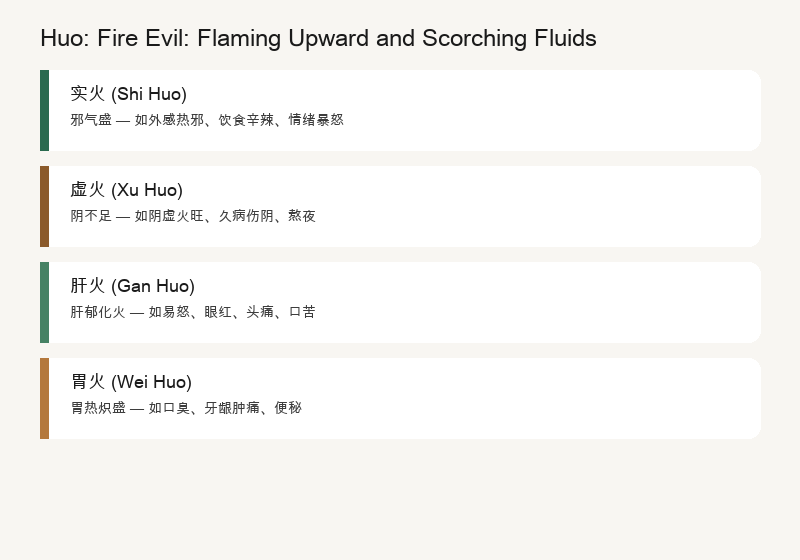
Fire is also divided into excess fire and deficient fire:
• Excess fire — "There is something to burn." There is excess heat in the body, such as infection, inflammation, or dietary stagnation. Manifestations: high fever, red face, thirst, constipation, dark urine, thick yellow tongue coating. Excess fire is like a blazing inferno; it needs "fire extinguishing" (clearing heat and purging fire).
• Deficient fire — "Nothing left to burn, but the charcoal is still smoking." Yin fluids in the body are insufficient, and yang qi is relatively hyperactive. Manifestations: five-center heat (heat in palms and soles), night sweats, dry mouth and throat, red tongue with little coating. Deficient fire is like smoldering charcoal; it needs "adding water" (nourishing yin to reduce fire), not "fire extinguishing" (bitter cold damaging yin).
All five organs can generate fire:
• Heart fire — mouth ulcers, restlessness and insomnia, red tongue tip.
• Liver fire — red eyes and headache, irritability and anger, rib pain.
• Stomach fire — swollen gums, bad breath, constipation, excessive hunger.
• Lung fire — coughing yellow phlegm, sore throat, dry nose.
• Kidney fire — tinnitus, weak and sore lower back, tidal fever and night sweats (mainly deficient fire).
The difference between fire and heat: fire is more intense, heat is more moderate. Fire has the characteristic of "flaming upward," heat is merely "elevated temperature." Fire easily generates wind and moves blood; heat generally does not. Clinically, "fire" and "heat" are often used interchangeably, but strictly speaking, fire is the "upgraded version" of heat — more intense, more upward, more urgent.
Therefore, what the ancients called "fire" is not merely "heat," but an intense, upward, mind-disturbing inflammatory pathological state. The ancients used "fire" to summarize what modern people need multiple concepts — "acute inflammation," "infection," "immune overreaction," "metabolic hyperactivity" — to explain.
Part 3giaogiao's Modern Translation
Okay, now let me translate "fire" into modern language.
I am not going to talk about inflammatory reactions, cytokines, or immune responses. Too complicated. You only need to remember one analogy:
Excess fire = The house is really on fire (acute infection, inflammation, immune overreaction)
Deficient fire = Not enough firefighters, small flames cannot be suppressed (insufficient yin fluids, decreased regulatory capacity)
Flaming upward = Flames burn upward, the head and face suffer first
Generating wind and moving blood = The fire is too big, igniting nearby things (complications)
Five organs generating fire = Every room could catch fire, but the flames manifest differently
That simple. Your "fire" is essentially an intense, urgent, upward inflammatory pathological state — not elevated temperature, but an "overreaction" of the immune system and metabolic system.
Specifically:
What does excess fire correspond to? It corresponds to acute inflammation and infection in modern medicine. Bacterial infection → elevated white blood cells, elevated C-reactive protein, local redness, swelling, heat, and pain (such as gingivitis, tonsillitis). Viral infection → fever, headache, sore throat (such as influenza). Immune overreaction → allergy, autoimmune disease (such as lupus). Dietary stagnation → gastrointestinal inflammation, dysbiosis (such as stomach fire after overeating). The essence of excess fire is the active battle of the immune system — there is a clear "enemy" (pathogen, allergen, irritant), and the body is fighting with full force.
What does deficient fire correspond to? It corresponds to chronic low-grade inflammation and regulatory dysfunction in modern medicine. Yin deficiency with fire hyperactivity → autonomic nervous system dysfunction, endocrine disorder (such as menopausal syndrome, hyperthyroidism). Chronic sleep deprivation → elevated cortisol, chronic inflammation, immune dysfunction. Chronic infection → pathogen persistently present at low levels, immune system in a "low-grade fever" state for a long time. The essence of deficient fire is regulatory system imbalance — there is no clear "enemy," but the body's "regulatory capacity" has declined, and the immune system is in a "sensitive" state.
What does "the nature of fire is to flame upward" correspond to? It corresponds to the anatomical distribution pattern of inflammation. The head and face have abundant blood supply and exposed mucous membranes, which are the first sites of contact for pathogens and irritants. The mucous membranes of the mouth, throat, eyes, and nasal cavity are the "front lines" of the immune system, most prone to inflammation. At the same time, the venous return in the head and face is abundant, and inflammatory factors easily gather here. So "fire" mostly manifests as head and face symptoms — not "flames burning upward," but the head and face are the immune front line and inflammatory factor gathering place.
What does "five organs generating fire" correspond to? It corresponds to inflammation in different organ systems. Heart fire → oral mucosal inflammation (ulcers); liver fire → conjunctival inflammation, vascular spasm (red eyes and headache); stomach fire → gum inflammation, excessive gastric acid; lung fire → respiratory infection, bronchial inflammation; kidney fire → urinary system inflammation, endocrine disorder. Five organs generating fire does not mean "the five organs are really on fire," but rather inflammation in different organ systems, manifesting differently due to anatomical location and function.
Therefore, "fire" is not mysticism. It is a functional analogy — describing an intense, urgent, upward inflammatory pathological state. The ancients used "fire" to summarize what modern people need multiple concepts — "acute inflammation," "infection," "immune overreaction," "metabolic hyperactivity" — to explain.
Part 4Life Cases
Four stories to help you instantly understand what "fire" is.
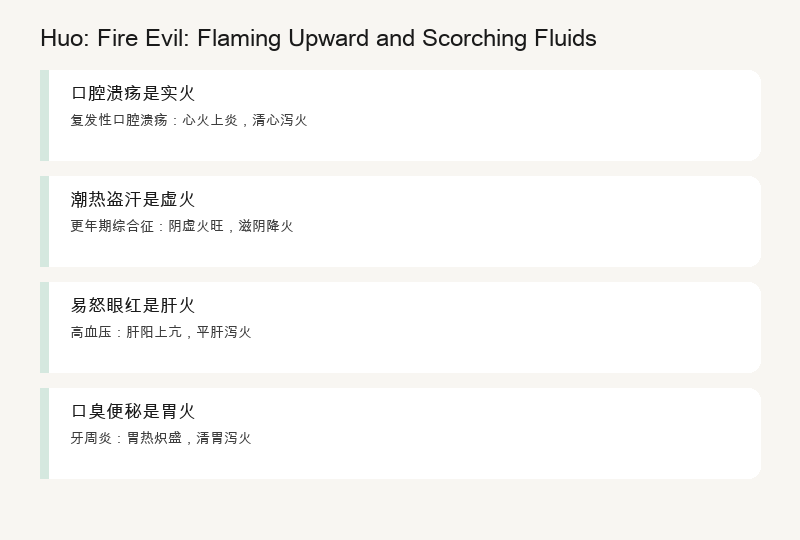
Case one: Mouth ulcers.
You have a mouth ulcer; your tongue tip is bright red like a strawberry, and it hurts so much you cannot eat. The doctor says: "Excessive heart fire, flaming upward to the mouth."
The truth: Mouth ulcers (recurrent aphthous ulcers) are local inflammation of the oral mucosa. Triggers: immune factors (T-cell mediated local immune response), genetic factors, nutritional deficiencies (iron, B12, folate), stress (elevated cortisol), local trauma (biting). It is not "fire in the heart," but local immune inflammatory response. However, the analogy of "heart fire" vividly describes the overreaction of the immune system.
Case two: The red-eyed, irritable young person.
After staying up late gaming, your eyes are red and swollen, with sticky discharge, and your temper is particularly explosive, easily triggered. The doctor says: "Liver fire flaming upward."
The truth: Staying up late keeps the sympathetic nervous system continuously excited, pupils dilated, conjunctival blood vessels dilated (red eyes). Sleep deprivation reduces tear secretion, making the ocular surface dry, with irritants accumulating (sticky discharge). At the same time, sleep deprivation reduces prefrontal cortex function, weakening emotional control (irritability). It is not "fire in the liver rushing upward," but eye blood vessel dilation + neuroendocrine disorder caused by sleep deprivation. However, the analogy of "liver fire flaming upward" precisely describes the symptom cluster after staying up late.
Case three: The swollen-gum food lover.
After eating hot pot or barbecue, your gums are swollen and painful, you have bad breath, and eating cold food feels better. The doctor says: "Intense stomach fire."
The truth: Spicy, greasy food irritates the oral and gastrointestinal mucosa, causing local inflammatory reactions. A high-sugar diet promotes oral bacterial reproduction, plaque accumulation, and gum inflammation (gingivitis). Food residue fermentation produces volatile sulfur compounds (bad breath). Eating cold food feels better because low temperature temporarily numbs nerves, reducing pain sensation. It is not "fire in the stomach," but dietary irritation + oral microbiome dysbiosis + local inflammation. However, the analogy of "stomach fire" precisely describes the pathological state after improper diet.
Case four: Menopausal hot flashes.
Your mother is in menopause; suddenly a wave of heat rises from her chest to her face, she sweats, feels restless, and cannot sleep at night. The doctor says: "Yin deficiency with fire hyperactivity, kidney fire internal disturbance."
The truth: During menopause, estrogen levels drop, affecting the hypothalamic temperature regulation center. The temperature regulation threshold narrows, and tiny temperature changes trigger heat dissipation responses (vasodilation, sweating). At the same time, decreased estrogen affects serotonin levels, leading to mood fluctuations and sleep disorders. It is not "fire in the kidney," but hormonal changes causing temperature regulation and neuroendocrine disorders. However, the analogy of "yin deficiency with fire hyperactivity" precisely describes this state of "the body is heating up without an enemy" — this is deficient fire.
Four cases, one underlying logic: fire is not real flame, but an overreaction of the immune system and metabolic system — excess fire has a clear enemy; deficient fire is regulatory imbalance.
Part 5Modern Research
Is there scientific research on "fire"?
Yes, and a great deal. Scientists do not use the word "fire"; they use:
• Acute Inflammatory Response. The typical manifestations of acute inflammation: redness (blood vessel dilation), swelling (exudate accumulation), heat (increased blood flow, accelerated metabolism), pain (nerve ending stimulation). This completely matches the characteristics of "fire" in TCM. Inflammatory mediators (prostaglandins, bradykinin, histamine) are released, causing pain and fever. Research shows that non-steroidal anti-inflammatory drugs (NSAIDs, such as ibuprofen) can inhibit prostaglandin synthesis, alleviating the symptoms of "fire." This is the scientific basis of "excess fire" — not "fire extinguishing," but inhibiting inflammatory mediators.
• Chronic Low-Grade Inflammation. Long-term stress, sleep deprivation, and unhealthy diet lead to persistent low-level inflammatory responses in the body (slightly elevated CRP, elevated IL-6). No clear infection, but the body is in a "low-grade fever" state. Manifestations: fatigue, mood fluctuations, sleep disorders, recurrent minor illnesses. This is the scientific basis of "deficient fire" — not "insufficient yin fluids," but decreased immune system regulatory function, long-term sensitivity.
• Neuro-Endocrine-Immune Network. Stress → hypothalamic-pituitary-adrenal axis activation → elevated cortisol → immune suppression + metabolic disorder. Long-term stress leads to imbalance in this network, producing various symptoms of "fire": insomnia (neural disorder), mouth ulcers (immune dysregulation), irritability (emotional regulation disorder). This is the scientific basis of "fire disturbing the heart spirit" — not "fire" disturbing the mind, but neuro-endocrine-immune network imbalance.
These studies fully demonstrate: "fire" is a system that can be precisely described using modern scientific language. The ancients summarized it as "fire"; modern people describe it as "acute inflammation," "chronic low-grade inflammation," and "neuro-endocrine-immune imbalance" — they are describing the same pathological state.
Part 6Practical Methods
Now that you understand "fire," how do you use this knowledge?
First, dispel a few misconceptions:
• When you have "fire," take fire-lowering medicine. Fire-lowering medicines (such as Huanglian Shangqing tablets) are mostly bitter and cold in nature. They can be used for excess fire, but not for deficient fire. Using bitter and cold medicine for deficient fire further damages yin fluids, making the deficiency worse. Distinguishing between excess fire and deficient fire is the prerequisite for "lowering fire."
• Mouth ulcers are caused by vitamin deficiency. Vitamin deficiency (B12, iron, folate) is one cause of mouth ulcers, but not the only cause. Immune factors, stress, genetics, and local trauma are equally important. Simply taking vitamins may not be effective.
Specific methods:
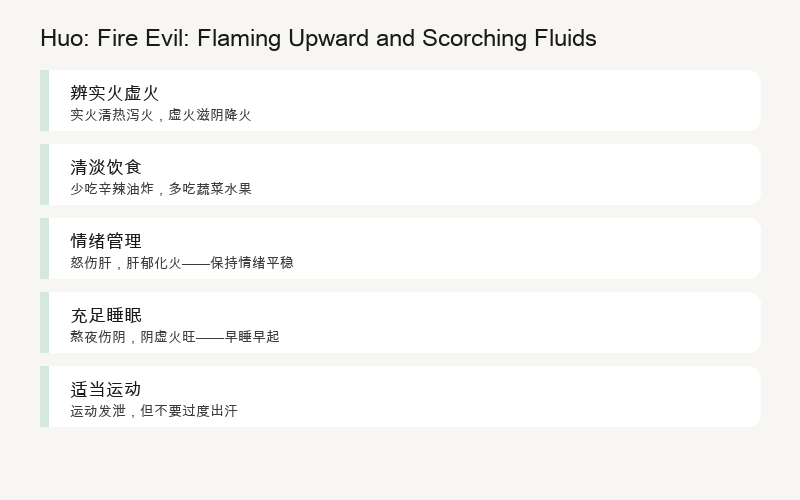
• Identify excess fire vs. deficient fire (correct identification is needed to "extinguish fire"). Excess fire: acute, severe symptoms, thick yellow tongue coating, constipation and dark urine, preference for cold drinks. Strategy: clear heat — drink more water, eat a light diet, rest appropriately. Deficient fire: chronic, mild symptoms, red tongue with little coating, five-center heat, night sweats. Strategy: nourish yin — get adequate sleep, relax your mind, exercise moderately. Do not indiscriminately take "fire-lowering medicine" without distinguishing between excess and deficient fire.
• Light diet (prevent stomach fire). Spicy, greasy, and high-sugar foods are the main sources of "stomach fire." Reduce the intake of hot pot, barbecue, and sweets; eat more vegetables, fruits, and whole grains. It is not "eating cold food lowers fire," but reducing inflammatory stimulation and balancing gut microbiota.
• Adequate sleep (lower liver fire and heart fire). Staying up late is the biggest trigger for liver fire and heart fire. Sleep deprivation keeps the sympathetic nervous system continuously excited, conjunctival blood vessels dilated (liver fire), emotional control capacity decreased (heart fire), and cortisol elevated (systemic inflammation). Getting 7-8 hours of sleep is the best way to "lower fire." It is not that sleeping can "extinguish fire," but that sleep restores neuroendocrine balance.
• Manage stress (prevent deficient fire). Long-term stress is the main source of deficient fire. Meditation, deep breathing, yoga, and walking can all lower cortisol and reduce chronic low-grade inflammation. It is not "a calm mind naturally cools," but stress management reduces the load on the neuro-endocrine-immune network.
• Local care (alleviate symptoms). Mouth ulcers: avoid spicy stimulation, rinse with salt water, use local ulcer patches. Red eyes: reduce screen time, use artificial tears, apply cold compresses. Swollen and painful gums: brush correctly, use dental floss, see a dentist if necessary. It is not "fire extinguishing," but local inflammation management.
These methods do not require you to believe in TCM. You only need to understand: fire is not real flame, but an overreaction of the immune system and metabolic system. Preventing and managing this overreaction is "lowering fire."
Part 7One-Minute Summary
🕐 One Minute to Understand "Fire"
Fire = Inflammation arsonist / fire scene inside the body; a pathogen of flaming upward; fire can arise in all five organs.
Fire is flaming, urgent, and disturbing — not high temperature, but an overreaction of the immune and metabolic systems.
Excess fire = acute inflammation/infection, with a clear enemy; deficient fire = regulatory imbalance, immune system is sensitive.
Fire = acute inflammation + chronic low-grade inflammation + neuro-endocrine-immune network imbalance.
Fire is not mysticism; it is the ancient analogy of inflammatory pathology.
Misconceptions: treating fire as a physical entity, not distinguishing excess from deficient fire, over-reliance on bitter cold medicines, neglecting lifestyle.
Methods: identify excess vs. deficient fire (correct identification to extinguish), light diet (prevent stomach fire), adequate sleep (lower liver and heart fire), manage stress (prevent deficient fire), local care (alleviate symptoms).
The ancients called it "fire is a yang pathogen; its nature is to flame upward"; modern people call it "acute inflammation + immune overreaction + metabolic hyperactivity."
Different names, but the body knows: fire is not burning flame, but the immune system fighting.
but the ancient analogy of the immune system fighting.
Excess fire is a blazing inferno, with an enemy to fight; deficient fire is smoldering charcoal, a regulatory system imbalance.
Understanding the essence of fire is understanding when the body is fighting, when it is harming itself,
and how to find a way out between inflammation and balance.
This is probably the most朴素 wisdom of the Chinese: Fire flames upward, and all five organs can generate fire; lowering fire is not extinguishing fire, but understanding what the body is burning.
Making money is the art of living; art is the life after making money
giaogiao decodes Chinese Traditional Wisdom · Concept 45
Using modern scientific language to help the world understand Chinese traditional wisdom.
No mysticism, no superstition, no belittlement.
Understand, rather than merely believe.
Coach Liu
Written in Florence