Why does TCM say "Pestilence" is like a biochemical weapon? The ancients had no microscope, yet precisely described airborne transmission
Part 1A Question
Have you ever had this experience?
You catch a cold, a common cold, and recover after a few days. But when COVID-19 came in 2020, you got infected just by standing on the same street, in the same elevator, or even just breathing the same office air. No close contact needed, no physical contact needed — air was enough. You ask: "What exactly is this thing?" Western medicine says: "Virus, RNA virus, airborne transmission." TCM says: "Li Qi, epidemic qi, entering through the mouth and nose." One says "RNA virus," the other says "Li Qi" — are they talking about the same thing?
Even more astonishing, when you look through ancient texts, you find that Wu Youke's Wen Yi Lun (1642) from the Ming Dynasty already stated: "Pestilence is not wind, not cold, not summer heat, not dampness, but a different kind of abnormal qi in heaven and earth." He also said this qi is "contagious" and can spread "from door to door," one person gets sick, the whole family suffers. Isn't what he described exactly "airborne transmission" and "contact transmission" in modern epidemiology? The ancients had no microscope, no PCR, no electron microscope, yet they precisely described the transmission patterns of epidemic diseases. What is going on?
There is another question: TCM says "Li Qi" is different from "Six Excesses" (wind, cold, summer heat, dampness, dryness, fire). The Six Excesses are "general" — anyone could be affected; Li Qi is "specialized" — one type of Li Qi causes one type of epidemic disease. SARS is one type of Li Qi, COVID-19 is one type of Li Qi, influenza is one type of Li Qi. Why does TCM distinguish between "Li Qi" and "Six Excesses"? What does this distinction correspond to in modern medicine?
What confuses you even more is that TCM says "Li Qi" enters through the mouth and nose, first attacks the lungs, then transmits and transforms. Western medicine says "respiratory viruses" enter through the mouth and nose, first infect the respiratory tract, then enter the bloodstream. The two statements are remarkably consistent. How did the ancients know?
What exactly is pestilence?
Part 2Traditional Chinese Explanation
The concept of "Pestilence" in TCM is an independent category of pathogenic factors, different from the Six Excesses. The ancients observed: there is a type of disease that is not caused by catching a cold from wind, not caused by eating spoiled food, but contracted mysteriously, and the whole family, whole village, or whole city gets it. This type of disease comes on quickly, spreads rapidly, and has severe symptoms. The ancients called this type of pathogenic factor Li Qi, also called epidemic qi or perverse qi — "Li" means "evil," and "Yi" means "epidemic" or "epidemic."
— Wu Youke, Wen Yi Lun
"When Li Qi spreads, every household has the pain of death, every room has the sorrow of weeping."
— Cao Zhi, Shuo Yi Qi
"Pestilence is caused by Li Qi of heaven and earth; it varies in abundance with the cycles of years, in thickness by region, and in strength by season."
— Wen Yi Lun
TCM summarized the characteristics of "Li Qi" into four keywords: Toxic, Severe, Contagious, Transforming.
Toxic (high toxicity) — Li Qi is not ordinary wind, cold, summer heat, or dampness, but a kind of "abnormal qi" whose toxicity is much stronger than ordinary Six Excesses. Wu Youke said: "When this qi comes, regardless of age or strength, whoever touches it gets sick." Meaning, no matter who you are, if you encounter it, you get sick. This is different from a common cold — with a common cold, a healthy person can resist; with Li Qi disease, even the healthiest person cannot avoid it.
Severe (rapid onset) — Li Qi disease has a rapid onset, severe symptoms, and fast changes. Unlike ordinary wind-cold colds that take three to five days to worsen. Li Qi disease often causes high fever, clouded consciousness, and convulsions within a day. The ancients described it as "sudden onset, critical condition" — in modern terms, "acute, severe, rapid progression."
Contagious (highly contagious) — The biggest characteristic of Li Qi is contagion. Wu Youke said it is "contagious" and spreads "from door to door," one person gets sick, the whole family suffers. The ancients observed that epidemic diseases can spread through air, contact, and food. They also proposed the idea of "avoiding its toxic qi" — isolation, ventilation, and disinfection — which the ancients had already thought of.
Transforming (rapid transmission) — Li Qi enters through the mouth and nose, first attacks the lungs, then transmits and transforms to other organs. TCM says "upper burner heart and lungs, middle burner spleen and stomach, lower burner liver and kidneys" — Li Qi starts from the lungs (upper burner) and can quickly spread throughout the body. This is the same logic as "respiratory viruses enter the bloodstream, causing systemic inflammatory response" in modern medicine.
Therefore, what the ancients called "Pestilence" is not just "epidemic influenza," but a category of external pathogenic factors with strong contagiousness — it is more toxic, more rapid in onset, more contagious, and faster in transmission. The ancients used "Li Qi" to summarize what modern people need a bunch of concepts like "virus," "bacteria," "source of infection," "transmission route," and "susceptible population" to explain.
Part 3giaogiao's Modern Translation
Okay, now let me translate "Pestilence" into modern language.
I am not going to talk about RNA viruses, envelope proteins, or ACE2 receptors. Too complicated. You only need to remember one analogy:
Six Excesses = Ordinary weather, everyone experiences it
Li Qi = Biochemical weapon, specifically designed to attack the human body
One type of Li Qi = One specific biochemical weapon
Contagion = Biochemical weapon spreading among people
Epidemic prevention = Blocking the transmission path of the biochemical weapon
That simple. Your "Pestilence" is essentially a type of pathogen with strong contagiousness — it does not attack indiscriminately like ordinary climate, but specifically targets particular systems of the human body.
Specifically:
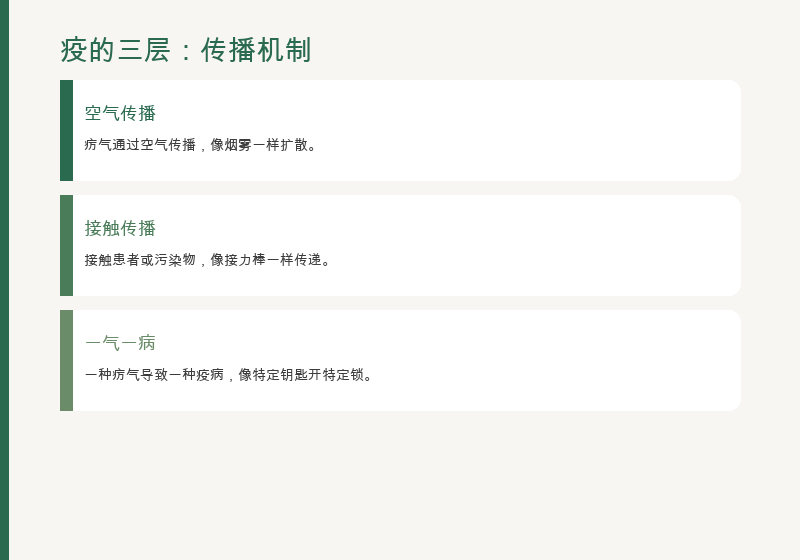
What does Li Qi correspond to? It corresponds to pathogens in modern medicine — viruses, bacteria, rickettsia, spirochetes, etc. COVID-19 is an RNA virus, influenza is an RNA virus, plague is Yersinia pestis, SARS is a coronavirus. What the ancients called "Li Qi" is essentially the collective term for these pathogens. The ancients had no microscope, but they observed "there is an invisible thing that passes from one person to another, causing the same disease" — this is the origin of the "Li Qi" concept.
What does "one qi one disease" correspond to? It corresponds to "one pathogen causes one disease" in modern medicine. COVID-19 causes COVID-19, influenza virus causes influenza, Yersinia pestis causes plague. TCM says "one type of Li Qi causes one type of epidemic disease," modern medicine says "one type of pathogen causes one type of infectious disease" — they are stating the same principle. The ancients had no pathogen taxonomy, but they precisely summarized the principle of "specific pathogenicity."
What does "entering through the mouth and nose, first attacking the lungs" correspond to? It corresponds to the transmission route of respiratory infectious diseases. COVID-19, influenza, and SARS are all respiratory viruses, entering through the mouth and nose, first infecting the upper respiratory tract, then entering the bloodstream. The ancients had no respiratory anatomy, but they precisely described the transmission route: "Li Qi enters through the mouth and nose, first attacking the lungs." This is not a coincidence, but a precise summary of clinical observation.
What does "avoiding its toxic qi" correspond to? It corresponds to the three principles of modern epidemic prevention: control the source of infection, cut off the transmission route, and protect the susceptible population. The ancients' "isolating patients," "ventilating," and "fumigating and disinfecting" are the core measures of modern epidemic prevention. Wu Youke's Wen Yi Lun detailed methods of isolation, disinfection, and personal protection. The ancients had no word for "epidemiology," but they already had the practice of epidemic prevention.
Therefore, "Pestilence" is not mysticism. It is a functional analogy — describing a category of pathogens with strong contagiousness. The ancients used "Li Qi" to summarize what modern people need three disciplines — "virology," "epidemiology," and "infectious disease science" — to explain.
Part 4Life Cases
Four stories to help you instantly understand what "Pestilence" is.
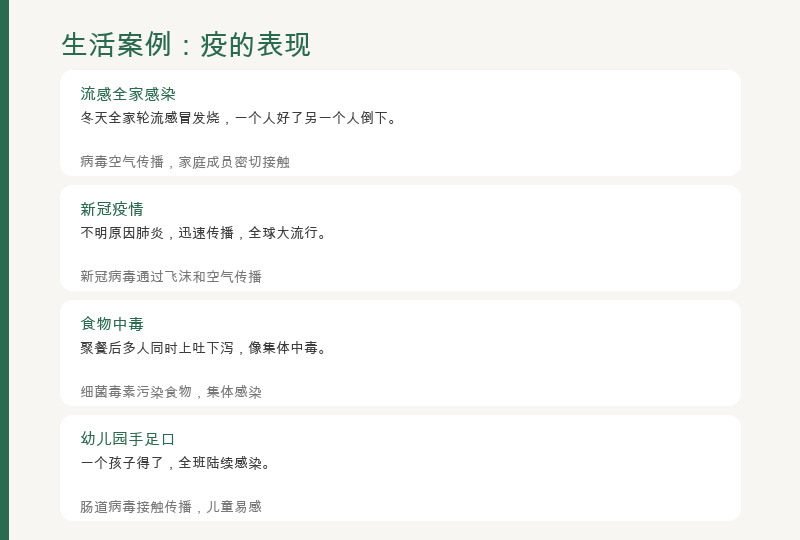
Case one: COVID-19 transmission.
In 2020, you took an elevator; there was only one person who coughed a few times. You went home, and three days later you had a high fever, cough, and lost your sense of taste. You ask: "I didn't touch him, how was I infected?" Western medicine says: "Aerosol transmission, virus particles suspended in the air." TCM says: "Li Qi enters through the mouth and nose, highly contagious."
The truth: COVID-19 is an RNA virus, transmitted through air (aerosols and droplets). Virus particles are expelled from the infected person's respiratory tract, suspended in the air, and inhaled by others. What TCM calls "Li Qi contagion" is the "airborne transmission" of modern epidemiology. The ancients had no word for "aerosol," but they observed that "those living in the same room infect each other" — living together means transmission through air. It is not "mysterious force," but airborne transmission of virus particles. However, the ancient concept of "Li Qi" precisely described the transmission pattern.
Case two: Flu comes every year.
Every winter, people around you always catch colds, one infects ten, ten infect a hundred. You got the flu vaccine, but still caught it. You ask: "Why does the flu come every year?" Western medicine says: "Influenza virus mutates quickly, vaccines can't keep up." TCM says: "Li Qi varies with time and place, abundance varies with the cycles of years."
The truth: The influenza virus is an RNA virus with a fast mutation rate (antigenic drift and antigenic shift). The prevalent strains differ each year, so vaccines need annual updates. TCM says "Li Qi varies in abundance with the cycles of years and in strength by season" — meaning the prevalence of Li Qi is influenced by time, climate, and region. Modern medicine says "influenza spreads seasonally, influenced by temperature, humidity, and population immunity levels" — they are stating the same principle. It is not "bad luck," but virus mutation + environmental conditions + population immunity. However, the ancient concept of "abundance with cycles of years" is a summary of empirical patterns.
Case three: The "severity" and "severity" of SARS.
In 2003, during SARS, you heard that someone was fine in the morning, but in the afternoon had a high fever and difficulty breathing, and was in the ICU within days. You ask: "Why does it come so quickly and so severely?" Western medicine says: "SARS virus causes acute respiratory distress syndrome (ARDS), cytokine storm." TCM says: "Li Qi is toxic and severe, sudden onset, rapid transmission."
The truth: After SARS virus infection, it replicates rapidly, causing severe lung inflammation. Some patients develop a "cytokine storm" — the immune system overreacts, attacking its own tissues. This is what TCM calls "Li Qi is toxic and severe, rapid transmission" — it is not that the virus itself is so powerful, but that the body's immune response is out of control. TCM uses methods of "clearing heat and detoxifying" and "cooling blood and dissipating stasis" to regulate the immune response and reduce inflammation. It is not "mysterious herbal medicine," but regulating the immune response and reducing inflammatory damage. However, the ancient concepts of "severity" and "severity" precisely described the disease characteristics.
Case four: The wisdom of ancient epidemic prevention.
You read history and find that when plagues occurred in ancient times, the government would "isolate patients," "burn the clothes of the dead," and "sprinkle lime at the city gates." You ask: "How did the ancients know these?" Western medicine says: "Accumulated experience, gained through trial and error." TCM says: "Avoiding its toxic qi, isolating the source of infection, cutting off the transmission route."
The truth: Ancient times had no modern disinfectants or protective clothing, but the ancients summarized methods of isolation, ventilation, and disinfection through observation. For example, the Wen Yi Lun records: "When an epidemic spreads, patients must be isolated to prevent contagion." Burning clothes is high-temperature disinfection, sprinkling lime is alkaline disinfection, and ventilation is diluting pathogens in the air. These methods are completely consistent with the core logic of modern epidemic prevention. It is not "the ancients had supernatural powers," but empirical observation + trial and error. However, the ancient concept of "avoiding its toxic qi" is the embryonic form of epidemiology.
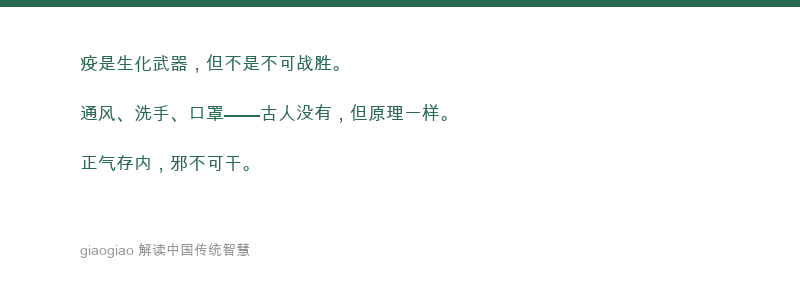
Four cases, one underlying logic: pestilence is a "biochemical weapon" — a pathogen with strong contagiousness, spreading through air and contact, first attacking the lungs, then transmitting throughout the body.
Part 5Modern Research
Is there scientific research on "Pestilence"?
Yes, and a great deal. Scientists do not use the word "Li Qi"; they use:
• Virology. Viruses are strictly intracellular parasites that must enter human cells to replicate. COVID-19 is an RNA virus, influenza is an RNA virus, SARS is a coronavirus. Viruses enter cells by binding envelope proteins to human cell receptors (such as the S protein of COVID-19 binding to ACE2 receptors), replicate, and destroy cells. This is the modern explanation of "Li Qi enters through the mouth and nose, first attacking the lungs" — viruses first infect respiratory tract cells, then enter the bloodstream.
• Epidemiology. The spread of infectious diseases requires three conditions: source of infection, transmission route, and susceptible population. COVID-19 spreads through air (aerosols, droplets), influenza spreads through air, plague spreads through fleas. TCM says "Li Qi is contagious" and "avoiding its toxic qi," which is the core of epidemiology's "cutting off the transmission route." The ancients had no word for epidemiology, but they already had the practice of epidemiology.
• Immunology. After the human body is infected by a pathogen, the immune system initiates defense. But sometimes the immune system overreacts, attacking its own tissues — "cytokine storm." Many severe patients of SARS and COVID-19 died from cytokine storms. TCM says "Li Qi is toxic and severe," describing not only the pathogen itself but also the body's excessive immune response. TCM uses methods of "clearing heat and detoxifying" and "cooling blood and dissipating stasis" to regulate the immune response and reduce inflammatory damage.
These studies fully demonstrate: "Pestilence" is a concept that can be precisely described using modern scientific language. The ancients summarized it as "Li Qi"; modern people describe it as "virology + epidemiology + immunology" — they are talking about the same thing.
Part 6Practical Methods
Now that you understand "Pestilence," how do you prevent it?
First, dispel a few misconceptions:
• Taking Ban Lan Gen can prevent all infectious diseases. Ban Lan Gen has certain inhibitory effects on some viruses, but it is not a "universal preventive medicine." The most reliable ways to prevent infectious diseases are vaccines, isolation, and personal hygiene. Chinese medicine can be used as an auxiliary, but cannot replace modern epidemic prevention measures.
• "When righteous qi is strong inside, evil cannot invade" means no epidemic prevention is needed. TCM indeed says "when righteous qi is strong inside, evil cannot invade" — strong immunity means less likely to get sick. But facing highly contagious Li Qi, relying solely on personal immunity is not enough. The ancients also emphasized "avoiding its toxic qi" — isolation and protection are equally important. It is not "as long as you are healthy, you are not afraid," but boosting immunity + cutting off transmission routes on both fronts.
Specific methods:
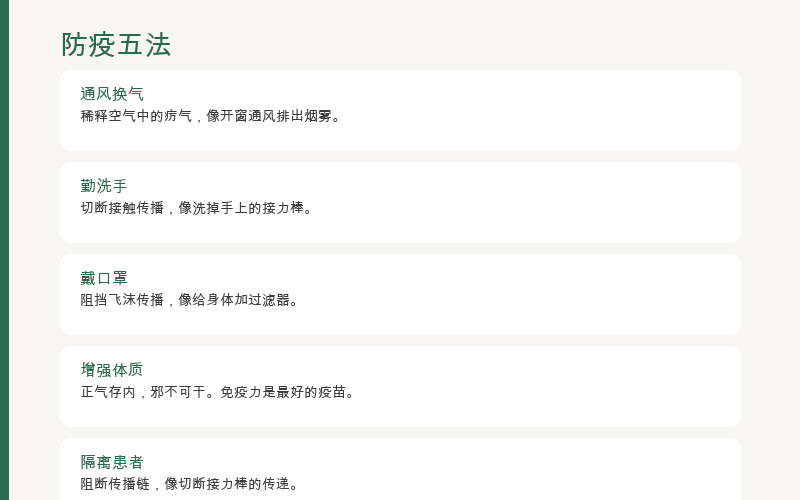
• Vaccination. Influenza vaccine, COVID-19 vaccine, are the most effective means of preventing infectious diseases. Vaccines train the immune system to recognize pathogens in advance and produce antibodies. It is not "one shot and you are done," but vaccines can significantly reduce the risk of severe illness and death.
• Personal hygiene. Frequent hand washing, wearing masks, maintaining social distance. These seemingly simple measures are the most effective ways to cut off transmission routes. Research during COVID-19 proved that masks can reduce transmission risk by more than 70%. It is not "making a fuss," but using simple methods to block complex transmission chains.
• Ventilation. Indoor air quality is key to aerosol transmission. Opening windows for ventilation can reduce indoor virus concentration by more than 50%. What the ancients called "avoiding its toxic qi," modern people call "ventilation and disinfection" — the logic is consistent.
• Boosting immunity. Adequate sleep, balanced diet, and moderate exercise are the foundation of immunity. TCM says "when righteous qi is strong inside, evil cannot invade" — immunity is the body's first line of defense. But immunity is not "built up by taking supplements," but the comprehensive result of lifestyle.
• Isolation and early treatment. When symptoms appear, isolate promptly to avoid infecting others. Early treatment can prevent the disease from worsening. The TCM Warm Disease School emphasizes "early treatment to prevent transformation" — intervene at the early stage of disease to prevent transmission. Modern medicine also emphasizes "early detection, early isolation, early treatment."
These methods do not require you to believe in TCM. You only need to understand: pestilence is a "biochemical weapon" — blocking transmission routes and boosting self-defense are the most effective responses.
Part 7One-Minute Summary
🕐 One Minute to Understand "Pestilence"
Pestilence = Biochemical weapon / collective attack.
Li Qi is different from the Six Excesses; it is "one qi one disease": one type of Li Qi causes one type of epidemic disease.
COVID-19, influenza, SARS, and plague are all caused by Li Qi.
Pestilence = virology + epidemiology + immunology.
Pestilence is not mysticism; it is a pathogen with strong contagiousness.
Misconceptions: taking Ban Lan Gen as a universal preventive, being healthy means not afraid of contagion.
Methods: vaccination, personal hygiene, ventilation, boosting immunity, isolation and early treatment.
The ancients called it "Li Qi," modern people call it "virus."
Different names, but the body knows: when the biochemical weapon comes, the best defense is blocking transmission + boosting self-defense.
It does not distinguish between strong and weak; whoever touches it gets sick.
The ancients had no microscope, but precisely described airborne and contact transmission.
This is probably the most朴素 wisdom of the Chinese: Avoid its toxic qi, keep righteous qi strong inside, and respond to all changes with unchanging principles.
Making money is the art of living; art is the life after making money
giaogiao decodes Chinese Traditional Wisdom · Concept 46
Using modern scientific language to help the world understand Chinese traditional wisdom.
No mysticism, no superstition, no belittlement.
Understand, rather than merely believe.
Coach Liu
Written in Florence