Why Does TCM Call "Seven Emotions" an Emotional Bomb? Your Anxiety Is Not Just Psychological—Your Body Is Sounding the Alarm
Part 1A Question
Have you ever had this experience?
You feel nervous before an exam, your stomach gurgles, and you run to the bathroom several times. You feel anxious before an interview, can't sleep all night, and have a headache the next day. When you get angry, your chest feels tight and your stomach cramps like you've been punched. After a breakup, you're so sad you lose your appetite and drop ten pounds. Under long-term work stress, your medical checkup shows abnormal thyroid function and high blood pressure. You ask Western medicine: "Is this a psychological or physical problem?" The doctor says: "Psychosomatic disease, caused by stress and emotions." You ask TCM: "What's going on?" The doctor says: "Internal damage from the Seven Emotions, liver qi stagnation, spleen and stomach damage."
One says "psychosomatic disease," the other says "internal damage from the Seven Emotions"—are they talking about the same thing?
Even more surprisingly, TCM says "joy harms the heart, anger harms the liver, pensiveness harms the spleen, sadness harms the lungs, fear harms the kidneys"—each emotion corresponds to a specific organ. Modern medicine says "chronic stress damages the cardiovascular system," "anger increases stroke risk," "anxiety affects the digestive system," "depression suppresses immune function"—emotions do indeed harm specific organs. Why did two medical systems, two thousand years apart, reach similar conclusions?
There's another question: you see a psychiatrist who says "this is anxiety disorder, needs cognitive behavioral therapy." You see a TCM doctor who says "liver qi stagnation, needs to soothe the liver and regulate qi." Two doctors, one treating the "heart," the other the "liver"—who is right?
What confuses you even more is that you take anti-anxiety medication, symptoms ease, but your mood is still low. You drink TCM herbs to soothe the liver, the chest tightness goes away, but work pressure remains. Emotions and organs—who is affecting whom?
What exactly are the Seven Emotions?
Part 2Traditional Chinese Explanation
The concept of "Seven Emotions" was systematically defined in the Yellow Emperor's Inner Canon. Ancient observers noticed that emotional changes were not just "psychological activities" but caused obvious physical reactions—anger makes qi rise, joy makes qi slow, sadness makes qi dissipate, fear makes qi descend, shock makes qi chaotic, pensiveness makes qi knotted. They divided emotions into seven types: joy, anger, worry, pensiveness, sadness, fear, and shock, called the Seven Emotions. Excessive Seven Emotions damage internal organs—this is not a metaphor, but a summary of clinical observation.
— Yellow Emperor's Inner Canon · Suwen
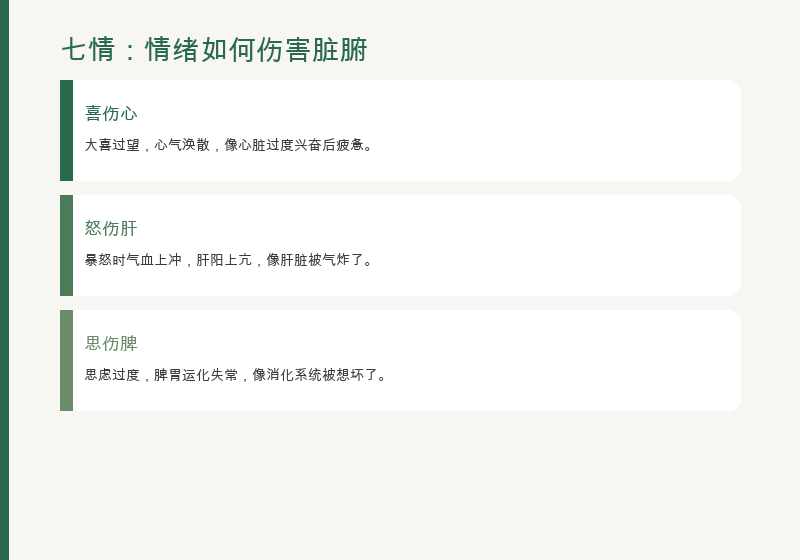
"Joy harms the heart, anger harms the liver, pensiveness harms the spleen, sadness harms the lungs, fear harms the kidneys."
— Yellow Emperor's Inner Canon · Suwen
"Diseases of the Seven Emotions arise from the heart's desires being unfulfilled, leading to disharmony of organ qi."
— Golden Mirror of Medicine
TCM summarizes the disease-causing patterns of the Seven Emotions with five keywords: Excess, Damage, Disorder, Stagnation, Depletion.
Excess (overindulgence)—The Seven Emotions themselves are normal, but excess causes disease. "Joy" is good, but excessive joy harms the heart (like Fan Jin passing the imperial exam, going mad with joy). "Anger" is a normal reaction, but rage harms the liver (like high blood pressure and cerebral hemorrhage after intense anger). "Pensiveness" is thinking, but excessive pensiveness harms the spleen (like long-term anxiety causing indigestion). Seven Emotions cause disease not because "having emotions makes you sick," but because "emotions are excessive, persistent, and unregulated."
Damage (organ injury)—Each excessive emotion damages a specific organ. Excessive joy harms the heart (scattered spirit), rage harms the liver (qi and blood rushing upward), excessive pensiveness harms the spleen (impaired digestion), sadness harms the lungs (constricted lung qi), fear harms the kidneys (kidney qi leaking downward). This correspondence is not mysticism but clinical observation: chronically angry people have liver discomfort and high blood pressure; chronically worried people have chest tightness and shortness of breath; chronically fearful people have weak knees and frequent urination.
Disorder (qi chaos)—Seven Emotions first affect the flow of "qi." Anger makes qi rise (qi and blood surge upward), joy makes qi slow (heart qi dissipates), sadness makes qi dissipate (lung qi depletes), fear makes qi descend (kidney qi sinks), shock makes qi chaotic (spirit unsettled), pensiveness makes qi knotted (spleen qi stagnates). Qi disorder is the first step of Seven Emotions disease. Once qi is chaotic, blood becomes chaotic, and organ function is disrupted.
Stagnation (blocked and stagnant)—Long-term emotional suppression causes qi stagnation, forming "stagnation." The most common is "liver qi stagnation"—long-term anger, suppression, and anxiety cause liver meridian qi stagnation, manifesting as chest and rib pain, emotional depression, and menstrual irregularities. What modern people call "high stress" and "emotional suppression," TCM calls "liver qi stagnation."
Depletion (qi and blood exhaustion)—Long-term emotional excess not only disorders qi but also depletes qi and blood. Sadness depletes lung qi, fear depletes kidney qi, pensiveness depletes spleen qi. Prolonged qi and blood depletion leads to organ function decline and deficiency symptoms. For example, chronically depressed people have sallow complexion, fatigue, and decreased immunity—this is "qi and blood dual deficiency."
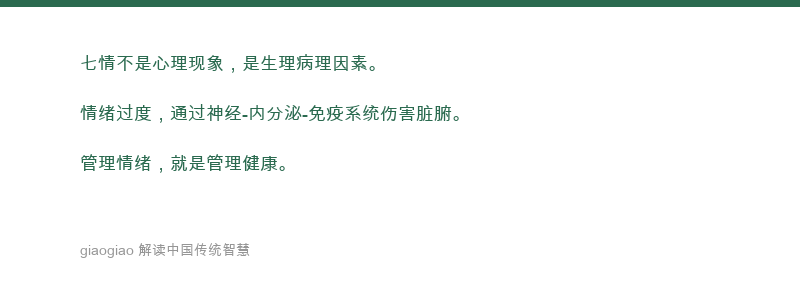
So, the ancient concept of "Seven Emotions" is not just a "psychological phenomenon" but a class of pathological factors that can directly damage internal organs. The ancients used "internal damage from Seven Emotions" to summarize what modern people need three disciplines—psychosomatic medicine, neuroendocrinology, and psychoimmunology—to explain.
Part 3giaogiao Modern Translation
Okay, now let's translate "Seven Emotions" into modern language.
I won't talk about the HPA axis, amygdala, or prefrontal cortex. Too complicated. You just need to remember one metaphor:
Normal emotion = normal signal, alerting you that something is happening
Excessive emotion = emotional bomb, exploding and damaging the body
Long-term suppression = psychological virus, chronic infection, slowly eroding
Anger = directional bomb, shooting straight at the liver (blood pressure rises)
Fear = freezing bomb, causing kidney qi to leak downward (cortisol spikes)
Pensiveness = tangling virus, clogging the spleen and stomach (indigestion)
That simple. Your "Seven Emotions" are essentially regulatory imbalance of emotions on the neuro-endocrine-immune system—excessive emotions overload the system, and organs are damaged.
Specifically:
What do the Seven Emotions correspond to? They correspond to "psychosomatic responses" in modern medicine. Emotions activate the limbic system (amygdala, hippocampus) of the brain, triggering the hypothalamic-pituitary-adrenal axis (HPA axis), releasing stress hormones (cortisol, adrenaline). These hormones act on the cardiovascular, digestive, and immune systems, causing systemic reactions. TCM says "anger harms the liver," corresponding to "elevated blood pressure and increased liver blood flow during anger"; "pensiveness harms the spleen," corresponding to "slowed gastrointestinal motility and reduced digestive secretion during anxiety"; "fear harms the kidneys," corresponding to "cortisol spikes and affected kidney function during fear."
What does "qi disorder" correspond to? It corresponds to autonomic nervous system imbalance. The sympathetic nervous system is the "fight or flight" system; the parasympathetic nervous system is the "rest and digest" system. Anger activates the sympathetic system, raising blood pressure and heart rate; fear also activates the sympathetic system while suppressing the parasympathetic system. Long-term emotional excess causes sustained sympathetic excitation and insufficient parasympathetic function—this is the modern explanation of "qi disorder."
What does "liver qi stagnation" correspond to? It corresponds to chronic stress-induced neuroendocrine disorders. Long-term stress, anxiety, and suppression cause sustained HPA axis activation and chronically elevated cortisol. Cortisol affects liver metabolism, gastrointestinal function, and immune system, causing a series of symptoms: indigestion, sleep disorders, decreased immunity, and mood swings. This is the modern scientific basis of "liver qi stagnation"—not "qi stuck in the liver," but chronic neuroendocrine system dysregulation.
What does "psychosomatic medicine" correspond to? It corresponds to the holistic view of TCM's "internal damage from Seven Emotions." Modern psychosomatic medicine studies how psychological factors affect physical health. It has found that depression increases heart disease risk, anxiety affects digestive function, and chronic stress suppresses the immune system. These findings are highly consistent with TCM's correspondence of "joy harms the heart, anger harms the liver, pensiveness harms the spleen, sadness harms the lungs, fear harms the kidneys." Not that "TCM guessed right," but that both medical systems observed the same bodily law.
So, the "Seven Emotions" are not mysticism. They are a functional metaphor—describing how emotions affect organs through the neuro-endocrine-immune system. The ancients used "internal damage from Seven Emotions" to summarize what modern people need three disciplines to explain.
Part 4Real-Life Cases
Four stories to help you instantly understand what the Seven Emotions are.
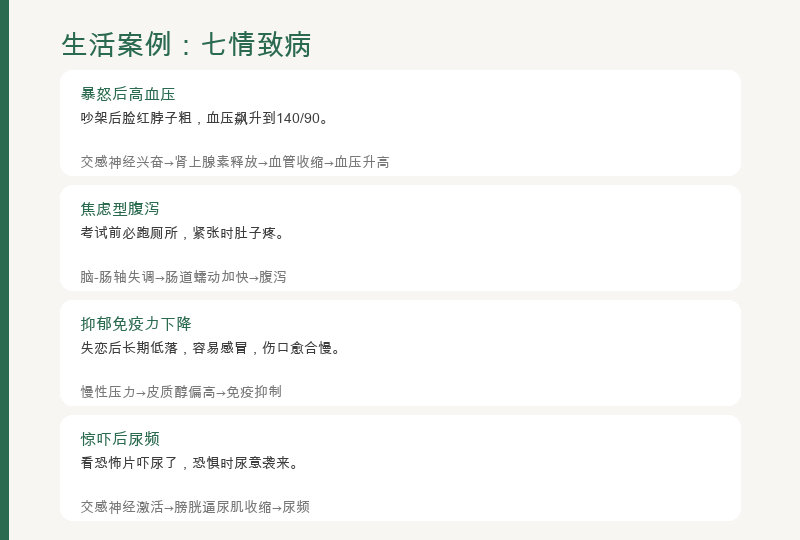
Case 1: High blood pressure after rage.
You argue with a colleague, and in a fit of rage, your face turns red, your neck veins bulge, your heart races, and your blood pressure soars. The next day at your checkup, it's 140/90. You ask: "Why does blood pressure rise when I'm angry?" Western medicine says: "Sympathetic nervous system excitement, adrenaline release, blood vessel constriction." TCM says: "Anger makes qi rise, anger harms the liver, liver yang rises excessively."
The truth: During anger, the brain's amygdala activates, releasing adrenaline and norepinephrine through the sympathetic nervous system. These hormones speed up the heartbeat, constrict blood vessels, and raise blood pressure. Chronic anger causes sustained blood vessel constriction, leading to hypertension and arteriosclerosis. TCM says "anger harms the liver"—the liver governs free flow, and during rage, qi and blood surge upward, causing liver yang to rise. Modern medicine says "anger increases cardiovascular event risk"—research shows that within two hours of an anger outburst, heart attack risk increases 4.7-fold. It's not "anger damages the liver," but sympathetic activation + blood vessel constriction + elevated blood pressure. But the description "anger harms the liver" precisely captures the physiological consequences of rage.
Case 2: Anxiety-induced diarrhea.
You get diarrhea when nervous—before exams, interviews, or presentations, you must run to the bathroom. You ask: "Why does nervousness cause diarrhea?" Western medicine says: "Irritable bowel syndrome (IBS), brain-gut axis dysfunction." TCM says: "Pensiveness harm the spleen, liver qi invades the spleen, spleen deficiency causes diarrhea."
The truth: The gut is called the "second brain," with a rich neural network (enteric nervous system). During anxiety, the brain sends signals to the gut via the brain-gut axis, speeding up intestinal motility and increasing secretion, causing diarrhea. At the same time, anxiety causes gut microbiome imbalance, further worsening symptoms. TCM says "pensiveness harms the spleen"—the spleen governs transformation, and excessive pensiveness disrupts spleen and stomach function, causing water and dampness to flow downward. Modern medicine says "brain-gut axis dysfunction"—disrupted neuro-endocrine signals between the brain and gut. It's not "thinking too much harms the spleen," but brain-gut axis neural signal disorder + gut microbiome imbalance. But the description "pensiveness harms the spleen" precisely captures the impact of anxiety on the digestive system.
Case 3: Chronic depression and decreased immunity.
After a breakup, you're chronically depressed, lose your appetite, and drop ten pounds. Six months later, you notice you catch colds easily, wounds heal slowly, and your white blood cell count is low. You ask: "Why does a bad mood weaken immunity?" Western medicine says: "Chronic stress suppresses the immune system, cortisol remains chronically elevated." TCM says: "Sadness harms the lungs, pensiveness harms the spleen, qi and blood deficiency."
The truth: Chronic depression and stress cause sustained HPA axis activation and chronically elevated cortisol. Cortisol suppresses immune cell function (T cells, B cells, NK cells), reduces antibody production, and weakens immune defense. At the same time, depression causes poor sleep quality, further affecting immune repair. TCM says "sadness harms the lungs"—the lungs govern qi, and sadness dissipates lung qi; "pensiveness harms the spleen"—the spleen governs transformation, and excessive pensiveness depletes qi and blood sources. Modern medicine says "chronic stress causes immune suppression"—research shows that chronically depressed people have reduced flu vaccine antibody responses and prolonged wound healing. It's not "sadness harms the lungs," but cortisol suppresses immunity + sleep disorders + malnutrition. But the descriptions "sadness harms the lungs, pensiveness harms the spleen" precisely capture the effects of emotions on immunity and digestion.
Case 4: Frequent urination after fright.
You watch a horror movie, and a sudden jump scare makes you feel the urge to urinate. Or you experience a frightening event, and for a while afterward, you have frequent urination and urgency. You ask: "Why does fear make me want to pee?" Western medicine says: "Fear activates the sympathetic nervous system, affecting bladder detrusor muscle." TCM says: "Fear harms the kidneys, kidney qi is not secured, bladder loses control."
The truth: During fear, the sympathetic nervous system activates, releasing adrenaline. Adrenaline acts on the bladder detrusor muscle, causing it to contract, while inhibiting the urethral sphincter, causing the urge to urinate. Severe fear can even cause urinary incontinence. This is an evolutionary "fight or flight" response—lighten the load to prepare for escape. TCM says "fear harms the kidneys"—the kidneys govern water, and kidney qi secures the bladder. During fear, kidney qi leaks downward, and the bladder loses control. Modern medicine says "fear activates the sympathetic nervous system, affecting bladder function"—describing the same mechanism. It's not "the kidneys are frightened," but sympathetic activation + bladder detrusor contraction. But the description "fear harms the kidneys" precisely captures the physiological response to fear.
Four cases, one underlying logic: the Seven Emotions are "emotional bombs"—when they explode excessively, they damage organs through the neuro-endocrine-immune system.
Part 5Modern Research
Is there scientific research on the "Seven Emotions"?
Yes, and a lot. Scientists don't use the term "Seven Emotions"; they use:
• Psychosomatic Medicine. It specifically studies how psychological factors affect physical health. It has found that depression increases heart disease risk 2-3 times, anxiety increases digestive system disease risk, and chronic stress suppresses the immune system. These findings are highly consistent with TCM's "internal damage from Seven Emotions." One of the founders of psychosomatic medicine, Wolff, proved that "emotions do affect the stomach" by studying the emotional states of ulcer patients.
• Neuroendocrinology. It studies how the brain regulates body functions through hormones. The HPA axis (hypothalamic-pituitary-adrenal axis) is the core pathway of the stress response. Emotional stress → hypothalamus releases CRH → pituitary releases ACTH → adrenals release cortisol. Chronic stress causes sustained elevated cortisol, damaging the cardiovascular system, suppressing immunity, and affecting metabolism. This is the modern mechanism of "qi disorder"—not "qi is chaotic," but hormonal regulation imbalance.
• Psychoneuroimmunology. It studies how psychological factors affect the immune system through the nervous system. It has found that chronic stress reduces NK cell activity, decreases antibody production, and delays wound healing. Depressed patients generally have lower immune indicators than normal people. This is the modern explanation of "sadness harms the lungs, pensiveness harms the spleen"—emotions regulate immune function through neuro-endocrine signals.
These studies fully demonstrate that the "Seven Emotions" is a system that can be precisely described in modern scientific language. The ancients used "internal damage from Seven Emotions" to summarize; modern people use "psychosomatic medicine + neuroendocrinology + psychoneuroimmunology" to describe—both are talking about the same thing.
Part 6Practical Methods
Now that you understand the "Seven Emotions," how do you regulate them?
First, dispel some myths:
• "Emotional problems can be solved by willpower alone." Emotions are not purely "psychological phenomena" but physiological reactions of the neuro-endocrine-immune system. Long-term emotional issues require comprehensive intervention—psychological counseling, lifestyle adjustments, and medication when necessary. It's not "just think positively and you'll be fine," but systematic mind-body regulation.
• "TCM herbs that soothe the liver and regulate qi can replace psychotherapy." TCM herbs can regulate physical states and relieve somatic symptoms caused by emotions, but they cannot replace psychotherapy. The root of emotional problems often lies in life events, cognitive patterns, and interpersonal relationships. TCM is auxiliary, not a panacea.
Specific methods:
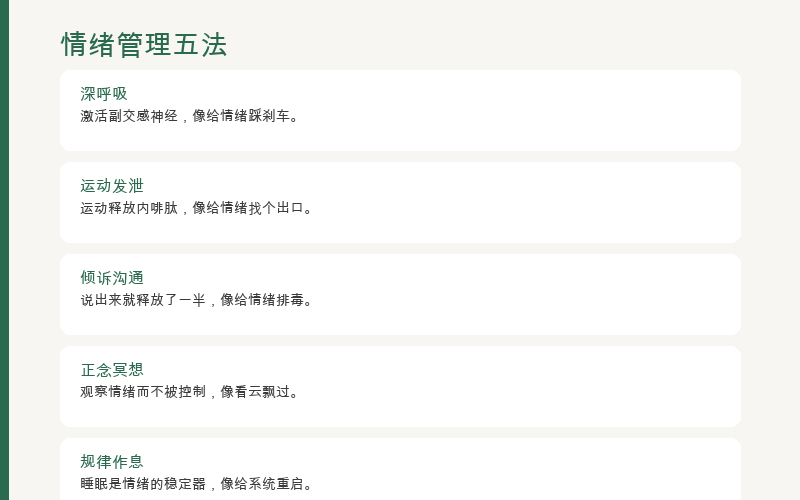
• Deep breathing (regulate the autonomic nervous system). Deep breathing activates the parasympathetic nervous system (the "rest and digest" system) and inhibits the sympathetic nervous system (the "fight or flight" system). Doing 5-10 minutes of deep breathing daily (inhale 4 seconds, hold 4 seconds, exhale 6 seconds) can significantly lower cortisol levels and relieve anxiety. It's not "qigong breathing," but regulating autonomic nervous system balance through breathing.
• Exercise (release stress hormones). Moderate exercise promotes endorphin release, improves mood, and consumes excess adrenaline and cortisol. Research shows that 150 minutes of moderate-intensity exercise per week reduces depressive symptoms by 47%. TCM says "movement generates yang"—exercise lifts yang qi and unblocks qi flow. Modern medicine says "exercise promotes neurotransmitter balance"—both describe the same effect.
• Mindfulness meditation (reshape brain circuits). Mindfulness meditation can change brain structure—increasing prefrontal cortex thickness (emotion regulation area) and reducing amygdala volume (fear response area). Just 10-20 minutes of mindfulness practice daily significantly improves anxiety and depression symptoms after 8 weeks. It's not "cultivating the mind," but scientific application of neuroplasticity.
• Social support (buffer stress). Good social relationships are a buffer against stress. Research shows that people with strong social support have smaller cortisol spikes when facing stress and recover faster. TCM says "joy harms the heart, but moderate joy can nourish the heart and calm the spirit"—the pleasure from social interaction indeed regulates the cardiovascular and nervous systems. Having dinner with a good friend is more effective than taking supplements alone.
• Regular sleep (stabilize biological clock). Emotional problems and sleep problems are mutually causal. Regular sleep, ensuring 7-8 hours, can stabilize the biological clock and regulate the secretion rhythms of neurotransmitters (serotonin, dopamine) and hormones (melatonin, cortisol). Research shows that after sleep improvement, emotional symptoms improve by an average of 30-50%. It's not empty talk of "early to bed and early to rise," but the biological clock is the foundation of neuroendocrine rhythms.
These methods don't require you to believe in TCM. You just need to understand: the Seven Emotions are "emotional bombs"—managing emotions is managing the balance of the neuro-endocrine-immune system.
Part 7One-Minute Summary
🕐 One Minute to Understand "Seven Emotions"
Seven Emotions = Emotional Bomb / Psychological Virus.
Joy, anger, worry, pensiveness, sadness, fear, and shock—seven emotions in excess damage internal organs.
Joy harms the heart, anger harms the liver, pensiveness harms the spleen, sadness harms the lungs, fear harms the kidneys.
Seven Emotions = Psychosomatic Medicine + Neuroendocrinology + Psychoneuroimmunology.
The Seven Emotions are not mysticism; they are the physiological effects of emotions on the neuro-endocrine-immune system.
Myths: Emotional problems can be solved by willpower; TCM herbs can replace psychotherapy.
Methods: Deep breathing, exercise, mindfulness meditation, social support, regular sleep.
The ancients called it "internal damage from Seven Emotions"; modern people call it "psychosomatic disease."
Different names, but the body knows: emotions are not just psychological, but physiological reactions of the body.
🕐 One Minute to Understand "Seven Emotions"
Seven Emotions = Emotional Bomb / Psychological Virus.
Joy, anger, worry, pensiveness, sadness, fear, and shock—seven emotions in excess damage internal organs.
Joy harms the heart, anger harms the liver, pensiveness harms the spleen, sadness harms the lungs, fear harms the kidneys.
Seven Emotions = Psychosomatic Medicine + Neuroendocrinology + Psychoneuroimmunology.
The Seven Emotions are not mysticism; they are the physiological effects of emotions on the neuro-endocrine-immune system.
Myths: Emotional problems can be solved by willpower; TCM herbs can replace psychotherapy.
Methods: Deep breathing, exercise, mindfulness meditation, social support, regular sleep.
The ancients called it "internal damage from Seven Emotions"; modern people call it "psychosomatic disease."
Different names, but the body knows: emotions are not just psychological, but physiological reactions of the body.
Anger makes qi rise, fear makes qi descend, pensiveness makes qi knot.
The ancients had no neuroscience, yet precisely described the body's regulation by emotions.
This is probably the most simple wisdom of the Chinese: Nourishing the heart is nourishing the body; regulating the spirit is regulating the body.
Making money is the art of living; art is the life after making money.
giaogiao Decodes Traditional Chinese Wisdom · Concept 47
Using modern scientific language to help the world understand traditional Chinese wisdom.
No mysticism, no superstition, no belittlement.
Understanding, not merely believing.
Coach Liu
Written in Florence