Why Does TCM Say Food Stagnation Is a Digestive Traffic Jam? Your Takeout Is Destroying Your Spleen and Stomach
Part 1A Question
Have you ever had this experience?
You work late into the night, order takeout — fried chicken, bubble tea, spicy hot pot. You fall asleep right after eating. The next morning, you have bloating, bad breath, and constipation. You think it's "internal heat," take some cooling medicine, and end up with worse diarrhea. You go to a weekend feast, eat and drink excessively, and the next day your stomach is swollen and tender to the touch, like there's a rock inside. You ask: "Did I eat too much?" Western medicine says: "Indigestion, delayed gastric emptying." TCM says: "Food stagnation, impaired spleen-stomach transformation and transportation."
One says "indigestion," the other says "food stagnation" — are they talking about the same thing?
Even more puzzling, some people with long-term food stagnation don't get fat — they get thin: sallow complexion, poor appetite, listless spirit. You ask: "Shouldn't eating too much make you fat? Why are they losing weight?" Western medicine says: "Impaired digestion and absorption, malnutrition." TCM says: "Food stagnation transforms into heat, consuming qi and blood; spleen deficiency fails to transform and transport." Both statements point to the same fact: a blockage in the digestive system can lead to impaired nutrient absorption, which then affects the entire body.
There's another question: you've heard that "when the spleen and stomach are injured, all diseases arise" — how can poor digestion lead to colds, allergies, and skin diseases? You ask Western medicine: "What does the gut have to do with immunity?" Western medicine says: "70% of immune cells are in the gut." You ask TCM: "What do the spleen and stomach have to do with all diseases?" TCM says: "The spleen and stomach are the foundation of acquired constitution, the source of qi and blood production." The two statements are remarkably consistent.
What confuses you even more is that you take digestive medication, the bloating eases, but it returns a few days later. You change your eating habits — regular meals, less greasy food — and the food stagnation heals without medicine. This shows that the root cause of food stagnation is not "lack of medicine," but "wrong way of eating."
What exactly is food stagnation?
Part 2Traditional Chinese Explanation
The concept of "food stagnation" was systematically elaborated in the Yellow Emperor's Inner Canon and Treatise on the Spleen and Stomach. The ancients observed: some people get bloated from overeating, some get diarrhea from eating the wrong things, and some suffer from chronic dietary indiscretion, becoming sallow and emaciated, with a hundred diseases arising. They called the pathological state caused by improper diet food stagnation — "food" means food, and "stagnation" means stagnation and accumulation. The essence of food stagnation is the impairment of the spleen and stomach's transformation and transportation function, with food lingering in the gastrointestinal tract and producing pathological products.
— Yellow Emperor's Inner Canon · Suwen
"When the spleen and stomach are injured, all diseases arise."
— Li Dongyuan, Treatise on the Spleen and Stomach
"Stagnation is of yin nature; it begins at a fixed location, and its pain does not leave that region."
— Classic of Difficulties
TCM summarizes the causes of "food stagnation" into four key words: excess, bias, disorder, and chronicity.
Excess (overeating) — binge eating and drinking, exceeding the spleen and stomach's capacity to transform and transport. The stomach has a limited capacity; stuffing too much in at once causes delayed gastric emptying, with food lingering and fermenting in the stomach, producing gas and toxins. This is the most common form of "food stagnation" — eating too much. But "excess" is not just about quantity; it also includes speed — eating too fast, insufficient chewing, large food particles increasing the burden on the gastrointestinal tract.
Bias (partiality) — dietary bias, improper temperature and flavor. Excessive consumption of cold and raw foods (iced beer, ice cream) damages spleen yang, leading to spleen-stomach deficiency-cold and impaired transformation. Excessive consumption of spicy foods (hot pot, spicy hot pot) damages stomach yin, leading to stomach heat flaming upward, dry mouth, and constipation. Excessive consumption of fatty and sweet foods (fried chicken, bubble tea) breeds phlegm-dampness, leading to obesity, high blood lipids, and fatty liver. Food stagnation is not just "eating too much" — it's "eating wrong."
Disorder (irregularity) — disordered eating times, irregular hunger and fullness. Eating when you should (skipping breakfast), with gastric acid secreted but no food to digest, damages the gastric mucosa. Eating when you shouldn't (late-night dining), with the gastrointestinal tract supposed to be resting but still working overtime, disrupts digestive secretion. Going hungry one meal and stuffing the next disrupts the gastrointestinal biological clock, causing digestive rhythm disorder. The 996 work culture and overtime culture of modern society are the greatest sources of "disorder."
Chronicity (long-term accumulation) — food stagnation is not a one-time event; it can persist long-term. Chronic dietary indiscretion gradually weakens spleen and stomach function, forming "chronic food stagnation." Manifestations include: long-term poor appetite, bloating, irregular bowel movements, sallow complexion, fatigue, and emaciation. Chronic food stagnation is the pathological basis of "when the spleen and stomach are injured, all diseases arise" — impaired digestion and absorption, insufficient qi and blood, and malnourishment of all organs.
So, what the ancients called "food stagnation" is not just "overeating," but a category of digestive system functional disorders caused by improper diet — including four forms: excess, bias, disorder, and chronicity. The ancients used "food stagnation" to summarize what modern people need a whole list of concepts like "indigestion," "gastrointestinal dysfunction," "gut microbiome imbalance," and "nutrient absorption disorder" to explain.
Part 3giaogiao's Modern Translation
Okay, now let's translate "food stagnation" into modern language.
I won't talk about gastric emptying, intestinal peristalsis, or digestive enzyme secretion. Too complicated. You only need to remember one analogy:
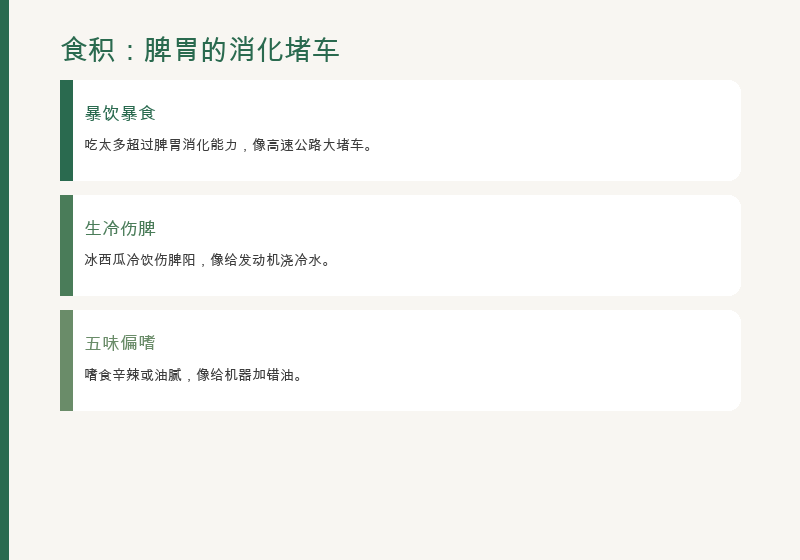
Normal digestion = highway, food flows smoothly
Food stagnation = massive highway traffic jam, food lingers and ferments
Binge eating = too many vehicles entering at once, entrance paralysis
Eating cold food = icy road, vehicles skid (digestive enzyme activity decreases)
Eating greasy food = sticky road, vehicles move slowly (fat digestion is difficult)
Late-night eating = road construction at night, road closed (gut should be resting)
That simple. Your "food stagnation" is essentially food lingering in the gastrointestinal tract, causing digestive dysfunction and toxin production — like a city-wide traffic paralysis, the entire system is affected.
Specifically:
What does food stagnation correspond to? It corresponds to indigestion, delayed gastric emptying, gastrointestinal dysfunction, and gut microbiome imbalance in modern medicine. When food stagnation occurs, food lingers in the stomach, fermenting and producing gas (bloating, belching). Food lingers in the intestines, with excessive water absorption (constipation), or fermentation producing toxins (diarrhea, intestinal rumbling). Long-term food stagnation leads to gut microbiome imbalance, with an increase in harmful bacteria producing endotoxins that enter the bloodstream, triggering systemic inflammation. This is the modern explanation for "when the spleen and stomach are injured, all diseases arise" — it's not that "the spleen and stomach are broken so all diseases arise," but gut barrier damage + microbiome imbalance + toxin entry into blood + systemic inflammation.
What does "food stagnation transforming into heat" correspond to? It corresponds to the inflammatory response produced by food lingering and fermenting. Food lingering in the gastrointestinal tract is fermented by bacteria, producing large amounts of gas and metabolic byproducts. These metabolic byproducts stimulate the gastrointestinal mucosa, causing a local inflammatory response — redness, swelling, heat, pain, and functional disorder. This is the scientific basis for "food stagnation transforming into heat": it's not that "food turns into fire," but fermentation products + bacterial metabolism + inflammatory response.
What does "spleen deficiency with food stagnation" correspond to? It corresponds to chronic digestive dysfunction. Long-term dietary indiscretion leads to declining gastrointestinal function, reduced digestive enzyme secretion, slower gastrointestinal motility, and reduced absorption area. Manifestations include: poor appetite, bloating, loose stools, sallow complexion, fatigue, and emaciation. This is the modern explanation for "spleen deficiency" — it's not that "the spleen is weak," but overall decline in digestive function.
What does "when the spleen and stomach are injured, all diseases arise" correspond to? It corresponds to the scientific discovery that the gut is the "second brain" and "immune center." Modern medicine has found that 70% of immune cells are in the gut, and gut microbiota affect whole-body metabolism, immunity, and neurological function. Damage to the gut barrier ("leaky gut") allows toxins to enter the blood, triggering systemic inflammation, which is linked to obesity, diabetes, allergies, autoimmune diseases, and depression. TCM says "the spleen and stomach are the foundation of acquired constitution" — digestion and absorption are the basis of whole-body health. Both statements point to the same fact: gut health is the cornerstone of whole-body health.
So, "food stagnation" is not mysticism. It is a functional metaphor — describing digestive system dysfunction caused by improper diet. The ancients used "food stagnation" to summarize what modern people need a whole list of concepts like "indigestion," "gastrointestinal dysfunction," "gut microbiome imbalance," and "nutrient absorption disorder" to explain.
Part 4Real-Life Cases
Four stories to help you instantly understand what "food stagnation" is.
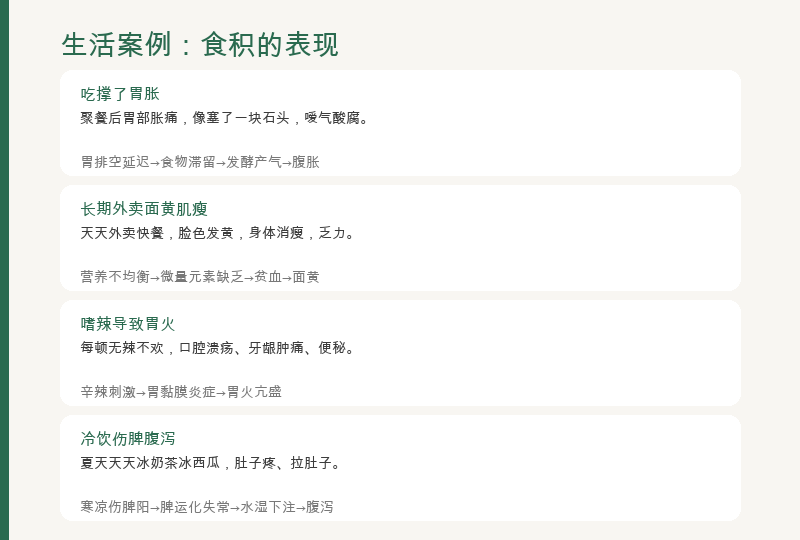
Case One: Bloating after binge eating.
You go to a weekend feast — hot pot, barbecue, beer — eating until you have to lean against the wall to walk. The next day your stomach is swollen like a balloon, tender to the touch, with foul-smelling belching. You take digestive tablets, feel a bit better, but still uncomfortable. You ask: "What's going on?" Western medicine says: "Excessive gastric expansion, delayed gastric emptying, food fermentation producing gas." TCM says: "Food stagnation, spleen-stomach transformation and transportation insufficient."
The truth: The normal stomach capacity is about 1–1.5 liters. Binge eating expands the stomach to 2–3 times its size, overstretching the stomach wall and delaying gastric emptying. Food lingers in the stomach for more than 4–6 hours, fermented by bacteria, producing large amounts of gas (hydrogen, methane, carbon dioxide). Gas accumulation causes bloating. Fermentation products stimulate the gastric mucosa, producing an inflammatory response. It's not that "there's gas in the stomach," but excessive gastric expansion + delayed emptying + fermentation gas production + inflammatory response. But the description of "food stagnation" precisely captures the pathological process of binge eating.
Case Two: Chronic constipation from daily takeout.
You eat takeout every day — high oil, high salt, low fiber. You're constipated, going to the bathroom once every three days, with difficult passage and hard, dry stools. You take probiotics and laxatives, which work for a few days, then the problem returns. You ask: "Why don't probiotics work?" Western medicine says: "Insufficient dietary fiber, gut microbiome imbalance, slowed motility." TCM says: "Food stagnation transforms into heat, intestinal fluids depleted, transmission impaired."
The truth: Dietary fiber is food for gut bacteria (prebiotics). Insufficient fiber leads to microbiome imbalance, with an increase in harmful bacteria producing toxins. At the same time, insufficient fiber means smaller stool volume, which cannot effectively stimulate intestinal wall peristalsis, weakening the defecation reflex. Daily takeout — high oil, low fiber — is the main culprit of constipation. TCM says "food stagnation transforms into heat, intestinal fluids depleted" — food lingers, water is excessively absorbed, stools become hard and dry. Modern medicine says "low-fiber diet causes constipation" — both describe the same mechanism. It's not that "the intestines lack fluids," but insufficient fiber + microbiome imbalance + slowed motility. But the description of "food stagnation transforming into heat" precisely captures the pathology of constipation.
Case Three: Childhood food stagnation and recurrent colds.
Your child loves snacks and doesn't like meals, with a sallow complexion and recurrent colds. You take him to the pediatrician, who says: "Malnutrition, low immunity." You take him to a TCM practitioner, who says: "Food stagnation with spleen deficiency, acquired constitution insufficient, exterior defense not secure." You ask: "How can indigestion cause colds?"
The truth: Long-term food stagnation damages spleen-stomach function, leading to impaired nutrient absorption. Insufficient protein, vitamins, and trace elements reduce the synthesis of immune cells (T cells, B cells, antibodies). At the same time, damage to the gut barrier allows toxins to enter the blood, with chronic inflammation consuming immune resources. TCM says "when the spleen is deficient, exterior defense is not secure" — poor digestion and absorption, insufficient qi and blood, and the body's surface defense (immunity) is weak. Modern medicine says "malnutrition leads to immune deficiency" — research has found that protein-deficient children have 3–5 times increased risk of respiratory infections. It's not that "spleen deficiency causes colds," but nutrient absorption disorder + reduced immune synthesis + gut barrier damage. But the description of "spleen deficiency, exterior defense not secure" precisely captures the relationship between malnutrition and immunity.
Case Four: Late-night dining causing gastroesophageal reflux.
You have a habit of eating before bed — fried chicken, instant noodles, bubble tea. You lie down after eating, with a burning sensation in your chest, acid reflux, and a sore throat. You take acid suppressants, which provide some relief, but the problem returns every time you eat late. You ask: "Why does lying down cause acid reflux?" Western medicine says: "Gastroesophageal reflux disease (GERD), lower esophageal sphincter relaxation, gastric contents refluxing." TCM says: "Food stagnation in the stomach, stomach qi rebelling upward."
The truth: Gastric emptying takes 2–4 hours. Eating before bed, the stomach hasn't emptied before you lie down, increasing intragastric pressure. At the same time, high-fat food reduces lower esophageal sphincter tone, making it easier for gastric contents to reflux into the esophagus. Gastric acid stimulates the esophageal mucosa, causing heartburn and acid reflux. Long-term reflux leads to esophagitis and Barrett's esophagus (a precancerous condition). TCM says "food stagnation in the stomach, stomach qi rebelling upward" — food lingers in the stomach, stomach qi cannot descend normally and instead rebels upward. Modern medicine says "delayed gastric emptying + lower esophageal sphincter relaxation + positional factors" — both describe the same mechanism. It's not that "stomach qi rebels upward," but delayed gastric emptying + positional factors + lower esophageal sphincter dysfunction. But the description of "stomach qi rebelling upward" precisely captures the pathology of reflux.
Four cases, one underlying logic: food stagnation is a "digestive system traffic jam" — food lingers, ferments, toxins are produced, and the whole body is affected.
Part 5Modern Research
Does "food stagnation" have scientific research?
Yes, and quite a lot. Scientists don't use the word "food stagnation"; they use:
• Gastrointestinal Motility. Research on gastric emptying, intestinal peristalsis, and digestive secretion. Findings: binge eating delays gastric emptying, high-fat food slows gastric emptying, and stress inhibits gastrointestinal motility. These studies directly correspond to the pathology of "food stagnation" in TCM — food lingering, transformation insufficient.
• Gut Microbiome. There are about 100 trillion bacteria in the gut, affecting digestion, immunity, metabolism, and neurological function. Improper diet (high fat, low fiber, high sugar) leads to microbiome imbalance, with an increase in harmful bacteria producing endotoxins. Endotoxins entering the blood trigger systemic inflammation (metabolic endotoxemia). This is the modern mechanism for "when the spleen and stomach are injured, all diseases arise" — gut microbiome imbalance affects whole-body health.
• Gut-Brain Axis. The gut and brain communicate bidirectionally through neural, hormonal, and immune signals. Gut microbiota affect the synthesis of neurotransmitters (serotonin, GABA), influencing mood, cognition, and sleep. Gut microbiome imbalance caused by food stagnation can affect brain function — this is the modern explanation for TCM's "when the spleen and stomach are not harmonious, sleep is not peaceful." Research has found that fecal microbiota transplantation can improve depression symptoms — gut health indeed affects mental health.
These studies fully demonstrate that "food stagnation" is a concept that can be precisely described in modern scientific language. The ancients used "food stagnation" to summarize; modern people use "gastrointestinal motility + gut microbiome + gut-brain axis" to describe — they are talking about the same thing.
Part 6Practical Methods
Now that you understand "food stagnation," how do you prevent it?
First, dispel a few myths:
• "If you eat too much, take digestive tablets." Digestive tablets (such as Jianwei Xiaoshi tablets) can temporarily promote digestion, but they cannot solve the root problem. Long-term reliance on digestive tablets causes the gastrointestinal tract to become dependent, and its own digestive function becomes even weaker. It's not that "with medicine, you can eat fearlessly," but medicine is auxiliary; eating habits are the root.
• "Probiotics can solve all gut problems." Probiotics are somewhat helpful for gut microbiome imbalance, but they are not a panacea. If eating habits don't change (high oil, low fiber), probiotics won't survive well either. It's not that "taking probiotics solves everything," but diet + lifestyle are the foundation of microbiome health.
Specific methods:
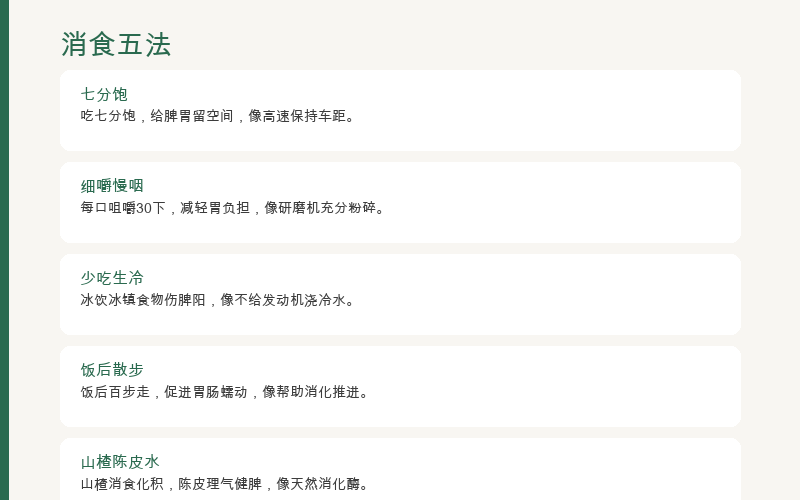
• Seventy percent full (leave space for the stomach). Eat until seventy percent full at each meal, leaving room for the stomach to digest. Excessive gastric expansion and delayed gastric emptying are the primary causes of food stagnation. Research has found that calorie restriction (seventy percent full) can extend lifespan and improve metabolism. It's not that "eating less is healthy," but moderately reducing the burden on the digestive system.
• Chew thoroughly (reduce gastrointestinal burden). Chew each bite 20–30 times; smaller food particles make it easier for digestive enzymes to act. At the same time, chewing stimulates saliva secretion, and the amylase in saliva begins preliminary digestion. Chewing also stimulates gastric digestive secretion, preparing in advance. Research has found that people who chew thoroughly feel fuller sooner and eat 15% less.
• Regular timing and quantity (stabilize gastrointestinal rhythm). Three meals a day at regular times — breakfast 7–8 AM, lunch 12–1 PM, dinner 6–7 PM. The gastrointestinal tract has a biological clock; regular eating leads to regular digestive secretion. Avoid late-night eating — don't eat within 3 hours of bedtime, allowing the gut to rest. Research has found that time-restricted eating can improve metabolism and reduce inflammation.
• High-fiber diet (feed the gut microbiome). Consume 25–30 grams of dietary fiber daily (vegetables, fruits, whole grains). Fiber is food for gut bacteria, promoting the growth of beneficial bacteria, increasing stool volume, and stimulating intestinal peristalsis. A high-fiber diet is associated with reduced risk of colon cancer, cardiovascular disease, and diabetes. It's not "eating grass," but providing essential nutrients for gut microorganisms.
• Moderate exercise (promote gastrointestinal motility). Thirty minutes of moderate-intensity exercise daily (brisk walking, jogging) promotes gastrointestinal motility, improves gastric emptying, and regulates gut microbiome. Research has found that exercise can increase gut microbiome diversity and promote the growth of beneficial bacteria. Don't lie down immediately after eating or exercise vigorously — take a 20-minute walk after meals to aid digestion.
These methods don't require you to believe in TCM. You only need to understand: food stagnation is a "digestive system traffic jam" — reducing traffic volume, improving road conditions, and regular traffic flow are the most effective solutions.
Part 7One-Minute Summary
🕐 One Minute to Understand "Food Stagnation"
Food Stagnation = Digestive system traffic jam / toxic takeout.
Food stagnation is not just "eating too much," but also "eating wrong" — improper temperature, flavor bias, disordered eating times.
The fast food, takeout, and late-night dining of modern society are the greatest sources of food stagnation.
Food stagnation = indigestion + gastrointestinal dysfunction + gut microbiome imbalance + nutrient absorption disorder.
Food stagnation is not mysticism; it is digestive system dysfunction caused by improper diet.
Myths: relying on digestive tablets, probiotics as a panacea.
Methods: seventy percent full, chew thoroughly, regular timing and quantity, high-fiber diet, moderate exercise.
The ancients called it "food stagnation"; modern people call it "indigestion + microbiome imbalance."
Different names, but the body knows: when the digestive system is not jammed, the whole body can flow freely.
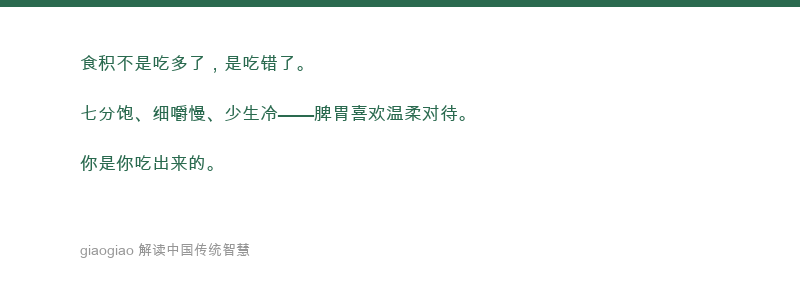
Food stagnation is not just overeating — it's eating wrong, eating chaotically, and eating for too long.
The ancients didn't have the concept of gut microbiota, but they knew that "when the spleen and stomach are injured, all diseases arise."
This is probably the most down-to-earth wisdom of the Chinese people: moderation in diet, harmony of the spleen and stomach, and no diseases arise.
Making money is the art of living; art is the life after making money
giaogiao Explains Traditional Chinese Wisdom · Concept 48
Using modern scientific language to help the world understand traditional Chinese wisdom.
Not mystical, not superstitious, not dismissive.
Understand, rather than merely believe.
Coach Liu
Written in Florence