Inquiry: How Can a TCM Doctor Know Your Medical History From Just a Few Questions?
Part 1The Question
Have you ever had this experience?
You go see a TCM doctor. Before they even take your pulse, they ask you: "Do you tend to feel cold or hot? Do you sweat at night? How many times a day do you have bowel movements? Are they well-formed?" You think: "Why are they asking about my household registration?" But based on your answers, the doctor says: "This is spleen deficiency with dampness encumbrance, qi and blood insufficiency." You ask: "How do you know from just a few questions?" Western medicine says: "History taking is the foundation of diagnosis. Systematic questioning can narrow the differential diagnosis." TCM says: "To know by asking is called skill — it means reconstructing the body's timeline through dialogue." Two ways of saying it, both pointing to the same fact: inquiry is the "information gateway" of diagnosis.
Even crazier, your friend goes to a TCM doctor, and the doctor asks: "How's your mood lately? Have you been angry?" Your friend answers: "I had a fight with my boss last week." The doctor says: "Liver qi stagnation, qi stagnation leading to blood stasis." You ask: "How does asking about mood reveal a physical problem?" Western medicine says: "Chronic stress affects the neuroendocrine system, causing multiple somatic symptoms." TCM says: "The liver governs the free flow of qi; emotional frustration leads to liver qi stagnation." Two different ways of saying it, but both might be right — emotional issues do cause physical symptoms. It's not about who's right or wrong; it's two systems using different languages to describe the same phenomenon.
Here's another question: You go to a TCM doctor, and they ask: "When did this start? Did it come on gradually or suddenly?" You ask: "Why do you ask that?" Western medicine says: "The timeline of illness is crucial for diagnosis. Acute onset suggests infection or trauma; chronic progression suggests degenerative or metabolic disease." TCM says: "New illness is mostly excess, long illness is mostly deficiency; sudden illness is mostly excess, gradual illness is mostly deficiency." Which is right? Modern science has found that the natural history of disease indeed has acute, chronic, and recovery phases, with different treatment strategies for each stage. It's not that TCM "guessed right" — it's that the ancients, through massive observation, summarized the relationship between disease course and disease nature.
Even more confusing, you go to a TCM doctor, and they ask: "What medications have you taken? How did they work?" Western medicine says: "Medication history is vital diagnostic information; it can prevent drug interactions and side effects." TCM says: "Medication taken helps judge the changes, using drug effects to determine the disease mechanism." Two different ways of saying it, yet they agree again. Drug reactions do reflect the body's metabolic state and treatment sensitivity. It's not "who copied whom" — it's two systems describing the same clinical logic from different angles.
So what exactly is inquiry?
Part 2Traditional Chinese Explanation
The concept of "inquiry" (wen) in TCM is the core method for obtaining medical history. The ancients observed: Some people feel cold and prefer warmth — this is yang deficiency. Some people feel hot and prefer coolness — this is yin deficiency. Some people sweat during the day — this is qi deficiency. Some people sweat at night — this is yin deficiency. Some people have loose stools — this is spleen deficiency. Some people have dry, hard constipation — this is intestinal dryness. The ancients summarized these symptom patterns into the Ten Questions — a systematic inquiry framework.
—— Classic of Difficulties, Chapter 61
"First ask about cold and heat, second about sweat, third about head and body, fourth about bowel movements, fifth about diet, sixth about the chest, seventh about deafness and eighth about thirst must all be distinguished, ninth about old illnesses and tenth about causes, plus medication taken to judge the changes."
—— Complete Works of Jingyue, "Ten Questions"
"For women, menstruation must be asked about; delay, speed, closure, and flooding are all visible."
—— Complete Works of Jingyue, "Ten Questions"
TCM summarizes inquiry into ten keywords: cold and heat, sweating, head and body, bowel movements, diet, chest and abdomen, ears and eyes, thirst, old illnesses, and causes.
Asking about cold and heat (feeling cold or hot) — Cold and heat are direct reflections of the body's yin-yang state. Feeling cold (aversion to cold) is mostly yang deficiency or external wind-cold; feeling hot (fever) is mostly yin deficiency or external wind-heat. Daytime fever is mostly qi deficiency (yang floating outward); nighttime fever is mostly yin deficiency (yin failing to control yang). TCM says "When yang is deficient, there is external cold; when yin is deficient, there is internal heat" — modern medicine says "thermoregulatory center dysfunction + metabolic rate changes" — both are describing the same mechanism.
Asking about sweating — Sweat is an external manifestation of qi, blood, and body fluids. Daytime spontaneous sweating (sweating without movement) is mostly qi deficiency, with failure to contain fluids; nighttime盗汗 (night sweats) is mostly yin deficiency, with virtual fire forcing fluids outward. No sweat (dry skin) is mostly blood deficiency or insufficient body fluids. TCM says "Sweat is the fluid of the heart" — modern medicine says "Sweating is part of thermoregulation and excretory function" — both point to the physiological significance of sweating.
Asking about head and body (pain and discomfort) — Headache, body pain, and sore limbs reflect the state of qi and blood circulation. Headache location (forehead, sides, back of head, top of head) is related to the pathways of the meridians. Heavy, tired body is mostly dampness encumbrance; wandering pain is mostly wind pathogen; fixed stabbing pain is mostly blood stasis. TCM says "If there is no free flow, there is pain; if there is no nourishment, there is pain" — modern medicine says "Pain is a signal of tissue damage or abnormal nerve conduction" — both are describing the same pathology.
Asking about bowel movements (urination and defecation) — Stool is a direct reflection of spleen and stomach function. Loose, unformed stools are mostly spleen deficiency with dampness; dry, hard stools are mostly intestinal dryness or heat accumulation; alternating constipation and diarrhea is mostly liver depression with spleen deficiency. Urine reflects kidney and bladder function. Dark yellow, scanty urine is mostly heat excess; clear, copious urine is mostly deficiency-cold; frequent, urgent urination is mostly bladder damp-heat. TCM says "Ask about the two excretions to know the organs" — modern medicine says "Urine and stool tests are basic diagnostic methods" — both are describing the same fact.
So when the ancients spoke of "inquiry," it wasn't just "chatting" — it was systematic information gathering: through asking about cold and heat, sweating, head and body, bowel movements, diet, chest and abdomen, ears and eyes, thirst, old illnesses, and causes, reconstructing the body's "timeline" and "state map." The ancients used the "Ten Questions" to summarize what modern people need "history taking + system review" to explain.
Part 3ggiao's Modern Translation
Alright, now let's translate "inquiry" into modern language.
I'm not going to talk about history taking, differential diagnosis, or system review. Too complicated. You just need to remember one metaphor:
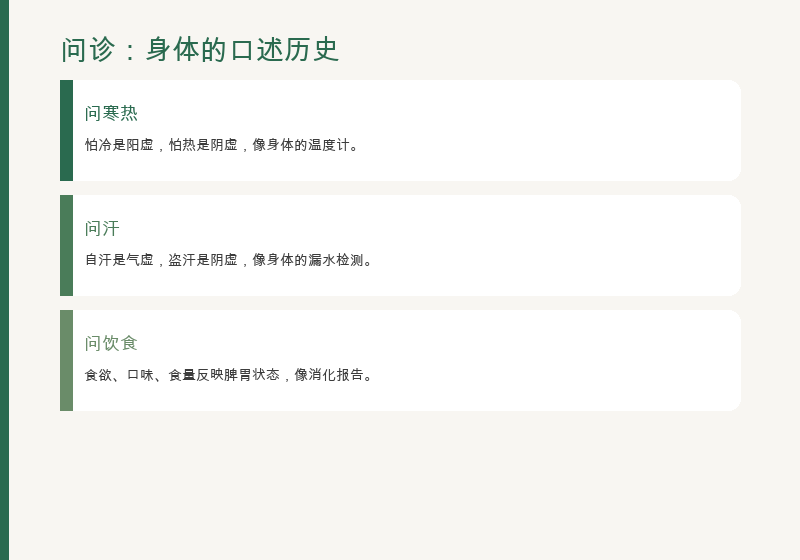
Cold and heat = The body's temperature control system log, reflecting metabolic and immune status
Sweating = The body's heat dissipation and excretion record, reflecting autonomic nerve function
Bowel movements = The body's digestive system report, reflecting nutrient absorption and metabolism
Diet = The body's energy input record, reflecting digestive function and appetite
Sleep = The body's repair system log, reflecting nervous and endocrine system status
Emotions = The body's psychological state record, reflecting neuroendocrine balance
That's it. Your "inquiry" is essentially obtaining the body's "oral history" through dialogue — like a detective investigating a case, reconstructing the complete timeline of bodily state changes by asking about time, place, people, and events.
Specifically:
"Do you feel cold or hot?" corresponds to what? It corresponds to the thermoregulatory center and metabolic rate. In hyperthyroidism, the metabolic rate increases, causing heat intolerance and excessive sweating. In hypothyroidism, the metabolic rate decreases, causing cold intolerance and fatigue. During infection, the thermoregulatory set point shifts upward, causing chills (feeling cold) and fever (feeling hot). TCM says "When yang is deficient, there is external cold; when yin is deficient, there is internal heat" — modern medicine says "thermoregulatory dysfunction + metabolic rate changes" — both are describing the same mechanism.
"Do you sweat during the day or at night?" corresponds to what? It corresponds to autonomic nervous system function. Daytime spontaneous sweating (sweating without movement) is mostly imbalance between sympathetic and parasympathetic nerves, with relatively excited sympathetic nerves causing increased sweat gland secretion. Nighttime sweating is mostly abnormal sympathetic activity during sleep (such as in infections, tuberculosis, or lymphoma) or vasomotor dysfunction caused by declining estrogen levels during menopause. TCM says "Spontaneous sweating indicates qi deficiency; night sweats indicate yin deficiency" — modern medicine says "autonomic nervous system dysfunction + hormonal fluctuations" — both are describing the same pathology.
"Are your stools well-formed or loose?" corresponds to what? It corresponds to digestive and absorptive function and gut microbiome status. Loose, unformed stools are mostly due to rapid intestinal motility, poor digestion and absorption, or gut microbiome imbalance (such as in irritable bowel syndrome). Constipation is mostly due to slow intestinal motility, insufficient dietary fiber, or inadequate water intake. TCM says "Loose stools indicate spleen deficiency; constipation indicates intestinal dryness" — modern medicine says "intestinal motility abnormalities + microbiome imbalance" — both are describing the same phenomenon.
"How's your mood?" corresponds to what? It corresponds to the neuroendocrine system status. During chronic stress, the HPA axis is continuously activated, cortisol is elevated, leading to anxiety, depression, insomnia, and indigestion. TCM says "The liver governs the free flow of qi; emotional frustration leads to liver qi stagnation" — modern medicine says "Chronic stress causes neuroendocrine disorders" — both are describing the same fact.
So "inquiry" isn't mysticism. It's a functional metaphor — describing the process of obtaining information about the body's state through dialogue. The ancients summarized it with the "Ten Questions"; modern people describe it with "history taking + system review" — they're talking about the same thing.
Part 4Real-Life Cases
Four stories to instantly show you what "inquiry" is.
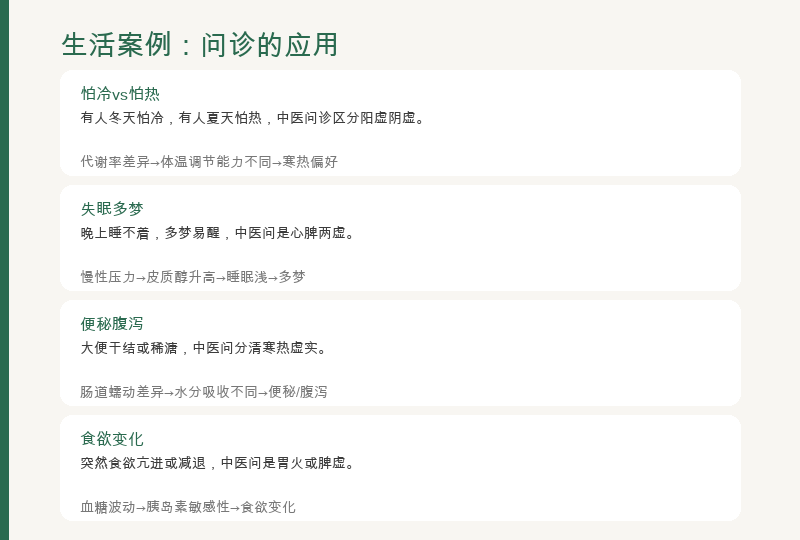
Case One: Menopausal Night Sweats.
Your mom is fifty, and lately she's been sweating at night, soaking her pajamas. She goes to a TCM doctor, who asks: "Is the sweating during the day or at night?" She says: "After falling asleep at night." The doctor says: "Yin deficiency with night sweats — a typical manifestation of menopause." You ask: "How do you know from just the timing?" Western medicine says: "Declining estrogen levels during menopause cause unstable vasomotor function and disrupted nighttime thermoregulation." TCM says: "When yin is deficient, yang becomes hyperactive; virtual fire forces fluids outward, causing night sweats."
The truth: Declining estrogen levels during menopause affect the hypothalamic thermoregulatory center, causing unstable vasomotor responses. During sleep at night, body temperature should normally drop, but in menopausal women, the thermoregulatory set point fluctuates, causing sudden sweating (hot flashes). TCM says "yin deficiency with night sweats" — "yin" is an inhibitory factor, "yang" is an excitatory factor, and when yin is deficient, yang becomes relatively hyperactive, causing nighttime sweating. Modern medicine says "declining estrogen + thermoregulatory dysfunction" — both are describing the same mechanism. It's not "menopause is just like that"; it's thermoregulatory dysfunction caused by hormonal changes. But the description of "yin deficiency with night sweats" precisely captures the characteristic sweating pattern of menopause.
Case Two: Young Person's Alternating Diarrhea and Constipation.
Your colleague is twenty-eight and often has diarrhea, but sometimes constipation too. You ask him: "When did this start?" He says: "It started when work got stressful." You go with him to a TCM doctor, who asks: "Which is more common, diarrhea or constipation? Any abdominal pain? How's your mood?" He says: "Diarrhea is more common. I get stomach cramps when I'm nervous, and I feel better after going. Work stress is high." The doctor says: "Liver depression with spleen deficiency, wood overwhelming earth." Western medicine says: "Irritable bowel syndrome (IBS), a stress-related functional bowel disorder."
The truth: IBS is a functional bowel disorder related to gut microbiome imbalance, increased intestinal sensitivity, and brain-gut axis dysfunction. Chronic stress activates the HPA axis, affecting intestinal motility and secretion, leading to alternating diarrhea and constipation. TCM says "liver depression with spleen deficiency" — the liver governs the free flow of qi; emotional frustration causes liver qi stagnation, which then overacts on the spleen (wood overwhelming earth), causing the spleen's transformation and transportation functions to fail, leading to diarrhea or constipation. Modern medicine says "chronic stress + brain-gut axis dysfunction" — both are describing the same mechanism. It's not "weak stomach"; it's abnormal nervous system regulation of the gut caused by stress. But the description of "liver depression with spleen deficiency" precisely captures the etiology and pathogenesis of IBS.
Case Three: Diabetic's "Three Excesses and One Deficiency."
Your father has been unusually thirsty lately, drinking a lot of water, urinating a lot too, and losing weight. You take him to the hospital, and the doctor asks: "How long have you been thirsty? How much urine? How much weight loss?" He says: "A month now. Drinking four or five liters a day, and lots of urine too. Lost five pounds." The doctor says: "Diabetes — the classic three excesses and one deficiency (excessive drinking, excessive urination, excessive eating, and weight loss)." TCM says: "Wasting-thirst disease — upper wasting (lungs) with excessive thirst and drinking, middle wasting (stomach) with excessive eating and hunger, lower wasting (kidneys) with excessive urination and weight loss."
The truth: In diabetes, insulin is insufficient or resisted, glucose cannot enter cells, and blood sugar rises. High blood sugar causes osmotic diuresis (excessive urination), excessive urination causes thirst (excessive drinking), cellular energy deficiency causes hunger (excessive eating), and fat and protein breakdown causes weight loss. TCM says "wasting-thirst disease" — the ancient name for diabetes, with "upper, middle, and lower wasting" corresponding to the three symptom clusters of thirst, excessive eating, and excessive urination. Modern medicine says "insulin resistance + high blood sugar metabolic disorder" — both are describing the same pathology. It's not "eating too much sugar"; it's insulin metabolic dysfunction. But the description of "wasting-thirst disease" precisely captures the clinical manifestations of diabetes.
Case Four: Athlete's Low Blood Pressure.
You run marathons with high training volume. Lately you've noticed you're always dizzy and fatigued, especially when standing up. You go to a TCM doctor, who asks: "When does the dizziness occur? After exercise or normally? Do you sweat a lot?" You say: "I get dizzy when I stand up, worse after exercise. I sweat a lot." The doctor says: "Qi deficiency with sinking, clear yang failing to rise." Western medicine says: "Orthostatic hypotension, autonomic nervous regulation insufficiency, possibly related to overtraining."
The truth: With long-term endurance training, although blood volume increases, autonomic nervous regulation may become over-adapted (excessive parasympathetic tone). When standing, the vasoconstriction response is insufficient, causing blood pressure to drop and insufficient cerebral blood supply, leading to dizziness. Heavy sweating causes electrolyte loss (sodium, potassium), further exacerbating blood pressure fluctuations. TCM says "qi deficiency with sinking, clear yang failing to rise" — "qi" is functional power, "clear yang" is the rising qi and blood, and when qi is deficient, qi and blood cannot nourish the head and eyes. Modern medicine says "autonomic nervous regulation insufficiency + orthostatic hypotension" — both are describing the same mechanism. It's not "anemia"; it's autonomic nervous over-adaptation + abnormal blood volume distribution. But the description of "qi deficiency with sinking" precisely captures the pathology of orthostatic hypotension.
Four cases, one underlying logic: Inquiry is "reconstructing the body's timeline" — through dialogue, obtaining the complete history of bodily state changes.
Part 5Modern Research
Is there scientific research on "inquiry"?
Yes, and quite a lot. Scientists don't use the term "inquiry"; they use:
• History Taking. Modern medicine considers history taking the cornerstone of diagnosis. Studies show that 70-80% of diagnoses can be made through detailed history taking without laboratory tests. For example, in a patient with chest pain, asking about the location, nature, radiation, triggers, and relieving factors can distinguish angina, myocardial infarction, gastroesophageal reflux, and intercostal neuralgia. This is consistent with TCM's "Ten Questions" approach — systematic inquiry is the core of diagnosis.
• Symptomatology. Symptomatology is the study of the relationship between symptoms and diseases. Modern research has found that many symptoms are highly specific. For example, night sweats are associated with tuberculosis, lymphoma, HIV infection, and menopause; orthostatic dizziness is associated with autonomic nervous dysfunction, dehydration, and medication side effects. This is consistent with TCM's approach of "asking about cold and heat and sweating" — specific symptoms point to specific pathologies.
• Patient-Reported Outcomes (PROs). In recent years, the medical community has increasingly valued patient-reported information. PROs are used to assess treatment effects, disease burden, and quality of life. Research has found that patients' subjective feelings (such as fatigue, pain, sleep) often reflect disease changes earlier than objective indicators. This is the scientific validation of "inquiry" — patients' subjective experiences are important information for diagnosis and treatment.
These studies fully demonstrate that "inquiry" is a concept that can be precisely described in modern scientific language. The ancients summarized it with the "Ten Questions"; modern people describe it with "history taking + symptomatology + PROs" — they're talking about the same thing.
Part 6Practical Methods
Now that you understand "inquiry," how do you apply it?
First, dispel a few misconceptions:
• "Asking a doctor is worse than using Baidu yourself." Online information is a mixed bag, and self-diagnosis is prone to misdiagnosis. The same symptom (such as headache) can correspond to completely different diseases (from tension headache to brain tumor). A professional doctor's inquiry training can distinguish these differences. It's not "Baidu knows me better"; it's systematic inquiry requires professional training.
• "Asking about symptoms is a waste of time; we should just test directly." History taking is the most efficient diagnostic tool. A detailed history can rule out a large number of unnecessary tests, saving time and money. It's not "the more tests the better"; it's inquiry is the "filter" of diagnosis.
Specific methods:
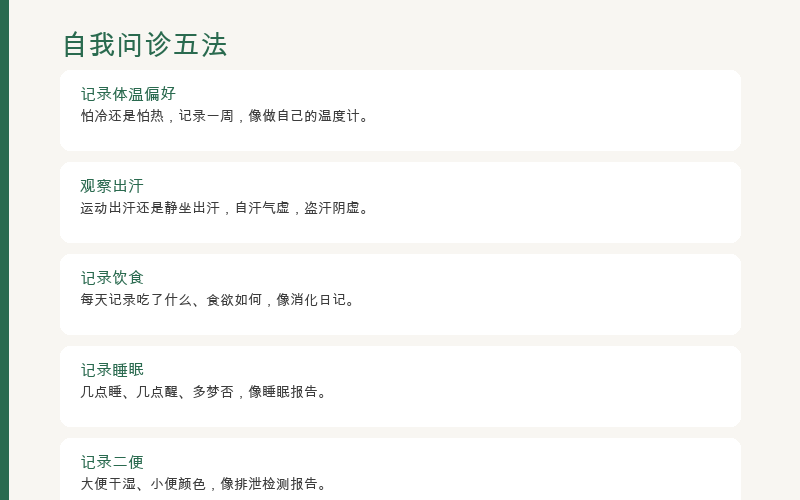
• Learn to keep your own "body log." Simply record every day: sleep duration, mental state, diet, bowel movements, and emotional state. Persist for a month, and you'll discover patterns in your body's changes. When you see a doctor, bring these records — they can greatly improve inquiry efficiency. It's not "writing a diary is a waste of time"; it's the body log is a tool for self-management.
• Before seeing a doctor, prepare to answer ten questions. Based on the Ten Questions, think ahead: Do you feel cold or hot? Sweating situation? Headache or body pain? Bowel movements? Diet? Chest tightness or abdominal bloating? Hearing and vision? Thirst? Past medical history? Cause of illness? It's not "I'll think about it when the doctor asks"; it's active preparation improves inquiry quality.
• Don't ignore "emotions" as key information. Many physical symptoms (indigestion, insomnia, headache, chronic pain) are closely related to emotional stress. When seeing a doctor, proactively mention your recent emotional state, work stress, and changes in interpersonal relationships. It's not "emotions have nothing to do with the body"; it's emotions are a window into the neuroendocrine system.
• Pay attention to the importance of the "timeline." When did the symptoms start? Did they come on gradually or suddenly? What factors are they related to (diet, exercise, emotions, season)? This information is crucial for diagnosis. It's not "when it started doesn't matter"; it's the timeline is the key clue for diagnosis.
• Honestly report medication history and past medical history. Many medications have side effects (such as certain blood pressure medications causing cough, certain antibiotics causing diarrhea), and past medical history affects current diagnosis. Don't hide it; report it honestly. It's not "what medications I took doesn't matter"; it's medication history is important diagnostic information.
These methods don't require you to believe in TCM. You just need to understand: Inquiry is "obtaining the body's oral history" — reconstructing the complete timeline of bodily state changes through systematic dialogue.
Part 7One-Minute Summary
🕐 One-Minute Understanding of "Inquiry"
Inquiry = The Body's Oral History + Detective Investigation.
Inquiry includes ten questions: cold and heat, sweating, head and body, bowel movements, diet, chest and abdomen, ears and eyes, thirst, old illnesses, and causes.
Reconstructing the body's timeline and state map through dialogue.
Menopausal night sweats, IBS alternation, diabetes three excesses and one deficiency, and athlete's low blood pressure are all clues that "inquiry" can reveal.
Inquiry = History taking + Symptomatology + Patient-reported outcomes (PROs).
Inquiry is not chatting; it's systematic information gathering.
Misconceptions: Using Baidu instead of inquiry, inquiry is inferior to direct testing.
Methods: Keep a body log, prepare ten questions, pay attention to emotions, note the timeline, honestly report medication history.
The ancients called it "To know by asking is called skill"; modern people call it "history taking."
Different names, but the body knows: The body has an oral history, and only those who ask questions can understand it.
Cold and heat are the temperature control log; bowel movements are the digestive report.
The ancients had no electronic medical records, but they knew the "Ten Questions."
This is probably the most simple wisdom of the Chinese people: Those who ask well, listen well; those who listen well, know the disease.
Making money is the art of living; art is life after making money
ggiao Decodes Chinese Traditional Wisdom · Concept 53
Using the language of modern science to help the world understand Chinese traditional wisdom.
No mysticism, no superstition, no belittlement.
Understanding, not merely believing.
Coach Liu
Written in Florence