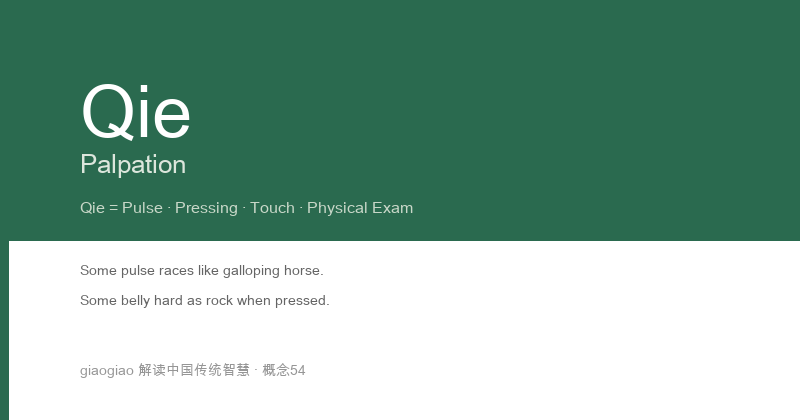
Palpation: How Can a TCM Doctor Know Your Qi and Blood Status by Just Feeling Your Pulse?
Part 1The Question
Have you ever had this experience?
You go see a TCM doctor, and they place three fingers on your wrist, close their eyes for a minute, then say: "The pulse is thin and weak — qi and blood insufficiency." You ask: "How do you know from just touching?" Western medicine says: "The pulse is a pressure wave generated by the heartbeat, conducted through peripheral vessels. Pulse rate, rhythm, and strength can reflect cardiac function and blood volume." TCM says: "The pulse is the residence of blood; it directly reflects the state of qi and blood circulation." Two ways of saying it, both pointing to the same fact — the pulse is the body's "traffic signal."
Even crazier, you hear that TCM pulse diagnosis divides the pulse into "cun, guan, chi" three positions, corresponding to the "upper, middle, and lower" burners. You ask: "Is there any scientific basis for this?" Western medicine says: "The radial artery is a continuous blood vessel; there are no three independent regions." TCM says: "Cun, guan, and chi are different depths and positions of the pulse, reflecting the qi and blood state of different organs." Two different ways of saying it, but both might be right — the radial artery is indeed one vessel, but the vascular wall tension, vessel diameter, and surrounding tissue pressure do vary at different positions. It's not about who's right or wrong; it's two systems using different languages to describe the same physiological phenomenon.
Here's another question: You hear that someone gets their abdomen pressed (physical palpation), and the doctor says "tenderness in the liver area" and "a mass in the abdomen." You ask: "What can pressing the belly tell you?" Western medicine says: "Abdominal palpation is a basic physical examination; it can detect organ enlargement, ascites, and masses." TCM says: "Physical palpation reveals deficiency and excess; hard and painful indicates excess, soft and sunken indicates deficiency." Two ways of saying it, which is right? Modern science has found that abdominal palpation can indeed detect pathological changes such as hepatosplenomegaly, tumors, ascites, and inflammation. It's not that TCM "guessed right" — it's that the ancients, through massive practice, summarized the diagnostic value of palpation.
Even more confusing, you hear that a pregnant woman's pulse is "slippery," like pearls rolling through. Western medicine says: "During pregnancy, blood volume increases, cardiac output increases, and peripheral vascular resistance decreases, so the pulse does indeed become more slippery." TCM says: "In pregnant women, the pulse is slippery, indicating abundant blood and qi." Two ways of saying it, and they agree again. During pregnancy, blood volume increases by 40-50%, cardiac output increases by 30-50%, and vessels dilate, making the pulse indeed more slippery and forceful. It's not "who copied whom" — it's two systems describing the same physiological change from different angles.
So what exactly is palpation?
Part 2Traditional Chinese Explanation
The concept of "palpation" (qie) in TCM includes two aspects: pulse diagnosis and physical palpation. The ancients observed: Some people's pulses are floating and forceful — this is external wind-cold; some people's pulses are deep and thin-weak — this is qi and blood deficiency; some people's pulses are slippery and smooth — this is phlegm-dampness or pregnancy; some people's pulses are choppy and obstructed — this is blood stasis. The ancients summarized these pulse changes into pulse patterns — twenty-eight pulse patterns, each corresponding to a different pathological state.
—— Classic of Difficulties, Chapter 61
"The pulse is the residence of blood. Long indicates regulated qi; short indicates diseased qi; rapid indicates vexed heart; large indicates advancing disease."
—— Yellow Emperor's Inner Canon, Basic Questions
"The wrist pulse is the great meeting of the pulse, the vessel of hand taiyin. It is where the five zang and six fu organs begin and end, so the method is taken from the wrist pulse."
—— Yellow Emperor's Inner Canon, Classic of Difficulties
TCM summarizes "palpation" into two keywords: pulse diagnosis and physical palpation.
Pulse diagnosis (feeling the pulse) — The pulse is the "traffic signal" of qi and blood. The ancient pulse-taking position was the "cun kou" (radial artery at the wrist), divided into cun, guan, and chi three positions. Cun (distal wrist) corresponds to the upper burner (heart and lungs), guan (middle wrist) corresponds to the middle burner (spleen and stomach), and chi (proximal wrist) corresponds to the lower burner (liver and kidneys). There are twenty-eight pulse patterns: floating, deep, slow, rapid, slippery, choppy, deficient, excess, long, short, surging, minute, tight, moderate, hollow, wiry, drumskin, firm, soggy, weak, scattered, thin, hidden, stirring, skipping, bound, intermittent, and racing. Each pulse pattern reflects a different qi and blood state. For example, floating pulse (felt with light pressure) mostly indicates external conditions; deep pulse (felt with heavy pressure) mostly indicates internal conditions; slow pulse (slow) mostly indicates cold conditions; rapid pulse (fast) mostly indicates heat conditions.
Physical palpation (touching the body) — Physical palpation is the method for examining the solid state of the organs. Pressing the abdomen can reveal whether the liver and spleen are enlarged, whether there are masses, and whether there is tenderness. Pressing the limbs can reveal temperature, swelling, and pain. Pressing acupuncture points can reveal the smoothness of meridian qi and blood flow. TCM says "Hard and painful indicates excess when pressed; soft and sunken indicates deficiency when pressed" — hard pain indicates tangible pathogens (phlegm, stasis, food accumulation); soft sinking indicates qi and blood deficiency. Modern medicine says "Palpation can detect organic lesions" — both are describing the same fact.
So when the ancients spoke of "palpation," it wasn't just "taking the pulse" — it was systematic tactile information reading — through feeling the pulse and touching the body, judging the abundance or decline of qi and blood, and the deficiency or excess of the organs. The ancients used "pulse diagnosis" and "physical palpation" to summarize what modern people need "physical examination + hemodynamic monitoring" to explain.
Part 3ggiao's Modern Translation
Alright, now let's translate "palpation" into modern language.
I'm not going to talk about hemodynamics, vascular tone, or pulse wave conduction velocity. Too complicated. You just need to remember one metaphor:
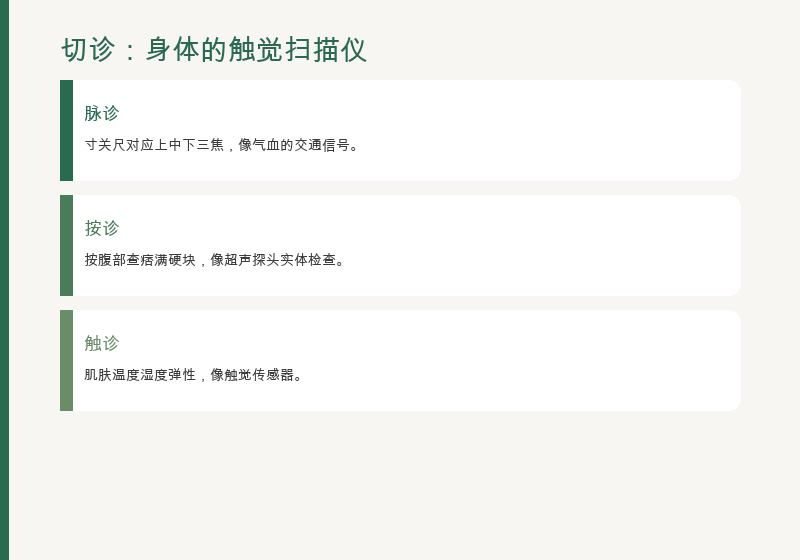
Pulse diagnosis = Touching the pressure wave of the blood vessel, reading the "traffic signal" of qi and blood
Physical palpation = Touching the solid state of the organs, checking for "fault points"
Cun-guan-chi = Three different "sensor positions," corresponding to different system regions
Floating-deep-slow-rapid = Different "signal patterns," representing different system states
Slippery-choppy-deficient-excess = Different "waveform characteristics," reflecting hemodynamic states
That's it. Your "palpation" is essentially the body transmitting internal state information through tactile signals — like an engineer feeling a machine's vibration by hand, or like a doctor using an ultrasound probe to check internal organs.
Specifically:
"Floating pulse" corresponds to what? It corresponds to peripheral vasodilation and changes in blood volume distribution. During external wind-cold invasion, the body increases heat dissipation by dilating peripheral vessels, increasing blood flow, so the pulse can be felt with light pressure (floating). At the same time, heart rate increases (rapid), and cardiac output increases. TCM says "Floating pulse indicates external conditions" — modern medicine says "peripheral vasodilation + blood flow redistribution" — both are describing the same mechanism.
"Deep pulse" corresponds to what? It corresponds to peripheral vasoconstriction and insufficient blood volume. When qi and blood are deficient, to maintain blood supply to core organs, peripheral vessels constrict, blood flow decreases, and the pulse requires heavy pressure to be felt (deep). At the same time, cardiac output decreases, and heart rate may slow. TCM says "Deep pulse indicates internal conditions and deficiency" — modern medicine says "peripheral vasoconstriction + insufficient blood volume" — both are describing the same pathology.
"Slippery pulse" corresponds to what? It corresponds to increased blood volume and good vascular elasticity. During pregnancy, blood volume increases by 40-50%, vessels dilate, and the pulse becomes slippery (like pearls rolling). In phlegm-dampness constitution, blood viscosity may change, altering blood flow state. TCM says "Slippery pulse indicates pregnancy and phlegm-dampness" — modern medicine says "increased blood volume + hemodynamic changes" — both are describing the same phenomenon.
"Choppy pulse" corresponds to what? It corresponds to increased blood viscosity and increased blood flow resistance. In blood stasis, blood viscosity increases, blood flow slows, and vascular resistance increases, making the pulse feel choppy (like scraping bamboo). In hyperlipidemia, diabetes, and arteriosclerosis, blood viscosity does indeed increase. TCM says "Choppy pulse indicates blood stasis" — modern medicine says "increased blood viscosity + increased blood flow resistance" — both are describing the same fact.
So "palpation" isn't mysticism. It's a functional metaphor — describing the process by which the body transmits internal state through tactile signals. The ancients summarized it with "pulse diagnosis" and "physical palpation"; modern people describe it with "physical examination + hemodynamic monitoring" — they're talking about the same thing.
Part 4Real-Life Cases
Four stories to instantly show you what "palpation" is.
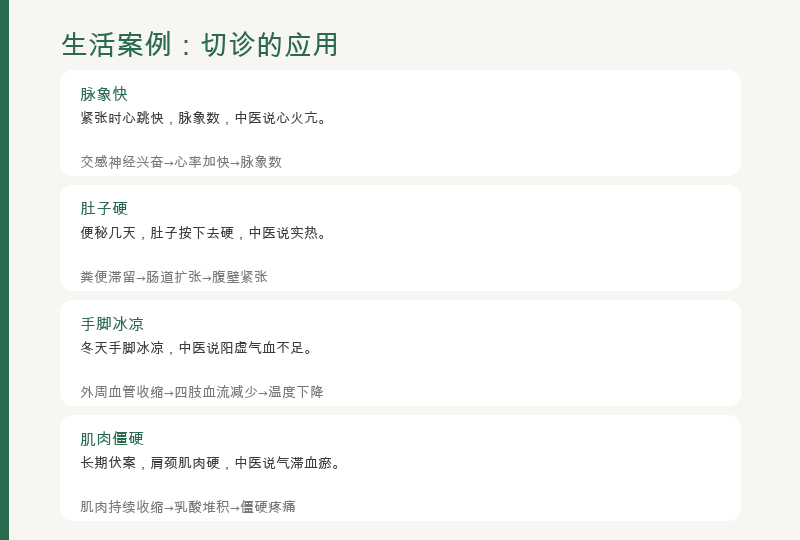
Case One: Floating Pulse During a Cold.
You catch a cold, with fever, aversion to cold, and headache. You go to a TCM doctor, who feels your pulse and says: "The pulse is floating; external wind-cold invasion." You ask: "Why does the pulse float during a cold?" Western medicine says: "During infection, the immune system activates, the thermoregulatory set point shifts upward, the body dissipates heat through peripheral vasodilation, blood flow increases, and the pulse becomes superficial and rapid." TCM says: "Wind-cold constrains the exterior; righteous qi resists the pathogen at the exterior, qi and blood tend toward the body surface, so the pulse is floating."
The truth: During infection, the thermoregulatory center (hypothalamus) raises the body temperature set point; the body produces heat through shivering and constricts peripheral vessels to preserve heat. After body temperature rises, peripheral vessels dilate to dissipate heat, blood flow increases, and the pulse becomes superficial (floating) and rapid (rapid). This is a normal physiological process of immune response and thermoregulation. TCM says "floating pulse indicates external conditions" — precisely describing the hemodynamic characteristics of early infection. It's not "the pulse floats up"; it's changes in pulse position caused by peripheral vasodilation. But the description of "floating pulse" precisely captures the pulse characteristics of early infection.
Case Two: Thin Pulse During Anemia.
You have long-term heavy menstrual bleeding and recently feel dizzy and fatigued. You go to a TCM doctor, who feels your pulse and says: "The pulse is thin and weak — qi and blood insufficiency." You ask: "Why does the pulse become thin during anemia?" Western medicine says: "During anemia, hemoglobin decreases, blood oxygen-carrying capacity drops, cardiac output compensatorily increases, but peripheral vascular resistance decreases, making the pulse thin and rapid." TCM says: "When blood is scant and qi is weak, the pulse channel is not filled, so the pulse is thin."
The truth: During anemia, hemoglobin decreases, oxygen-carrying capacity per stroke volume decreases, and the heart compensates by increasing heart rate. But blood volume may decrease, peripheral vascular resistance drops, the pulse pressure wave weakens, and when felt, it feels "thin" and "weak." At the same time, peripheral vasoconstriction to maintain blood pressure may make the pulse position somewhat "deep." TCM says "thin pulse indicates qi and blood deficiency" — precisely describing the hemodynamic characteristics of anemia. It's not "the pulse becomes thinner"; it's the tactile sensation caused by decreased blood volume + weakened pressure wave. But the description of "thin pulse" precisely captures the pulse characteristics of anemia.
Case Three: Slippery Pulse in a Pregnant Woman.
You are three months pregnant and go to a TCM clinic for fetal protection. The doctor feels your pulse and says: "Slippery pulse; the fetal qi is normal." You ask: "Why does the pulse become slippery during pregnancy?" Western medicine says: "During pregnancy, blood volume increases by 40-50%, cardiac output increases by 30-50%, vessels dilate, blood flow accelerates, and the pulse indeed becomes more slippery and forceful." TCM says: "In pregnant women, blood is abundant and qi is full, the pulse is smooth like pearls."
The truth: In early pregnancy, blood volume begins to increase, reaching its peak by mid-pregnancy (increasing by 40-50%). Cardiac output synchronously increases (by 30-50%), and heart rate increases by 10-20 beats per minute. Peripheral vessels dilate (especially uterine vessels), and vascular resistance decreases. These hemodynamic changes make the pulse feel more "slippery" (accelerated blood flow + good vascular elasticity) and more "forceful" (increased cardiac output). TCM says "slippery pulse indicates pregnancy" — precisely describing the hemodynamic characteristics of pregnancy. It's not "there are pearls in the pulse"; it's the tactile sensation caused by increased blood volume + accelerated blood flow. But the description of "slippery pulse" precisely captures the pulse characteristics of pregnancy.
Case Four: Wiry Pulse in a Liver Cirrhosis Patient.
Your father has been drinking heavily for a long time and recently has abdominal distension and fatigue. You take him to the hospital; ultrasound shows liver cirrhosis. You also visit a TCM doctor, who feels the pulse and says: "The pulse is wiry; liver qi stagnation, liver and spleen disharmony." You ask: "Why does the pulse become wiry in liver disease?" Western medicine says: "In liver cirrhosis, liver fibrosis leads to increased liver hardness, portal vein pressure rises, peripheral vascular resistance changes, and the pulse may become tense (high tension)." TCM says: "Wiry pulse indicates liver and gallbladder disease; liver qi stagnation makes the pulse channel tense."
The truth: In liver cirrhosis, intrahepatic fibrosis causes increased vascular resistance, portal hypertension, and collateral circulation opening. At the same time, peripheral vascular resistance may change, arterial wall tension increases, and the pulse feels "tense" and "hard" (wiry). In addition, decreased liver function leads to abnormal hormone metabolism (such as reduced estrogen inactivation), which may also affect vascular tension. TCM says "wiry pulse indicates liver and gallbladder disease" — precisely describing the hemodynamic and vascular tension changes in liver disease. It's not "the pulse is like a guitar string"; it's the tactile sensation caused by increased vascular tension + changed blood flow resistance. But the description of "wiry pulse" precisely captures the pulse characteristics of liver disease.
Four cases, one underlying logic: Palpation is "touching the body's signals" — the pulse is the traffic signal of qi and blood, and physical palpation is the solid examination of the organs.
Part 5Modern Research
Is there scientific research on "palpation"?
Yes, and quite a lot. Scientists don't use the term "palpation diagnosis"; they use:
• Pulse Wave Analysis. Modern research has found that the pulse's waveform, velocity, and intensity are closely related to the functional state of the cardiovascular system. For example, in patients with arteriosclerosis, pulse wave conduction velocity (PWV) increases and the waveform becomes steep (wiry pulse). In patients with insufficient blood volume, the pulse wave amplitude decreases (thin pulse). A 2010 study published in Hypertension used pulse wave analysis to assess arteriosclerosis severity, with an accuracy rate exceeding 90%. This is consistent with TCM's "pulse diagnosis" approach — the pulse is a window into the cardiovascular system's state.
• Objectification of Pulse Diagnosis. In recent years, sensor technology and machine learning have been applied to pulse diagnosis research. In 2018, Shanghai University of Traditional Chinese Medicine and Fudan University collaborated to use pressure sensor arrays to record pulse patterns, combined with machine learning to classify pulse types (floating, deep, slow, rapid, slippery, choppy, etc.), with an accuracy rate exceeding 85%. The study found that different pulse patterns correspond to different hemodynamic parameters (heart rate, blood pressure, vascular resistance, vascular elasticity). This is the scientific validation that "pulse diagnosis is a hemodynamic signal" — not mysticism, but sensors + medical statistics.
• Neuroscience of Touch. Touch is a highly sensitive sensory channel. The tactile receptors in human skin (Meissner corpuscles, Pacinian corpuscles, Merkel cells) can detect changes in pressure, vibration, and texture. Experienced doctors, through their fingers' tactile receptors, can perceive subtle changes that ordinary people cannot detect (such as tiny differences in the pulse, mild abdominal tenderness). This is the scientific basis for "to know by palpation is called artful" — tactile training can improve perceptual precision.
These studies fully demonstrate that "palpation" is a concept that can be precisely described in modern scientific language. The ancients summarized it with "pulse diagnosis" and "physical palpation"; modern people describe it with "pulse wave analysis + sensor technology + tactile neuroscience" — they're talking about the same thing.
Part 6Practical Methods
Now that you understand "palpation," how do you apply it?
First, dispel a few misconceptions:
• "Taking the pulse can diagnose all diseases." Pulse diagnosis is only one diagnostic clue; it cannot replace comprehensive examination. The same pulse pattern (such as thin pulse) can correspond to completely different diseases (anemia, hypotension, heart failure). Diagnosing based solely on pulse diagnosis is prone to misdiagnosis. It's not "knowing everything from one touch"; it's pulse diagnosis is a clue, not a conclusion.
• "TCM pulse taking is just mumbo-jumbo." The pulse is an objectively existing physiological signal, closely related to heart rate, blood pressure, vascular resistance, and blood volume. Denying pulse diagnosis is denying basic physiology. It's not "mysterious and unfathomable"; it's an observation method with scientific basis.
Specific methods:
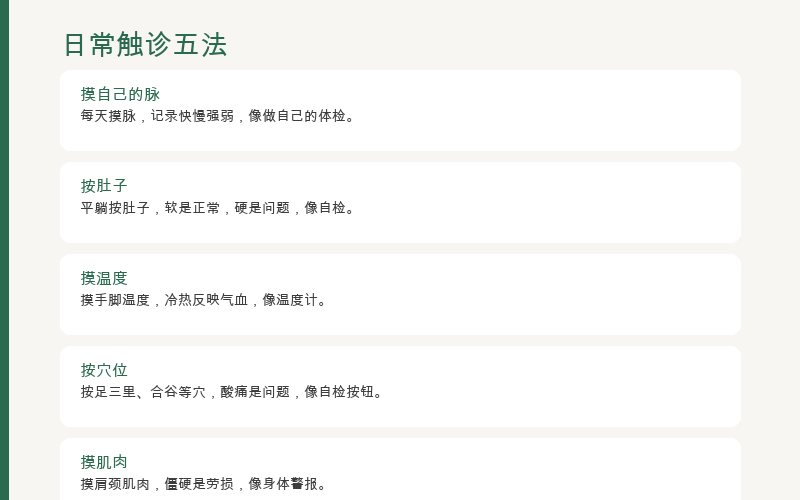
• Learn to take your own pulse. Every morning upon waking, use your index and middle fingers to lightly press the radial artery at the wrist (thumb side), and count your heartbeat for one minute. Normal resting heart rate for adults is 60-100 beats per minute. Long-term recording of your heart rate changes can reveal fluctuations in your physical state. It's not "taking the pulse is useless"; it's heart rate is a window into the autonomic nervous system's state.
• Pay attention to changes in pulse "texture." Besides heart rate, notice the pulse's "texture": Is it forceful? Is it regular? Is it smooth? During a cold, the pulse may become "floating" (superficial); when fatigued, it may become "thin" (weak). It's not "texture is mysticism"; it's pulse texture is a clue to hemodynamics.
• Pay attention to abdominal palpation. Regularly self-examine your abdomen: Lie flat, gently press your abdomen with your palm, checking for tenderness, masses, or bloating. Right upper quadrant tenderness may be related to the liver and gallbladder; left lower quadrant tenderness may be related to the intestines. If you find abnormalities, seek medical attention promptly. It's not "pressing the belly is useless"; it's abdominal palpation is the first line of defense for detecting internal organ abnormalities.
• Record heart rate variability (HRV). Modern smartwatches can measure heart rate variability (HRV), reflecting the balance state of the autonomic nervous system. Decreased HRV indicates chronic stress, fatigue, or overtraining. It's not "HRV is pseudoscience"; it's HRV is a quantitative indicator of autonomic nervous function.
• Understand basic pulse pattern meanings. Floating (superficial) is mostly related to external conditions or peripheral vasodilation; deep (deep-seated) is mostly related to internal conditions or insufficient blood volume; slow (slow) is mostly related to cold conditions or low metabolic rate; rapid (fast) is mostly related to heat conditions or high metabolic rate; slippery (smooth) is mostly related to adequate blood volume or pregnancy; choppy (choppy) is mostly related to blood stasis or high blood viscosity. It's not "pulse patterns determine destiny"; it's pulse patterns are clues that need to be combined with other information for judgment.
These methods don't require you to believe in TCM. You just need to understand: Palpation is "touching the body's signals" — the pulse is the traffic signal of qi and blood, and physical palpation is the solid examination of the organs.
Part 7One-Minute Summary
🕐 One-Minute Understanding of "Palpation"
Palpation = The Body's Tactile Scanner + Palpation Probe.
Palpation includes pulse diagnosis (feeling the pulse) and physical palpation (touching the body).
Cun-guan-chi corresponds to the upper, middle, and lower burners; there are twenty-eight pulse patterns.
Floating pulse with cold, thin pulse with anemia, slippery pulse in pregnancy, and wiry pulse in liver cirrhosis are all signals that "palpation" can detect.
Palpation = Pulse wave analysis + Pulse diagnosis objectification + Tactile neuroscience.
Palpation is not mysticism; it's the body transmitting internal state through tactile signals.
Misconceptions: Taking the pulse diagnoses all diseases, TCM pulse taking is mumbo-jumbo.
Methods: Take your own pulse, note texture changes, abdominal palpation, record HRV, understand basic pulse pattern meanings.
The ancients called it "To know by palpation is called artful"; modern people call it "physical examination + hemodynamic monitoring."
Different names, but the body knows: The pulse is the traffic signal of qi and blood, and only those who can feel it can read the body.
The pulse is the traffic signal of qi and blood; physical palpation is the solid examination of the organs.
The ancients had no pressure sensors, but they knew "the pulse is the residence of blood."
This is probably the most simple wisdom of the Chinese people: What can be touched is the flow of qi and blood; to know by palpation is called artful.

Making money is the art of living; art is life after making money
ggiao Decodes Chinese Traditional Wisdom · Concept 54
Using the language of modern science to help the world understand Chinese traditional wisdom.
No mysticism, no superstition, no belittlement.
Understanding, not merely believing.
Coach Liu
Written in Florence