Tongue Diagnosis: Why Is the Tongue a Holographic Map of the Body?
Part 1A Question
Have you ever had this experience?
You have a fever and cold, and the TCM doctor asks you to stick out your tongue. The doctor looks and says: "Red tongue with yellow coating — heat pattern." You ask: "Why does a red tongue mean heat?" Western medicine says: "During infection, the blood vessels in the tongue mucosa dilate, blood flow increases, and the tongue turns red. At the same time, bacterial metabolism in the tongue coating becomes more active, turning the color yellow." TCM says: "The tongue is the sprout of the heart; heart fire rises upward, so the tongue is red. Heat steams the coating, so it turns yellow." Both explanations point to the same fact — the tongue is a "holographic projection" of the body's interior.
Even more surprisingly, when you have long-term digestive issues, teeth marks appear along the edges of your tongue. You ask: "Why are there tooth impressions on my tongue?" Western medicine says: "The tongue swells, and teeth press against it, possibly related to water-sodium retention, allergic reactions, or glossitis." TCM says: "Teeth-marked tongue indicates spleen deficiency with dampness retention, causing tongue swelling." The two explanations sound different, but both may be correct — tongue swelling does cause teeth marks, and spleen deficiency with dampness retention is indeed related to digestive dysfunction and fluid metabolism. It's not about who's right or wrong; it's two systems describing the same phenomenon in different languages.
Here's another question: you've heard of someone with a bright red tongue tip, like a strawberry. You ask: "What does this mean?" Western medicine says: "It could be glossitis, vitamin B deficiency, or viral infection." TCM says: "The tongue tip belongs to the heart and lungs; a red tip indicates heart fire rising upward or lung heat." Which is right? Modern research has found that vitamin B deficiency indeed causes glossitis (especially at the tip and edges of the tongue), and viral infections (like scarlet fever) also cause "strawberry tongue" (red tip with protruding papillae). It's not that TCM "guessed correctly" — it's that ancient practitioners, through massive observation, summarized the correlations between different tongue regions and bodily states.
What confuses you even more: you've heard of someone with no tongue coating at all, their tongue smooth like a mirror. Western medicine says: "Atrophic glossitis, possibly related to anemia, vitamin B12 deficiency, or autoimmune disease." TCM says: "Mirror tongue indicates exhaustion of stomach yin, severe damage to stomach qi." Once again, the two converge. In atrophic glossitis, the tongue papillae atrophy, the coating disappears, and the tongue surface becomes smooth — indeed related to severe malnutrition and digestive decline. It's not "who copied whom" — it's two systems describing the same pathology from different angles.
So, what exactly is the tongue?
Part 2Traditional Chinese Explanation
The concept of "she" (tongue) in TCM is a crucial part of visual diagnosis. Ancient physicians observed: some people have red tongues with yellow coating — that's a heat pattern; some have pale tongues with white coating — that's a cold pattern; some have purple-dark tongues — that's blood stasis; some have swollen tongues — that's dampness retention; some have thick greasy coatings — that's phlegm-dampness; some have smooth tongues without coating — that's exhaustion of stomach yin. They summarized these changes as tongue diagnosis — determining the state of qi, blood, and internal organs by observing the tongue body and coating.
—— Huangdi Neijing · Suwen
"Observing the tongue body reveals the yin-yang, deficiency and excess of the body's true state; examining the coating reveals the cold-heat and depth of pathogenic factors."
—— Linzheng Yanshe Fa
"The tongue tip belongs to the heart and lungs, the center to the spleen and stomach, the root to the kidneys, and the sides to the liver and gallbladder."
—— Shejian Bianzheng
TCM summarizes tongue observation into two key terms: tongue body and tongue coating.
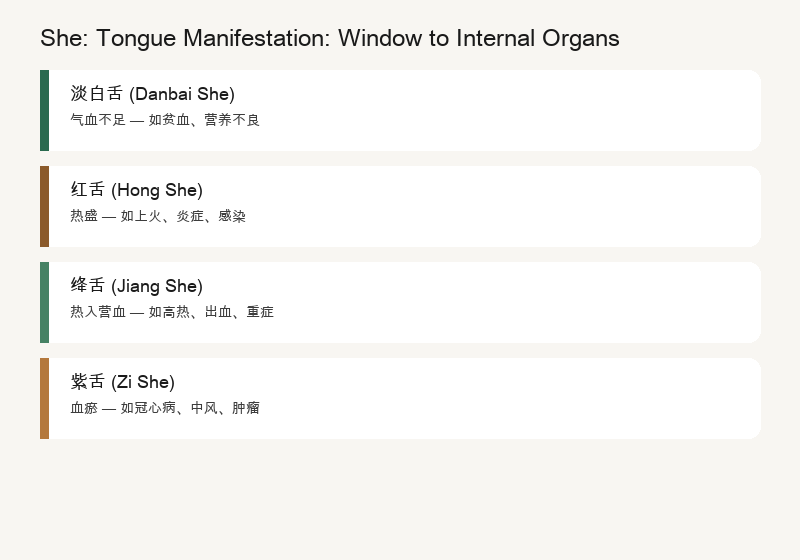
Tongue body (the essence of the tongue) — The tongue body reflects the abundance or deficiency of qi and blood. A pale tongue usually indicates qi and blood deficiency; a red tongue usually indicates heat pattern or yin deficiency; a purple-dark tongue usually indicates blood stasis; a swollen tongue usually indicates water-dampness retention; a thin tongue usually indicates yin deficiency or qi-blood deficiency. The flexibility of the tongue also reflects its state: a stiff tongue with slurred speech usually indicates stroke or neurological disease; a trembling tongue usually indicates internal stirring of liver wind. Modern research has found that tongue color is closely correlated with objective indicators like hemoglobin, blood oxygen saturation, and tongue mucosal blood flow.
Tongue coating (the moss-like substance on the tongue surface) — The tongue coating reflects stomach energy and digestive state. A thin white coating is normal or indicates a mild condition; a thick greasy coating indicates phlegm-dampness or food stagnation; a yellow coating indicates heat pattern; a gray-black coating indicates extreme cold or extreme heat. The moisture of the coating also reflects fluid state: a dry coating indicates fluid deficiency; a slippery coating indicates water-dampness retention. Modern medicine says the tongue coating is a mixture of shed epithelial cells, bacteria, and food residue — its thickness and color are closely related to digestive function, oral microbiome, and metabolic state.
Tongue zones (holographic correspondence) — TCM believes the tongue is a "holographic projection" of the internal organs: the tip corresponds to the heart and lungs (upper burner), the center to the spleen and stomach (middle burner), the root to the kidneys (lower burner), and the sides to the liver and gallbladder. This correspondence isn't arbitrary; it's based on the pathways of the meridians and clinical practice. For example, the heart and lung meridians are related to the tongue tip region; the spleen and stomach meridians to the center; the kidney meridian to the root; the liver and gallbladder meridians to the sides. Modern research has found that different tongue regions are indeed associated with visceral nerve reflexes (such as tongue-stomach reflex, tongue-heart reflex).
So what the ancients called "she" wasn't just "looking at the tongue" — it was systematic visual information reading — determining the abundance or deficiency of qi and blood, the deficiency or excess of organs by observing the tongue body, coating, and zones. The ancients used "tongue diagnosis" to summarize what modern people would need "oral examination + digestive assessment + nutritional assessment" to explain.
Part 3giaogiao's Modern Translation
Okay, now let's translate "she" into modern language.
I'm not going to talk about tongue mucosal microcirculation, oral microbiome, or nerve reflex arcs. Too complicated. You only need to remember one analogy:
Tongue body = The "display screen" of blood, reflecting hemoglobin, blood oxygen, and blood flow state
Tongue coating = The "sensor" of digestion, reflecting stomach function, microbiome, and metabolic state
Tongue color = The body's "thermometer" — red means heat, white means cold, purple means stagnation
Tongue shape = The body's "edema detector" — swollen means dampness, thin means deficiency
Tongue zones = The "map projection" of organs — tip for heart/lungs, center for spleen/stomach, root for kidneys, sides for liver/gallbladder
That's it. Your "tongue" is essentially the body transmitting internal state information through visual signals on the tongue — like an endoscope directly observing the interior, like a holographic projector mapping three-dimensional information onto a two-dimensional plane.
Specifically:
What does "red tongue" correspond to? It corresponds to dilation of tongue mucosal blood vessels and increased blood flow. During infection, fever, or inflammation, the sympathetic nervous system is activated, tongue mucosal vessels dilate, and the tongue color turns red. At the same time, the metabolic rate increases and tongue mucosal cell turnover accelerates. TCM says "red tongue indicates heat" — modern medicine says "tongue mucosal vessel dilation + increased blood flow" — both describe the same mechanism.
What does "teeth-marked tongue" correspond to? It corresponds to tongue swelling and fluid metabolism disorder. When the tongue swells, teeth press against the edges, creating teeth marks. The causes of swelling may include water-sodium retention (such as decreased kidney function, malnutrition), inflammatory response (such as glossitis), or allergic reactions. TCM says "teeth-marked tongue indicates spleen deficiency with dampness retention" — modern medicine says "tongue swelling + fluid retention" — both describe the same pathology.
What does "thick greasy coating" correspond to? It corresponds to decreased digestive function and imbalance of oral microbiome. The tongue coating is a mixture of shed epithelial cells, bacteria, and food residue. When digestive function is impaired, coating shedding increases, bacterial reproduction accelerates, and the coating thickens. At the same time, gastrointestinal dysfunction may alter oral pH, affecting microbiome balance. TCM says "thick greasy coating indicates phlegm-dampness" — modern medicine says "decreased digestive function + oral microbiome imbalance" — both describe the same phenomenon.
What does "mirror tongue" correspond to? It corresponds to atrophy of tongue papillae and severe malnutrition. In atrophic glossitis, the tongue papillae (filiform and fungiform) atrophy, the coating disappears, and the tongue surface becomes smooth. Common causes: vitamin B12 deficiency, iron deficiency, anemia, autoimmune disease (such as Sjögren's syndrome). TCM says "mirror tongue indicates exhaustion of stomach yin" — modern medicine says "tongue papillae atrophy + severe malnutrition" — both describe the same fact.
So "she" is not mysticism. It's a functional metaphor — describing the process by which the body transmits internal states through the tongue. The ancients used "tongue diagnosis" and "tongue zones" to summarize it; modern people use "oral examination + digestive assessment + nutritional assessment" to describe it — they're talking about the same thing.
Part 4Life Examples
Four stories to help you instantly understand what "she" is.
Example 1: The "red tongue" after hot pot.
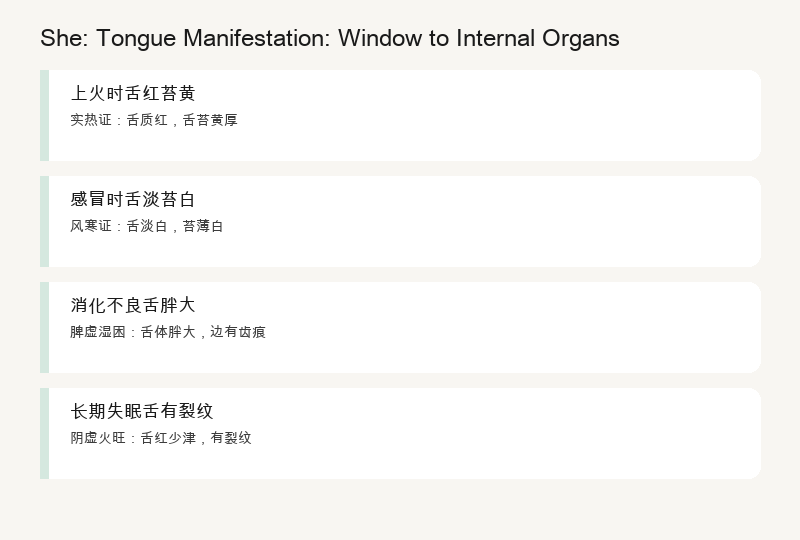
You eat a spicy hot pot and the next day discover your tongue is especially red, with ulcers at the tip. You see a TCM doctor who says: "Red tongue with yellow coating, heart fire rising upward." You ask: "Why does spicy food make the tongue red?" Western medicine says: "Capsaicin stimulates the tongue mucosa, causing vessel dilation and inflammatory response. At the same time, spicy food increases metabolic rate and body temperature, increasing tongue blood flow." TCM says: "Spicy food assists fire; the nature of fire rises upward, steaming the tongue."
The truth: Capsaicin activates TRPV1 receptors, causing tongue mucosal vessel dilation and neuropeptide release, leading to local congestion and inflammation. At the same time, spicy food stimulates the sympathetic nervous system, increasing heart rate and metabolic rate, further increasing tongue blood flow. Ulcers form because inflammation damages the tongue mucosal epithelium. TCM says "heart fire rising upward" — "fire" is pathological functional hyperactivity, corresponding to inflammatory response and vessel dilation. It's not "having too much internal heat" — it's capsaicin-induced mucosal inflammatory response. But the description "red tongue + ulcers" precisely captures the tongue changes after eating spicy food.
Example 2: The "thin red tongue" of chronic insomnia.
You've been sleeping only 5 hours a day for a long time. You notice your tongue is getting thinner, the color is偏 red, and the coating is minimal. You see a TCM doctor who says: "Red tongue with little coating, yin deficiency with fire excess." You ask: "Why does insomnia change the tongue?" Western medicine says: "Chronic sleep deprivation causes sustained sympathetic nervous system activation, increased tongue mucosal blood flow (red), and reduced saliva secretion (less coating), while the tongue may become thin due to dehydration." TCM says: "When yin is deficient, yang becomes hyperactive; deficient fire internally disturbs, causing red tongue with little coating. When fluids are insufficient, the tongue loses nourishment, so it becomes thin."
The truth: Chronic sleep deprivation causes sustained activation of the sympathetic nervous system, leading to peripheral vessel constriction but simultaneously increased local tongue mucosal blood flow (due to metabolic demand). At the same time, sleep deprivation affects saliva secretion (reduced by more than 50%), decreasing tongue coating formation. Furthermore, chronic stress leads to elevated cortisol, affecting nutrient absorption and metabolism, and the tongue may become thin due to nutritional deficiency. TCM says "yin deficiency with fire excess" — precisely describing the neuroendocrine disorder and metabolic hyperactivity caused by chronic insomnia. It's not "the tongue is deformed" — it's mucosal and metabolic changes caused by chronic stress and sleep deprivation. But the description "red tongue with little coating" precisely captures the tongue characteristics of insomnia.
Example 3: The "thick greasy coating" of digestive dysfunction.
You've been overeating for a long time, with bloating and acid reflux. One day you look in the mirror and discover the coating is thick and yellow, like a layer of butter. You see a TCM doctor who says: "Yellow thick greasy coating, damp-heat accumulating in the spleen, food stagnation internally." You ask: "Why does digestive dysfunction make the coating thick?" Western medicine says: "When gastrointestinal function is impaired, stomach contents reflux, food stagnates, oral microbiome becomes imbalanced, and the coating thickens and turns yellow."
The truth: Long-term digestive dysfunction causes delayed gastric emptying; food stays in the stomach too long, producing large amounts of acidic substances and metabolic waste. These substances reflux through the esophagus into the mouth, altering oral pH and promoting the growth of certain bacteria (such as pigment-producing bacteria). At the same time, gastrointestinal dysfunction causes systemic inflammatory response, increasing tongue mucosal epithelial cell shedding and coating accumulation. TCM says "damp-heat accumulating in the spleen, food stagnation internally" — "damp-heat" describes inflammation and metabolic disorder, "food stagnation" describes digestive dysfunction. Modern medicine says "gastrointestinal dysfunction + oral microbiome imbalance" — both describe the same mechanism. It's not "too much dampness" — it's decreased digestive and metabolic function. But the description "yellow thick greasy coating" precisely captures the tongue characteristics of digestive dysfunction.
Example 4: The "pale tongue" of an anemic elderly person.
Your mother is seventy years old, recently pale and weak. You take her to the hospital; her hemoglobin is only 80 (normal 120-150). You also see a TCM doctor, who asks her to stick out her tongue, looks, and says: "Pale tongue, no blood color, qi and blood deficiency." Western medicine says: "In anemia, hemoglobin decreases, blood oxygen-carrying capacity drops, tongue mucosal blood flow decreases, and tongue color becomes pale." TCM says: "Qi and blood deficiency, the tongue loses nourishment, so it becomes pale."
The truth: In anemia, hemoglobin decreases, the red color of blood becomes lighter, and the color of skin and mucosa (including tongue mucosa) follows suit. At the same time, during anemia, cardiac output may compensatorily increase, but peripheral vascular resistance decreases, and tongue mucosal blood flow relatively decreases, making the tongue appear even paler. Furthermore, anemia is often accompanied by nutritional deficiency (iron, folic acid, B12), slowing tongue mucosal cell turnover and making the tongue surface smoother. TCM says "qi and blood deficiency" — precisely describing the nutritional and circulatory state during anemia. It's not "the tongue lacks blood color" — it's changes in mucosal color caused by decreased hemoglobin. But the description "pale tongue" precisely captures the tongue characteristics of anemia.
Four examples, one underlying logic: the tongue is "the body's holographic map" — tongue color, coating, shape, and zones are all projections of the body.
Part 5Modern Research
Is there scientific research on "she"?
Yes, and quite a lot. Scientists don't use the term "tongue diagnosis"; they use:
• Tongue Mucosal Microcirculation Research. Modern research has found that the microcirculatory state of the tongue mucosa is closely related to the body's overall circulatory state. For example, in anemic patients, tongue mucosal capillary density decreases and blood flow decreases, making the tongue color pale. In diabetic patients, tongue mucosal microcirculation is impaired, vascular permeability increases, and the tongue color may become dark. A 2012 study published in Microcirculation used laser Doppler flowmetry to measure tongue mucosal blood flow, finding that tongue blood flow is significantly correlated with hemoglobin levels and blood oxygen saturation. This aligns with TCM's idea of "the tongue body shows qi and blood" — the tongue mucosa is a window into the body's overall circulation.
• Computer-Aided Tongue Diagnosis. In recent years, image processing and machine learning technologies have been applied to tongue diagnosis research. In 2016, Beijing University of Chinese Medicine collaborated with the Chinese Academy of Sciences to use hyperspectral imaging technology to analyze tongue color, combined with machine learning to classify tongue types (pale, red, purple, dark, etc.), achieving an accuracy of over 90%. The study found that tongue color characteristics are correlated with objective indicators such as gastrointestinal disease, metabolic syndrome, and immune function. This is the scientific validation that "tongue diagnosis is a sensor of overall body state" — not mysticism, but image recognition + medical statistics.
• Oral Microbiome and Systemic Diseases. Modern microbiological research has found that the oral microbiome is closely related to various systemic diseases. For example, periodontal disease is associated with cardiovascular disease, diabetes, and rheumatoid arthritis. The thickness and composition of the tongue coating reflect the composition and metabolic state of the oral microbiome. A 2020 review published in Nature Reviews Microbiology pointed out that the oral microbiome is an important "biomarker" of overall health. This is the scientific basis for "the tongue coating shows stomach energy" — the tongue coating is a microbial window into the digestive and immune systems.
These studies fully demonstrate that "she" is a concept that can be precisely described in modern scientific language. The ancients used "tongue diagnosis" and "tongue zones" to summarize it; modern people use "tongue mucosal microcirculation + computer-aided analysis + oral microbiome research" to describe it — they're talking about the same thing.
Part 6Practical Methods
Now that you understand "she," how do you apply it?
First, let's dispel a few misconceptions:
• "Looking at the tongue can diagnose all diseases". Tongue diagnosis is only one clue in diagnosis and cannot replace comprehensive examination. A red tongue may indicate a heat pattern, or it may be from eating red foods (such as strawberries or beets). Diagnosing based solely on tongue diagnosis is prone to misdiagnosis. It's not "one look at the tongue and you know everything" — it's tongue diagnosis is a clue, not a conclusion.
• "TCM tongue observation is superstition". Tongue color and coating are objectively existing physiological signals, closely related to hemoglobin, blood oxygen saturation, oral microbiome, and digestive function. Denying tongue diagnosis is denying basic physiology. It's not "mysterious and incomprehensible" — it's an observation method with scientific basis.
Specific methods:
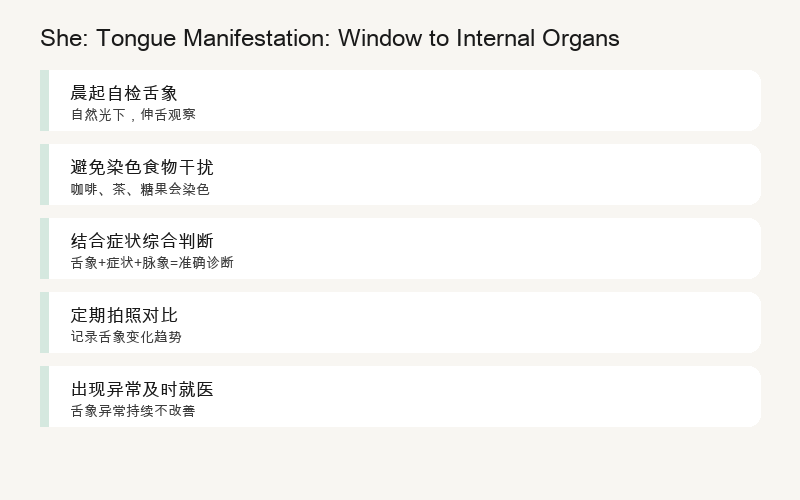
• Observe your own tongue every day. Every morning before brushing your teeth, look in the mirror and observe your tongue. Notice the color (pale, red, purple?), coating (thin white, thick greasy, yellow coating?), and shape (swollen, thin, teeth marks?). Record changes and compare them with your bodily state (diet, sleep, emotions). It's not "pointless" — it's the tongue is a free self-check tool for the body.
• Pay attention to changes in tongue zones. Red tip (may be related to heart and lungs), thick greasy center (may be related to spleen and stomach), reduced coating at the root (may be related to kidney yin), purple-dark sides (may be related to liver and gallbladder blood stasis). It's not "zones determine destiny" — it's zones are clues that need to be combined with other information for judgment.
• Exclude interference from food and medication. Certain foods (coffee, tea, beets, dragon fruit) can temporarily change tongue color. Certain medications (antibiotics, bismuth-containing stomach medicine) can change tongue coating color. When observing tongue signs, do so in the morning on an empty stomach, before eating. It's not "a change in tongue color means illness" — it's interference factors need to be excluded.
• Focus on the "quality" of the coating rather than the "quantity". A thin white coating is normal. A sudden thickening, yellowing, or greasiness of the coating may indicate digestive dysfunction or infection. A sudden disappearance of the coating (mirror tongue) may indicate severe malnutrition or autoimmune issues. It's not "the more coating the better" — it's the quality and quantity of the coating are both signals.
• Combine with other symptoms for judgment. Tongue signs need to be combined with facial complexion, pulse, and symptoms for comprehensive judgment. A red tongue alone doesn't necessarily mean illness, but red tongue + dry mouth + insomnia + irritability suggests yin deficiency with fire excess. It's not "a red tongue means internal heat" — it's tongue signs need to be combined with overall information for judgment.
These methods don't require you to believe in TCM. You only need to understand: the tongue is "the body's holographic map" — the tongue body, coating, and zones are all projections of the body.
Part 7One-Minute Summary
🕐 One Minute to Understand "She"
She = The body's endoscope + holographic projector.
Tongue diagnosis includes observing the tongue body (shows qi and blood) and tongue coating (shows stomach energy).
Tongue zones: tip = heart/lungs, center = spleen/stomach, root = kidneys, sides = liver/gallbladder.
Hot pot red tongue, insomnia thin red tongue, digestive dysfunction thick greasy coating, anemia pale tongue — these are all signals that "she" can detect.
She = tongue mucosal microcirculation + computer-aided analysis + oral microbiome research.
She is not mysticism; it's the body transmitting internal states through the tongue.
Misconceptions: diagnosing all diseases by looking at the tongue, TCM tongue observation is superstition.
Methods: daily tongue observation, pay attention to zone changes, exclude interference factors, focus on coating quality, combine with other symptoms.
The ancients called it "the tongue is the sprout of the heart, the outward sign of the spleen"; modern people call it "oral examination + digestive assessment."
Different names, but the body knows: the tongue is the body's holographic map. Only those who can read it can understand the body.
The tongue body is the display screen of qi and blood; the tongue coating is the sensor of digestion.
The ancients didn't have hyperspectral imaging, but they knew "the tip belongs to the heart and lungs, the root to the kidneys."
This is probably the most朴素 wisdom of the Chinese people: Where the tongue is, the body's projection is; observing the tongue to know illness is called wisdom.
Making money is the art of living; art is the life after making money
giaogiao Decodes Traditional Chinese Wisdom · Concept 55
Using the language of modern science to help the world understand traditional Chinese wisdom.
Not mysterious, not superstitious, not dismissive.
Understand, rather than merely believe.
Coach Liu
Written in Florence