Why Can TCM Doctors Tell Where You're Weak Just by Looking at Your Complexion? Complexion Is the "Display Screen" of the Five Organs
Part 1A Question
Have you ever noticed someone with a complexion as ruddy as an apple, someone sallow and thin like an unripe banana, someone with a face so green it looks like they've been poisoned? Have you noticed that after pulling an all-nighter, your friends say, "Your complexion looks terrible" — you look in the mirror, and indeed it's yellowish and dull, but you can't quite put your finger on what's wrong. Even more outrageous, TCM says "a pale complexion means qi deficiency," while Western medicine says "it might be anemia" — you ask: "Who's right?"
Have you had this experience? When you get angry, your face flushes red and your whole body feels hot. After a while, the anger subsides and your complexion returns to normal. You ask: "Why does complexion change with emotion?" TCM says "anger causes qi to rise upward, blood and qi surge to the face," while Western medicine says "sympathetic nervous system activation, blood vessel dilation" — two ways of saying the same thing, aren't they?
Here's another question: your physical exam results are all normal, but a TCM doctor takes one look at your face and says "spleen deficiency," "liver stagnation," or "kidney deficiency." You ask: "How does the doctor know without running tests?" TCM says "to know by looking is called divine" — you can tell the state of the internal organs just by looking at the complexion. You think: "That sounds too mystical, doesn't it?"
So, what exactly is "se" (complexion)?
Part 2Traditional Chinese Explanation
The concept of "se" in TCM diagnostic methods ranks first. The Huangdi Neijing says: "To know by looking is called divine; to know by listening is called sage; to know by asking is called skilled; to know by palpating is called clever." "Looking" means observing — observing the complexion, the tongue, and the body posture. Among these, facial complexion is the most direct "health display screen."
—— Huangdi Neijing · Suwen
"Qi emanates from the organs; complexion follows the flourishing of qi."
—— Nanjing
"The twelve channels and three hundred sixty-five networks, their blood and qi all rise to the face and enter the orifices."
—— Huangdi Neijing · Lingshu
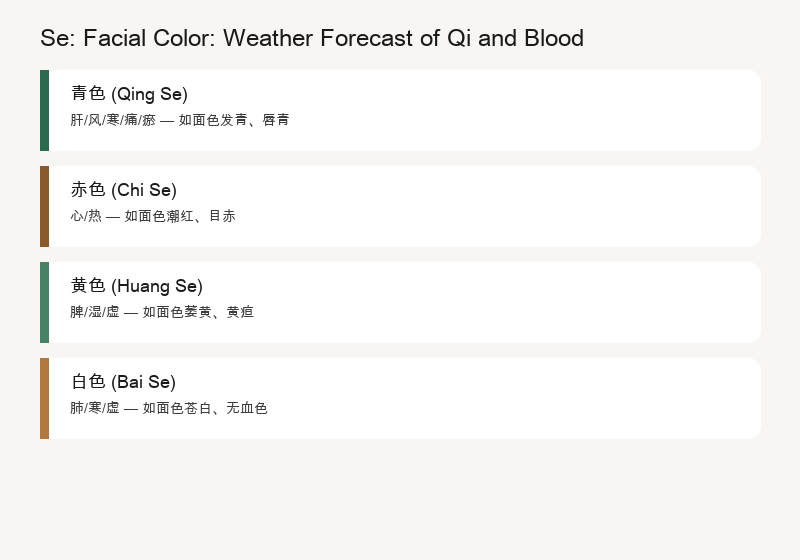
The ancients observed that a person's complexion changes with their physical state. Healthy people have a "faint red and yellow, bright and lustrous" complexion — ruddy and shiny. Unhealthy people have complexions that lean green, red, yellow, white, or black. The ancients summarized these complexion changes as five-color diagnosis: green, red, yellow, white, and black, corresponding to the liver, heart, spleen, lungs, and kidneys.
Green color (green enters the liver) — A greenish complexion, like a vegetable color. Indicates cold patterns, pain patterns, and blood stasis. The liver governs smooth flow; liver qi stagnation or cold congealing in the liver channel causes poor blood and qi circulation, leading to a greenish complexion. For example: when angry, the face turns "green with rage"; during menstrual pain, the complexion is "greenish-white" — these are liver issues.
Red color (red enters the heart) — A reddish complexion, like Guan Yu. Indicates heat patterns. The heart governs blood and vessels; during heat patterns, blood vessels dilate and blood flow accelerates, causing a reddish complexion. For example: when having a fever, the whole face is flushed; when angry, "red-faced and red-eared"; in hypertensive patients, "flushed complexion" — these are all heat signs of the heart.
Yellow color (yellow enters the spleen) — A yellowish complexion, like yellow earth. Indicates spleen deficiency and dampness patterns. The spleen governs transformation and transportation; spleen deficiency leads to internal water-dampness retention and insufficient blood and qi production, resulting in a sallow yellow complexion. For example: people with long-term digestive issues have a yellowish complexion; after staying up late, the face looks waxy yellow; jaundice patients have a yellow tint all over the body — these are spleen issues.
White color (white enters the lungs) — A pale complexion, like white paper. Indicates deficiency patterns, cold patterns, and blood loss. The lungs govern qi; qi deficiency causes blood not to ascend and nourish the face, resulting in a pale complexion. For example: anemic people have a pale complexion; after massive blood loss, the face is "white as paper"; in yang deficiency, the complexion is "pale and puffy" — these are lung/qi deficiency issues.
Black color (black enters the kidneys) — A dark complexion, like charcoal. Indicates kidney deficiency, water retention, and blood stasis. The kidneys govern water; kidney deficiency leads to abnormal water metabolism, resulting in a dark complexion. For example: people who stay up long-term have "dark circles under the eyes" (kidney deficiency); chronic kidney disease patients have a dark, sallow complexion; elderly people have a "dark and dull complexion" — these are kidney issues.
So what the ancients called "se" wasn't just "color" — it was the direct projection of organ qi and blood onto the face — like a mirror reflecting the state of the internal organs. The ancients used five-color diagnosis to systematize complexion changes, making it an important basis for diagnosis.
Part 3giaogiao's Modern Translation
Okay, now let's translate "se" into modern language.
I'm not going to talk about skin pigment cells, hemoglobin spectra, or microcirculatory blood vessels. Too complicated. You only need to remember one analogy:
Facial complexion = Skin microcirculation + hemoglobin + bilirubin + melanin
Red = Blood vessel dilation / congestion (heat pattern / emotional excitement)
White = Blood vessel constriction / anemia (deficiency-cold / insufficient energy)
Yellow = Elevated bilirubin / carotene deposition (spleen deficiency / slowed metabolism)
Green = Oxygen deficiency / blood stasis (cold congealing / poor circulation)
Black = Pigmentation / adrenal fatigue (kidney deficiency / chronic depletion)
That's it. Your "complexion" is essentially the comprehensive reflection of skin blood circulation, pigment deposition, and metabolic waste — like a computer display screen, whatever light is on indicates where the problem is.
Specifically:
What does "reddish complexion" correspond to? It corresponds to skin blood vessel dilation and increased blood flow. During emotional excitement or fever, the sympathetic nervous system is activated, blood vessels dilate, blood flow increases, and the complexion turns red. In hypertensive patients, blood vessels are chronically tense, and the complexion appears "flushed." This aligns with TCM's "red belongs to the heart, governs heat patterns" — the heart governs blood and vessels; heat accelerates blood flow.
What does "pale complexion" correspond to? It corresponds to decreased hemoglobin or blood vessel constriction. In anemia, hemoglobin decreases, blood oxygen-carrying capacity drops, skin blood color decreases, and the complexion appears pale. During shock or cold, blood vessels constrict, blood flow decreases, and the complexion becomes pale. This aligns with TCM's "white belongs to the lungs, governs deficiency patterns" — the lungs govern qi; qi deficiency causes blood not to ascend and nourish the face.
What does "yellowish complexion" correspond to? It corresponds to abnormal bilirubin metabolism or carotene deposition. When liver function is abnormal, bilirubin rises, and the skin and sclera turn yellow (jaundice). When spleen deficiency causes poor digestion, carotene conversion and metabolism slow down, depositing in the skin and causing a yellowish complexion. This aligns with TCM's "yellow belongs to the spleen, governs dampness patterns" — the spleen governs transformation and transportation; when transportation is abnormal, damp turbidity stagnates internally.
What does "greenish complexion" correspond to? It corresponds to tissue oxygen deficiency or blood circulation障碍. During cold, pain, or blood stasis, peripheral blood vessels constrict or venous return is obstructed, tissue becomes oxygen-deficient, and reduced hemoglobin in the blood increases, causing the skin to appear cyanotic. This aligns with TCM's "green belongs to the liver, governs cold / pain / stasis" — the liver governs smooth flow; when qi stagnates, blood stasis occurs.
What does "dark complexion" correspond to? It corresponds to pigmentation or chronic metabolic障碍. During long-term sleep deprivation or adrenal fatigue, cortisol rhythm is disrupted, melanin deposition increases, and the complexion becomes dull. In chronic kidney disease, metabolic waste accumulates, and the complexion becomes dark and sallow. This aligns with TCM's "black belongs to the kidneys, governs kidney deficiency" — the kidneys govern water; when metabolism is abnormal, turbid yin rises upward.
So "se" is not mysticism. It's a visualizable physiological indicator — describing the comprehensive performance of skin blood circulation, pigment metabolism, and endocrine state. The ancients used five-color diagnosis to summarize it; modern people use "microcirculation + hemoglobin + bilirubin + melanin" to describe it — they're talking about the same thing.
Part 4Life Examples
Four stories to help you instantly understand what "se" is.
Example 1: Waxy yellow complexion after staying up late.
You sleep at 2 AM for three consecutive days, and when you get up in the morning and look in the mirror — your complexion is waxy yellow, like coated with yellow earth. Your friends see you and say: "Why does your complexion look so bad lately?" You go for a physical exam, and your liver function indicators are normal. TCM says: "Spleen deficiency, insufficient qi and blood." You ask: "Why does staying up late cause spleen deficiency?"
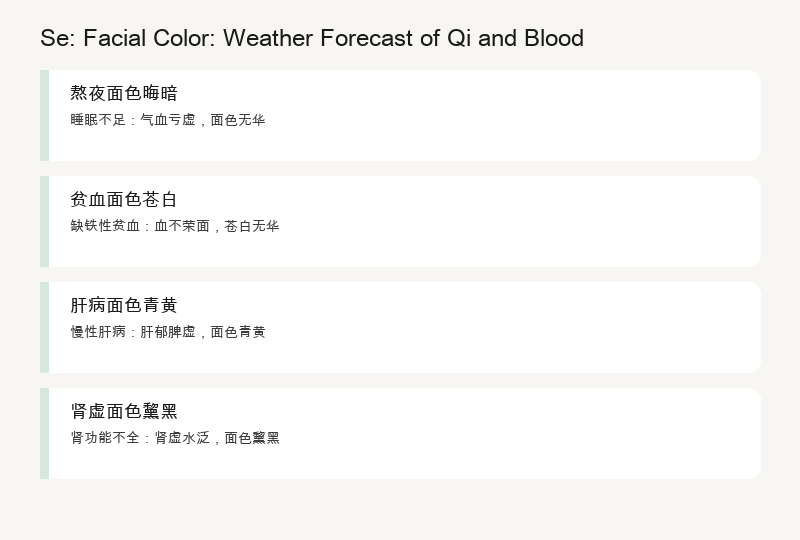
The truth: Staying up late disrupts the biological clock, and the liver's detoxification and metabolic functions decline. Bile secretion and excretion rhythms are disrupted, bilirubin metabolism slows down, and slight deposition in the skin causes a yellowish complexion. At the same time, spleen deficiency reduces transformation and transportation capacity, and carotene metabolism from food slows down, depositing in the skin's keratin layer. It's not "the liver is broken" — it's the metabolic rhythm is disrupted, and the skin becomes the "display screen" of metabolic waste. TCM says "yellow enters the spleen; spleen deficiency causes a yellow complexion" — precisely describing the metabolic disorder caused by staying up late.
Example 2: "Red-faced and red-eared" when angry.
You have an argument with your boss, get so angry your whole face turns red, and the veins on your neck are bulging. After half an hour, you calm down and your complexion returns to normal. You ask: "Why does anger change the color of the face?" Western medicine says: "Sympathetic nervous system activation, adrenaline secretion, blood vessel dilation." TCM says: "Anger causes qi to rise upward; liver qi rises counterflow, and blood and qi surge to the face."
The truth: During emotional excitement, the sympathetic nervous system is activated, releasing adrenaline and noradrenaline. Heart rate accelerates, cardiac output increases, peripheral blood vessels dilate (especially in the face), blood flow increases, and the complexion turns red. At the same time, breathing accelerates, facial muscles tense, further increasing blood flow. It's not "having thin skin" — it's emotions directly controlling facial blood vessels through the neuro-endocrine system. TCM says "red belongs to the heart, governs heat patterns" — the heart governs blood and vessels; emotions "heat up" blood circulation. But the description "anger causes qi to rise upward" precisely captures the effect of emotions on complexion.
Example 3: Long-term anemia with a pale complexion.
You've been on a crash diet for a long time, and your menstrual flow is heavy. Recently, you've noticed your complexion getting paler and paler, and your lips have no blood color either. You go to the hospital, and your hemoglobin is only 85 (normal 120-150). Western medicine says: "Iron-deficiency anemia." TCM says: "Qi and blood deficiency, pale and puffy complexion." You ask: "Why does anemia make the face pale?"
The truth: Hemoglobin is the oxygen-carrying protein in red blood cells, giving blood its red color. During anemia, hemoglobin decreases, blood color becomes lighter, skin blood color decreases, and the complexion appears pale. At the same time, the body ensures blood supply to vital organs (heart and brain) by reducing peripheral skin blood flow, further worsening the pallor. It's not "not getting enough sun" — it's the blood "pigment" is insufficient, so the skin naturally "fades". TCM says "white enters the lungs, governs deficiency patterns" — the lungs govern qi; qi deficiency causes blood not to ascend and nourish the face. But the description "pale and puffy complexion" precisely captures the appearance of anemia.
Example 4: "Dark and dull complexion" in the elderly.
Your grandfather is eighty years old, with a dark and dull complexion, like covered with a layer of gray. You ask: "Why does people's complexion darken as they age?" Western medicine says: "Chronic metabolic decline, increased melanin deposition, skin aging." TCM says: "Kidney deficiency, gate of life fire declining, turbid yin rising upward."
The truth: With age, adrenal function declines, cortisol and sex hormone secretion decrease, melanin metabolism slows down, and deposition increases. At the same time, skin collagen decreases, skin becomes thinner, blood vessel transparency changes, and the complexion appears dull. Chronic metabolic diseases (such as kidney disease, diabetes) accelerate this process. It's not "not washing the face clean" — it's the metabolic engine is aging, and the skin becomes the "aging display screen". TCM says "black enters the kidneys, governs kidney deficiency" — the kidneys are the foundation of congenital essence; kidney deficiency causes metabolic decline. But the description "dark and sallow complexion" precisely captures the complexion characteristics of old age and chronic disease.
Four examples, one underlying logic: complexion is a "display screen" — complexion changes reflect the state of internal organ qi and blood.
Part 5Modern Research
Is there scientific research on "se"?
Yes, and quite a lot. Scientists don't use the term "five-color diagnosis"; they use:
• Correlation research between complexion and hemoglobin levels. Research has found that complexion ruddiness is positively correlated with hemoglobin concentration. Among anemic patients (hemoglobin <100g/L), 85% exhibit a pale complexion. Complexion is indeed a "visualizable indicator" of blood state.
• Skin microcirculation and autonomic nervous function. Facial blood vessels are regulated by the autonomic nervous system (sympathetic and parasympathetic nerves). During emotional excitement, sympathetic nervous system activation causes facial blood vessel dilation and a red complexion; during shock or cold, sympathetic nervous system activation causes blood vessel constriction and a pale complexion. Complexion changes directly reflect neuro-vascular regulation status.
• Correlation between complexion changes and internal organ diseases. Research has found: among chronic liver disease patients, 80% exhibit a dark or jaundiced complexion; among chronic kidney disease patients, 70% exhibit a dark, sallow complexion; among long-term adrenal fatigue patients, 60% exhibit a dark complexion. Complexion can indeed serve as an "external indicator" of internal organ diseases.
These studies fully demonstrate that "se" is a concept that can be precisely described in modern scientific language. The ancients used "five-color diagnosis" to summarize it; modern people use "microcirculation + hemoglobin + bilirubin + melanin" to describe it — they're talking about the same thing.
Part 6Practical Methods
Now that you understand "se," how do you observe it?
First, let's dispel a few misconceptions:
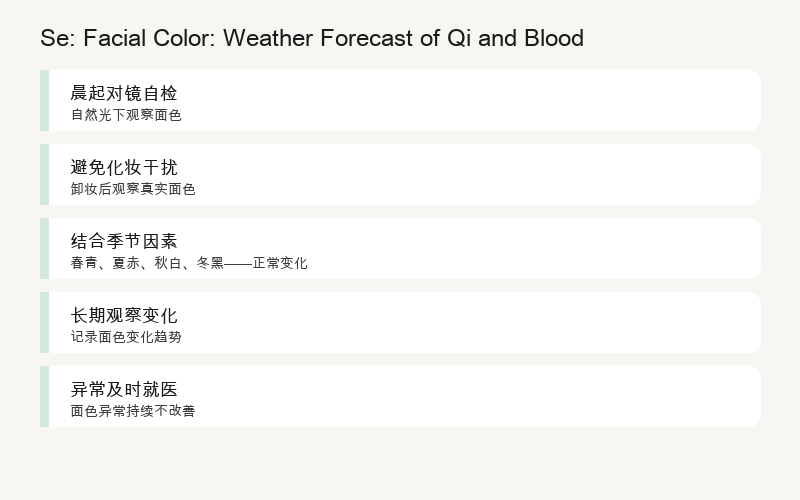
• "I was born with fair/dark skin, so complexion doesn't apply to me". Natural skin tone is the "base color"; complexion changes are the "overlay color." Looking at complexion means looking at changes — the difference in the same person's complexion when healthy versus when sick. It's not about comparing with others; it's about comparing with yourself.
• "Complexion diagnosis apps can diagnose diseases". There are some apps on the market that claim to "take a photo of your complexion and automatically diagnose." Complexion is only one reference in diagnosis and cannot replace a complete medical examination. Complexion apps may capture color changes but cannot determine the cause. It's not "technology replacing doctors" — it's complexion is a clue, not a diagnosis.
Specific methods:
• Morning mirror self-check (best timing). Right after getting up in the morning, before washing your face, applying makeup, or being affected by lighting, the complexion is closest to its true state. Observe: Is the complexion even? Is there any color bias? Are the eyelids yellow? Are the lips pale? Record once a week and compare changes.
• Look at the color of the whites of your eyes (jaundice indicator). The whites of the eyes (sclera) are the most sensitive site for observing jaundice. When liver function is abnormal, bilirubin rises, and the sclera turns yellow first. If the sclera remains yellow, check liver function promptly.
• Look at lip color (qi and blood indicator). Lips are rich in blood vessels, with no stratum corneum blocking them, making them the most direct window for observing qi and blood. Ruddy lips = sufficient qi and blood; pale lips = anemia or qi deficiency; purplish-dark lips = blood stasis or oxygen deficiency.
• Compare palms with face (circulation indicator). Healthy people should have consistent palm and facial complexion. If palms are red ("liver palms") while the face is yellow, it may indicate liver issues. If palms are pale while the face is red, it may indicate abnormal blood circulation.
• Keep a complexion change diary. Record your complexion, sleep, diet, emotions, and symptoms for two consecutive weeks. You'll discover: yellowish after staying up late, red after getting angry, pale after fatigue — complexion changes are highly correlated with physical state. This is your own "health database."
These methods don't require you to believe in TCM. You only need to understand: complexion is a "display screen" — observing complexion changes is observing the body's internal "signal output."
Part 7One-Minute Summary
🕐 One Minute to Understand "Se"
Se = The display screen of the five organs + status indicator light.
Five colors correspond to five organs: green enters the liver, red enters the heart, yellow enters the spleen, white enters the lungs, black enters the kidneys.
Complexion changes are the direct reflection of organ qi and blood — it's not about beauty or ugliness, it's about health status.
Se = skin microcirculation + hemoglobin + bilirubin + melanin.
Red (heat / congestion), white (deficiency-cold / anemia), yellow (dampness / spleen deficiency), green (cold / pain / stasis), black (kidney deficiency / metabolic decline).
Misconceptions: using natural skin tone as an excuse, blindly trusting complexion diagnosis apps.
Methods: morning self-check, whites of eyes, lip color, palm comparison, change diary.
The ancients called it "five-color diagnosis"; modern people call it "skin physiology."
Different names, but the body knows: complexion is the display screen of the internal organs. Whatever light is on, something's wrong there.
The ancients didn't have microscopes, but they knew "blood and qi rise to the face."
This is probably the most朴素 wisdom of the Chinese people: To know by looking is called divine; complexion is the body's most honest display screen.

Making money is the art of living; art is the life after making money
giaogiao Decodes Traditional Chinese Wisdom · Concept 56
Using the language of modern science to help the world understand traditional Chinese wisdom.
Not mysterious, not superstitious, not dismissive.
Understand, rather than merely believe.
Coach Liu
Written in Florence