How Can TCM Diagnose by Just Listening? Sound Is the "Audio Signature" of Your Organs
Part 1A Question
Have you ever noticed how some people speak like a booming loudspeaker, while others whisper like a mosquito? Have you noticed that when you catch a cold and your voice goes hoarse, you say "my throat's inflamed," but TCM says "lung qi deficiency" — and you ask: "What does sound have to do with the lungs?"
Even more absurd, TCM says "a weak voice means qi deficiency, a strong voice means ample lung qi." Your colleague shouts through every meeting and TCM says "his lung qi is robust." You speak like you're whispering secrets and TCM says "you're qi deficient." You think: "Isn't that way too simplistic?"
Here's another question: when you're angry and yelling, you call it "venting emotions," but TCM calls it "liver qi rushing upward." When you're sad and your voice pitches higher, you say "I couldn't help it," but TCM says "lung qi is dispersing." When you're sighing all day, you say "I'm in a bad mood," but TCM says "liver qi stagnation." Does sound really have a relationship with the five organs?
What exactly is Sheng?
Part 2Traditional Chinese Explanation
The concept of "Sheng" (sound) ranks second in TCM diagnostic methods — Wang (observation), Wen (listening), Wen (inquiry), and Qie (pulse-taking). "Wen" means listening to sound. The ancients didn't just listen to what you said, but how you said it — the volume, pitch, strength, and clarity of the voice were all diagnostic clues.
— Huangdi Neijing (Yellow Emperor's Inner Canon), Suwen
"When speech is light and slow, with shortness of breath insufficient for breathing, this is qi deficiency."
— Jingyue Quanshu (Complete Works of Jingyue)
"When the voice sounds as if coming from a room, this is due to dampness in the middle qi."
— Huangdi Neijing, Suwen
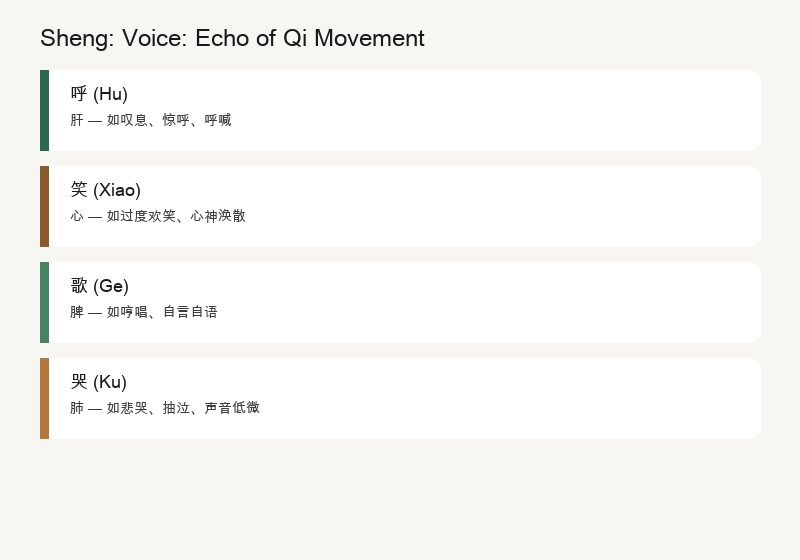
The ancients observed that human voices change with physical condition. Healthy people have loud, clear, and forceful voices. Unhealthy people develop weak, hoarse, or dull voices. The ancients classified sound changes into the Five Sounds Diagnosis: shouting, laughing, singing, weeping, and groaning, corresponding to liver, heart, spleen, lungs, and kidneys.
Shouting (hu, belongs to the liver) — Loud cries during anger or pain. The liver governs free-flowing (shu-xie), and when liver qi stagnates or rushes upward, people involuntarily emit "hu" sounds. For example: yelling when angry, moaning when in pain — these are all changes in liver qi movement.
Laughing (xiao, belongs to the heart) — Joyful vocalization. The heart governs the spirit (shen-ming), and when heart qi is smooth, one naturally laughs. But "laughing uncontrollably" can also be pathological — excessive heart fire or mental disturbance causing involuntary laughter. TCM says: "When heart qi is deficient, one tends to sadness; when heart qi is excessive, one laughs uncontrollably."
Singing (ge, belongs to the spleen) — When the spleen meridian is harmonious, people hum songs unconsciously. The spleen governs thought (si), and overthinking damages the spleen. But conversely, when in a good mood with harmonious spleen and stomach, people naturally "hum little tunes." If someone is constantly "whimpering," it may also indicate spleen qi weakness.
Weeping (ku, belongs to the lungs) — Crying during sadness. The lungs govern grief (bei), and people with weak lung qi easily become sad and weep. Conversely, excessive sadness also damages the lungs — "grief harms the lungs." Lin Daiyu wept all day and eventually coughed up blood from lung disease — a classic TCM case of "grief harms the lungs."
Groaning (shen, belongs to the kidneys) — Low groans during pain or weakness. The kidneys govern bones, and people with kidney deficiency have weak lower back and knees, groaning when in pain. Meanwhile, the kidneys are the root of congenital essence (xian-tian zhi ben), and when kidney deficiency reaches an extreme, people groan weakly — that kind of "weak and breathless" sound.
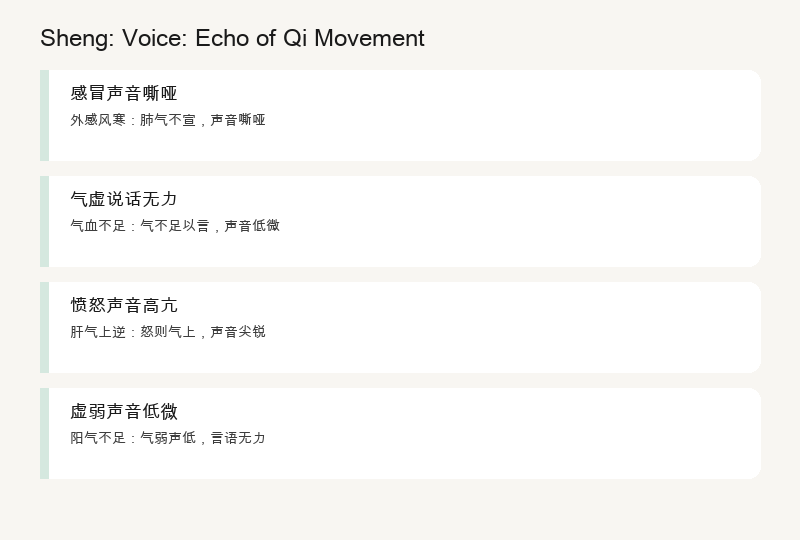
Beyond the five sounds, TCM also listens to voice strength: loud voice = ample lung qi; weak voice = qi deficiency; hoarse voice = lung dryness/fluid deficiency; heavy/dull voice = phlegm-dampness accumulation; rapid voice = excess pattern/heat pattern; intermittent voice = deficiency pattern/critical condition.
So when the ancients spoke of "Sheng," they didn't just mean "voice." They meant the direct projection of organ qi and blood into sound — like each person's unique "audio signature," one listen reveals the body's state. The ancients systematized sound changes through listening diagnosis, making it an important diagnostic tool.
Part 3giaogiao's Modern Translation
Okay, now let's translate "Sheng" into modern language.
I'm not going to talk about vocal cord vibration frequency, acoustic resonance, or lung capacity tests. Too complicated. You just need to remember one metaphor:
Voice = Vocal cord vibration + Airflow drive + Resonance chamber resonance
Loud voice = Ample lung capacity + Good vocal cord tension + Abundant energy
Weak voice = Weak respiratory muscles + Insufficient energy + Decreased drive
Hoarse voice = Vocal cord inflammation/edema + Abnormal mucus secretion
Incoherent speech = Cerebral cortex dysfunction + Abnormal nerve conduction
Sighing = Changed breathing pattern + Altered vagal nerve tension
That's it. Your "voice" is essentially the comprehensive output of the respiratory system, vocalization system, and nervous system — like an audio signature, anyone's physical state can be known with one listen.
Specifically:
What does a "loud voice" correspond to? It corresponds to ample lung capacity, strong respiratory muscles, and good vocal cord tension. Large lung capacity means abundant airflow, powerfully driving vocal cord vibration for a naturally loud voice. At the same time, sufficient energy metabolism and good muscle tension make the entire vocalization system highly efficient. This aligns with TCM's "loud voice means ample lung qi" — the lungs govern qi, and when qi is ample, the voice is loud.
What does a "weak voice" correspond to? It corresponds to weak respiratory muscles, insufficient energy, and decreased neural drive. During qi deficiency or chronic fatigue, respiratory muscles (diaphragm, intercostal muscles) lose contraction strength, lung capacity decreases, and airflow is insufficient to drive vocal cords to vibrate powerfully. Meanwhile, neuromuscular excitability drops and vocal cord tension weakens. This aligns with TCM's "weak voice means qi deficiency" — when qi is insufficient, the driving force is inadequate.
What does a "hoarse voice" correspond to? It corresponds to vocal cord inflammation, edema, or dryness. During a cold, viral or bacterial infection causes inflammation and edema of the vocal cord mucosa, obstructing vibration and causing hoarseness. Long-term smoking or air pollution irritates the vocal cords, causing chronic inflammation. Meanwhile, insufficient fluids (dehydration) means inadequate vocal cord lubrication, increasing friction. This aligns with TCM's "hoarse voice means lung dryness/fluid deficiency" — the lungs govern fluids, and when fluids are depleted, the voice becomes hoarse.
What does "incoherent speech" correspond to? It corresponds to cerebral cortex dysfunction. During high fever, mental confusion, or brain lesions, the brain's language centers (Broca's area, Wernicke's area) are impaired, reducing language organization ability and causing incoherent speech. This aligns with TCM's "incoherent speech means disturbed heart spirit" — the heart governs the spirit (shen-ming), and when the spirit is disturbed, language becomes disordered.
What does "sighing" correspond to? It corresponds to changed breathing patterns and emotional regulation. Sighing is a deep exhalation reflex that helps regulate breathing rhythm and emotional stress. During chronic anxiety or depression, autonomic nervous system dysfunction and abnormal vagal nerve tension alter breathing rhythm, manifesting as frequent sighing. This aligns with TCM's "sighing means liver qi stagnation" — the liver governs free-flowing (shu-xie), and when qi movement is blocked, one sighs.
So "Sheng" is not mysticism. It's a listenable physiological indicator — describing the comprehensive state of respiration, vocalization, and the nervous system. The ancients summarized it as "listening diagnosis" (wen zhen); modern people describe it as "acoustic analysis + pulmonary function testing" — they're talking about the same thing.
Part 4Life Stories
Four stories to help you instantly understand what "Sheng" is.
Story 1: Hoarse voice after a cold.
You catch a cold, your throat hurts, and your voice sounds like a duck. You say "my throat's inflamed," but TCM says "lung dryness, insufficient fluids." You ask: "Why does a cold make my voice hoarse?"
Here's the truth: Cold viruses attack the upper respiratory tract, causing inflammation, congestion, and edema of the throat mucosa. The vocal cords are part of the throat and are similarly affected — mucosal swelling obstructs vibration, causing hoarseness. Meanwhile, fever increases water evaporation, causing dehydration, and inadequate vocal cord lubrication further worsens hoarseness. It's not that "your throat is broken" — it's that the vocal cords are "clogged" by inflammation. TCM says "lung dryness, hoarse voice" — a precise description of the fluid depletion and mucosal inflammation caused by a cold. But the TCM description of "the lungs govern sound" accurately summarizes the connection between voice and the respiratory system.
Story 2: Long-term weak voice (qi deficiency).
Recently you've been under heavy work pressure, working overtime every day. You notice your voice getting weaker and weaker, your voice getting smaller during meetings, and colleagues saying "speak up." You go to the hospital and all indicators are normal. TCM says "qi deficiency, weak voice." You ask: "Why would qi deficiency affect my voice?"
Here's the truth: Chronic fatigue and sleep deprivation lead to decreased energy metabolism. Respiratory muscles (diaphragm, intercostal muscles) don't get sufficient energy, their contraction strength drops, and lung capacity decreases. Airflow is insufficient to powerfully drive vocal cord vibration, so the voice naturally becomes weak. Meanwhile, neuromuscular excitability drops and vocal cord tension weakens. It's not that "you don't want to talk" — it's that your body is "out of battery," and the vocalization system is underpowered. TCM says "weak voice means qi deficiency" — a precise summary of the vocalization decline caused by chronic fatigue. But the description "qi deficiency leads to weak voice" is more concise than any modern medical terminology.
Story 3: Voice getting louder when angry.
You're arguing with your neighbor, your voice gets louder and louder, and eventually you're shouting so the whole building can hear. After calming down, your throat hurts. You ask: "Why does anger make my voice louder?" Western medicine says "adrenaline surges, breathing quickens, vocal cords tense." TCM says "anger causes qi to rise, liver qi rushing upward."
Here's the truth: During emotional excitement, the sympathetic nervous system activates and releases adrenaline. Heart rate increases, breathing quickens, airflow increases, and the driving force for vocal cord vibration greatly increases. Meanwhile, facial and neck muscles tense, the resonance chamber changes, and the voice becomes loud and sharp. This is part of the "fight or flight" response — animals roar loudly when threatened, and humans are the same. It's not that "you have a bad temper" — it's that evolution left you a "battle alarm". TCM says "anger causes qi to rise" — qi rushes upward, and the voice naturally becomes louder. But the description of "liver qi rushing upward" precisely summarizes the effect of emotion on vocalization.
Story 4: Elderly voice becoming lower and deeper.
Your grandfather is eighty. He used to speak with a loud voice, but now his voice is low and hoarse, and sometimes he "leaks air" when speaking. You ask: "Why does a person's voice change with age?" Western medicine says "vocal cord aging, muscle atrophy, lung capacity decline." TCM says "kidney deficiency, sound originates from the kidneys."
Here's the truth: As age increases, vocal cord muscles atrophy, elasticity decreases, mucosa thins, and vibration efficiency drops. Lung capacity declines year by year (approximately 20-30ml per year), and airflow drive weakens. Meanwhile, the nervous system reacts more slowly, and muscle control precision decreases. It's not that "he's lost his spirit" — it's that the vocalization system's "hardware is aging". TCM says "the kidneys are the root of congenital essence, kidney deficiency leads to low voice" — a precise summary of age-related vocal decline. But while the description "sound originates from the kidneys" isn't completely precise, it points to the deep mechanism of aging.
Four stories, one underlying logic: Sound is the "audio signature" — changes in voice reflect the state of organ qi and blood.
Part 5Modern Research
Is there scientific research on "Sheng"?
Yes, and plenty of it. Scientists don't use the term "listening diagnosis" (wen zhen); they use:
• Voice analysis and pulmonary function correlation studies. Research has found that voice fundamental frequency (pitch) and intensity (loudness) are positively correlated with lung capacity. For every 1 liter increase in lung capacity, voice intensity increases by an average of 3-5 decibels. Voice truly is an "audio indicator" of lung function.
• Acoustic characteristics and emotional states. Computer acoustic research can identify emotional states (anger, sadness, joy, anxiety) by analyzing voice frequency, rhythm, and formants, with accuracy rates of 75-85%. This aligns with TCM's "five sounds correspond to five organs" concept — voice carries emotional information.
• Voice spectrum analysis in disease diagnosis. Research has found: Parkinson's patients have voice tremor (increased perturbation); depressed patients have monotonous speech (reduced frequency variation); heart failure patients have weak voices (decreased intensity). Voice analysis is becoming a new tool for disease screening.
These studies fully demonstrate that "Sheng" is a concept that can be precisely described in modern scientific language. The ancients summarized it as "listening diagnosis"; modern people describe it as "acoustic analysis + pulmonary function + neuroscience" — they're talking about the same thing.
Part 6Practical Methods
Now that you understand "Sheng," how do you listen?
First, clear up some misconceptions:
• "A loud voice means good health." Voice volume is just one indicator; you also need to look at voice clarity, endurance, and stability. Some people are naturally loud but have hoarse, intermittent voices, possibly indicating insufficient lung qi. It's not that "loud equals healthy" — voice "quality" matters more than "volume".
• "Voiceprint diagnosis can replace a physical exam." Voiceprint analysis can reflect certain health conditions, but it cannot replace comprehensive medical examinations. Voice is just a clue, not a diagnosis. It's not "listen to the voice to diagnose disease" — voice is an aid, not a substitute.
Specific methods:
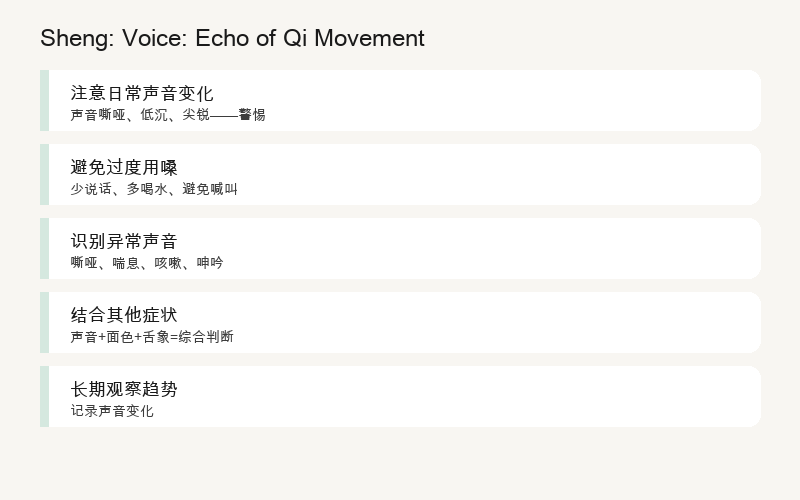
• Self-recording (listen to your own voice changes). Record a fixed-content reading (like a poem) every week and compare voice changes: Is the volume stable? Is it hoarse? Is it weak? Record continuously for a month, and you'll discover that voice and physical condition are highly correlated.
• Pay attention to morning voice (the most sensitive indicator). Right after waking up in the morning, your voice state best reflects your true physical condition. If your morning voice is hoarse and dry, it may indicate nighttime dehydration or chronic pharyngitis. If your morning voice is low and weak, it may indicate poor sleep quality or qi deficiency.
• Listen to family members' voice changes (early warning). Changes in the voices of parents or partners are often the earliest health signals. Voice suddenly becoming hoarse (lasting more than two weeks), voice becoming lower (without obvious cold), or voice becoming rapid — all deserve attention.
• Notice voice changes after emotions (mind-body connection). Does your voice recover after emotional excitement? If hoarseness persists long after anger, it may indicate fragile vocal cords or insufficient lung qi. If weakness persists after sadness, it may indicate qi deficiency.
• Combine with breathing to judge voice (pulmonary function indicator). Speaking requires breathing; if you gasp after finishing one sentence, it indicates insufficient lung capacity. If you frequently breathe mid-sentence, it may indicate abnormal breathing patterns. Speaking endurance (how long you can speak continuously) is a simple self-test of lung function.
These methods don't require you to believe in TCM. You just need to understand: Sound is the "audio signature" — listening to voice changes is listening to the body's "signal output."
Part 7One-Minute Summary
🕐 One Minute to Understand "Sheng"
Sound = The audio signature of the five organs + identity marker.
Five sounds correspond to five organs: shouting, laughing, singing, weeping, and groaning correspond to liver, heart, spleen, lungs, and kidneys.
Voice changes reflect organ function — loud voice means ample lung qi, weak voice means qi deficiency, hoarse voice means lung dryness.
Sound = Vocal cord vibration + Airflow drive + Resonance chamber resonance.
Loud voice (ample lung capacity), weak voice (weak respiratory muscles), hoarse voice (vocal cord inflammation), incoherent speech (disturbed heart spirit), sighing (liver qi stagnation).
Misconceptions: Loud voice equals health; voiceprint diagnosis replaces physical exams.
Methods: Self-recording, pay attention to morning voice, listen to family changes, notice post-emotion voice, combine with breathing.
The ancients called it "listening diagnosis" (wen zhen); modern people call it "acoustic analysis."
Different names, but the body knows: Sound is the audio signature of the five organs. Listening to sound is listening to the body speak.
The ancients had no spectrographs, but they knew "five sounds correspond to five organs."
This is probably the most朴素 wisdom of the Chinese: One who knows by listening is called a sage; sound is the most honest audio signature of the body.
Making money is the art of living; art is life after making money
giaogiao Decodes Chinese Traditional Wisdom · Concept 57
Using modern scientific language to help the world understand Chinese traditional wisdom.
No mystery, no superstition, no disparagement.
Understanding, not merely believing.
Coach Liu
Written in Florence