Why Do You Suddenly Crave Sour Foods? Taste Is the "Chemical Alarm" of Your Organs
Part 1A Question
Have you ever noticed that sometimes you wake up with a bitter, sweet, sour, or even salty taste in your mouth? Have you noticed that you always crave sweets, and you say "I'm just craving it," but TCM says "spleen qi deficiency" — and you ask: "What does wanting sweets have to do with the spleen?"
Even more absurd, you wake up with a bitter taste and say "I didn't brush my teeth," but TCM says "gallbladder heat." Your mouth tastes sour and you say "I ate too much yesterday," but TCM says "liver-stomach disharmony." Your mouth tastes salty and you say "the food was too salty," but TCM says "kidney deficiency." You think: "Can the taste in my mouth really reflect internal organ problems?"
Here's another question: your mouth tastes bland, everything has no flavor, and you say "taste fatigue," but TCM says "spleen deficiency with dampness encumbrance." Your friend has a bitter taste, gets a gastroscopy, and finds bile reflux — TCM says "gallbladder heat rising upward." Are the two descriptions talking about the same thing?
What exactly is Kou?
Part 2Traditional Chinese Explanation
The concept of "Kou" (mouth) is an important window in TCM diagnostic methods. The Huangdi Neijing says: "The spleen opens into the mouth, and its splendor manifests on the lips." The mouth is not just a place for eating; it is the spleen's "taste sensor" — changes in taste directly reflect the state of the spleen and stomach.
— Huangdi Neijing, Suwen
"Bitter taste indicates gallbladder heat; sweet taste indicates spleen dampness; sour taste indicates liver-stomach disharmony; salty taste indicates kidney deficiency; bland taste indicates spleen deficiency."
— Jingyue Quanshu
"The five flavors enter the mouth, each traveling its own path, each causing its own disease."
— Huangdi Neijing, Suwen
The ancients observed that human taste changes with physical condition. Healthy people have normal taste, neither bitter nor sweet nor sour nor salty. Unhealthy people develop abnormal tastes in the mouth. The ancients classified taste changes into the Five Flavors Diagnosis: bitter, sweet, sour, salty, and bland, corresponding to different organ states.
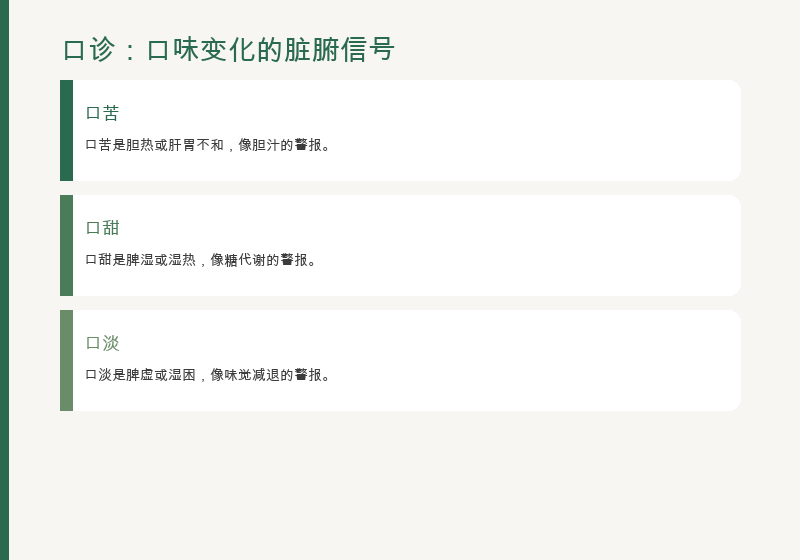
Bitter taste (gallbladder heat / liver-stomach disharmony) — A bitter taste in the mouth, like holding coptis root. When gallbladder heat is present, bile rises upward, causing bitterness in the mouth. When liver fire flames upward, the mouth also becomes bitter. For example: bitter taste after staying up late, bitter taste after anger, long-term bitter taste in cholecystitis patients — all indicate heat in the liver and gallbladder.
Sweet taste (spleen dampness) — A sweet taste in the mouth, like holding sugar. When spleen dampness is present, water-dampness stagnates internally, the spleen's transformation function is abnormal, and sweetness is produced in the mouth. For example: diabetics with sweet taste (high blood sugar), people with indigestion with sweet taste, people with heavy dampness with sweet taste — all are spleen problems.
Sour taste (liver-stomach disharmony) — A sour taste in the mouth, like drinking vinegar. Liver qi stagnates, attacks the stomach horizontally, stomach acid rises upward, and the mouth tastes sour. For example: sour taste after anger, sour taste in people with acid reflux and heartburn, sour taste in gastritis patients — all are liver-stomach disharmony.
Salty taste (kidney deficiency) — A salty taste in the mouth, like holding salt. When kidney deficiency is present, water metabolism is abnormal, kidney qi is not secure, and the mouth tastes salty. For example: chronic nephritis patients with salty taste, long-term night owls with salty taste, elderly people with salty taste — all are kidney deficiency.
Bland taste (spleen deficiency) — No taste in the mouth, nothing tastes good. When spleen deficiency is present, transformation function declines, taste bud sensitivity decreases, and the mouth is bland and flavorless. For example: bland taste after major illness, bland taste with chronic fatigue, bland taste with indigestion — all are spleen deficiency.
So when the ancients spoke of "Kou," they didn't just mean "mouth." They meant the "taste alarm" of the organs — abnormal taste is the body sending a chemical alarm. The ancients used taste changes to externalize the state of internal organs, making it an intuitive diagnostic indicator.
Part 3giaogiao's Modern Translation
Okay, now let's translate "Kou" into modern language.
I'm not going to talk about taste bud cells, taste nerve conduction, or saliva composition analysis. Too complicated. You just need to remember one metaphor:
Bitter taste = Bile reflux / oral bacterial metabolism (gallbladder heat)
Sweet taste = Elevated blood sugar / oral yeast (spleen dampness)
Sour taste = Gastric acid reflux / gastroesophageal reflux (liver-stomach disharmony)
Salty taste = Electrolyte imbalance / altered saliva composition (kidney deficiency)
Bland taste = Decreased taste bud sensitivity / weakened nerve conduction (spleen deficiency)
That's it. Your "taste" is essentially the comprehensive reflection of oral environment, digestive fluid composition, and nerve sensitivity — like a chemical sensor, it "alarms" when it detects abnormalities.
Specifically:
What does "bitter taste" correspond to? It corresponds to bile reflux or abnormal oral bacterial metabolism. When the gallbladder contracts, bile is discharged into the duodenum. If gastrointestinal function is disordered, bile may reflux into the stomach or even the esophagus, causing a bitter taste. Meanwhile, oral bacteria (such as Gram-negative bacteria) decompose sulfur-containing proteins, producing bitter substances. Staying up late or under stress disrupts bile secretion rhythm and accelerates oral bacterial reproduction, worsening the bitter taste. This aligns with TCM's "bitter taste means gallbladder heat" — when gallbladder heat is present, bile rises upward, and the mouth becomes bitter.
What does "sweet taste" correspond to? It corresponds to elevated blood sugar or oral yeast reproduction. When blood sugar rises, glucose concentration in saliva increases, stimulating sweet taste receptors. Meanwhile, the high-glucose environment promotes oral yeast (such as Candida) reproduction, producing sweet metabolic byproducts. Diabetics with sweet taste is a direct signal of elevated blood sugar. This aligns with TCM's "sweet taste means spleen dampness" — the spleen governs transformation, and when transformation is abnormal, damp turbidity stagnates internally and blood sugar metabolism is disordered.
What does "sour taste" correspond to? It corresponds to gastric acid reflux. When the lower esophageal sphincter relaxes or gastric pressure increases, gastric acid refluxes into the esophagus or even the mouth, causing a sour taste. During anger or anxiety, autonomic nervous system dysfunction increases gastric acid secretion and relaxes the lower esophageal sphincter, worsening acid reflux. This aligns with TCM's "sour taste means liver-stomach disharmony" — the liver governs free-flowing (shu-xie), liver qi stagnation attacks the stomach horizontally, and stomach qi rises upward causing sour water to rise.
What does "salty taste" correspond to? It corresponds to electrolyte imbalance or altered saliva composition. During kidney deficiency / chronic kidney disease, water metabolism and electrolyte regulation are abnormal, sodium ion concentration in saliva rises, and the mouth tastes salty. Meanwhile, adrenal insufficiency (kidney deficiency) reduces aldosterone secretion, increasing sodium excretion, and sodium ion concentration in saliva relatively rises. This aligns with TCM's "salty taste means kidney deficiency" — the kidneys govern water, and when water metabolism is abnormal, electrolytes are disordered.
What does "bland taste" correspond to? It corresponds to decreased taste bud sensitivity or weakened nerve conduction. During spleen deficiency / malnutrition, zinc deficiency occurs (zinc is a component of gustin, a taste substance), and taste bud sensitivity decreases. Meanwhile, chronic fatigue slows nerve conduction speed and weakens taste signal transmission. Bland taste is most common after major illness or chronic fatigue. This aligns with TCM's "bland taste means spleen deficiency" — the spleen governs transformation, and when spleen is deficient, nutrition is insufficient and taste buds lose nourishment.
So "Kou" is not mysticism. It's a tastable physiological indicator — describing the comprehensive performance of oral environment, digestive fluids, and metabolic state. The ancients summarized it as "taste diagnosis"; modern people describe it as "oral chemistry + digestive fluid analysis + nerve conduction" — they're talking about the same thing.
Part 4Life Stories
Four stories to help you instantly understand what "Kou" is.
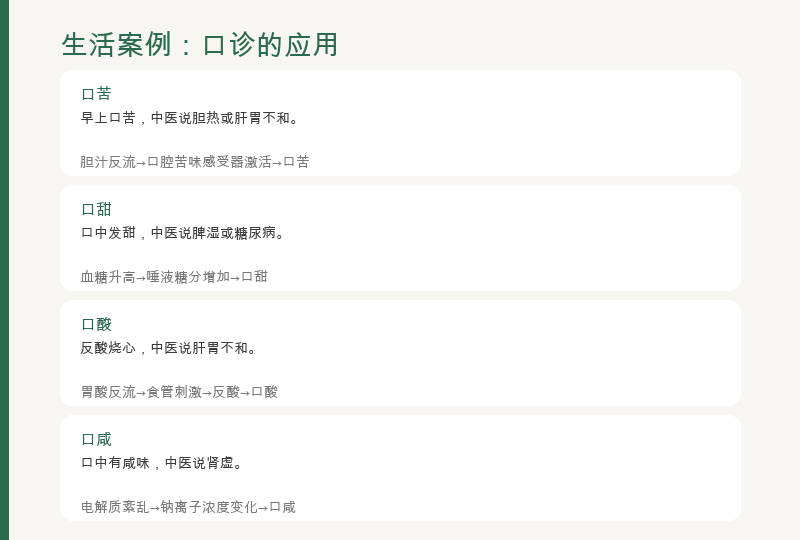
Story 1: Bitter taste after staying up late.
You've been working overtime for a week, going to bed at 2 AM every day. Every morning you wake up with a bitter taste in your mouth, and brushing doesn't help. You say "I didn't get enough rest," but TCM says "gallbladder heat, bile rising upward." You ask: "Why does staying up late cause a bitter taste?"
Here's the truth: Staying up late disrupts the biological clock and gallbladder contraction rhythm. Normally, the gallbladder stores bile at night and releases it when eating in the morning. When staying up late, eating rhythm is disrupted, bile release timing is disordered, and it easily refluxes into the stomach. Meanwhile, at night the parasympathetic nervous system is excited, the Oddi sphincter relaxes, and bile is more likely to reflux. Oral bacteria reproduce at night, decomposing proteins to produce bitter substances. It's not that "you didn't brush your teeth" — it's that the bile rhythm is disrupted, and the mouth has become a "bitterness laboratory." TCM says "gallbladder heat causes bitter taste" — a precise description of the bile metabolism disorder caused by staying up late. But the description of "gallbladder heat rising upward" precisely summarizes the mechanism of bitter taste.
Story 2: Diabetic with sweet taste.
Your mother was diagnosed with diabetes, with long-term high blood sugar. She recently keeps saying "my mouth tastes sweet, like holding sugar." You thought it was "psychological," but TCM says "spleen dampness, blood sugar rising upward." You ask: "What does sweet taste have to do with blood sugar?"
Here's the truth: When blood sugar rises, glucose concentration in the blood increases, and is secreted into saliva through salivary glands. Elevated glucose concentration in saliva directly stimulates sweet taste receptors on the tongue. Meanwhile, the high-glucose environment promotes oral yeast reproduction, producing sweet metabolic byproducts. Research shows that when blood sugar > 10 mmol/L, 50% of patients experience sweet taste. It's not "psychological" — it's that blood sugar is literally "leaking" into the mouth. TCM says "sweet taste means spleen dampness" — a precise summary of the mechanism of diabetic sweet taste. But while the description "spleen dampness" uses ancient terminology, it points to the core of metabolic disorder.
Story 3: Sour taste after anger.
You had a fight with your partner, got so angry your stomach hurt. After a while, you noticed your mouth tasted sour, and your burps were all acidic. You said "my stomach is weak," but TCM says "liver-stomach disharmony, sour water rising upward." You ask: "Why does anger cause a sour taste?"
Here's the truth: During emotional excitement, the sympathetic nervous system activates, and gastric acid secretion increases (stress response). Meanwhile, the lower esophageal sphincter (the valve that prevents gastric acid reflux) changes in tension and is more likely to relax. Gastric acid refluxes into the esophagus, even reaching the throat, and the mouth tastes sour. People with long-term anxiety and stress have a 3-fold increased incidence of chronic reflux esophagitis. It's not that "your stomach is too delicate" — it's that emotions directly "flip the switch" for gastric acid reflux. TCM says "liver-stomach disharmony" — liver qi attacks the stomach horizontally, and stomach qi rises upward causing sour water to rise. But the description of "liver-stomach disharmony" precisely summarizes the connection between emotion and digestion.
Story 4: Bland taste after major illness.
You got the flu, had a high fever for three days, and it finally broke. But you noticed everything had no taste, porridge, meat, and vegetables all tasted like eating blank paper. You said "taste fatigue," but TCM says "spleen deficiency, taste buds losing nourishment." You ask: "Why does taste disappear after being sick?"
Here's the truth: During fever, the body consumes large amounts of zinc (immune response requires zinc). Zinc is an essential component of gustin (a taste substance), and zinc deficiency causes decreased taste bud sensitivity. Meanwhile, fever slows taste bud cell renewal and weakens taste nerve conduction. After recovering from a major illness, nutritional reserves are depleted, and nerve repair requires time and nutrition. It's not that "your taste is broken" — it's that your taste buds are "starving" and need nutrition to recover. TCM says "bland taste means spleen deficiency" — the spleen governs transformation, and when spleen is deficient, nutrition is insufficient and taste buds lose nourishment. But the description of "spleen deficiency" precisely summarizes the pathology of post-illness taste decline.
Four stories, one underlying logic: The mouth is the "chemical alarm" — abnormal taste reflects the metabolic state of internal organs.
Part 5Modern Research
Is there scientific research on "Kou"?
Yes, and plenty of it. Scientists don't use the term "taste diagnosis"; they use:
• The relationship between taste and endocrine function. Research has found that taste sensitivity is closely related to blood sugar and insulin levels. Diabetics have decreased sweet sensitivity (a taste protection mechanism), but when blood sugar rises, saliva glucose increases,反而 producing "sweet taste." Taste is the "chemical window" of metabolic state.
• Oral microbiota and systemic diseases. There are over 700 species of bacteria in the mouth. Research has found that oral microbiota imbalance is closely related to diabetes, cardiovascular disease, and kidney disease. Bitter and sweet substances produced by oral bacterial metabolism are important causes of abnormal taste. "Kou" truly is the "chemical sensor" of whole-body health.
• Taste abnormalities and neurodegenerative diseases. Research has found that taste decline (especially bitter and sour tastes) may be an early sign of Parkinson's disease and Alzheimer's disease. Taste nerve degeneration occurs earlier than motor symptoms and cognitive symptoms. Taste changes may become an "early warning" for neurodegenerative diseases.
These studies fully demonstrate that "Kou" is a concept that can be precisely described in modern scientific language. The ancients summarized it as "taste diagnosis"; modern people describe it as "oral chemistry + microbiology + neuroscience" — they're talking about the same thing.
Part 6Practical Methods
Now that you understand "Kou," how do you taste?
First, clear up some misconceptions:
• "Bitter or sweet taste means 'internal heat,' just take cooling medicine." Bitter taste may be gallbladder heat or bile reflux; sweet taste may be spleen dampness or diabetes. Different causes require different treatments. It's not "take cooling medicine across the board" — taste abnormality is a signal that needs to be investigated.
• "Bland taste just means no appetite, take appetite stimulants." Bland taste may be spleen deficiency, zinc deficiency, or nerve damage. Appetite stimulants may temporarily increase appetite but don't solve the root cause. It's not "no appetite so take appetite stimulants" — bland taste is a signal of nutritional or nerve problems.
Specific methods:
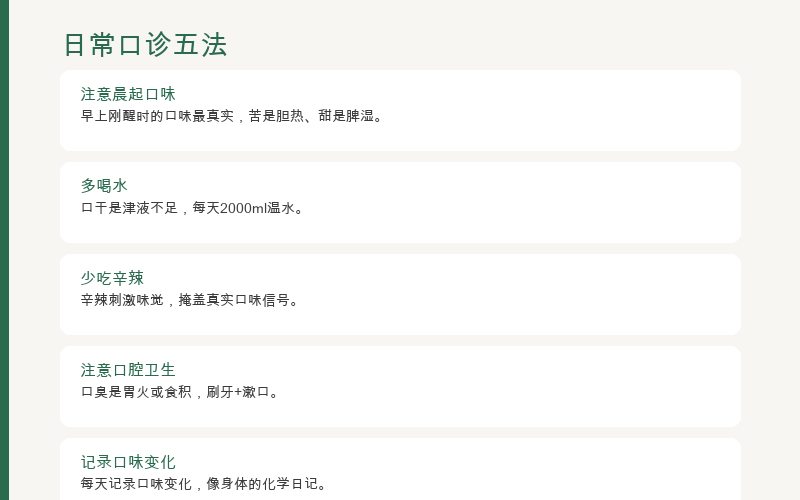
• Morning self-check (most sensitive timing). When you wake up in the morning, before drinking water or brushing your teeth, notice if there is any abnormal taste in your mouth. Bitter? Sweet? Sour? Salty? Bland? Record for a week, and you'll discover the connection between taste and sleep, diet, and emotions.
• Keep a taste change diary. Record taste, diet, sleep, emotions, and symptoms for two consecutive weeks. For example: bitter taste after staying up late, sour taste after anger, sweet taste after eating sweets — find the triggers of taste changes. This is your own "chemical alarm database."
• Notice taste changes after eating. Normal people's taste returns to normal after eating. If bitter taste worsens after eating, it may be bile reflux; if sour taste worsens after eating, it may be excessive gastric acid; if bland taste persists after eating, it may be poor spleen transformation.
• Check tongue coating (taste + tongue appearance combined). Bitter taste + yellow greasy tongue coating = damp-heat; sweet taste + white greasy tongue coating = cold-damp; sour taste + red tongue edges = liver-stomach disharmony; bland taste + thin white tongue coating = spleen deficiency. Tongue coating is the "visual supplement" to taste; combined observation is more accurate.
• Pay attention to accompanying symptoms (comprehensive judgment). Bitter taste + hypochondriac pain = liver-gallbladder problem; sweet taste + excessive thirst and urination = check blood sugar; sour taste + acid reflux and heartburn = gastroesophageal reflux; salty taste + lower back soreness = check kidney function; bland taste + fatigue = supplement nutrition. Taste abnormality + accompanying symptoms point to more precise diagnosis.
These methods don't require you to believe in TCM. You just need to understand: The mouth is the "chemical alarm" — tasting taste changes is tasting the "chemical signals" inside the body.
Part 7One-Minute Summary
🕐 One Minute to Understand "Kou"
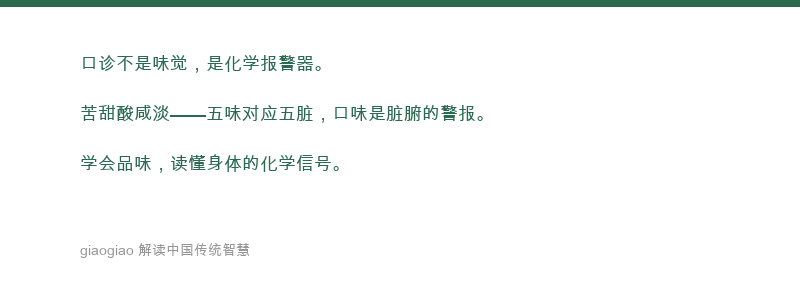
Mouth = The taste alarm of the five organs + chemical sensor.
Bitter taste (gallbladder heat / bile reflux), sweet taste (spleen dampness / high blood sugar), sour taste (liver-stomach disharmony / gastric acid reflux), salty taste (kidney deficiency / electrolyte imbalance), bland taste (spleen deficiency / taste bud malnutrition).
Taste is not "what you feel like eating" — it's "your body is alarming."
Mouth = Oral environment + Digestive fluid composition + Nerve sensitivity.
Abnormal taste is a chemical signal of internal organ metabolism — not a preference, but a pathology.
Misconceptions: Taking cooling medicine randomly for taste abnormalities, taking appetite stimulants for bland taste.
Methods: Morning self-check, keep a diary, notice changes after eating, check tongue coating, pay attention to accompanying symptoms.
The ancients called it "taste diagnosis"; modern people call it "oral chemical analysis."
Different names, but the body knows: Taste is the chemical alarm of the five organs. When you taste something abnormal, the body is sending an alarm.
The ancients had no blood glucose meters, but they knew "sweet taste means spleen dampness."
This is probably the most朴素 wisdom of the Chinese: The spleen opens into the mouth, and taste is the most honest chemical alarm of the body.
Making money is the art of living; art is life after making money
giaogiao Decodes Chinese Traditional Wisdom · Concept 58
Using modern scientific language to help the world understand Chinese traditional wisdom.
No mystery, no superstition, no disparagement.
Understanding, not merely believing.
Coach Liu
Written in Florence