Why does TCM say 'Warming the Interior' is the body's heating system? Warm therapy is the body's 'heater'
Part 1A Question
Have you ever noticed that in winter your hands and feet are like ice, even with thick socks and heavy blankets? Have you found that eating anything cold gives you diarrhea, your abdomen feels cold to the touch, and you love hot porridge and hot water bottles?
Even more bizarrely, TCM says this is called 'internal cold syndrome' and needs 'warm therapy' — aconite, dried ginger, cinnamon — and you ask: 'Isn't this just eating warm food? Why call it a therapy?'
Another question: you ask Western medicine, 'My hands and feet are cold, is it poor circulation?' Western medicine says 'maybe Raynaud's syndrome, maybe a normal physiological phenomenon.' You ask TCM, and TCM says 'spleen-stomach deficiency-cold' or 'kidney-yang deficiency' — and you ask: 'What is deficiency-cold? Why can't Western medicine detect it?'
One last question: you hear that 'warm therapy promotes fire, and those with yin-deficiency fire excess should avoid it' — and you ask: 'What does warm therapy have to do with getting heated? Why do some people get more fired up the more they warm themselves?'
What is Wen, after all?
Part 2Traditional Chinese Explanation
The concept of 'warm therapy' is one of the Eight Methods of TCM. TCM treats disease with eight basic methods: sweating, vomiting, purging, harmonizing, warming, clearing, dissolving, and tonifying. Warm therapy uses warm-hot medicinals to treat internal cold syndrome — a state of 'cold' inside the body.
— Yellow Emperor's Inner Canon
"To restore yang and save from collapse, aconite is the first."
— Essentials of Materia Medica
"The nature of ginger and cinnamon is intensely hot and dispersing, able to warm the middle and scatter cold, restore yang and unblock the vessels."
— Compendium of Materia Medica
The ancients observed: the inside of the body can be 'cold' — not low body temperature, but low function. Cold spleen-stomach (poor digestion), cold kidney-yang (low metabolism), cold heart-yang (poor circulation) — these 'cold' states cannot be measured with a thermometer; they are states of function.
Warm therapy = heating system + heater. It's not simply 'eating warm food'; it is using warm-hot medicinals to help the body restore function.
The position of warm therapy in TCM:
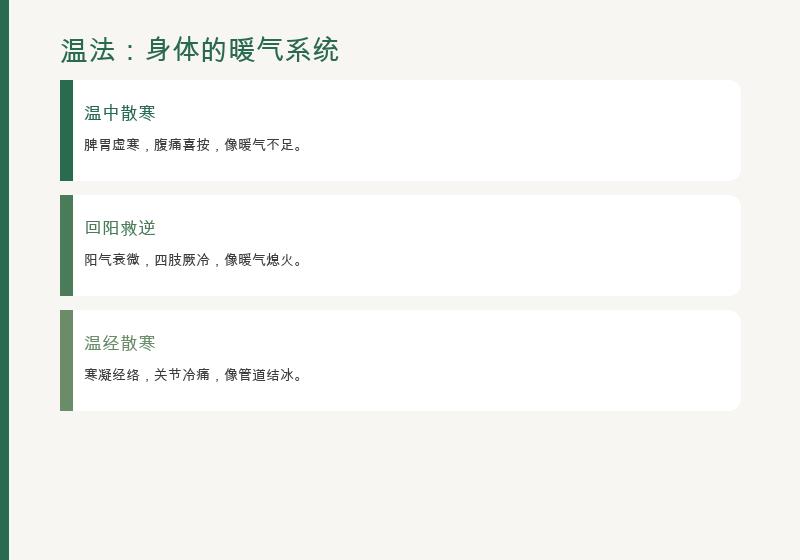
• Aconite — the fiercest general of warm therapy. Aconite is intensely hot, able to restore yang and save from collapse. Used for heart-kidney yang deficiency, cold limbs, and a pulse on the verge of disappearing. Like adding coal to the heating system and lighting the fire — fierce heat, but must be used with caution.
• Dried ginger — warms the middle and scatters cold. Dried ginger warms the spleen-stomach, used for deficiency-cold of the spleen-stomach, abdominal pain that likes pressure, and clear thin diarrhea. Like adding insulation to the heating pipes, preventing heat loss.
• Cinnamon — warms the kidney and assists yang. Cinnamon warms kidney-yang, used for kidney-yang deficiency, cold pain in the waist and knees, and impotence. Like turning up the thermostat on the heating system, raising the overall temperature.
The three main forces of warm therapy: aconite, dried ginger, and cinnamon. Each has its focus: aconite restores yang (emergency), dried ginger warms the middle (spleen-stomach), and cinnamon assists yang (kidney-yang).
But warm therapy has a contraindication: those with yin-deficiency fire excess should avoid it. Warm therapy promotes fire; if the body itself has 'insufficient yin' (insufficient body fluids and nutrients), adding warmth is like 'adding fuel to the fire' — leading to dry mouth, sore throat, insomnia, and irritability — all 'fire excess' symptoms.
For example: deficiency-cold of the spleen-stomach. Eating anything cold causes diarrhea, cold abdominal pain, a preference for warm food and drink — this is the spleen-stomach being 'cold,' digestive function is low. Using dried ginger, atractylodes, and codonopsis (Regulate the Middle Decoction) to warm the middle and strengthen the spleen, restoring digestive function. It is not 'eating warm food is enough,' it is warm-hot medicinals helping to restore function.
Another example: heart-yang deficiency. Cold limbs, palpitations, shortness of breath, pale complexion — this is insufficient heart-yang, the heart's pumping power is weak. Using aconite, dried ginger, and licorice (Frigid Extremities Decoction) to restore yang and save from collapse, enhancing cardiac function. This is an emergency use; aconite is toxic and must be processed before use.
So what the ancients called 'wen' is not just 'heat' — it is the body's heating system + heater, helping to restore vitality when function is low.
Part 3giaogiao Modern Translation
Okay, now let's translate 'wen' into modern language.
I'm not going to talk about mitochondrial function or thyroid hormones. Too complicated. You just need to remember one metaphor:
Warm therapy = raising metabolic rate + promoting blood circulation + enhancing organ function + improving energy metabolism
Aconite (restore yang) = strengthening the heart + raising blood pressure + improving peripheral circulation (like adding coal to the heating system and lighting the fire)
Dried ginger (warm the middle) = promoting gastrointestinal motility + increasing digestive secretion + improving gastric mucosal blood flow (like adding insulation to the heating pipes)
Cinnamon (assist yang) = improving insulin sensitivity + promoting peripheral vasodilation + raising basal metabolism (like turning up the thermostat)
Internal cold syndrome = low metabolic rate + poor circulation + reduced organ function
Yin-deficiency fire excess = insufficient body fluids + hypermetabolism + warm therapy adding fuel to the fire
That's it. 'Wen' is essentially raising the body's metabolic function and circulatory efficiency — like adding coal to the heating system and turning up the temperature in winter, so the room warms up.
Specifically:
What does 'deficiency-cold of the spleen-stomach' correspond to? It corresponds to reduced digestive function + increased vagal tone. Reduced gastric acid secretion, insufficient gastric motility, decreased digestive enzyme activity — overall digestive function is 'cold' (a low metabolic state). Gingerol in dried ginger promotes gastrointestinal motility, increases digestive secretion, and improves gastric mucosal blood flow. It's not 'eating ginger warms the stomach,' it is ginger helping the stomach and intestines restore function.
What does 'kidney-yang deficiency' correspond to? It corresponds to low basal metabolic rate + hypothyroidism + adrenal insufficiency. Fear of cold, weak and sore waist and knees, decreased sexual function, edema — this is the metabolic 'engine' running low on power. Cinnamaldehyde in cinnamon can improve insulin sensitivity, promote peripheral vasodilation, and raise basal metabolism. Like turning up the thermostat on the heating system.
What does 'heart-yang deficiency' correspond to? It corresponds to reduced cardiac function + peripheral circulatory disorder. Palpitations, shortness of breath, cold limbs, pale complexion — this is the heart's 'pump' running low on power, poor circulation. Aconitine in aconite (toxicity reduced after processing) has a cardiotonic effect, enhancing myocardial contractility and improving peripheral circulation. Like adding coal to the heating system and lighting the fire — fierce heat.
What does 'yin-deficiency fire excess should avoid warm therapy' correspond to? It corresponds to insufficient body fluids + hypermetabolism. Dry mouth, sore throat, insomnia, irritability, night sweats — this is insufficient 'yin fluids' in the body, metabolism is already hyperactive. Using warm therapy is like adding coal to a furnace that is already too hot — adding fuel to the fire. One must first nourish yin (supplement body fluids and nutrients), then consider warm supplementation.
So 'wen' is not mysticism. It is simply a way to raise metabolic function and circulatory efficiency — the ancients used aconite, dried ginger, and cinnamon to warm up; modern people use exercise, nutrition, and hormone replacement to regulate — the core logic is the same: when function is low, warmth is needed.
Part 4Life Cases
Four stories to instantly understand what 'wen' is.
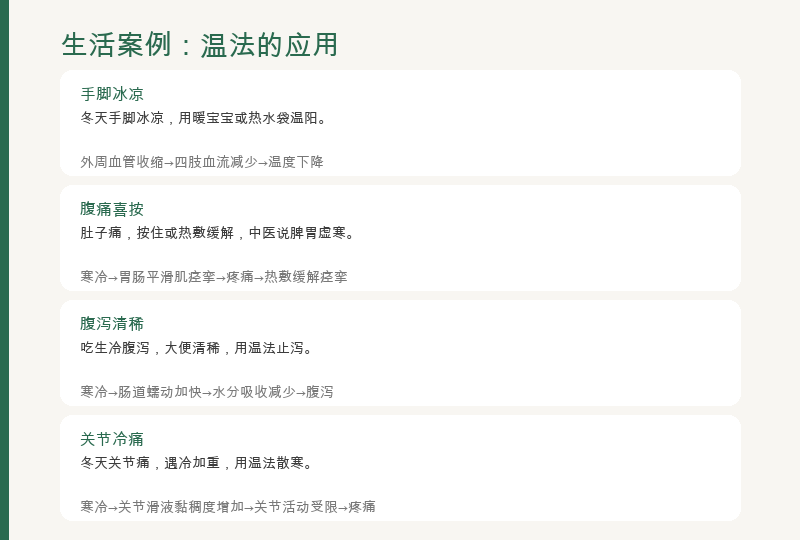
Case 1: Deficiency-cold of the spleen-stomach (the 'cold palace' of digestion).
You have chronic cold stomach pain. Eating anything cold causes diarrhea, loose stools, and you love hot porridge and hot water bottles. Western medicine says 'chronic gastritis'; TCM says 'deficiency-cold of the spleen-stomach,' and uses Regulate the Middle Pill (dried ginger, ginseng, atractylodes, licorice). You ask: 'Why not anti-inflammatory drugs?'
The truth: this is reduced gastric mucosal function + increased vagal tone. Reduced gastric acid secretion, insufficient gastric motility, decreased digestive enzyme activity — overall digestive function is 'cold' (a low metabolic state). Anti-inflammatory drugs (targeting inflammation) are ineffective for this condition because the main problem is not inflammation, but low function. Dried ginger in Regulate the Middle Pill warms the middle and scatters cold, while ginseng tonifies qi and strengthens the spleen — helping to restore digestive function. It's not 'gastritis needs anti-inflammatory treatment,' it is deficiency-cold needs warm supplementation. TCM says 'deficiency-cold of the spleen-stomach' — a precise description of a low metabolic state of digestive function.
Case 2: Kidney-yang deficiency (the metabolic engine is running low on power).
You are chronically afraid of cold, with weak and sore waist and knees. No matter how much you wear in winter, you are still cold. Sexual function is decreased, and there is mild edema in the lower limbs. Western exam: thyroid function is normal. TCM says 'kidney-yang deficiency' and uses Golden Cabinet Kidney Qi Pill (cinnamon, aconite, rehmannia, etc.). You ask: 'The exam is normal, so why am I still afraid of cold?'
The truth: this is low basal metabolic rate + peripheral circulatory disorder. Although thyroid function is normal, adrenal function and mitochondrial function may be low, leading to overall metabolic 'heat' being insufficient. Cinnamaldehyde in cinnamon raises basal metabolism and improves peripheral circulation; aconite improves circulatory power. Like turning up the thermostat on the heating system. It's not 'the exam is normal so there is no disease,' it is a low metabolic state needs regulation. TCM says 'kidney-yang deficiency' — a precise description of a metabolic engine running low on power.
Case 3: Cold-congealed menstrual pain (the 'cold palace' of the uterus).
Every time your period comes, you have cold pain in the lower abdomen, like there is an ice cube inside. It improves with heat application. The menstrual blood is dark red with clots. Western medicine says 'primary dysmenorrhea' and gives ibuprofen. TCM says 'cold-congealed menstrual pain' and uses Mugwort and Aconite Warm the Palace Pill. You ask: 'Why does heat application help?'
The truth: this is uterine smooth muscle spasm + local circulatory disorder. Cold causes uterine blood vessel constriction, smooth muscle spasm, and pain. Heat application promotes local vasodilation, relieves spasm, and reduces pain. Mugwort and cinnamon in the pill warm the meridians and scatter cold, helping to improve uterine blood circulation. It's not 'menstrual pain is just inflammation,' it is cold-congealment causes spasm, so warmth is needed to unblock. TCM says 'when cold congeals, there is pain; when warmth unblocks, it is relieved' — a precise description of the pain mechanism caused by cold.
Case 4: Yin-deficiency fire excess (contraindication for warm therapy).
You have dry mouth, sore throat, insomnia, irritability, and night sweats. Your palms and soles are hot. You hear that 'cold hands and feet are yang deficiency,' so you start eating aconite and cinnamon to warm up. The result: you get more and more 'fired up,' your dry mouth worsens, and your insomnia gets worse. You ask: 'Why does warm supplementation make me feel worse?'
The truth: this is yin-deficiency fire excess, not yang deficiency. Insufficient body fluids (yin-deficiency), metabolism is already hyperactive (fire excess). Using warm therapy is adding fuel to the fire. One must first nourish yin (supplement body fluids and nutrients), such as ophiopogon, rehmannia, and dendrobium, and only after yin-deficiency improves, consider whether warm supplementation is needed. It's not 'cold hands and feet need warming,' it is first distinguish cold and heat, then determine the treatment principle. TCM says 'those with yin-deficiency fire excess should avoid warm therapy' — a precise description of the contraindication for warm therapy.
Four cases, one underlying logic: warm therapy is a heating system — warm up when function is low, but do not warm up when there is yin-deficiency fire excess.
Part 5Modern Research
Does 'wen' have scientific research?
Yes, and research on warm therapy is rapidly developing. Scientists don't use the term 'warm therapy'; they use:
• The pharmacological effects of ginger. Research shows that gingerol in dried ginger promotes gastrointestinal motility, increases digestive secretion, improves gastric mucosal blood flow, and has anti-inflammatory and analgesic effects. This is completely consistent with TCM's description of 'dried ginger warms the middle and scatters cold.' Ginger can also improve peripheral circulation and relieve cold hands and feet.
• Cinnamon and metabolism. Research shows that cinnamaldehyde in cinnamon can improve insulin sensitivity, lower blood sugar, promote peripheral vasodilation, and raise basal metabolic rate. This is consistent with TCM's description of 'cinnamon warms the kidney and assists yang' — improving metabolism and raising 'heat.'
• The cardiotonic effect of aconite. Aconitine in aconite (toxicity greatly reduced after processing) has a cardiotonic effect, raising blood pressure and improving peripheral circulation. Modern clinical use in heart failure, shock, and other emergency situations — consistent with TCM's application of 'aconite restores yang and saves from collapse.' But aconite is toxic and must be professionally processed and used under professional medical guidance.
These studies fully demonstrate that 'wen' is a concept that can be precisely described in modern scientific language. The ancients used aconite, dried ginger, and cinnamon to warm up; modern people use exercise, nutrition, and hormones to regulate — the core logic is the same: when function is low, metabolic and circulatory enhancement is needed.
Part 6Practical Methods
Understood 'wen'? How do you use it?
First, dispel a few misconceptions:
• 'Cold hands and feet are yang deficiency, so warm supplementation is needed.' Cold hands and feet have many causes: it may be yang deficiency (low function), it may be anemia (low hemoglobin), it may be peripheral vasoconstriction (stress, cold environment), or it may be yin-deficiency fire excess (hypermetabolism with insufficient body fluids). It's not 'cold hands and feet need warming,' it is first distinguish cold and heat, then determine the treatment principle.
• 'Warm therapy is just eating chili peppers and hot pot.' Chili peppers are pungent-hot foods that can temporarily stimulate blood circulation, but chili peppers are not medicinals. Warm therapy is a systematic treatment method that requires pattern differentiation. Moreover, chili peppers stimulate the gastrointestinal tract; those with deficiency-cold of the spleen-stomach should eat them in moderation, as excess can harm the stomach. It's not 'eating spicy food is warm supplementation,' it is warm therapy needs pattern-differentiated use.
Specific methods:
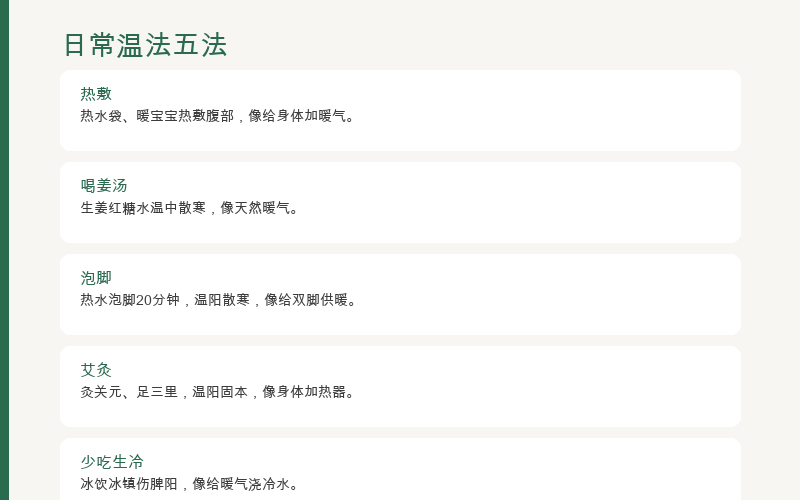
• Eat warm-natured foods to nourish stomach qi. For those with deficiency-cold of the spleen-stomach, eat more warm-natured foods: ginger, scallions, garlic, lamb, chicken, red dates, Chinese yam. Avoid cold and raw: iced drinks, raw fruits and vegetables, cold salads. It's not 'never eat cold food,' it is choose according to your constitution.
• Foot soaking to warm and unblock the meridians. Soak your feet in warm water for 15-20 minutes every night (water temperature around 40°C), to promote blood circulation and improve cold hands and feet. You can add some ginger and mugwort to enhance the warming and unblocking effect. This is the simplest and safest 'warm therapy.'
• Moxibustion to warm the meridians and scatter cold. Moxibustion at points such as Guanyuan, Qihai, and Zusanli warms the meridians and scatters cold, improving deficiency-cold symptoms. But moxibustion produces smoke, so pay attention to ventilation; those with yin-deficiency fire excess should not use moxibustion. It is best done under professional guidance.
• Sunbathing, natural warm supplementation. Sunlight is the best 'warm therapy.' Sunbathe for 15-20 minutes every day (avoid midday sun), to promote vitamin D synthesis, improve blood circulation, and boost mood. This is a free method of warming yang.
• Moderate exercise to raise metabolism. Exercise is the most effective way to raise basal metabolism. Brisk walking, jogging, and tai chi help the body 'heat up,' improve circulation, and raise metabolism. It's not 'intense exercise,' it is moderate exercise, persistently.
These methods don't require you to become a TCM doctor. You only need to understand: warm therapy is a heating system — warm up when function is low, but do not warm up when there is yin-deficiency fire excess.
Part 7One-Minute Summary
🕐 One-Minute Understanding of 'Wen'
Wen = the body's heating system + heater.
Warm therapy uses warm-hot medicinals to treat internal cold syndrome — cold limbs, abdominal pain that likes pressure, and clear thin diarrhea. Like adding coal to the body's heating system and lighting the fire.
Aconite, dried ginger, and cinnamon are the three main forces of warm therapy: aconite restores yang (emergency), dried ginger warms the middle (spleen-stomach), and cinnamon assists yang (kidney-yang).
Deficiency-cold of the spleen-stomach = low metabolic digestive function; kidney-yang deficiency = low basal metabolic rate; heart-yang deficiency = reduced cardiac function.
Cold-congealed menstrual pain = uterine smooth muscle spasm + local circulatory disorder.
Warm therapy promotes fire; those with yin-deficiency fire excess should avoid it — adding fuel to the fire.
Misconceptions: cold hands and feet are yang deficiency; warm therapy is just eating chili peppers.
Methods: warm-natured foods, foot soaking, moxibustion, sunbathing, moderate exercise.
The ancients called it 'warm therapy'; modern people call it 'raising metabolism + improving circulation.'
The names are different, but the body knows: when function is low, warmth is needed; but when yin is insufficient, warming is adding fuel to the fire.
The ancients had no thermometer, but they knew 'for cold, use heat.'
This is probably the most simple wisdom of the Chinese people: when it's cold, add heat; but add the wrong fire, and you burn yourself.
Making money is the art of life; art is life after making money.
giaogiao Decodes Traditional Chinese Wisdom · Concept 65
Using modern scientific language to help the world understand traditional Chinese wisdom.
Not mysterious, not superstitious, not belittling.
Understanding, not just believing.
Coach Liu
Written in Florence