Why Does TCM Say "Same Disease, Different Treatment"? The Pattern Is the Body's "Comprehensive Diagnostic Report"
Part 1A Question
Have you ever noticed that two people both have a cold, but one gets better with ginger soup while the other gets worse? Have you found that you and your friend both have "insomnia," but sleeping pills work for you but not for her — and you ask, "Why is the same disease treated differently?"
Even more surprising, TCM says "colds are divided into wind-cold, wind-heat, and summer-damp," and you ask: "Aren't they all viruses?" Western medicine says "insomnia is divided into difficulty falling asleep, difficulty maintaining sleep, and early waking," while TCM says "insomnia is divided into heart-spleen deficiency, liver stagnation transforming into fire, and heart-kidney disconnection" — two different statements, which is more precise?
Another question: you ask Western medicine, "What disease do I have?" Western medicine says "gastritis." You ask TCM, and TCM says "spleen-stomach deficiency-cold pattern" — and you ask: "What is pattern? Why isn't it disease?"
What is "xiang" (pattern) after all?
Part 2Traditional Chinese Explanation
The concept of "xiang" (pattern) is the core of TCM diagnosis. The Huangdi Neijing says: "What is inside must manifest outside" — pathological changes inside the body inevitably show on the outside. TCM doesn't look at disease names; it looks at "pattern" — a comprehensive judgment of symptoms, signs, tongue, and pulse.
— Yi Men Fa Lu
"Same disease, different treatment; different disease, same treatment."
— Huangdi Neijing
"What is inside must manifest outside; observe the outside to know the inside."
— Huangdi Neijing
The ancients observed: the same disease (like a cold) manifests differently in different people. Some are afraid of cold, have clear nasal discharge, and a white tongue coating; some have fever, sore throat, and yellow phlegm; some have dizziness, chest tightness, and nausea. The same disease name, but different "patterns" — completely different treatments.
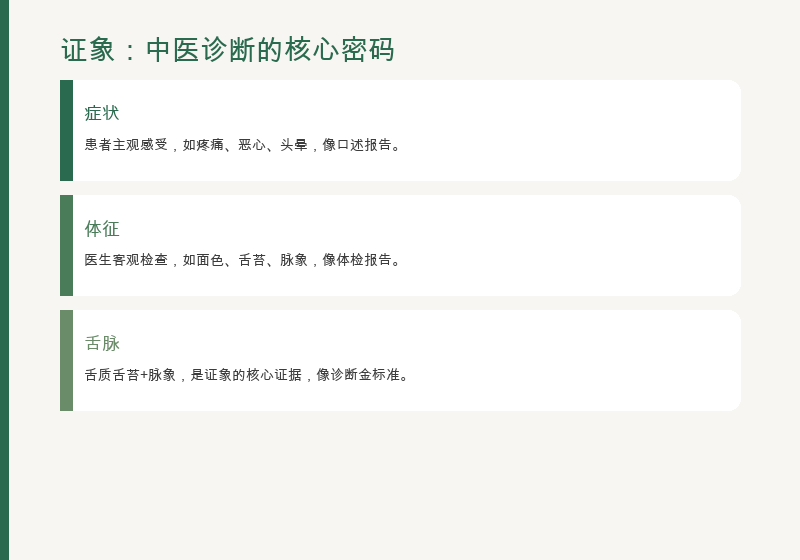
Pattern = symptoms + signs + tongue appearance + pulse appearance. Not a single indicator, but a comprehensive judgment. Like a detective solving a case, you need to collect multiple clues: fingerprints at the scene, witness testimony, surveillance footage — combined together to identify the suspect.
Eight-Principle Pattern Differentiation — yin-yang, exterior-interior, cold-heat, deficiency-excess. This is the most basic pattern differentiation framework in TCM.
• Yin-Yang: General principle. Yang pattern = excitation, heat, excess; Yin pattern = inhibition, cold, deficiency.
• Exterior-Interior: Disease location. Exterior pattern = external pathogen on the body surface (early-stage cold); Interior pattern = pathogen deep inside internal organs (pneumonia, gastritis).
• Cold-Heat: Disease nature. Cold pattern = afraid of cold, likes warmth, white tongue coating; Heat pattern = fever, likes coolness, yellow tongue coating.
• Deficiency-Excess: Disease momentum. Deficiency pattern = functional insufficiency (fatigue, shortness of breath, spontaneous sweating); Excess pattern = pathogen hyperactivity (pain, bloating, constipation).
For example: the common cold. All are "viral upper respiratory tract infections" (Western disease name), but TCM divides them into:
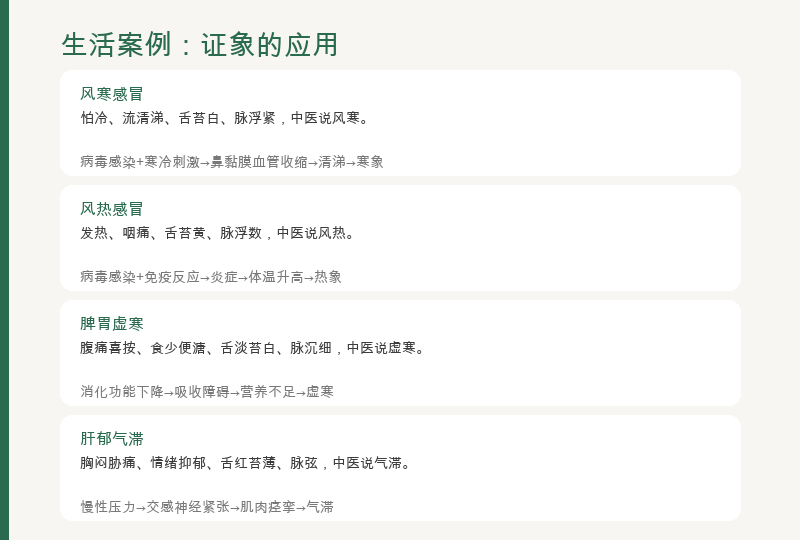
• Wind-cold pattern: afraid of cold, no sweating, clear nasal discharge, white tongue coating, floating and tight pulse — treatment principle: acrid-warm exterior-releasing (ginger soup, Ephedra Decoction).
• Wind-heat pattern: fever, sweating, sore throat, yellow phlegm, yellow tongue coating, floating and rapid pulse — treatment principle: acrid-cool exterior-releasing (Honeysuckle and Forsythia Powder, Mulberry and Chrysanthemum Drink).
• Summer-damp pattern: dizziness, chest tightness, nausea, heavy body, greasy tongue coating — treatment principle: clear summerheat and transform dampness (Newly Augmented Elsholtzia Drink).
The same disease, three "patterns," three treatments. This is same disease, different treatment — the core logic of TCM.
Conversely, different people with different diseases, but the same "pattern," can use the same prescription. For example: gastroptosis, uterine prolapse, rectal prolapse — three different diseases (Western medicine), but TCM considers them all as "middle qi sinking pattern" (spleen deficiency and qi deficiency, unable to lift), all treated with "Tonify the Middle and Augment the Qi Decoction." This is different disease, same treatment.
So, what the ancients called "xiang" (pattern) is not just "symptoms," but a "health snapshot" of comprehensive information — determining treatment principles and methods. The pattern is the "core code" of TCM diagnosis.
Part 3giaogiao Modern Translation
Okay, now let's translate "xiang" into modern language.
I'm not going to talk about patternology, genomics, or metabolomics. Too complicated. Just remember one metaphor:
Pattern = symptom cluster + biomarkers + functional state + environmental factors
Wind-cold cold = low metabolic state + peripheral vasoconstriction + early immune response (low inflammation)
Wind-heat cold = high metabolic state + inflammatory response + thermoregulatory center upregulation
Spleen-stomach deficiency-cold = digestive function decline + increased vagal tone + decreased gastrointestinal motility
Liver stagnation qi stagnation = autonomic nervous dysfunction + smooth muscle spasm + emotional regulation center abnormality
Same disease, different treatment = same disease, different pathophysiological states, requiring different interventions
Different disease, same treatment = different diseases, same pathophysiological state, can use same intervention
That's it. "Pattern" is essentially a comprehensive portrait of pathophysiological characteristics — like a medical report, not looking at just one indicator, but making a comprehensive judgment.
Specifically:
What does "wind-cold cold" correspond to? It corresponds to the low metabolic state in early viral infection. External pathogens (viruses) invade the body surface, the immune system initiates an early response, but the inflammatory response has not yet been fully activated. Peripheral vasoconstriction (afraid of cold), sweat gland inhibition (no sweating), increased nasal mucus secretion (clear nasal discharge). This aligns with TCM's description of "wind-cold" — cold causes contraction, the interstitial spaces are closed, pores are shut.
What does "wind-heat cold" correspond to? It corresponds to the inflammatory response phase after viral infection. The immune system is activated, inflammatory mediators are released (IL-1, IL-6, TNF-α), the thermoregulatory center is upregulated (fever), blood vessels dilate (sweating), mucosal inflammation (sore throat, yellow phlegm). This aligns with TCM's description of "wind-heat" — heat causes dispersion, the interstitial spaces are open, inflammatory response.
What does "spleen-stomach deficiency-cold" correspond to? It corresponds to digestive function decline + increased vagal tone. Gastric mucosal atrophy, reduced gastric acid secretion, slowed gastrointestinal motility ("cold"), overall digestive function decline ("deficiency"). Increased vagal tone leads to increased gastrointestinal secretion but insufficient motility, causing bloating and loose stools. This aligns with TCM's description of "spleen-stomach deficiency-cold" — the spleen governs transformation, and deficiency-cold leads to weak transformation.
What does "liver stagnation qi stagnation" correspond to? It corresponds to autonomic nervous dysfunction + smooth muscle spasm. Long-term emotional stress, sympathetic-parasympathetic imbalance, leads to smooth muscle spasm (hypochondriac pain, chest tightness, stomach bloating), while the emotional regulation center (amygdala, prefrontal cortex) functions abnormally. This aligns with TCM's description of "liver stagnation qi stagnation" — the liver governs free flow, and qi stagnation leads to emotional blockage and qi mechanism obstruction.
So, "xiang" (pattern) is not mysticism. It is simply a "comprehensive portrait" of pathophysiological state — the ancients used symptom clusters + tongue and pulse to depict it, and modern people use symptom clusters + biomarkers + imaging to depict it — the core logic is consistent: not looking at disease names, but looking at states.
Part 4Real-Life Cases
Four stories to make you instantly understand what "xiang" (pattern) is.
Case 1: Wind-cold cold (low metabolic state).
You got caught in the rain, and when you got home you started feeling afraid of cold, sneezing, and having clear nasal discharge. You covered yourself with two quilts and still shivered. You took your temperature, 37.8°C, not a high fever. You drank ginger soup, broke out in a sweat, and got better. You ask: "Why does ginger soup work for me?"
Truth: This is early viral infection, the immune system has just started responding. Peripheral vasoconstriction (afraid of cold), sweat glands closed (no sweating), increased nasal mucus secretion (clear nasal discharge). The body is in a "low metabolism + vasoconstriction" state. Ginger soup's gingerol promotes blood circulation, induces sweating and releases the exterior, helping the body warm up, open pores, and expel pathogens. It's not "ginger soup kills bacteria," but ginger soup helps the body adjust its state. TCM says "wind-cold pattern, acrid-warm exterior-releasing" — precisely describing the low metabolic state of external pathogen invasion. But the "wind-cold" "pattern" determines using ginger soup instead of Isatis root.
Case 2: Wind-heat cold (inflammatory response).
Your colleague also caught a cold, but his symptoms are completely different: high fever 39°C, sore throat like swallowing razor blades, yellow phlegm that can't be coughed out, thirsty and wants to drink cold water. He drank ginger soup and felt worse. TCM says "wind-heat pattern, acrid-cool exterior-releasing," using Honeysuckle and Forsythia Powder. You ask: "Why is it that the same cold, he can't use ginger soup?"
Truth: This is the inflammatory response phase after viral infection. The immune system is fully activated, large amounts of inflammatory mediators are released, the thermoregulatory center is upregulated (high fever), blood vessels dilate (flushed face), mucosal inflammation (sore throat, yellow phlegm). The body is in a "high metabolism + inflammatory response" state. Ginger soup is hot in nature, which fuels the internal heat and worsens inflammation. The honeysuckle and forsythia in Honeysuckle and Forsythia Powder have anti-inflammatory and antiviral effects, helping to reduce the inflammatory response. It's not "ginger soup is bad," but ginger soup was used for the wrong "pattern." TCM says "wind-heat pattern, avoid using acrid-warm" — precisely describing the logic of same disease, different treatment.
Case 3: Spleen-stomach deficiency-cold (digestive function decline).
You have long-term stomach cold pain, get diarrhea after eating anything cold, have loose stools, like to drink hot porridge, and your abdomen feels cold to the touch. Western medicine says "chronic gastritis," TCM says "spleen-stomach deficiency-cold pattern," using Regulate the Middle Pill. You ask: "Why not anti-inflammatory drugs?"
Truth: This is gastric mucosal function decline + increased vagal tone. Reduced gastric acid secretion, insufficient gastric motility, decreased digestive enzyme activity — overall digestive function "decline" (deficiency). High vagal tone leads to increased gastrointestinal secretion but insufficient motility, causing bloating and loose stools. Anti-inflammatory drugs (targeting inflammation) are ineffective for this situation, because the main problem is not inflammation, but functional decline. The dried ginger in Regulate the Middle Pill warms the middle and disperses cold, and ginseng supplements qi and strengthens the spleen — helping to restore digestive function. It's not "gastritis requires anti-inflammation," but you need to look at the "pattern" — deficiency-cold requires warm supplementation. But the "spleen-stomach deficiency-cold" "pattern" determines using Regulate the Middle Pill instead of antibiotics.
Case 4: Liver stagnation qi stagnation (autonomic nervous dysfunction).
You have high work pressure, often have chest tightness, hypochondriac pain, sighing, and major mood swings, and your stomach is so bloated you can't eat. Western examination: normal ECG, normal gastroscopy, normal liver function. Western medicine says "functional dyspepsia, possibly anxiety." TCM says "liver stagnation qi stagnation pattern," using Bupleurum Liver-Soothing Powder. You ask: "All tests are normal, why do I still have symptoms?"
Truth: This is autonomic nervous dysfunction. Long-term emotional stress, continuous sympathetic nervous system excitement, leads to smooth muscle spasm (chest tightness, hypochondriac pain, stomach bloating), while the emotional regulation center (overactive amygdala, decreased prefrontal cortex function) is imbalanced. Western tests are normal because the structure is fine, it's a functional problem. TCM doesn't look at structure, it looks at "pattern" — liver stagnation qi stagnation is a functional qi mechanism blockage. Bupleurum Liver-Soothing Powder helps regulate qi mechanism and relieve spasm. It's not "normal tests mean no disease," but functional problems need to look at "pattern." But the "liver stagnation qi stagnation" "pattern" precisely summarizes the stress-induced mind-body syndrome.
Four cases, one underlying logic: pattern is a "comprehensive diagnostic report" — not looking at disease names, but looking at states.
Part 5Modern Research
Does "xiang" (pattern) have scientific research?
Yes, and it is developing rapidly. Scientists don't use the word "pattern"; they use:
• Pattern and genomics. Research has found that patients with different "patterns" have different gene expression profiles. For example: "cold pattern" patients show downregulated expression of mitochondrial function-related genes (low energy metabolism); "heat pattern" patients show upregulated expression of inflammation-related genes. Patterns have a biological basis.
• Pattern and metabolomics. Through blood and urine metabolite analysis, characteristic metabolic fingerprints have been found for different patterns. For example: "spleen deficiency pattern" patients have abnormal short-chain fatty acid metabolism; "kidney yang deficiency pattern" patients have disordered lipid metabolism and energy metabolism. Patterns have a metabolic basis.
• Personalized medicine and precision medicine. Modern medicine increasingly emphasizes "same disease, different treatment" — the same cancer, different gene mutations, use different targeted drugs. The same hypertension, different mechanisms, use different antihypertensive drugs. This is completely consistent with the core logic of TCM's "pattern differentiation and treatment" — not looking at disease names, but looking at states.
These studies fully demonstrate that "xiang" (pattern) is a concept that can be precisely described using modern scientific language. The ancients summarized it as "pattern," and modern people describe it as "pathophysiological state + genomics + metabolomics" — the core logic is consistent: comprehensive judgment, individualized treatment.
Part 6Practical Methods
Now that you understand "xiang," how do you use it?
First, dispel some misconceptions:
• "TCM is unscientific because it doesn't look at test reports." TCM looks at "pattern," not that it doesn't look at tests, but it looks at tests + symptoms + signs + tongue and pulse comprehensively. Modern medicine also increasingly emphasizes "comprehensive judgment" — a single indicator cannot determine treatment. It's not "TCM doesn't look at tests," but TCM looks at comprehensive state, not a single indicator.
• "Self-diagnosing patterns and buying medicine." There are many online "pattern self-tests"; after testing, you buy medicine yourself. But pattern judgment requires professional training, and self-testing is prone to misjudgment. For example: "dry mouth" could be yin deficiency or damp-heat — opposite treatments. It's not "symptom matching," but patterns require professional judgment.
Specific methods:
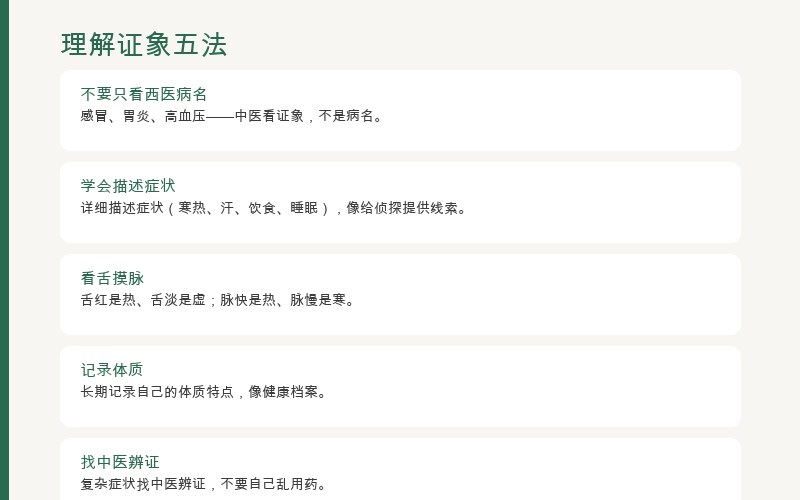
• Record symptom clusters (not just single symptoms). Don't just record "I have a cold," but record: afraid of cold or heat? sweating or no sweating? white or yellow phlegm? thirsty or not? white or yellow tongue coating? A cluster of symptoms constitutes a "pattern."
• Pay attention to tongue changes (important pattern indicator). White tongue coating = cold/damp; yellow tongue coating = heat; greasy tongue coating = damp; little tongue coating = yin deficiency. Red tongue edges = liver heat; cracks in the center of the tongue = stomach yin deficiency. The tongue is an intuitive window of "pattern"; observe it every morning upon waking.
• Self-check pulse (simple cold-heat and deficiency-excess judgment). Floating pulse = disease at the exterior; deep pulse = disease in the interior. Rapid pulse = heat pattern; slow pulse = cold pattern. Strong pulse = excess pattern; weak pulse = deficiency pattern. Although precise pulse diagnosis requires professional training, basic cold-heat and deficiency-excess can be self-tested.
• Observe emotional associations (mind-body unity). After emotional fluctuations, do symptoms worsen? Anger leads to stomach bloating = liver-stomach disharmony; anxiety leads to insomnia = heart-spleen deficiency; depression leads to fatigue = qi deficiency. The association between emotions and symptoms is an important clue of "pattern."
• Combine with seasonal judgment (unity of heaven and human). Summer is prone to "summer-damp" (dizziness, chest tightness, nausea); winter is prone to "wind-cold" (afraid of cold, no sweating, clear nasal discharge); spring is prone to "liver stagnation" (mood swings, hypochondriac pain); autumn is prone to "lung dryness" (dry cough, dry mouth). Season is a background factor of "pattern."
These methods don't require you to become a TCM doctor. You only need to understand: pattern is a "comprehensive diagnostic report" — recording symptom clusters, observing tongue appearance, and feeling emotions is collecting your own "health data."
Part 7One-Minute Summary
🕐 One Minute to Understand "Pattern"
Pattern = the body's comprehensive diagnostic report + health snapshot.
TCM doesn't look at disease names, but looks at "pattern" — a comprehensive judgment of symptoms, signs, tongue, and pulse.
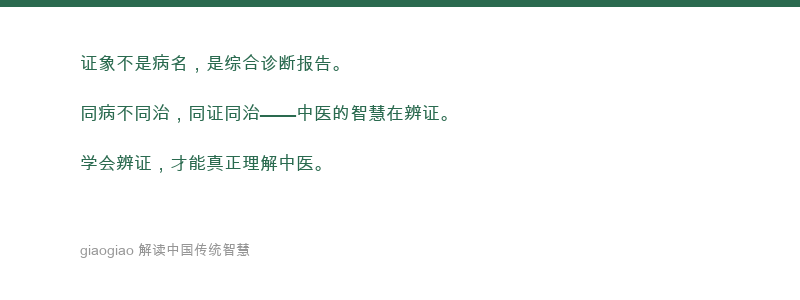
Same disease, different treatment: the same disease (cold), different patterns (wind-cold, wind-heat), different treatments.
Different disease, same treatment: different diseases (gastroptosis, rectal prolapse), same pattern (middle qi sinking), same treatment.
Pattern = comprehensive portrait of pathophysiological state.
Eight-principle pattern differentiation: yin-yang (general principle), exterior-interior (location), cold-heat (nature), deficiency-excess (momentum).
Misconceptions: TCM doesn't look at tests, self-diagnosing patterns and buying medicine.
Methods: record symptom clusters, observe tongue, self-check pulse, observe emotional associations, combine with season.
The ancients called it "pattern differentiation and treatment," modern people call it "precision medicine."
Different names, but medicine knows: not looking at disease names, but looking at states; not one prescription for all, but individualized treatment.
The ancients had no genetic testing, but knew "same disease, different treatment; different disease, same treatment."
This is probably the most simple wisdom of the Chinese people: Pattern differentiation and treatment is not looking at disease names, but looking at states — when the state is right, the disease naturally improves.
Making money is the art of living; art is the life after making money.
giaogiao Decodes Chinese Traditional Wisdom · Concept 60
Using modern scientific language to help the world understand Chinese traditional wisdom.
Not mysterious, not superstitious, not belittling.
Understand, rather than merely believe.
Coach Liu
Written in Florence