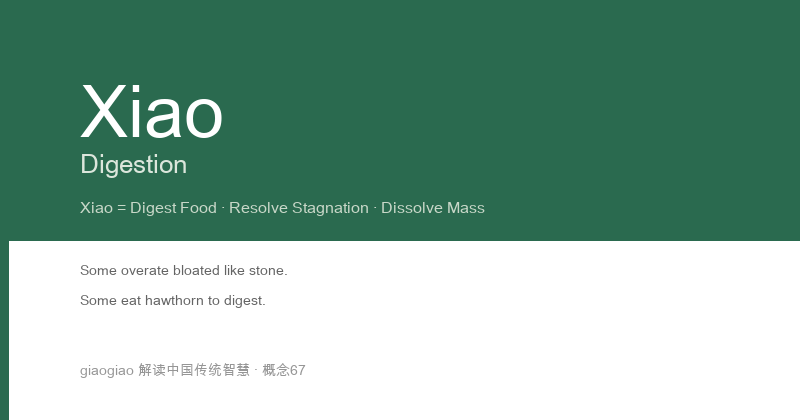
Xiao (xiāo) — The Dissolving Method: Your Body's Digestive Enzyme
Part 1A Question
Have you ever noticed that after a New Year feast, your stomach feels like it's stuffed with a balloon, and your burps still smell like yesterday's hotpot? Have you found that after eating too much greasy food, you feel drowsy all over, your tongue coating is thick and sticky, your stools are sticky — and you ask, "Why can't I digest? Why does my body feel clogged?"
What's even more bizarre is that in TCM, "xiao" isn't just about digesting food. When you eat too much, use xiao. When there's too much phlegm, use xiao. For blood stasis, use xiao. Even tumors are called "zheng ji" — use xiao. You ask: "What exactly is xiao? Is it some kind of 'universal enzyme' for the digestive system?"
There's another question: You have a bloated stomach, take Jianwei Xiaoshi tablets, and feel better. Your friend also has a bloated stomach, takes the same medicine, but it doesn't work. In fact, she feels even more depleted. TCM says: "Her spleen and stomach are weak and deficient. The dissolving method consumes qi — the more she dissolves, the more deficient she becomes." You ask: "Why is it that for the same bloated stomach, some people can use xiao and some can't?"
What exactly is xiao? How should the body's "digestive enzyme" be used?
Part 2Traditional Chinese Explanation
The concept of "xiao" is one of the "Eight Methods" of TCM — the Dissolving Method. Through digesting food and resolving stagnation, dispersing lumps and masses, it treats food stagnation, phlegm accumulation, blood stasis, and lumps. The Yellow Emperor's Inner Canon says: "What is hard should be cut down; what is knotted should be dispersed."
— Yi Xue Xin Wu
"Digest food and guide stagnation, transform accumulations and disperse masses."
— Pi Wei Lun
"Hawthorn dissolves meat accumulation; Shenqu dissolves grain accumulation; Malt dissolves flour accumulation."
— Ben Cao Gang Mu
The ancients observed that the body develops "accumulations and stagnation" — eating too much and not digesting (food stagnation), phlegm-dampness coalescing (phlegm accumulation), blood pooling (blood stasis), abnormal tissue growth (zheng ji). Like a clogged sewer flooding the place. The dissolving method is like unclogging the sewer and adding enzymes to break it down.
Dissolving Method = Digesting food and guiding stagnation + Dissolving phlegm and dispersing masses + Activating blood and resolving stasis + Dissolving zheng and transforming accumulations. It's not just "digesting" — it's a precise decomposition targeting different kinds of stagnation.
• Digesting food and guiding stagnation: For food stagnation. Overeating, too much greasy food, stomach bloating, foul belching, smelly stools — like a kitchen drain clogged with grease, needs enzyme breakdown. Hawthorn, Shenqu, and Malt are the main players.
• Dissolving phlegm and dispersing masses: For phlegm accumulation. Phlegm-dampness coalescing into lumps, scrofula, phlegm nodules, thyroid nodules — like limescale in water pipes, needs dissolving. Pinellia, Tangerine peel, and Poria are the main players.
• Activating blood and resolving stasis: For blood stasis. Trauma injuries, menstrual pain, lumps, blood vessel blockage — like pipes clogged with debris, needs clearing. Peach kernel, Safflower, and Danshen are the main players.
• Dissolving zheng and transforming accumulations: For zheng ji. Tumors, cysts, hyperplasia — like a foreign object growing inside a wall, needs gradual decomposition. Sparganium, Zedoary, and Turtle shell are the main players.
So, what the ancients called "xiao" isn't just "digestive tablets" — it's the body's "decomposition system," a precise enzyme targeting different kinds of stagnation.
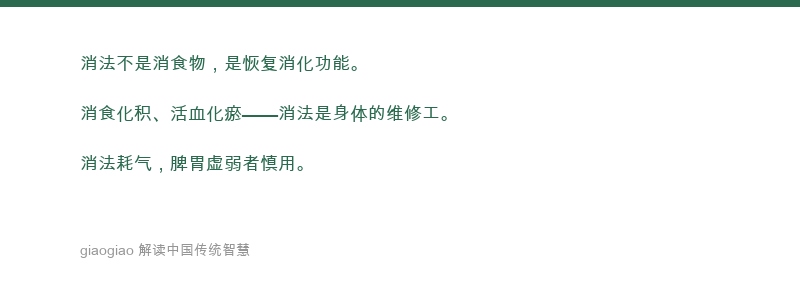
But the dissolving method has one big principle: it consumes qi. Breaking down accumulations requires energy, just like using enzymes to break down grease — the enzymes themselves consume resources. People with weak spleen and stomach become more depleted the more they dissolve.

Part 3giaogiao's Modern Translation
Okay, now let's translate "xiao" into modern language.
I'm not going to talk about digestive enzymes, thrombolytic mechanisms, or anti-tumor immunity. Too complex. You just need to remember one analogy:
Digesting food and guiding stagnation = Promoting digestive enzyme secretion + Enhancing gastrointestinal motility + Regulating gut microbiota
Dissolving phlegm and dispersing masses = Regulating fluid metabolism + Promoting tissue fluid return + Anti-inflammatory swelling reduction
Activating blood and resolving stasis = Improving microcirculation + Anti-coagulation + Promoting tissue repair
Dissolving zheng and transforming accumulations = Inhibiting abnormal proliferation + Regulating immunity + Promoting cell apoptosis
Food stagnation = Digestive overload (insufficient enzymes + insufficient motility + microbiota imbalance)
Phlegm accumulation = Tissue fluid metabolism disorder (lymphatic return obstruction + chronic inflammation)
Blood stasis = Microcirculation disorder (slow blood flow + abnormal coagulation function)
Zheng ji = Abnormal cell proliferation (immune surveillance failure + cell cycle dysregulation)
That's it. "Xiao" is essentially the body's "decomposition + clearing system" — like adding enzymes to a clogged pipe, clearing it, and maintaining it.
Specifically:
What does "food stagnation" correspond to? It corresponds to digestive overload. Eating too much food in a short time exceeds the digestive capacity of the stomach and intestines; digestive enzyme secretion becomes relatively insufficient, gastrointestinal motility slows down, and gut microbiota becomes imbalanced. Food stagnates and ferments, producing gas and toxins (stomach bloating, foul belching, bad breath). The organic acids and lipase in Hawthorn promote gastric acid secretion and fat breakdown; the yeast and enzymes in Shenqu promote starch and protein breakdown; the amylase in Malt helps break down carbohydrates. It's not some mystical "digesting food" — it's supplementing digestive enzymes + promoting gastrointestinal motility.
What does "phlegm accumulation" correspond to? It corresponds to tissue fluid metabolism disorder. Chronic inflammation or metabolic disorder leads to obstructed tissue fluid return, lymphatic fluid accumulation, and the formation of nodules or lumps. The alkaloids in Pinellia have anti-inflammatory, cough-suppressing, and fluid-metabolism-regulating effects; the volatile oils in Tangerine peel promote respiratory secretion and expulsion. It's not some mystical "dissolving phlegm" — it's regulating fluid metabolism + promoting inflammation resolution.
What does "blood stasis" correspond to? It corresponds to microcirculation disorder. Increased blood viscosity, vascular endothelial damage, and slow blood flow lead to local tissue ischemia and hypoxia. The amygdalin in Peach kernel and the safflower yellow pigments in Safflower have anti-coagulation, microcirculation-improving, and tissue-repair-promoting effects. It's not some mystical "activating blood and resolving stasis" — it's improving blood rheology + promoting angiogenesis.
So, "xiao" is not mysticism. It's simply a "maintenance system" for decomposing stagnation and clearing pipes — the ancients used "accumulations and stagnation" to describe it, while modern people use "digestive enzymes, microcirculation, and fluid metabolism" to describe it — the core logic is the same: when it's clogged, clear it; when it's accumulated, dissolve it.
Part 4Real-Life Examples
Four stories to help you get what "xiao" is in seconds.
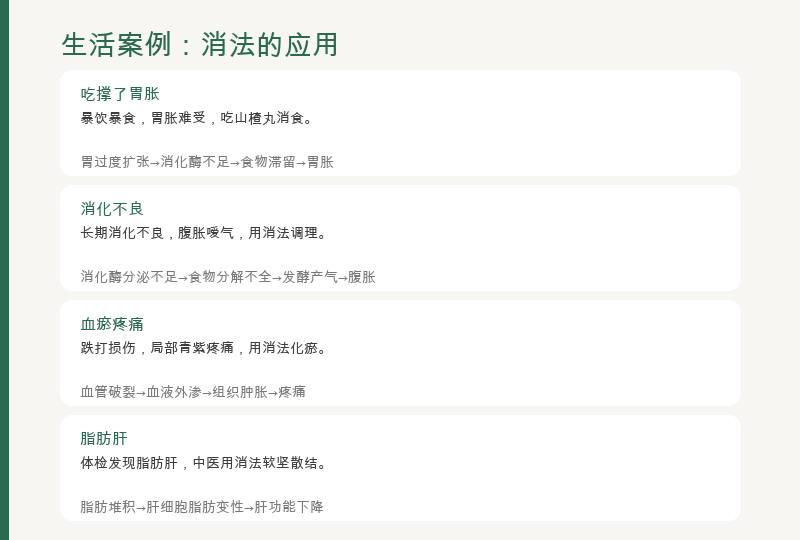
Case 1: Food stagnation and stomach bloating (digestive overload).
During New Year, you ate three hotpot meals, your stomach feels like it's stuffed with a balloon, your burps smell spicy, your tongue coating is thick and sticky, and your stools stink. You took Jianwei Xiaoshi tablets, and felt better. You ask: "Why do digestive tablets work?"
Here's the truth: This is digestive overload. In a short time, you consumed a large amount of high-fat, high-protein food; gastric acid and digestive enzyme secretion couldn't keep up, gastrointestinal motility slowed down, and food stagnated and fermented. The Hawthorn, Shenqu, and Malt in Jianwei Xiaoshi tablets supplement digestive enzymes, promote gastric acid secretion, and accelerate gastrointestinal motility. It's not a "miracle cure" — it's helping the digestive system work overtime. TCM says "food stagnation, dissolve and guide stagnation" — precisely describing digestive overload. But the judgment of "food stagnation" determines using the dissolving method, not the tonifying method.
Case 2: Phlegm nodules (tissue fluid metabolism disorder).
You have a swollen lymph node on your neck, the size of a broad bean, soft to the touch, painless. Western medicine says: "Chronic lymphadenitis, just observe." TCM says: "Phlegm nodule," and uses Pinellia, Tangerine peel, and Poria to dissolve phlegm and disperse masses. After three months, the nodule has shrunk. You ask: "Why can 'dissolving phlegm' shrink nodules?"
Here's the truth: This is tissue fluid accumulation caused by chronic inflammation. Lymphatic return is obstructed, inflammatory cells gather, and a nodule forms. Pinellia and Tangerine peel have anti-inflammatory and fluid-metabolism-regulating effects, helping inflammation subside and tissue fluid return. It's not mystical "dissolving phlegm and dispersing masses" — it's regulating chronic inflammation + promoting lymphatic return. TCM says "phlegm nodule, dissolve phlegm and disperse masses" — precisely describing the pathology of chronic inflammation. But the judgment of "phlegm nodule" determines using phlegm dissolution, not blood activation.
Case 3: Blood stasis menstrual pain (microcirculation disorder).
You have menstrual pain; the menstrual blood is dark purple with clots; your lower abdomen is tender, like a knife is twisting inside. Western medicine says: "Primary dysmenorrhea." TCM says: "Blood stasis syndrome," and uses Tao Hong Si Wu Tang. After three months, the menstrual pain is significantly reduced. You ask: "Why can 'activating blood' relieve pain?"
Here's the truth: This is uterine microcirculation disorder. Menstrual blood doesn't flow out smoothly, uterine smooth muscle spasms, and local ischemia and hypoxia occur. Peach kernel and Safflower have anti-coagulation and microcirculation-improving effects, helping menstrual blood flow out smoothly and relieving smooth muscle spasms. It's not mystical "activating blood and resolving stasis" — it's improving uterine blood flow + reducing smooth muscle spasms. TCM says "blood stasis causes menstrual pain, activate blood and resolve stasis" — precisely describing microcirculation disorder. But the judgment of "blood stasis" determines using blood activation, not heat clearing.
Case 4: Misuse of the dissolving method (weak spleen and stomach become more depleted with dissolution).
Your friend has chronic stomach bloating, but can't gain weight, feels fatigued, and has a sallow complexion. She takes Hawthorn pills every day; the stomach bloating temporarily improves, but she becomes more depleted. TCM says: "Weak spleen and stomach, the dissolving method consumes qi — the more she dissolves, the more deficient she becomes." You ask: "Why doesn't the dissolving method work for her?"
Here's the truth: Her stomach bloating isn't "food stagnation" (digestive overload) but "spleen deficiency" (low digestive function). Gastrointestinal motility is already slow, and digestive enzyme secretion is already low. Using the dissolving method further consumes the already limited energy, leading to "the more she dissolves, the more deficient she becomes." She should first tonify the spleen (enhance digestive function) rather than dissolve food. It's not that "digestive tablets are bad" — it's using the wrong enzyme: when the pipe is old and clogged, you shouldn't blast it with enzymes; you should repair the pipe. TCM says "spleen deficiency with qi stagnation, tonify the spleen first" — precisely distinguishing between excess and deficiency patterns.
Four cases, one underlying logic: xiao is the "digestive enzyme" — you need to see clearly what's clogged before choosing which enzyme. The wrong enzyme might corrode the pipe itself.
Part 5Modern Research
Is there scientific research on "xiao"?
Yes, and it's quite extensive. Scientists don't use the term "dissolving method"; they use:
• Hawthorn's digestive enzyme effects. Modern research has found that Hawthorn is rich in organic acids (citric acid, malic acid) and lipase, which can significantly promote gastric acid secretion and fat breakdown. Hawthorn extract can increase pepsin activity and accelerate gastrointestinal motility. It's not mystical "dissolving meat accumulation" — it's real digestive enzyme-promoting effects.
• Activating blood and resolving stasis with microcirculation. The tanshinones in Danshen and the ligustrazine in Chuanxiong have been confirmed by modern research to dilate blood vessels, improve microcirculation, and inhibit platelet aggregation. They're even called "Chinese medicine aspirin." Peach kernel and Safflower have anti-coagulation and fibrinolysis-promoting effects. It's not mystical "activating blood and resolving stasis" — it's the science of improving blood rheology.
• Dissolving phlegm and dispersing masses with anti-inflammation. The alkaloids in Pinellia and the volatile oils in Tangerine peel have anti-inflammatory, phlegm-removing, and immune-regulating effects. Modern research has found that Pinellia extract can inhibit inflammatory mediator release and promote respiratory cilia movement. It's not mystical "dissolving phlegm" — it's anti-inflammatory + phlegm-expelling pharmacological effects.
These studies fully demonstrate that "xiao" is a concept that can be precisely described in modern scientific language. The ancients used "accumulations and stagnation" to describe it; modern people use "digestive overload, microcirculation, and fluid metabolism" to describe it — the core logic is the same: when accumulated, dissolve it, but see clearly what kind of accumulation it is and where it is.
Part 6Practical Methods
Now that you understand "xiao," how do you use it?
First, let's dispel a few misconceptions:
• "Take digestive tablets whenever you have a bloated stomach — they work for everyone." Digestive tablets are suitable for food stagnation (overeating), not for spleen deficiency (low digestive power). People with weak spleen and stomach who take digestive tablets become more depleted. It's not that "digestive tablets are universal" — it's that you need to see whether it's "clogged" or "weak".
• "The dissolving method can be used long-term." The dissolving method consumes qi; long-term use damages the spleen and stomach. Like using powerful enzymatic cleaners for a long time — the pipe walls themselves become thinner. It's not that "the dissolving method is harmless" — it's that once the stagnation is dissolved, stop.
Specific methods:
• Distinguish between food stagnation and spleen deficiency (choose the right enzyme). Food stagnation: overeating, stomach bloating, foul belching, thick and sticky tongue coating, smelly stools. Spleen deficiency: bloating even with little food, fatigue, sallow complexion, pale tongue with white coating. Food stagnation = dissolve; spleen deficiency = tonify — the treatments are opposite.
• Skip a meal when you have food stagnation (give the digestive system a break). When you overeat and feel bloated, first stop eating for 6-8 hours to let the stomach and intestines rest. Don't rush to take medicine first — let the body regulate itself.
• Use food-as-medicine (gentle dissolving and guiding). Hawthorn (dissolves meat accumulation), Malt (dissolves flour accumulation), Radish (moves qi and dissolves phlegm), Tangerine peel (moves qi and strengthens the spleen), Chicken gizzard stone (dissolves food and stones). Food and medicine share the same origin — dissolve without damaging.
• Take a hundred steps after meals (promote gastrointestinal motility). For mild food stagnation, take a 20-30 minute walk after meals to promote gastrointestinal motility. It's not that only "dissolving medicine" works — exercise itself is the best dissolving and guiding method.
• For spleen deficiency, strengthen the spleen (repair the pipe). If you often have stomach bloating but don't eat much, it might be spleen deficiency. Don't dissolve — tonify: Chinese yam, Lotus seed, Euryale seed, Atractylodes. Enhance digestive function, not decompose stagnation.
These methods don't require you to become a TCM doctor. You just need to understand: xiao is the "digestive enzyme" — for food stagnation, add enzymes; for spleen deficiency, repair the pipe. The right enzyme brings smooth digestion; the wrong enzyme makes you more depleted.

Part 7One-Minute Summary
🕐 One Minute to Understand 'Xiao'
Xiao = Your body's digestive enzyme + Digestive system maintenance.
The dissolving method treats food stagnation, phlegm accumulation, blood stasis, and lumps through digesting food and resolving stagnation — like adding enzymes to a clogged pipe to break it down.
Food stagnation = Digestive overload; Phlegm accumulation = Tissue fluid metabolism disorder; Blood stasis = Microcirculation disorder; Zheng ji = Abnormal proliferation.
Xiao = A "maintenance system" for decomposing stagnation and clearing pipes.
Three main players: Hawthorn (dissolves meat accumulation), Shenqu (dissolves grain accumulation), Malt (dissolves flour accumulation).
Misconceptions: Taking digestive tablets whenever you have a bloated stomach works for everyone; the dissolving method can be used long-term.
Methods: Distinguish between food stagnation and spleen deficiency, skip a meal when you have food stagnation, use food-as-medicine, take a hundred steps after meals, and for spleen deficiency strengthen the spleen.
The ancients called it "cut down what is hard," while modern people call it "promoting digestion, improving circulation, and reducing inflammation and swelling."
Different names, but medicine knows: when accumulated, dissolve it, but see clearly what kind of accumulation it is — the wrong enzyme might corrode the pipe itself.
The ancients had no concept of digestive enzymes, but knew that "Hawthorn dissolves meat accumulation, Malt dissolves flour accumulation."
This is probably the most down-to-earth wisdom of the Chinese people: when accumulated, dissolve it, but the dissolving method consumes qi — the right enzyme brings smooth digestion, the wrong enzyme makes you more depleted.
Making money is the art of living; art is life after making money
giaogiao Decodes Traditional Chinese Wisdom · Concept 67
Using modern scientific language to help the world understand traditional Chinese wisdom.
No mysticism, no superstition, no belittlement.
Understand, rather than merely believe.
Coach Liu
Written in Florence