Bu (bǔ) — The Tonifying Method: Your Body's Repair Fund
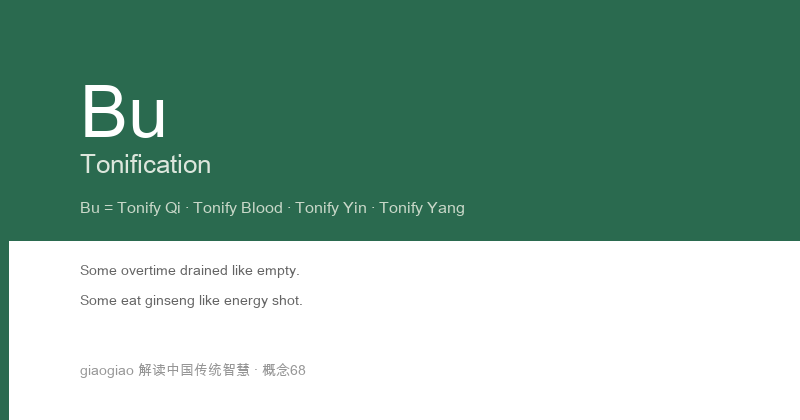
Part 1A Question
Have you ever noticed that after a month of overtime work, you feel completely drained, barely able to speak, and get winded climbing two flights of stairs? Have you found that some people feel energized like they've been injected with adrenaline after taking ginseng, while others get nosebleeds, insomnia, and acne — and you ask, "Why does the same tonifying method produce completely different results?"
What's even more bizarre is that TCM says "xu bu shou bu" — the more deficient a person is, the less they can take heavy tonics. You ask: "If they're deficient, shouldn't they be tonified even more? Why does tonifying make them flare up?"
There's another question: You feel fatigued, short of breath, and have spontaneous sweating; TCM says "qi deficiency" and uses Astragalus and Ginseng. You have dry mouth, insomnia, and hot palms and soles; TCM says "yin deficiency" and uses Ophiopogon and Rehmannia. You feel cold, have weak and sore knees, and frequent nighttime urination; TCM says "yang deficiency" and uses Aconite and Cinnamon. You ask: "Aren't they all deficiency? Why are there so many different types?"
What exactly is bu? How should the body's "repair fund" be recharged?
Part 2Traditional Chinese Explanation
The concept of "bu" is one of the "Eight Methods" of TCM — the Tonifying Method. Through nourishing qi, blood, yin, and yang, it treats deficiency patterns. The Yellow Emperor's Inner Canon says: "What is deficient should be tonified" — when deficient, tonify; this is the most basic treatment principle.
— Huang Di Nei Jing · Su Wen
"For qi deficiency, tonify qi; for blood deficiency, tonify blood; for yin deficiency, tonify yin; for yang deficiency, tonify yang."
— Jing Yue Quan Shu
"Ginseng greatly supplements primordial qi; Astragalus tonifies qi and secures the exterior; Angelica tonifies blood and activates blood; Cooked Rehmannia nourishes yin and tonifies the kidneys."
— Ben Cao Gang Mu
The ancients observed that the body develops "deficiency" — insufficient function, depleted substances, low energy. Like a house that has fallen into disrepair and needs a repair fund. But deficiency comes in different forms: qi deficiency means "not enough workers," blood deficiency means "not enough materials," yin deficiency means "not enough lubrication," and yang deficiency means "not enough power." Tonify the wrong one, and things get even more messed up.
Tonifying Method = Tonifying qi + Tonifying blood + Tonifying yin + Tonifying yang. It's not just "boosting nutrition" — it's a precise recharge targeting different types of deficiency.
• Tonifying qi: For qi deficiency. Fatigue, shortness of breath, spontaneous sweating, weak voice — like a factory without enough workers, low production efficiency. Ginseng, Astragalus, and Atractylodes are the main players.
• Tonifying blood: For blood deficiency. Pale complexion, dizziness, palpitations, scanty menstruation — like not enough building materials, the house can't be properly repaired. Angelica, Cooked Rehmannia, and Donkey-hide gelatin are the main players.
• Tonifying yin: For yin deficiency. Dry mouth, insomnia, hot palms and soles, night sweats — like a machine lacking lubrication, running dry and rough. Rehmannia, Ophiopogon, and Goji berries are the main players.
• Tonifying yang: For yang deficiency. Cold intolerance, weak and sore knees, frequent nighttime urination, reduced sexual function — like a boiler with insufficient fire, the heating doesn't work. Aconite, Cinnamon, and Deer antler velvet are the main players.
So, what the ancients called "bu" isn't just "eating well" — it's the body's "repair fund," a precise recharge targeting different types of deficiency.
But the tonifying method has one big principle: xu bu shou bu. People with severely deficient spleen and stomach have low digestive and absorptive capacity; heavy tonics can't be absorbed and instead become a burden — like pouring oil into a clogged pipe, the pipe bursts.

Part 3giaogiao's Modern Translation
Okay, now let's translate "bu" into modern language.
I'm not going to talk about mitochondrial function, hematopoiesis mechanisms, or the neuroendocrine system. Too complex. You just need to remember one analogy:
Tonifying qi = Enhancing cellular energy metabolism + Boosting mitochondrial function + Improving tissue oxygenation
Tonifying blood = Promoting hematopoietic function + Increasing hemoglobin + Improving tissue nutrient supply
Tonifying yin = Nourishing tissue repair + Regulating fluid balance + Reducing neural excitability
Tonifying yang = Enhancing endocrine function + Increasing basal metabolic rate + Improving thermoregulation
Qi deficiency = Low energy metabolism (insufficient ATP synthesis + reduced mitochondrial function)
Blood deficiency = Decreased oxygen-carrying capacity (insufficient hemoglobin + poor microcirculation perfusion)
Yin deficiency = Insufficient tissue repair (decreased protein synthesis + excessive fluid loss)
Yang deficiency = Low endocrine function (hypothyroidism + insufficient adrenal function)
That's it. "Bu" is essentially a comprehensive system for "recharging" and "repairing" the body — like supplying workers and materials to a house that has fallen into disrepair.
Specifically:
What does "qi deficiency" correspond to? It corresponds to low energy metabolism. Cellular mitochondrial function declines, ATP synthesis becomes insufficient, and tissue oxygen supply and utilization capacity drops. Manifested as fatigue, shortness of breath, spontaneous sweating, weak voice. The ginsenosides in Ginseng can enhance mitochondrial function, promote ATP synthesis, and improve tissue tolerance to hypoxia. The astragalus polysaccharides in Astragalus can enhance immunity and improve myocardial energy metabolism. It's not mystical "greatly supplementing primordial qi" — it's boosting cellular energy metabolism.
What does "blood deficiency" correspond to? It corresponds to insufficient hematopoietic function or blood loss. Iron, folic acid, or vitamin B12 deficiency, or chronic blood loss, leads to reduced hemoglobin synthesis and decreased red blood cell count. Manifested as pale complexion, dizziness, palpitations, scanty menstruation. The ferulic acid in Angelica and the polysaccharides in Cooked Rehmannia can promote bone marrow hematopoiesis and increase hemoglobin. It's not mystical "tonifying blood" — it's promoting hematopoiesis + improving blood oxygen-carrying capacity.
What does "yin deficiency" correspond to? It corresponds to insufficient tissue repair + fluid imbalance. Chronic wasting diseases, staying up late, and stress lead to decreased protein synthesis, tissue fluid loss, and increased neural excitability. Manifested as dry mouth, insomnia, hot palms and soles, night sweats. The iridoid glycosides in Rehmannia and the polysaccharides in Ophiopogon have tissue repair-promoting, immune-regulating, and neural excitability-reducing effects. It's not mystical "nourishing yin and reducing fire" — it's repairing tissue + regulating the neuroendocrine system.
What does "yang deficiency" correspond to? It corresponds to low endocrine function. Hypothyroidism and insufficient adrenal cortical function lead to decreased basal metabolic rate, thermoregulation disorders, and reduced sexual function. Manifested as cold intolerance, weak and sore knees, frequent nighttime urination. The aconitine in Aconite (toxicity reduced after processing) and the cinnamaldehyde in Cinnamon have sympathetic nerve-stimulating, basal metabolic rate-increasing, and endocrine function-enhancing effects. It's not mystical "tonifying yang" — it's enhancing endocrine function + increasing metabolic rate.
So, "bu" is not mysticism. It's simply a "recharge system" for cellular repair, energy metabolism, and endocrine regulation — the ancients described it with qi, blood, yin, and yang; modern people describe it with energy metabolism, hematopoietic function, and endocrine regulation — the core logic is the same: when deficient, tonify, but see clearly what kind of deficiency it is.
Part 4Real-Life Examples
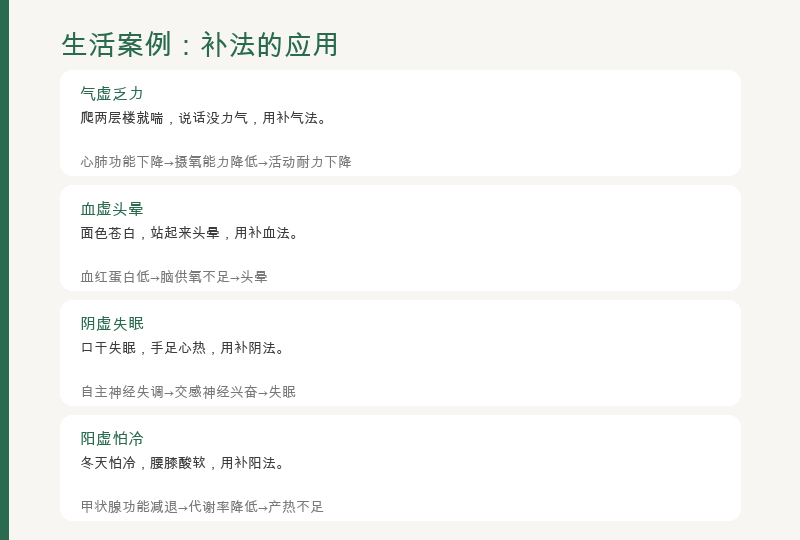
Four stories to help you get what "bu" is in seconds.
Case 1: Qi deficiency and fatigue (low energy metabolism).
You worked overtime for a month, feel completely drained, barely able to speak, get winded climbing two flights of stairs, and have spontaneous sweating. You drank Astragalus water, and after a week felt more energetic. You ask: "Why can Astragalus 'tonify qi'?"
Here's the truth: This is chronic low energy metabolism. Long-term overwork leads to reduced mitochondrial function, insufficient ATP synthesis, and decreased tissue hypoxia tolerance. The astragalus polysaccharides and saponins in Astragalus can enhance myocardial contractility, improve tissue oxygenation, and increase energy metabolism efficiency. It's not mystical "tonifying qi" — it's boosting the cell's "power generation capacity". TCM says "qi deficiency, tonify qi and secure the exterior" — precisely describing low energy metabolism. But the diagnosis of "qi deficiency" determines using Astragalus, not Cooked Rehmannia.
Case 2: Blood deficiency and dizziness (insufficient hematopoietic function).
You have heavy menstrual bleeding, chronic anemia, pale complexion, dizziness, palpitations, and white nails. Western medicine says: "Iron-deficiency anemia." TCM says "blood deficiency," and uses Angelica, Cooked Rehmannia, and Donkey-hide gelatin. After three months, hemoglobin has risen. You ask: "Why can 'tonifying blood' increase hemoglobin?"
Here's the truth: This is insufficient hematopoietic function. Too much iron loss leads to reduced hemoglobin synthesis and decreased red blood cell oxygen-carrying capacity, resulting in insufficient oxygen supply to the brain (dizziness). The ferulic acid in Angelica promotes bone marrow hematopoiesis; the polysaccharides in Cooked Rehmannia increase red blood cell production; Donkey-hide gelatin is rich in protein and iron. It's not mystical "tonifying blood" — it's providing hematopoietic raw materials + promoting hematopoietic function. TCM says "blood deficiency, tonify blood and nourish blood" — precisely describing insufficient hematopoiesis. But the diagnosis of "blood deficiency" determines using Angelica, not Aconite.
Case 3: Yin deficiency and insomnia (insufficient tissue repair + neural excitation).
You stay up late chronically, have dry mouth, insomnia, hot palms and soles, night sweats, and a red tongue with little coating. Western medicine says: "Neurasthenia, take some sleeping pills." TCM says "yin deficiency with internal heat," and uses Rehmannia, Ophiopogon, and Zizyphus seed. After a month, sleep has improved. You ask: "Why can 'nourishing yin' treat insomnia?"
Here's the truth: This is insufficient tissue repair + increased neural excitability. Chronic sleep deprivation leads to decreased protein synthesis, neurotransmitter imbalance (insufficient GABA, excessive glutamate), and autonomic nervous system disorder. Rehmannia and Ophiopogon have tissue repair-promoting and neurotransmitter-regulating effects; Zizyphus seed has sedative and hypnotic effects. It's not mystical "nourishing yin and reducing fire" — it's repairing tissue + regulating nerves. TCM says "yin deficiency with internal heat, nourish yin and calm the spirit" — precisely describing chronic depletion-induced neural disorder. But the diagnosis of "yin deficiency" determines using Rehmannia, not Astragalus.
Case 4: Xu bu shou bu (poor spleen and stomach, tonifying causes flaring up).
Your friend has chronic fatigue and a sallow complexion; she takes ginseng thinking to "tonify up," but ends up with nosebleeds, insomnia, and acne. TCM says: "Weak spleen and stomach, xu bu shou bu." You ask: "If she's deficient, shouldn't she be tonified even more? Why does tonifying make her flare up?"
Here's the truth: This is low spleen and stomach digestive and absorptive function. Her gastrointestinal motility is already low, and digestive enzyme secretion is already scarce. Taking heavy tonics like ginseng, the nutrients can't be absorbed and instead become a gastrointestinal burden. At the same time, ginseng excites the central nervous system, leading to insomnia and elevated blood pressure. It's not that "ginseng is bad" — it's the pipe is clogged, and pouring oil in forcefully makes the pipe burst. She should first strengthen the spleen (repair digestive function), then gradually tonify. TCM says "xu bu shou bu, first strengthen the spleen" — precisely reminding us of the sequence of tonification.
Four cases, one underlying logic: bu is the "repair fund" — you need to see clearly what kind of deficiency it is before choosing what material to use. The wrong material might collapse the house itself.
Part 5Modern Research
Is there scientific research on "bu"?
Yes, and it's quite extensive. Scientists don't use the term "tonifying"; they use:
• Adaptogenic effects of Ginseng. Modern pharmacological research has found that ginsenosides can regulate the hypothalamic-pituitary-adrenal axis (HPA axis), improving the body's tolerance to physical, chemical, and biological stress. They enhance mitochondrial function, promote ATP synthesis, and improve immune response. Modern research calls them "adaptogens." It's not mystical "greatly supplementing primordial qi" — it's the science of neuroendocrine immune regulation.
• Hematopoietic effects of Angelica. Angelica polysaccharides have been confirmed to promote the proliferation and differentiation of bone marrow hematopoietic stem cells, increasing the production of red blood cells, white blood cells, and platelets. Ferulic acid can improve microcirculation and increase tissue perfusion. It's not mystical "tonifying blood" — it's a real hematopoietic promoter.
• Immune enhancement of Astragalus. Astragalus polysaccharides are among the most thoroughly researched traditional Chinese medicine polysaccharides; they can significantly enhance macrophage activity, promote T-cell and B-cell proliferation, and increase antibody levels. Clinically used for chronic fatigue and low immune function. It's not mystical "tonifying qi" — it's the science of immune regulation.
These studies fully demonstrate that "bu" is a concept that can be precisely described in modern scientific language. The ancients used "qi, blood, yin, and yang" to describe it; modern people use "energy metabolism, hematopoietic function, and endocrine regulation" to describe it — the core logic is the same: when deficient, tonify, but see clearly what kind of deficiency it is and how to tonify.
Part 6Practical Methods
Now that you understand "bu," how do you use it?
First, let's dispel a few misconceptions:
• "If you're deficient, you need heavy tonics, the more the better." The tonifying method isn't better the more you use; xu bu shou bu — people with poor spleen and stomach flare up when heavily tonified. Like pouring water into a leaky bucket — the more you pour, the more it leaks. It's not that "more tonics are better" — it's that you need to see if the spleen and stomach can absorb it.
• "Tonics can be taken long-term." Tonics also have biases; long-term use of a single tonic may lead to yin-yang imbalance. For example, long-term use of ginseng may lead to elevated blood pressure and insomnia. It's not that "tonics are harmless" — it's that the right tonic is beneficial, the wrong one is harmful.
Specific methods:
• Distinguish between qi deficiency, blood deficiency, yin deficiency, and yang deficiency (choose the right recharge method). Qi deficiency: fatigue, shortness of breath, spontaneous sweating, weak voice. Blood deficiency: pale complexion, dizziness, palpitations, scanty menstruation. Yin deficiency: dry mouth, insomnia, hot palms and soles, night sweats. Yang deficiency: cold intolerance, weak and sore knees, frequent nighttime urination, reduced sexual function. Four types of deficiency, four tonifying methods.
• First strengthen the spleen, then tonify (repair the pipe before recharging). If you have weak spleen and stomach (bloating after eating a little more, loose stools), don't tonify first — strengthen the spleen first: Chinese yam, Lotus seed, Euryale seed, Atractylodes. Repair the digestive and absorptive function, then tonify.
• Use food-as-medicine (gentle tonification). Qi deficiency: Chinese yam, Jujube, Chicken. Blood deficiency: Red dates, Longan, Pork liver. Yin deficiency: White fungus, Lily bulb, Black sesame. Yang deficiency: Lamb, Chives, Walnuts. Food and medicine share the same origin — tonify without harshness.
• Tonify gradually (don't make a large one-time recharge). Deficiency is the result of long-term depletion; tonification should also be gradual. Don't expect one dose of ginseng to "restore primordial qi completely." Chronic deficiency requires long-term regulation. It's not "instant results" — it's a slow and steady flow.
• Cooperate with lifestyle (don't spend recklessly after recharging). Tonifying while still staying up late, overworking, and being anxious is like pouring water into a leaky bucket. While tonifying, reduce consumption — adequate sleep, moderate exercise, and emotional management. It's not that "after tonifying, you can do whatever you want" — it's that even after recharging, you need to save.
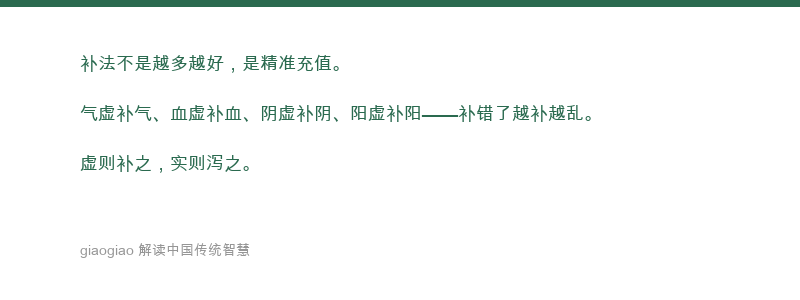
These methods don't require you to become a TCM doctor. You just need to understand: bu is the "repair fund" — for qi deficiency, add workers; for blood deficiency, add materials; for yin deficiency, add lubrication; for yang deficiency, add fuel. But the prerequisite is that the pipe is clear (good spleen and stomach); otherwise, the recharge is wasted.

Part 7One-Minute Summary
🕐 One Minute to Understand 'Bu'
Bu = Your body's repair fund + Gas station.
The tonifying method treats deficiency patterns by nourishing qi, blood, yin, and yang — qi deficiency, blood deficiency, yin deficiency, and yang deficiency.
Qi deficiency = Low energy metabolism; Blood deficiency = Insufficient hematopoietic function; Yin deficiency = Insufficient tissue repair; Yang deficiency = Low endocrine function.
Bu = A "recharge system" for cellular repair, energy metabolism, and endocrine regulation.
Four main players: Ginseng (greatly supplements primordial qi), Astragalus (tonifies qi and secures the exterior), Angelica (tonifies blood and activates blood), Cooked Rehmannia (nourishes yin and tonifies the kidneys).
Misconceptions: If you're deficient, you need heavy tonics, the more the better; tonics can be taken long-term.
Methods: Distinguish the four types of deficiency, first strengthen the spleen then tonify, use food-as-medicine, tonify gradually, and cooperate with lifestyle.
The ancients called it "what is deficient should be tonified," while modern people call it "nutritional support, metabolic regulation, endocrine therapy."
Different names, but medicine knows: when deficient, tonify, but see clearly what kind of deficiency it is — xu bu shou bu, heavy tonics might make the account explode.
The ancients had no concept of mitochondria, but knew that "for qi deficiency, tonify qi; for blood deficiency, tonify blood."
This is probably the most down-to-earth wisdom of the Chinese people: when deficient, tonify, but xu bu shou bu — repair the pipe before recharging, otherwise the more you tonify, the more it leaks.
Making money is the art of living; art is life after making money
giaogiao Decodes Traditional Chinese Wisdom · Concept 68
Using modern scientific language to help the world understand traditional Chinese wisdom.
No mysticism, no superstition, no belittlement.
Understand, rather than merely believe.
Coach Liu
Written in Florence