Wind (fēng) — Pathogenic Wind: Leader of All Diseases

Part 1A Question
Have you ever noticed that after sleeping with the AC on all night in summer, you wake up with a headache, stuffy nose, and sneezing — a cold? Have you noticed that the same "catching cold" can manifest differently: some people feel chilly with clear nasal discharge (wind-cold), while others get fever with sore throat (wind-heat) — what's the difference?
Here's the kicker: Traditional Chinese Medicine says "wind is the leader of all diseases" — wind is the "big boss" of the Six External Evils (wind, cold, summer heat, dampness, dryness, fire). When wind evil arrives, the others follow. You ask: how can a gust of wind become the source of disease? Is opening windows for ventilation health-preserving or disease-causing?
Another question: have you seen urticaria patients who break out in hives whenever they encounter wind or weather changes, itching unbearably? TCM calls this "wind rash" or "wind wheals," but modern medicine can't find specific allergens. What's going on?
You ask: what exactly is wind? What is "wind evil" in ancient terms, in modern science? Why does TCM take wind so seriously — "wind is the beginning of all diseases"?
Part 2Chinese Traditional Explanation
The concept of "wind" holds extremely high status in TCM theory. The Yellow Emperor's Inner Canon opens with: "Wind is the leader of all diseases; when it changes, other diseases arise." Meaning: wind is the "big boss" of diseases — when wind evil arrives, other evils follow and develop.
— The Yellow Emperor's Inner Canon · Plain Questions
"Wind is good at moving and changes frequently."
— The Yellow Emperor's Inner Canon · Plain Questions
"Wind's nature is to open and discharge; its nature is light and ascending."
— Fundamentals of TCM Theory
The ancients observed four major characteristics of wind evil, explaining why it's called "leader of all diseases":
First, wind opens and discharges. Wind evil attacks the body, first opening skin pores (couli). Once pores open, the body's wei qi (defensive energy) dissipates, and other evils (cold, heat, dampness) enter. So wind doesn't cause disease alone — it's the "vanguard" that opens the city gate, letting other enemies in.
Second, wind moves swiftly and changes frequently. "Moves swiftly" means wind-caused disease wanders — for example, joint pain that moves from here to today, there tomorrow — TCM calls this "moving bi." "Changes frequently" means wind-caused disease transforms rapidly — like urticaria, appearing and disappearing without trace. This is identical to modern allergic immediate reactions.
Third, wind is active. Wind evil often causes "movement" symptoms — convulsions, tremors, dizziness, itching. TCM says "all wind trembling and dizziness belong to the liver" — liver wind stirring internally manifests as dizziness and convulsions. This parallels modern increased nervous system excitability.
Fourth, wind is light and ascending. Wind evil easily attacks the upper body (head, face, throat) and body surface (skin, hair, couli). So common cold from wind first manifests as headache, stuffy nose, itchy throat — all starting from above.
More importantly, wind often "carries" other evils: wind with cold is "wind-cold," wind with heat is "wind-heat," wind with dampness is "wind-dampness." Wind is like a "Trojan horse" carrying other pathogens into the body.
So, "wind" in ancient terms is not just natural air movement — it's a "pathogen invasion trigger system" — wind opens the door, other evils slip in.
Part 3giaogiao Modern Translation
Alright, now let's translate "wind" (wind evil) into modern language.
I'm not going to talk about fluid dynamics or aerodynamics. Too complicated. You only need to remember one analogy:
External wind = sudden temperature change + air convection → rapid skin pore opening/closing → body temperature regulation imbalance → immune system stress
Wind opens and discharges = pore expansion + surface heat loss → local immune defense drops
Moves swiftly and changes frequently = rapid pathogen replication + rapid immune response → rapidly changing, wandering symptoms
Wind is active = increased neural excitability → allergic reactions, muscle tremors, itching
Wind-cold = viral infection + cold environment (vasoconstriction, immune suppression)
Wind-heat = viral infection + inflammatory response (elevated temperature, immune activation)
Wind-dampness = allergens + humid environment (fungal growth, dust mite proliferation)
Internal wind = autonomic nervous system dysfunction + abnormal neuromuscular excitability (dizziness, tremors, convulsions)
External wind = environmental stressors (temperature, airflow, pressure changes) triggering immune reactions
That's it. "Wind" (wind evil) is essentially an "environmental stress-immune trigger" system — wind is not the pathogen itself, but the "accomplice" that gives pathogens an opportunity.
Specifically:
What does "wind opens and discharges" correspond to? It corresponds to skin vascular responses and pore opening/closing caused by sudden temperature changes. When ambient temperature suddenly drops (cold wind, AC), skin cold receptors activate, pores contract (goosebumps); but if you're sweating when cold wind hits, body surface temperature drops sharply, local blood vessels constrict, blood flow decreases, and immune cell patrol efficiency drops. Meanwhile, nasal and throat mucosa under cold stimulation have slower ciliary movement and reduced secretory IgA — viruses get their chance. Not "wind opens pores letting evil in" mystical mumbo-jumbo, but sudden temperature change → local immune defense drop → pathogen invasion science.
What does "moves swiftly and changes frequently" correspond to? It corresponds to rapid viral infection changes and rapid immune system responses. Viral infection characteristics: rapid replication, rapid mutation, rapidly changing symptoms. Wind evil "moving swiftly" (wandering) — like urticaria wheals "wandering" on the skin — corresponds to histamine release in allergic reactions, causing local blood vessel dilation and increased permeability, with rashes "moving" as blood flow distribution changes. Not "wind evil wandering" mystical mumbo-jumbo, but immune mediator dynamic distribution + neurovascular reaction science.
What does "wind is active" correspond to? It corresponds to increased nervous system excitability. Wind-caused "movement" — convulsions, tremors, dizziness — corresponds to abnormal neuromuscular excitability. For example, histamine and leukotrienes released in allergic reactions can stimulate nerve endings, causing itching (neurogenic inflammation); internal wind (liver wind stirring) dizziness and convulsions correspond to autonomic nervous system dysfunction, vestibular system imbalance, neurotransmitter abnormalities. Not "wind makes things move" mystical mumbo-jumbo, but neural excitability + immune mediator science.
What do wind-cold, wind-heat, wind-dampness correspond to? They correspond to different environmental conditions and pathogen combinations. Wind-cold = cold environment + viral infection (rhinovirus, coronavirus, etc.) — cold suppresses respiratory mucosal immune function, viruses colonize more easily; wind-heat = warm environment + post-viral inflammatory response — elevated body temperature, strong immune response, manifesting as fever, sore throat; wind-dampness = humid environment + allergens/fungi — high humidity promotes dust mite and mold growth, allergen concentration increases. Not "wind carrying other evils" mystical mumbo-jumbo, but environmental conditions + pathogens + immune response combinations.
So "wind" is not mystical. It's an environmental stress trigger — temperature, airflow, pressure changes affecting skin, mucosa, and blood vessel physiological states, lowering local immune defense, giving pathogens opportunities. Ancients described it with "wind evil," modern people describe it with "temperature stress, immune suppression, neurovascular reactions" — core logic is consistent: environmental change → body defense drops → disease occurs.
Part 4Life Cases
Four real-life stories to help you understand "wind" in seconds.
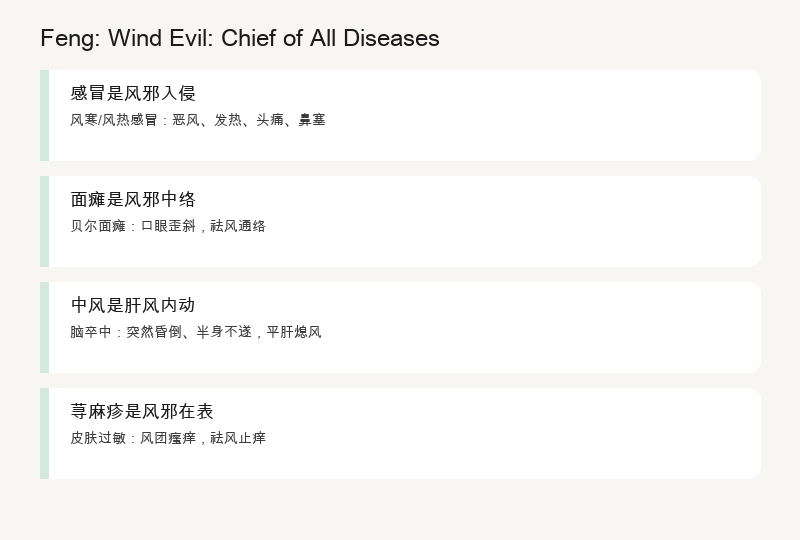
Case 1: AC room cold (wind opens and discharges + immune drop).
You sweat in summer, rush into an AC room, temperature drops from 35°C to 20°C, and the next day you have stuffy nose, runny nose, headache. You ask: "I just blew cold air, how did I catch a cold?"
Truth: When sweating, pores open, surface blood vessels dilate, heat dissipation increases. Suddenly entering a low-temperature environment, body surface temperature drops sharply, blood vessels constrict, local blood flow decreases. Nasal and throat mucosa under cold stimulation have slower ciliary movement (pathogen clearance decreases), reduced secretory IgA (local antibodies decrease), and constricted blood vessels slow immune cell arrival at mucosa. Meanwhile, rhinovirus and other cold viruses replicate more actively in low temperatures. Not "wind evil invasion" mystical mumbo-jumbo, but sudden temperature change → local immune defense drop → virus taking advantage science. Modern research: exposure to low-temperature environments increases cold risk 2-3 times — not because cold itself causes disease, but because cold makes your immune system "doze off."
Case 2: Urticaria triggered by wind (wind moves swiftly and changes frequently + allergic reaction).
You see wind or weather changes, and large wheals appear on your body, itching unbearably, disappearing here and appearing there. TCM says it's "wind rash" or "wind evil causing trouble." Western medicine checks for allergens but can't find specific problems. You ask: "How can wind make skin break out?"
Truth: This is chronic urticaria, an immune-mediated vascular reaction. Temperature changes, airflow friction, pressure changes stimulate skin mast cells to release histamine — histamine causes local blood vessel dilation and increased permeability, plasma exuding into subcutaneous tissue forming wheals. Wheals "wander" because histamine distributes with blood circulation, with vascular reactions rising and falling in different areas. Not "wind evil wandering" mystical mumbo-jumbo, but mast cell degranulation → histamine release → increased vascular permeability science. Modern research: about 30% of chronic urticaria patients are sensitive to temperature changes, airflow, and physical stimuli (physical urticaria), which is the immune system's overreaction to physical stimuli.
Case 3: Facial paralysis after morning exercise sweating (wind evil entering channels + nerve inflammation).
An elderly person exercises in the park in the morning, sweats, a north wind blows, and the next day finds their mouth crooked and eye can't close — facial nerve paralysis (Bell's palsy). TCM says "wind struck the channels." You ask: "How can a gust of wind make a face crooked?"
Truth: This is an inflammatory lesion of the facial nerve. After sweating, facial blood vessels dilate, pores open, cold wind blows, facial temperature drops sharply, blood vessels constrict, local blood flow decreases. The facial nerve passes through a small hole in the skull, narrow space; once local inflammation and edema occur, the nerve gets compressed, causing functional impairment (facial paralysis). Not "wind evil striking channels" mystical mumbo-jumbo, but sudden temperature change → vasoconstriction → local ischemia → nerve inflammation and edema → nerve compression science. Modern research: Bell's palsy is related to viral infection (herpes simplex virus) and local immune response, with cold stimulation being a clear trigger. Prevention is simple: avoid wind after sweating, especially face and neck.
Case 4: Migraine triggered by wind (wind is light and ascending + neurovascular reaction).
You have migraines, every windy day or weather change, headache attacks. TCM says "head wind." You ask: "How can wind make the head hurt?"
Truth: This is neurovascular headache. Pressure changes, temperature changes, airflow stimulation activate the trigeminovascular system — trigeminal nerve releases CGRP (calcitonin gene-related peptide) and other neuropeptides, causing cerebral blood vessel dilation, increased permeability, neurogenic inflammation, triggering headache. Wind directly blowing on the face (especially forehead, temples) stimulates skin and mucosal nerve endings, triggering neurovascular reflexes. Not "wind evil attacking upward" mystical mumbo-jumbo, but temperature/pressure changes → trigeminal nerve activation → cerebral blood vessel dilation → neurogenic inflammation science. Modern research: migraine patients are 3 times more sensitive to weather changes than normal people, with pressure drops and sudden temperature changes being major triggers.
Four cases, one underlying logic: wind is an "environmental stress trigger" — temperature, airflow, pressure changes affect skin, mucosa, blood vessels, nerves, lowering immune defense or activating neurovascular reactions, giving diseases opportunities. Wind itself isn't disease; wind is the "accomplice."

Part 5Modern Research
Does "wind" (wind evil) have scientific research?
Yes, and very thoroughly. Scientists don't use the term "wind evil"; they use "temperature physiology" and "immunology":
• Temperature changes and immune suppression. Modern research confirms: when ambient temperature drops suddenly, respiratory mucosa temperature drops, ciliary movement slows, mucus secretion increases, secretory IgA decreases, local immune defense drops. Meanwhile, rhinovirus and other cold viruses replicate best at 33-35°C (nasal temperature). Cold doesn't directly cause disease but creates a "breeding ground" for viruses. Cardiff University research: exposure to low-temperature cold wind increases cold risk 2.5 times — not because there are more viruses, but because your immune system "dozes off." Not "wind evil invasion" mystical mumbo-jumbo, but precise temperature physiology + virology mechanisms.
• Air flow and pathogen transmission. Wind (air flow) itself isn't a pathogen, but wind can carry viruses, bacteria, allergens (pollen, dust mites, fungal spores). In enclosed spaces, AC airflow can spread one person's exhaled aerosols throughout the room. But moderate ventilation (opening windows) can reduce indoor pathogen concentration — so "opening windows for ventilation" isn't absolutely good or bad, depends on the situation. Not "wind is good or bad" mystical mumbo-jumbo, but fluid dynamics + epidemiology.
• Pressure changes and joint pain. Many rheumatism and arthritis patients say "weather changes cause pain." Modern research confirms: when pressure drops, intra-articular pressure relatively increases, stimulating joint capsule nerve endings, causing pain. Meanwhile, pressure changes affect tissue oxygen partial pressure, slowing metabolic waste clearance in inflamed areas, worsening pain. Not "wind-dampness invasion" mystical mumbo-jumbo, but precise pressure physiology + pain neurology mechanisms. Research shows: about 60-70% of arthritis patients are sensitive to pressure changes.
• Neurovascular reactions and wind evil. Skin and mucosal nerve endings (C fibers, Aδ fibers) are very sensitive to temperature, airflow, and mechanical stimulation. Cold wind stimulating the face activates the trigeminovascular system, releasing CGRP, substance P and other neuropeptides, causing blood vessel dilation, increased permeability, neurogenic inflammation — this is the scientific mechanism of "head wind" (migraine). Not "wind evil attacking upward" mystical mumbo-jumbo, but precise neurophysiology mechanisms.
These studies fully demonstrate: "wind" (wind evil) is a concept that can be precisely described in modern scientific language. Ancients described it with "opens and discharges, moves swiftly and changes frequently, light and ascending, active"; modern people describe it with "temperature stress, immune suppression, neurovascular reactions, pressure changes" — core logic is consistent: environmental change → body reaction → disease occurs.
Part 6Practical Methods
Now that we understand "wind" (wind evil), how to prevent it?
First, bust a few myths:
• "Wind is just air, how can it cause disease?" Wind itself doesn't cause disease, but wind brings temperature changes, airflow stimulation, and pressure changes that affect your immune and nervous systems. Not "wind itself causes disease," but wind as an environmental stress trigger lowers your defenses.
• "Ventilation is health-preserving, the more the better." Ventilation is right, but after sweating, during sleep, or on windy days, excessive ventilation (direct blowing) is a disease factor. Not "more ventilation is better," but moderate ventilation, avoid direct blowing.
Specific methods:
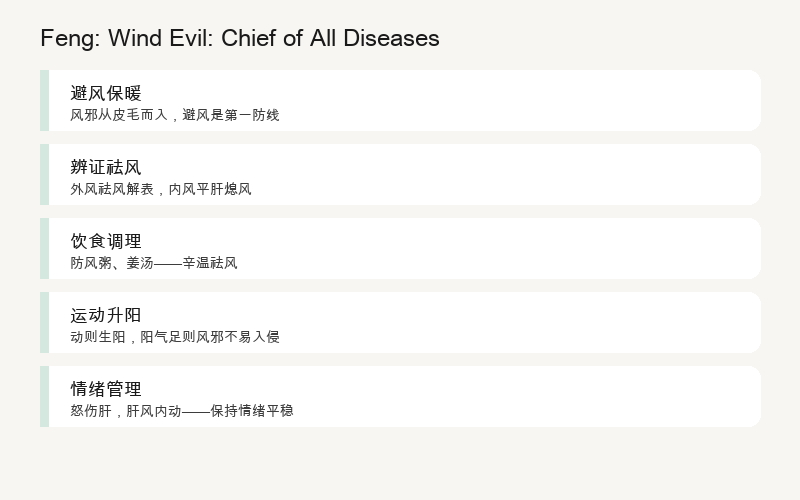
• Avoid wind like avoiding arrows: don't blow cold air after sweating (prevent wind opening and discharging). After exercise, bathing, or sweating, pores are open; blowing cold air at this time most easily causes colds. Dry sweat, put on clothes, wait until sweat dries before exposing to wind. The ancients said "sweating when wind strikes" — modern medicine confirms: after sweating, skin temperature is high, pores dilate, cold wind blows, body temperature drops sharply, immunity drops. Not "be careful of wind evil" mystical mumbo-jumbo, but temperature physiology + immunology science.
• AC temperature not lower than 26°C, avoid direct blowing (prevent wind opening and discharging). AC is the main reason modern people "attract wind." Indoor-outdoor temperature difference shouldn't exceed 7°C, AC vent shouldn't blow directly on people. Especially during sleep, when metabolic rate drops and body temperature regulation ability decreases, direct cold wind blowing easily triggers colds, facial paralysis, and joint pain. Not "AC disease" mystical mumbo-jumbo, but sudden temperature change → immune stress science.
• Wind-cold cold: ginger and scallion soup (acrid-warm exterior-releasing). After catching cold, stuffy nose, clear runny nose, feeling cold — this is wind-cold cold (viral infection + cold stimulation). Ginger contains gingerol, promotes blood circulation, raises body temperature; scallion contains volatile oils, stimulates mucosal secretion, promotes sweating. A cup of hot ginger soup, cover with blanket to sweat, body temperature rises, immune system activity increases. Not "dispelling wind-cold" mystical mumbo-jumbo, but warm stimulation → immune activation + sweating for heat dissipation science.
• Wind rash itching: Fangfeng (Saposhnikovia), Jingjie (Schizonepeta) (regulate immunity + anti-allergy). For chronic urticaria and skin itching, TCM uses Fangfeng and Jingjie. Modern research: Fangfeng contains cimifugin and chromones, with anti-allergic and anti-inflammatory effects; Jingjie contains volatile oils, with sedative and anti-itching effects. Not "dispelling wind to stop itching" mystical mumbo-jumbo, but phytochemistry + immune regulation science. Note: severe allergies require medical attention; herbal medicine is only supplementary.
• Migraine: wind protection and warmth, avoid wind blowing on head (prevent neurovascular reactions). Migraine patients should wear hats and scarves on windy days, avoid cold wind directly blowing on forehead and temples. Reduce trigeminovascular system stimulation. Not "avoiding wind evil" mystical mumbo-jumbo, but reducing nerve stimulation → preventing neurogenic inflammation science. Research shows: keeping the head warm can reduce about 30% of weather-related migraine attacks.
These methods don't require you to become a doctor. You only need to understand: wind is an "environmental stress trigger" — temperature, airflow, pressure changes affect your immune and nervous systems, giving diseases opportunities. Avoiding wind means reducing environmental stress.
Part 6 (continued)Practical Methods: Five Wind-Proof Health Methods
Part 7One-Minute Summary
🕐 Understand "Wind" in One Minute
Wind = pathogen transmission medium + immune stress trigger.
Wind is the leader of all diseases because wind "opens the city gate" (opens and discharges couli), letting other evils slip in.
Wind opens and discharges = sudden temperature change → pore opening/closing → local immune defense drops.
Moves swiftly and changes frequently = rapidly changing, wandering symptoms = immune mediator dynamic distribution + neurovascular reactions.
Wind is active = increased neural excitability → itching, tremors, dizziness.
Wind is light and ascending = first attacks upper body (head, face) and body surface (skin, hair).
Wind-cold = viral infection + cold environment; wind-heat = viral infection + inflammatory response; wind-dampness = allergens + humid environment.
Myths: wind itself doesn't cause disease; more ventilation is always better.
Methods: avoid cold wind after sweating, AC not below 26°C, wind-cold drink ginger soup, wind rash use Fangfeng and Jingjie, migraine wear hat for warmth.
Ancients called it "wind evil invasion," modern people call it "temperature stress → immune suppression → pathogen invasion."
Different names, but medicine knows: environmental changes affect immunity, avoiding wind protects defensive power.
The ancients didn't have immunology, but knew "avoid wind like avoiding arrows," "sweating when wind strikes causes great humpback."
This is probably the most down-to-earth wisdom of the Chinese people: respect the environment, follow nature, protect the body's defensive power.

Making money is the art of living; art is the life after making money.
giaogiao Decodes Chinese Traditional Wisdom · Concept 81
Using modern scientific language to help the world understand Chinese traditional wisdom.
No mysticism, no superstition, no negation.
Understanding, not merely believing.
Coach Liu
Written in Florence