Cold (hán) — Cold Evil: Congealing and Contracting
Part 1A Question
Have you ever noticed that in winter your fingers get so stiff you can't hold a pen or button your shirt? Have you noticed that after eating iced watermelon or drinking iced beer, your stomach cramps and you get diarrhea?
Here's the kicker: Traditional Chinese Medicine says "cold nature congeals" — cold makes qi and blood "freeze up," and when they can't flow, there is pain. It also says "cold nature contracts" — cold makes muscles and tendons contract and spasm. You ask: how does cold become disease? How does modern medicine explain "cold evil"?
Another question: have you seen elderly people with arthritis whose knees hurt so much in winter they can't walk? Applying warm packs or using an electric heater relieves the pain. TCM calls this "cold bi," but Western medicine X-rays show no obvious structural changes in the joints. What's going on?
You ask: what exactly is cold? Why does TCM say "cold is the master of pain" — cold is the primary cause of pain? Why is "keeping warm" the first principle of TCM health preservation?
Part 2Chinese Traditional Explanation
The concept of "cold" holds extremely high status in TCM etiology. Cold is one of the Six External Evils (wind, cold, summer heat, dampness, dryness, fire) and represents the yin evil. The Yellow Emperor's Inner Canon says: "Cold is congealing and contracting." Four words that capture the core characteristics of cold evil.
— The Yellow Emperor's Inner Canon · Plain Questions
"Pain means there is much cold qi; there is cold, therefore there is pain."
— The Yellow Emperor's Inner Canon · Plain Questions
"Blood and qi like warmth and dislike cold; when cold, they congeal and cannot flow; when warm, they dissolve and depart."
— The Yellow Emperor's Inner Canon · Plain Questions
The ancients observed two major characteristics of cold evil, explaining why it is called the evil that "masters pain":
First, cold nature congeals. "Congeals" means to coagulate, "stagnates" means to stop. When cold evil invades the body, the flow of qi and blood slows and stagnates. Stagnant qi and blood are like frozen river water that can't flow — local areas don't get nourishment, metabolic wastes can't be eliminated, and pain results. TCM says "when there is flow there is no pain; when there is pain there is no flow" — cold is the primary cause of "no flow." So the most prominent symptom of cold evil disease is pain.
Second, cold nature contracts. "Contracts" means to shrink, "pulls" means to tighten and cramp. When cold evil invades, the body's tendons and muscles contract and spasm. When you suddenly jump into cold water while swimming, your muscles cramp; when you don't wear gloves in winter, your fingers curl and stiffen — this is "contracting." TCM says cold evil invading the joints causes joint stiffness and restricted movement; cold evil invading the abdomen causes abdominal muscle spasms and colicky pain.
More importantly, cold is a yin evil that easily damages yang qi. The function of yang qi is to warm, propel, and transform. When cold evil arrives, yang qi is suppressed, the body's warming function decreases, metabolism slows, water fluids accumulate (edema, phlegm-rheum), and digestive function declines (abdominal pain, diarrhea). So cold evil not only causes pain and contraction but also leads to whole-body functional decline.
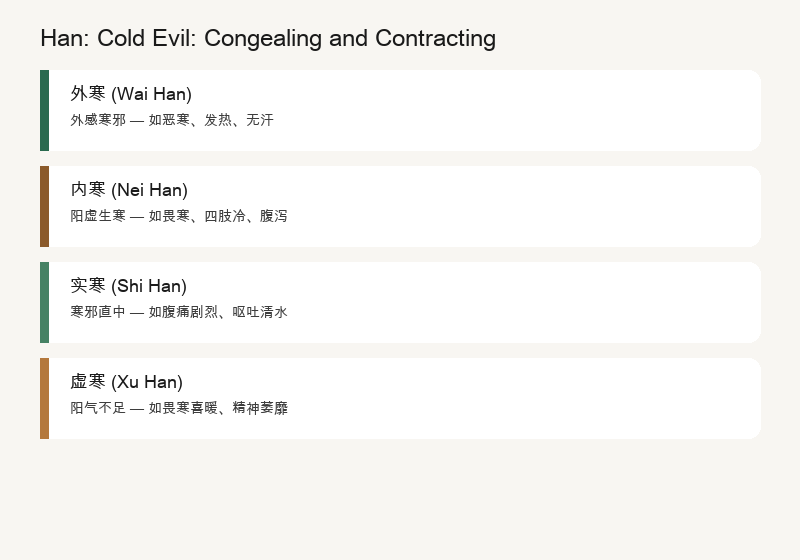
Cold evil also has the distinction between external cold and internal cold:
• External cold: environmental cold, cold evil invading from the body surface. For example, getting caught in rain, wading in water, wearing thin clothes, or direct AC blowing. External cold first invades the muscle surface (exterior cold), manifesting as aversion to cold, absence of sweat, headache, and body pain; if it penetrates deeper into the channels and joints, it becomes "cold bi" — joints that are cold and painful, with restricted movement.
• Internal cold: insufficient yang qi, cold generated from within the body. For example, long-term consumption of raw and cold foods, overexertion, old age and physical weakness leading to spleen-kidney yang deficiency. Internal cold manifests as aversion to cold with cold limbs, pale complexion, abdominal pain that likes warmth, clear thin diarrhea, clear long urine — this is the body's internal "furnace" not burning brightly enough.
So, "cold" in ancient terms is not just low temperature — it is a "vasoconstriction-metabolic slowdown-functional decline" pathological system. The core logic of cold evil: low temperature → qi and blood congeal → pain; low temperature → tendon contraction → stiffness; low temperature → yang qi damaged → functional decline.
Part 3giaogiao Modern Translation
Alright, now let's translate "cold" (cold evil) into modern language.
I'm not going to talk about thermodynamics or biochemistry. Too complicated. You only need to remember one analogy:
Cold nature congeals = cold stimulus → vasoconstriction → blood flow reduced by 40-60% → tissue oxygen supply drops → metabolic products (lactic acid, bradykinin, substance P) accumulate → stimulate pain nerves → pain
Cold nature contracts = cold stimulus → involuntary skeletal muscle contraction (shivering) → increased muscle tension → muscle spasm → restricted joint movement
Cold damages yang = low temperature → basal metabolic rate drops (BMR decreases 10-15%) → enzyme activity drops → insufficient energy production → cellular function decline → whole-body functional decline
External cold = low environmental temperature → body temperature regulation mechanism activates (vasoconstriction, shivering, piloerection) → local ischemia and oxygen deprivation
Internal cold = hypothyroidism → metabolic rate decreases → heat production decreases → aversion to cold with cold limbs
Excess cold = acute low-temperature exposure (frostbite, drowning, cold environment)
Deficiency cold = chronic low-metabolism state (hypothyroidism, adrenal insufficiency, chronic anemia, malnutrition)
That's it. "Cold" (cold evil) is essentially a "low-temperature stress-vasoconstriction-metabolic suppression" system — cold is not something external, but the body's physiological response to low temperature; when this response becomes excessive or persistent, it becomes a pathological state.
Specifically:
What does "cold nature congeals" correspond to? It corresponds to the vasoconstriction and blood flow reduction caused by cold stimulus. When environmental temperature drops, skin cold receptors are activated, and through the sympathetic nervous system, local vasoconstriction occurs — this is the body's heat-preservation mechanism, reducing heat loss. But vasoconstriction causes blood flow reduction, local tissue oxygen supply drops, and metabolic products (lactic acid, carbon dioxide, bradykinin, prostaglandins) accumulate. These metabolic products stimulate C fibers (pain nerve fibers), producing pain. TCM says "when there is no flow there is pain" — corresponding to blood flow reduction → ischemia and oxygen deprivation → metabolic waste accumulation → pain nerve activation. Not "qi and blood congeal" mystical mumbo-jumbo, but precise vascular physiology + pain neurology mechanisms. Modern research: local temperature dropping from 35°C to 25°C reduces blood flow by about 50% and tissue oxygen partial pressure by 30%.
What does "cold nature contracts" correspond to? It corresponds to muscle contraction caused by cold stimulus. Skeletal muscles under cold stimulus produce involuntary contraction (shivering) — this is the body's heat production method (muscle contraction generates heat). But persistent cold stimulus causes continuous muscle tension and spasm, muscle fiber shortening, and restricted joint movement. TCM says "tendon and vessel cramping" — corresponding to cold stimulus → alpha motor neuron excitation → muscle spindle sensitivity → increased muscle tone → muscle spasm. Not "cold makes tendons and vessels contract" mystical mumbo-jumbo, but precise neuromuscular physiology mechanisms. That's why winter swimming easily causes cramps and winter joints get stiff — muscles have enhanced contraction ability and reduced elasticity in low temperatures.
What does "cold damages yang" correspond to? It corresponds to metabolic rate decrease caused by low temperature. Humans are warm-blooded animals, maintaining core body temperature around 37°C. When environmental temperature drops, the body needs to consume more energy to maintain temperature — but if energy supply is insufficient (eating raw and cold foods, malnutrition, hypothyroidism), or if insulation is insufficient (wearing too little), the body will "save energy" — lowering metabolic rate, reducing non-essential functions. TCM's "yang qi" largely corresponds to basal metabolic rate (BMR) and thyroid function. Hypothyroid patients have metabolic rates reduced by 20-30%, heat production decreases, manifesting as aversion to cold with cold limbs, mental fatigue, and low digestive function — this is the modern medical counterpart of "internal cold" and "yang deficiency." Not "yang qi is damaged by cold" mystical mumbo-jumbo, but precise metabolic endocrinology mechanisms.
What do "external cold" and "internal cold" correspond to? External cold = acute low environmental temperature causing physiological stress responses (vasoconstriction, shivering, piloerection); internal cold = chronic metabolic function decline (hypothyroidism, adrenal insufficiency, chronic anemia, malnutrition). External cold is "the environment is too cold"; internal cold is "the body doesn't produce enough heat." Not "external evil invades" and "yang qi is insufficient" mystical mumbo-jumbo, but environmental stress vs. metabolic function decline — a scientific distinction.
So "cold" is not mystical. It is a low-temperature stress system — temperature drops → vasoconstriction → blood flow reduction → tissue oxygen deprivation → metabolic waste accumulation → pain; temperature drops → muscle contraction → spasm → joint stiffness; temperature drops → metabolic rate decrease → functional decline. The ancients described it with "congeals, contracts, damages yang"; modern people describe it with "vasoconstriction, metabolic suppression, neuromuscular reaction" — core logic is consistent: low temperature → body reaction → pathological change.
Part 4Life Cases
Four real-life stories to help you understand "cold" in seconds.
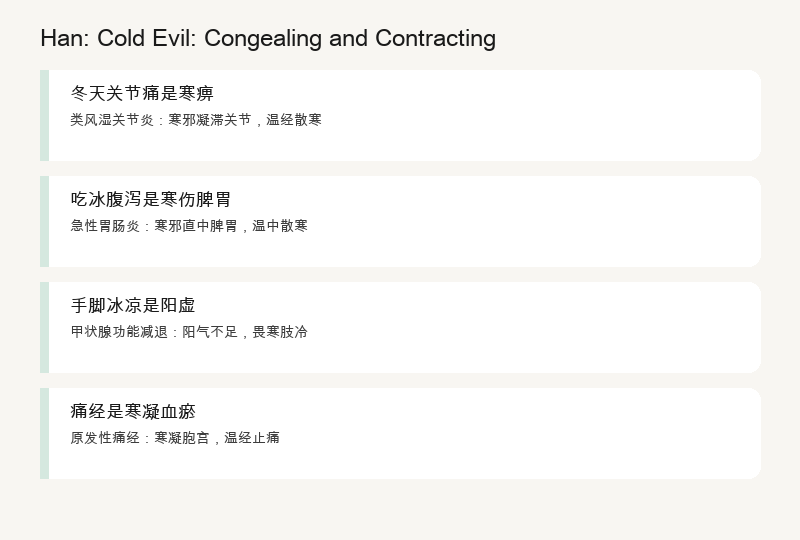
Case 1: Muscle cramp after winter swimming (cold nature contracts + muscle contraction).
You like swimming in summer; one autumn day the water temperature dropped, you didn't notice, jumped in, swam for five minutes, and suddenly your calf cramped, excruciating pain, almost drowning. You ask: "Why did cold water cause cramps?"
Truth: This is cold-stimulus-induced muscle cramp. When water temperature drops below 25°C, skin cold receptors are activated, signals travel to the spinal cord, alpha motor neurons are excited, causing involuntary skeletal muscle contraction (shivering for heat production). Meanwhile, low temperature causes abnormal calcium ion release from the sarcoplasmic reticulum, disrupting excitation-contraction coupling in muscle fibers, leading to cramps. The lower the water temperature, the higher the cramp risk. Not "cold evil contracts tendons and vessels" mystical mumbo-jumbo, but science: cold stimulus → increased neuromuscular excitability → calcium ion metabolism disturbance → muscle spasm. Modern research: when water temperature drops below 20°C, muscle cramp risk increases 3-fold. Prevention: warm up before entering water, reduce swimming time when water temperature is below 20°C, keep warm immediately after exiting water.
Case 2: Girl eating cold drinks during menstruation, worsening menstrual pain (cold nature congeals + uterine vasoconstriction).
Every time you menstruate, you have menstrual pain. One summer you ate three popsicles, the menstrual pain became severe, cold sweat poured, and only a hot water bottle on your stomach relieved it. TCM says "cold congeals blood stasis." You ask: "How do cold drinks worsen menstrual pain?"
Truth: This is low-temperature-stimulus-induced pelvic vasoconstriction. Cold food entering the gastrointestinal tract causes reflexive contraction of pelvic visceral blood vessels (including uterine blood vessels) through visceral-visceral reflex. Uterine blood vessel constriction reduces endometrial blood flow, ischemia and oxygen deprivation, and increased prostaglandin (PGF2α) synthesis — prostaglandins stimulate strong contraction of uterine smooth muscle, producing pain. Hot water bottle application dilates blood vessels, increases blood flow, and prostaglandins are diluted and metabolized, relieving pain. Not "cold congeals blood stasis" mystical mumbo-jumbo, but science: cold stimulus → visceral blood vessel constriction → uterine ischemia → increased prostaglandin → uterine spasm. Modern research: pelvic temperature drops by 1°C during menstruation, menstrual pain increases by about 30%. Recommendation: avoid cold drinks and cold foods during menstruation, keep the abdomen warm.
Case 3: Elderly person with worse joint pain in winter (cold nature congeals + joint ischemia).
Your grandfather has knee arthritis; every winter, pain worsens, walking becomes difficult, and applying warm packs or using an electric heater relieves it. TCM calls this "cold bi." Western medicine X-rays show no severe joint degeneration. You ask: "Why do joints hurt when it's cold?"
Truth: This is low-temperature-induced joint blood flow reduction and increased joint fluid viscosity. When knee joint temperature drops, surrounding blood vessels constrict, synovial blood flow decreases, synovial fluid secretion decreases, and joint cartilage nutrition supply drops. Meanwhile, low temperature increases joint fluid viscosity (joint fluid is a viscoelastic liquid that becomes more viscous at lower temperatures), increasing joint friction. Already inflamed joints have more pain-sensitive nerve endings, and low temperature directly activates C fibers. Warm packs raise local temperature, dilate blood vessels, increase blood flow, and decrease joint fluid viscosity, relieving pain. Not "cold evil invades joints" mystical mumbo-jumbo, but science: low temperature → joint blood flow reduction + increased joint fluid viscosity → increased joint friction + nerve sensitivity → pain. Modern research: joint temperature drops by 1°C, joint fluid viscosity increases by about 15%, and joint pain score increases by about 20%.
Case 4: Long-term cold hands and feet (internal cold + hypothyroidism).
You have chronically cold hands and feet, even in summer, aversion to cold, fatigue, low energy, and many tonics haven't worked. TCM says "yang deficiency with internal cold." You check thyroid function and find elevated TSH and decreased T3, T4 — hypothyroidism. You ask: "Why does hypothyroidism cause aversion to cold?"
Truth: This is insufficient heat production due to low metabolic rate. Thyroid hormones (T3, T4) are the key hormones regulating basal metabolic rate. In hypothyroidism, T3, T4 levels decrease, cellular mitochondrial oxidative phosphorylation efficiency drops, ATP production decreases, and heat production is insufficient. Meanwhile, insufficient thyroid hormone reduces sympathetic nerve activity, skin vasoconstriction response weakens but persists, peripheral blood flow decreases, and distal extremity temperatures drop. Not "yang qi is insufficient" mystical mumbo-jumbo, but science: insufficient thyroid hormone → decreased metabolic rate → reduced heat production → aversion to cold with cold limbs. Modern research: hypothyroid patients have basal metabolic rates reduced by 20-40%, core body temperature often below 36.5°C, and hand and foot skin temperature can drop to 28-30°C. Treatment: thyroid hormone replacement (levothyroxine), not taking tonics.
Four cases, one underlying logic: cold is a "low-temperature stress system" — temperature drops → vasoconstriction → blood flow reduction → tissue oxygen deprivation → pain; temperature drops → muscle contraction → spasm; temperature drops → metabolic rate decrease → functional decline. Not the mysterious power of "cold evil," but the body's physiological response to low temperature.
Part 5Modern Research
Does "cold" (cold evil) have scientific research?
Yes, and very thoroughly. Scientists don't use the term "cold evil congeals"; they use "temperature physiology" and "vascular neurology":
• Cold stimulus and vasoconstriction. Modern research confirms: skin temperature drops by 1°C, local vasoconstriction occurs, blood flow decreases by about 10-15%. When temperature drops from 35°C to 25°C, blood flow decreases by 40-60%. Vasoconstriction is mediated by the sympathetic nervous system, through alpha-adrenergic receptors, causing vascular smooth muscle contraction. Local tissue oxygen partial pressure drops, lactic acid accumulates, pH decreases, bradykinin, prostaglandins and other pain-causing substances are released, stimulating C fibers and Aδ fibers, producing pain. Not "qi and blood congeal" mystical mumbo-jumbo, but sympathetic nervous system + vascular physiology + pain neurology precise mechanisms. Research shows: Raynaud's phenomenon (cold-induced finger pallor and pain) patients have local vasoconstriction responses 3-5 times stronger than normal people.
• Cold and muscle cramps. The effect of low temperature on skeletal muscles: muscle temperature drops, sarcoplasmic reticulum calcium ion release rate increases, troponin sensitivity to calcium changes, leading to increased muscle excitability and uncoordinated contraction. Meanwhile, low temperature reduces muscle fiber elasticity and extensibility, making muscles more prone to injury during contraction. Shivering is involuntary rhythmic skeletal muscle contraction, with heat production efficiency 4-5 times that of resting state, but persistent shivering causes muscle fatigue and soreness. Not "tendons and vessels contract" mystical mumbo-jumbo, but muscle biomechanics + neuromuscular physiology precise mechanisms.
• Cold and joint fluid viscosity. Joint synovial fluid is a viscoelastic liquid whose viscosity changes significantly with temperature. Temperature drops from 37°C to 30°C, synovial fluid viscosity increases by about 25-30%. Increased viscosity leads to increased joint friction coefficient, decreased articular cartilage surface lubrication, increased friction during movement, stimulating joint capsule nerve endings, producing pain. Meanwhile, low temperature reduces the elasticity of surrounding ligaments and tendons, decreasing joint range of motion. Not "cold evil blocks joints" mystical mumbo-jumbo, but bio-rheology + joint biomechanics precise mechanisms. Research shows: arthritis patients' joint temperature is often 2-3°C lower than normal joints, and local warmth significantly improves symptoms.
• Cold and metabolic rate. In cold environments, the human body increases basal metabolic rate (through shivering and non-shivering thermogenesis). But with long-term cold exposure, or hypothyroidism, metabolic rate decreases instead — the body enters "energy-saving mode," reducing non-essential energy consumption. Hypothyroid patients' basal metabolic rate can decrease by 20-40%, manifesting as aversion to cold, fatigue, low energy, and weight gain. Not "yang qi is insufficient" mystical mumbo-jumbo, but endocrine metabolism precise mechanisms. Thyroid hormone is the core hormone regulating metabolic rate; T3 directly acts on cellular mitochondria, increasing oxidative phosphorylation efficiency.
These studies fully demonstrate: "cold" (cold evil) is a concept that can be precisely described in modern scientific language. The ancients described it with "congeals, contracts, damages yang"; modern people describe it with "vasoconstriction, metabolic suppression, muscle spasm, increased joint fluid viscosity" — core logic is consistent: low temperature → body reaction → pathological change.
Part 6Practical Methods
Now that we understand "cold" (cold evil), how to prevent it?
First, bust a few myths:
• "Cold is a way to train willpower, the colder the better." Moderate cold stimulus can activate brown fat and enhance immunity, but excessive cold exposure causes vasoconstriction, immune suppression, and joint damage. Not "the colder the better," but moderate cold, avoid excess.
• "Cold hands and feet are normal, don't worry about it." Long-term cold hands and feet may be signals of hypothyroidism, anemia, or vascular disease. Not "normal constitution," but a symptom that needs investigation for underlying disease.
Specific methods:
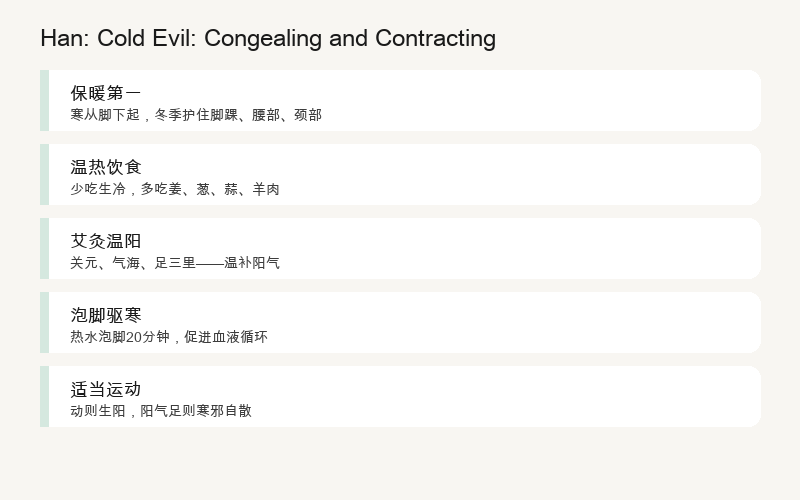
• Keep three areas warm: abdomen, waist, and feet (prevent cold evil invasion). The abdomen contains the spleen, stomach, and intestines; cold directly affects digestion. The waist contains the kidney shu and life gate points; cold damages kidney yang. The feet are where yin and yang channels converge, farthest from the heart, with the poorest blood circulation. TCM says "cold rises from the feet" — low foot temperature causes whole-body vasoconstriction. Modern medicine confirms: when foot temperature drops below 28°C, whole-body sympathetic nerve activation occurs, blood vessels constrict, and blood pressure rises. Wear thick socks and warm shoes in winter, soak feet before bed (40-45°C warm water, 15-20 minutes), which can significantly improve whole-body circulation. Not "warm feet health preservation" mystical mumbo-jumbo, but precise temperature physiology + circulation science mechanisms.
• Eat warm food, avoid raw and cold (prevent internal cold generation). The spleen and stomach like warmth and dislike cold. Cold food entering the gastrointestinal tract causes local temperature to drop sharply, gastrointestinal blood vessels constrict, and digestive enzyme activity decreases (digestive enzymes are most active at 37°C), reducing digestive function. Long-term consumption of raw and cold foods leads to chronic gastrointestinal ischemia, indigestion, and nutrient absorption disorders. TCM's "spleen-stomach deficiency-cold" corresponds to chronic gastrointestinal dysfunction + poor digestion and absorption. Recommendation: drink warm water, eat warm food, avoid eating ice on an empty stomach. Especially during menstruation, after meals, and after exercise, avoid cold drinks. Not "avoid raw and cold" mystical mumbo-jumbo, but digestive physiology science.
• Moxibustion: Guanyuan, Qihai, Zusanli (warm yang and dispel cold). Moxibustion is the main TCM method to dispel cold. Guanyuan (3 cun below navel) and Qihai (1.5 cun below navel) are important conception vessel points; moxibustion can locally raise temperature (40-50°C), promote blood circulation, activate heat shock proteins (HSP), and enhance cellular repair capacity. Zusanli is the stomach channel's he-sea point; moxibustion can regulate gastrointestinal function and enhance immunity. Modern research: moxibustion can raise local skin temperature by 5-8°C, increase blood flow by 50-80%, with lasting effects for several hours. Not "warm yang and dispel cold" mystical mumbo-jumbo, but thermotherapy physiology + immune regulation science. Note: yin deficiency with fire excess, excess heat conditions are not suitable for moxibustion.
• Exercise: promote blood circulation (generate heat to dispel cold). Exercise is the most effective way to produce heat. Moderate-intensity exercise (brisk walking, jogging, swimming) increases muscle heat production by 5-10 times, dilates whole-body blood vessels, accelerates blood flow, raises metabolic rate, with lasting effects for several hours. TCM says "movement generates yang" — corresponding to exercise → increased metabolic rate → increased heat production → vasodilation. Research shows: 150 minutes of moderate-intensity exercise per week can increase basal metabolic rate by 5-10%, reducing winter cold symptoms by 40%.
• Hypothyroidism screening: long-term aversion to cold needs thyroid function check (address internal cold at the root). If you are chronically averse to cold, fatigued, low-energy, gaining weight, with dry skin, check thyroid function (TSH, T3, T4). Hypothyroidism is the most common cause of "internal cold"; after thyroid hormone replacement (levothyroxine), symptoms can improve significantly within weeks. Not "tonify yang qi" mystical mumbo-jumbo, but endocrine replacement therapy. Hypothyroidism affects about 5-10% of women, even higher in middle-aged and elderly people; many are misdiagnosed as "cold constitution" and take many ineffective tonics.
These methods don't require you to become a doctor. You only need to understand: cold is a "low-temperature stress system" — temperature drops → vasoconstriction → blood flow reduction → pain; temperature drops → muscle contraction → spasm; temperature drops → metabolic rate decrease → functional decline. Keeping warm means reducing low-temperature stress; warm food and exercise mean raising metabolic heat production.
Part 6 (continued)Practical Methods: Five Methods to Dispel Cold
Part 7One-Minute Summary
🕐 Understand "Cold" in One Minute
Cold = vasoconstriction + metabolic slowdown + tissue oxygen deprivation.
Cold nature congeals = low temperature → vasoconstriction → blood flow reduced by 40-60% → tissue oxygen deprivation → metabolic waste accumulation → pain.
Cold nature contracts = cold stimulus → involuntary muscle contraction → increased muscle tone → spasm → joint stiffness.
Cold damages yang = low temperature → metabolic rate decrease → enzyme activity drops → insufficient energy → functional decline.
External cold = low environmental temperature → body temperature regulation stress (vasoconstriction, shivering); internal cold = metabolic function decline (hypothyroidism, anemia, malnutrition).
Myths: cold trains willpower; cold hands and feet are normal.
Methods: keep abdomen, waist, and feet warm; eat warm food and avoid raw cold; moxibustion at Guanyuan, Qihai, and Zusanli; exercise to promote blood circulation; long-term aversion to cold requires hypothyroidism screening.
The ancients called it "cold nature congeals and contracts"; modern people call it "vasoconstriction + metabolic suppression + neuromuscular reaction."
Different names, but medicine knows: low temperature is strong body stress, keeping warm is the most efficient health preservation.
The ancients didn't have vascular physiology, but knew "pain means there is much cold qi" and "blood and qi like warmth and dislike cold."
This is probably the most down-to-earth wisdom of the Chinese people: respect the body's temperature; keeping warm is not being delicate, but protecting the basic need of life.
Making money is the art of living; art is the life after making money.
giaogiao Decodes Chinese Traditional Wisdom · Concept 82
Using modern scientific language to help the world understand Chinese traditional wisdom.
No mysticism, no superstition, no negation.
Understanding, not merely believing.
Coach Liu
Written in Florence