Zhen — Acupuncture: Meridian Regulation
Part 1A Question
Ever notice that acupuncture has been WHO-certified for 43 diseases — including pain, digestive, nervous, and respiratory conditions?
Ever realize that sticking needles isn't "stab where it hurts" — it's stimulating specific acupoints to mobilize the body's self-healing, like pressing the body's "reboot button"? Even crazier, science confirms: acupuncture stimulates Aδ fibers, closes the pain gate, and releases endorphins — a pain relief mechanism similar to morphine, but without addiction?
You ask: How can sticking a few needles, without injecting any drug, actually cure disease? If it works, is it a placebo effect, or is there a real physiological mechanism? If there is a real physiological mechanism, why did the ancients describe it with "meridians, acupoints, qi and blood" instead of nerves, blood vessels, and hormones?
There's another question: Is moxibustion just "warming by fire"? Why use mugwort burning, not firewood? What's the difference between warm stimulation and needle stimulation?
Zhen, what is it exactly? Is acupuncture the "bioelectric switch" invented by the ancients?
Part 2Traditional Chinese Explanation
The concept of "Zhen" is the core of external treatment in Chinese medicine. Acupuncture includes "zhen" (needle insertion) and "jiu" (moxibustion) — needles use metal needles to stimulate acupoints, moxibustion uses burning mugwort for warm stimulation of acupoints. The ancients believed: meridians are the channels through which qi and blood flow, acupoints are the "switches" on the meridians — stimulating acupoints can regulate qi and blood, balance yin and yang, and unblock the meridians.
— Yellow Emperor's Inner Canon, Spiritual Pivot
"The key to needling is: when qi arrives, it is effective."
— Yellow Emperor's Inner Canon
"The meridians are what can determine life and death, treat all diseases, regulate excess and deficiency — they cannot be blocked."
— Yellow Emperor's Inner Canon, Spiritual Pivot
The ancients observed: the body surface has specific "sensitive points" — when pressed, pain is reduced or increased, and when stimulated, the body produces specific reactions. These points are "acupoints," connected into lines they form "meridians."
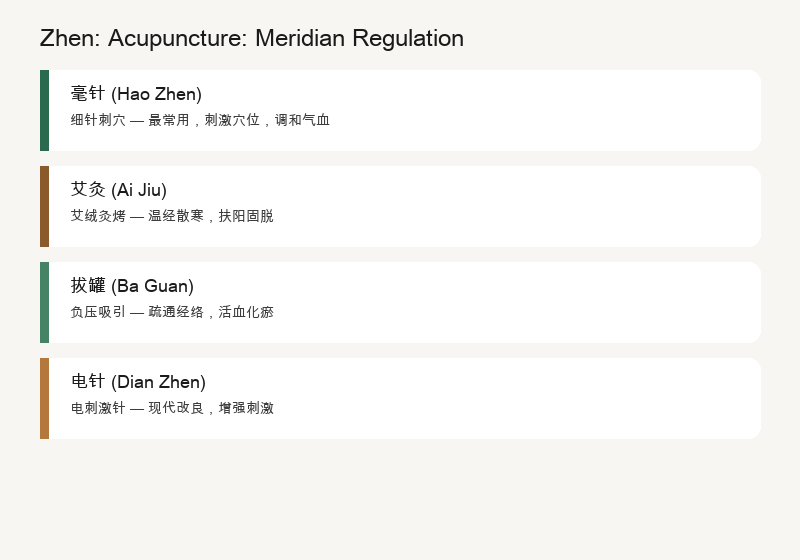
Needling = inserting needles into acupoints, mobilizing channel qi. Using metal needles (gold, silver, stainless steel) inserted to a specific depth, through lifting, thrusting, and rotating techniques, producing a "deqi" sensation (sour, numb, swollen, heavy) — this is the signal that "channel qi" has been mobilized.
Moxibustion = burning mugwort, warm stimulation. Using mugwort floss (dried leaf floss of mugwort) burned to warmly stimulate acupoints — like local "heat therapy," warming the meridians and dispelling cold, supporting yang and preventing collapse.
Meridians = channels through which qi and blood flow. Twelve primary channels and eight extraordinary channels, like the body's "highway system," connecting the internal organs and the limbs.
Acupoints = "switches" on the meridians. 361 meridian acupoints, plus extraordinary points and ah-shi points, like the body's "control buttons" — stimulating specific buttons regulates specific functions.
So what the ancients called "zhen" wasn't just "sticking needles" — it was a "meridian regulation system" — through stimulating specific points on the body surface, regulating the function of internal organs.
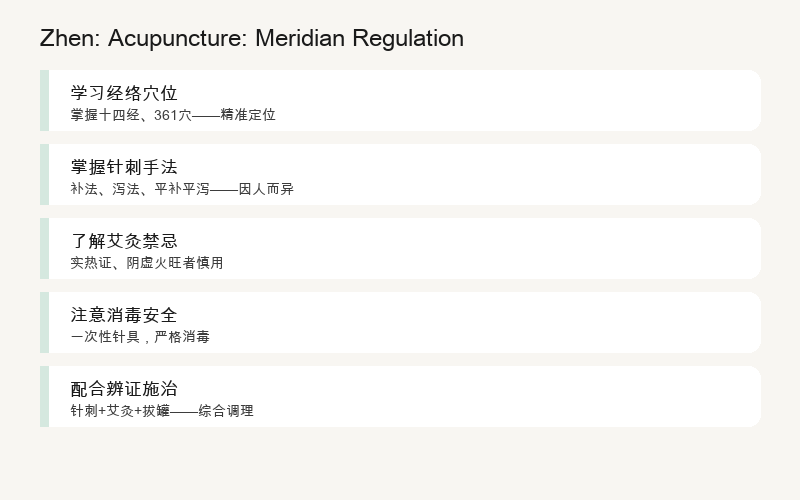
But acupuncture has one big principle: needle supplementation and drainage, differ according to the pattern. Deficiency patterns use supplementation (light stimulation, needling along the channel), excess patterns use drainage (strong stimulation, needling against the channel). It's not "needling is good" — it's technique, acupoint, depth, and direction must all be precise.
Part 3The giaogiao Modern Translation
Okay, now let's translate "Zhen" (acupuncture) into modern language.
I'm not going to talk about neuroanatomy or electrophysiology. Too complicated. You just need to remember one analogy:
Needling = Mechanical stimulation → activates nerve endings (Aδ fibers, C fibers) → nerve signal ascends → brain releases endorphins and other analgesic substances → closes the pain gate
Moxibustion = Warm stimulation → local vasodilation → improves microcirculation → heat effect activates heat shock proteins → enhances cell repair
Acupoint = Nerve-vascular dense area (neurovascular hilum — gateway where nerves and blood vessels enter muscles/bones)
Meridian = Neuro-vascular-fascial functional pathway (not an anatomical entity, but a functional network)
Deqi = Needle sensation (sour, numb, swollen, heavy) = feedback signal of nerve-muscle activation
Acupuncture analgesia = Stimulates Aδ fibers → closes the spinal pain gate (Gate Control Theory) → releases endorphins (Enkephalin/Endorphin) → activates descending inhibitory system
Moxibustion = Local heat therapy (40–45°C) → promotes blood flow → enhances immunity → activates repair mechanisms
Acupuncture = Neuro-endocrine-immune network regulation technology (WHO-certified 43 indications)
That's it. "Zhen" (acupuncture) is essentially a "neuro-endocrine-immune" regulation technology — through body surface stimulation, mobilizing the body's self-healing system.
Specifically:
"Acupuncture analgesia" corresponds to what? It corresponds to the "Gate Control Theory" of neurophysiology. Acupuncture stimulates Aδ nerve fibers (myelinated fast-conducting fibers), and the signals produced arrive at the spinal cord faster than the C fibers (unmyelinated slow-conducting pain fibers), "closing" the gate for pain signal transmission. At the same time, after the brain receives the acupuncture signal, it releases endorphins — natural "morphine" — producing an analgesic effect. It's not the mystical "unblocking the meridians" — it's the precise mechanism of neurophysiology + neurochemistry. Modern research: The analgesic effect of acupuncture can be partially blocked by naloxone (a morphine antagonist) — proving it shares the same pathway as morphine, but without addiction.
"Moxibustion warmth" corresponds to what? It corresponds to the physiological effects of local heat therapy. Mugwort burning temperature is about 40–50°C, warm stimulation of the acupoint area causes local vasodilation, increased blood flow, and enhanced metabolism. The warmth also activates "heat shock proteins" (HSP), enhancing cellular stress resistance and repair capacity. It's not the mystical "warming the meridians and dispelling cold" — it's the physiological effects of heat therapy. Modern research: Moxibustion can improve local microcirculation by 40–60%, enhance immune cell activity, and promote tissue repair.
"Acupoints" correspond to what? They correspond to nerve-vascular dense areas. Modern anatomy has found that most acupoints are located at the "gateway" positions where nerves and blood vessels enter muscles or bones (neurovascular hilum) — dense nerves, blood vessels, and lymphatic vessels, and stimulation of these areas makes signals easiest to transmit to the central nervous system. It's not a "mysterious point" — it's the "sensitive area" of neuroanatomy. Research shows: The density of nerve endings in acupoint areas is 2–3 times higher than in surrounding tissues, with a richer variety of receptors.
So "Zhen" is not mysticism. It's simply through mechanical/warm stimulation of the body surface, activating the neuro-endocrine-immune network "bioelectric switch" — the ancients described it with "meridians, acupoints, qi and blood," modern people describe it with "nerve fibers, neurotransmitters, receptors, signal pathways" — the core logic is consistent: stimulate the body surface, regulate the interior.
Part 4Life Cases
Four stories that instantly explain what "Zhen" (acupuncture) is.
Case One: Acupuncture for pain (closing the pain gate).
You've had back pain for three years, CT shows lumbar disc herniation, the doctor recommends surgery. You try acupuncture, needles are inserted at Yaoyangguan, Shenshu, and Weizhong, and after 20 minutes, the back pain is reduced by half. You ask: "How can a few needles make a herniated disc go back?"
The truth: Acupuncture can't make the disc "go back," but it can make the brain "not feel pain." Acupuncture stimulates nerve endings in the lumbar area, the signal is transmitted via Aδ fibers quickly to the spinal cord and brain, and the brain releases endorphins — natural painkillers. At the same time, acupuncture relaxes spasming muscles in the lumbar area, improves local blood flow, and reduces inflammation. It's not the mystical "unblocking the meridians" — it's the science of neural analgesia + muscle relaxation + blood flow improvement. Modern research: Acupuncture's efficacy for chronic lower back pain is comparable to conventional physiotherapy, but with fewer side effects. WHO lists lower back pain as one of acupuncture's primary indications.
Case Two: Moxibustion for menstrual cramps (heat therapy).
You have menstrual cramps every period, Western medicine gives ibuprofen, but it hurts your stomach. Chinese medicine uses moxibustion at Guanyuan, Qihai, and Sanyinjiao, the warmth spreads from the abdomen to the whole body, and menstrual cramps are significantly relieved. You ask: "Why can warming a fire treat menstrual cramps?"
The truth: It's the physiological effect of heat therapy. The warmth of moxibustion (40–50°C) causes pelvic vasodilation, improving uterine blood flow, and reducing uterine smooth muscle spasms; the warmth also activates heat shock proteins, enhancing cellular repair capacity. The volatile oils produced by mugwort burning (eucalyptol, camphor, etc.) also have mild anti-inflammatory and analgesic effects. It's not the mystical "warming the meridians and dispelling cold" — it's the science of heat therapy improving blood flow + anti-inflammatory analgesia. Modern research: Moxibustion for primary dysmenorrhea has an efficacy rate exceeding 80%, comparable to ibuprofen, but without gastrointestinal side effects.
Case Three: Acupuncture for smoking cessation (neural regulation "reboot").
You have a heavy smoking habit and want to quit. The acupuncturist needles the "lung point" and "shenmen point" on the ear, combined with body acupuncture. After one week, the craving for cigarettes is significantly reduced. You ask: "How can needling the ear make you not want to smoke?"
The truth: It's the "reboot" effect of neural regulation. The ear has extremely dense nerve distribution (vagus nerve, trigeminal nerve, sympathetic nerve), and stimulating ear acupoints produces nerve signals that travel to the brain, activating the endogenous opioid system (producing pleasure to replace nicotine), while regulating the dopamine system (reducing the craving for nicotine). It's not "mysterious ear acupoints" — it's nerve stimulation → brain reward system reshaping. Modern research: Acupuncture smoking cessation success rate is about 20–30%, comparable to nicotine replacement therapy, but without side effects. The US National Institutes of Health (NIH) lists acupuncture as an auxiliary smoking cessation method.
Case Four: Acupuncture for facial paralysis (nerve re-education).
You wake up one morning, your mouth is crooked, your eye won't close — facial nerve palsy (Bell's palsy). Western medicine uses hormones, but with large side effects. Chinese medicine uses acupuncture, needling facial acupoints (Dicang, Jiache, Yangbai, Sibai), combined with electroacupuncture. After three weeks, the face is basically back to normal. You ask: "How can needles make nerves recover?"
The truth: It's the "electrical stimulation therapy" of nerve re-education. After the facial nerve is damaged, the muscles it controls lose nerve signals and atrophy. Acupuncture (especially electroacupuncture) produces weak current stimulation, simulating nerve signals, preventing muscle atrophy, and promoting nerve regeneration. At the same time, acupuncture improves local blood flow, providing more nutrients and oxygen, accelerating nerve repair. It's not the mystical "dispelling wind and unblocking the collaterals" — it's the science of electrical stimulation preventing muscle atrophy + blood flow improvement promoting nerve repair. Modern research: Acupuncture + electroacupuncture for Bell's palsy has an efficacy rate exceeding 90%, superior to drug treatment alone.
Four cases, one underlying logic: Zhen is a "bioelectric switch" — through stimulating nerve-dense areas, activating the brain's self-healing system, regulating the neuro-endocrine-immune network. It's not injecting drugs, it's mobilizing resources the body already has.
Part 5Modern Research
Does "Zhen" (acupuncture) have scientific research?
Yes, and it's very thorough. Scientists don't use the term "meridian qi and blood"; they use "neurophysiology" and "electrophysiology":
• Neural mechanisms of acupuncture analgesia. In the 1970s, Chinese scientists discovered that acupuncture analgesia could be blocked by naloxone — proving that acupuncture activated the endogenous opioid system. Modern neuroimaging (fMRI, PET) confirms: acupuncture at specific acupoints can activate the medial prefrontal cortex, periaqueductal gray (PAG) and other analgesic centers in the brain, releasing β-endorphins, enkephalins and other natural analgesic substances. At the same time, acupuncture stimulates Aδ fibers, and through the "Gate Control Theory" closes the spinal transmission of pain signals. It's not the mystical "unblocking the meridians" — it's the precise mechanism of neurophysiology + neurochemistry.
• WHO certification of acupuncture. The World Health Organization (WHO) published "Acupuncture: Review and Analysis of Reports on Controlled Clinical Trials" in 2003, certifying acupuncture for 43 diseases, including: pain (headache, lower back pain, arthritis, dysmenorrhea), digestive (nausea, vomiting, constipation, diarrhea), nervous (facial paralysis, stroke sequelae, insomnia, depression), respiratory (asthma, allergic rhinitis), etc. In 2019, WHO incorporated traditional medicine into the International Classification of Diseases (ICD-11), and acupuncture is an important component. It's not an "Eastern mystical therapy" — it's a formal therapy recognized by the modern medical system.
• Acupuncture regulates the neuro-endocrine-immune network. Modern research confirms that acupuncture not only relieves pain, but also regulates the entire neuro-endocrine-immune network. Acupuncture can reduce stress hormone (cortisol) levels and improve anxiety; regulate immune cell (T cells, NK cells) activity and enhance immunity; regulate insulin sensitivity and improve glucose metabolism; regulate gastrointestinal hormones (gastrin, motilin) and improve digestive function. It's not the mystical "regulating qi and blood" — it's the comprehensive effect of multi-system regulation — this is precisely the direction of "Integrative Medicine" that modern medicine pursues.
These studies fully demonstrate that "Zhen" (acupuncture) is a concept that can be precisely described using modern scientific language. The ancients described it with "meridians, acupoints, qi and blood," modern people describe it with "nerve fibers, neurotransmitters, receptors, signal pathways" — the core logic is consistent: stimulate the body surface, regulate the interior.
Part 6Practical Methods
Understanding "Zhen" (acupuncture), how do you use it?
First, let's clear up some misconceptions:
• "Acupuncture is a placebo, a psychological effect". Acupuncture does have a partial placebo effect (all treatments have one), but modern research confirms its clear physiological mechanism — endorphin release, neural gate control, blood flow improvement. It's not "purely psychological" — it's a therapy with real physiological mechanisms.
• "Acupuncture can cure all diseases". Acupuncture has clear indications and contraindications. WHO certifies 43 indications, but not all diseases are effective. Acute abdominal conditions, malignant tumors, bleeding disorders, etc. are not suitable for acupuncture. It's not a "universal cure" — it's a medical technique with clear scope of application.
Specific methods:
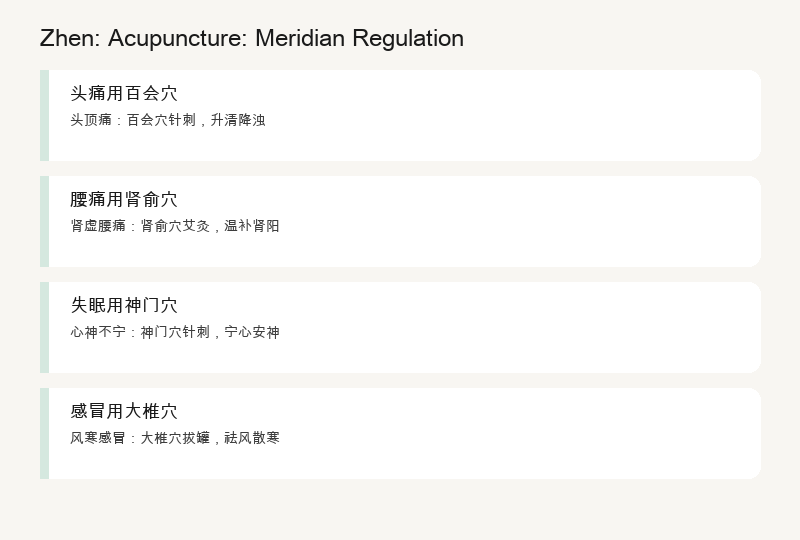
• Chronic pain is the first choice for acupuncture (lower back pain, neck pain, arthritis, dysmenorrhea). Acupuncture analgesia mechanism is clear, few side effects, no addiction. Find a qualified acupuncturist, choose evidence-based effective acupoints (such as for lower back pain choose Shenshu, Dachangshu, Weizhong). It's not "needling anywhere works" — it's precise acupoint selection + standardized operation.
• Digestive problems use acupuncture (nausea, vomiting, constipation). Acupuncture at Neiguan and Zusanli regulates gastrointestinal motility and digestive fluid secretion. Postoperative nausea, chemotherapy vomiting — acupuncture is a WHO-recommended auxiliary therapy. It's not the mystical "regulating the spleen and stomach" — it's the science of neuro-gastrointestinal axis regulation.
• Insomnia and anxiety use acupuncture (regulating neuroendocrine). Acupuncture at Shenmen, Baihui, and Sanyinjiao reduces cortisol levels and increases GABA (inhibitory neurotransmitter) activity. It's not the mystical "calming the spirit" — it's the science of neurotransmitter regulation. Research shows: Acupuncture for insomnia has an efficacy rate of about 70–80%, comparable to sleeping pills, but without dependence and next-day drowsiness.
• Cold-deficiency constitution uses moxibustion (heat therapy). Cold hands and feet, aversion to cold, chronic diarrhea, moxibustion at Guanyuan, Qihai, Zusanli. Warm stimulation improves local blood flow and enhances metabolism. It's not "warming by fire" — it's precise heat therapy + acupoint stimulation. Note: Moxibustion temperature is controlled at 40–50°C, avoid burns; contraindicated for those with yin deficiency and excessive fire.
• Choose regular institutions and licensed physicians (safety first). Acupuncture is an invasive procedure, requiring strict disinfection. Choose a licensed acupuncturist, use disposable sterile needles. It's not "go wherever is cheap" — it's a medical procedure, safety first. Avoid receiving acupuncture in irregular places (infection risk, inaccurate acupoints, improper technique).
These methods don't require you to become an acupuncturist. You just need to understand: Zhen is a "bioelectric switch" — through stimulating nerve-dense areas, mobilizing the body's self-healing system. But acupuncture is a medical act, requiring professional operation; do not needle yourself.
Part 6 (Continued)Practical Methods: Five Ways to Use Acupuncture
Part 7One-Minute Summary
🕐 Understanding "Zhen" in One Minute
Zhen = Meridian Regulator + Bioelectric Switch.
Acupuncture isn't just sticking needles; it's stimulating meridians and acupoints to mobilize the body's self-healing capacity.
WHO certifies 43 diseases for which acupuncture can be used.
Needling = Mechanical stimulation → activates Aδ nerve fibers → closes the pain gate → releases endorphins → analgesia.
Moxibustion = Warm stimulation (40–50°C) → local vasodilation → improves blood flow → activates heat shock proteins → repair.
Acupoint = Nerve-vascular dense area (neurovascular hilum); Meridian = Neuro-vascular-fascial functional pathway.
Deqi = Feedback signal of nerve-muscle activation (sour, numb, swollen, heavy).
Misconceptions: Acupuncture is a placebo; acupuncture can cure all diseases.
Methods: Chronic pain choose acupuncture, digestive problems needle Neiguan and Zusanli, insomnia and anxiety needle Shenmen and Baihui, cold-deficiency constitution use moxibustion, choose regular institutions.
The ancients called it "meridian qi and blood," modern people call it "neuro-endocrine-immune network regulation."
Different names, but medicine knows: the body has self-healing capacity, and acupuncture is the switch that activates it.
The ancients didn't have neurophysiology, but knew "the key to needling is: when qi arrives, it is effective."
This is probably the most down-to-earth Chinese wisdom: The body has self-healing capacity, and the doctor's task is not to replace it, but to awaken it.
Making money is the art of living; art is the life after making money.
giaogiao Decodes Traditional Chinese Wisdom · Concept 80
Using modern scientific language to help the world understand traditional Chinese wisdom.
No mysticism, no superstition, no belittling.
Understand, not just believe.
Coach Liu
Written in Florence